


Get to know Shuangqiao District
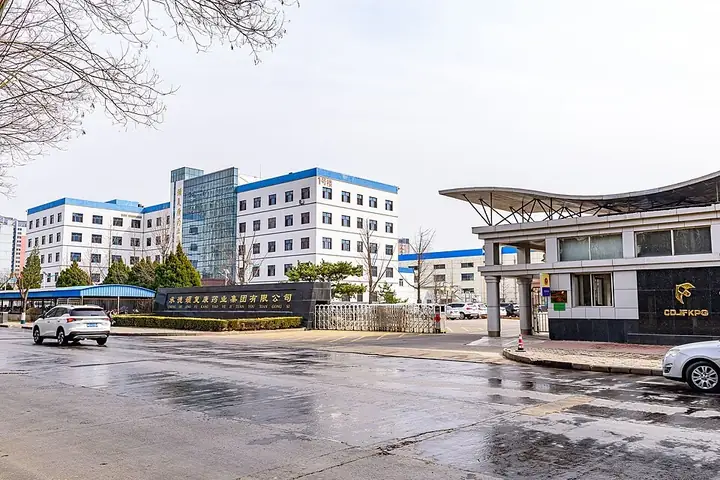
Photo adjustments
Full frame retained; resized proportionally to a maximum dimension of 960 pixels and converted to WebP quality 88. No crop, retouch, generated elements, or subject alteration. Final website rendition: full frame retained, proportionally resized to at most 720 pixels and converted to WebP. No additional retouching or subject alteration. Card displays may crop the view.
- Administrative area
- District · 市辖区
- Part of
- Chengde
- Chinese name
- 双桥区
- Local areas
- District guide
Area & population
- Area in the source
- 651.67 km²
- Population · 2020 census
- 358,431
- Administrative seat
- Zhonghua Road Subdistrict
Source: cited geographic source, as of the dates shown.
History
Work on the Mountain Resort began in 1703 under the Kangxi Emperor, and the main outline stood by 1708; building went on through the Yongzheng and Qianlong reigns until 1792. Qing emperors usually arrived in the fourth or fifth lunar month and returned to Beijing in the ninth or tenth, so the resort became a second political centre outside Beijing. Officials, troops and guards who followed the court camped outside the walls, markets, inns and wine houses grew up around them, and a town took shape. The Rehe sub-prefecture (热河厅) was created in 1723, Chengde Prefecture (承德州) in 1733 and Chengde Superior Prefecture (承德府) in 1778.
What to see
The Mountain Resort, also called the Rehe Travelling Palace (热河行宫), occupies a long valley on the west bank of the Wulie River (武烈河) and covers 5.64 million square metres inside a 10-kilometre wall. In the palace area, the Danbo Jingcheng Hall (澹泊敬诚殿), where emperors held court, is built of nanmu wood without painted decoration. The Yanbo Zhishuang Hall (烟波致爽殿) was the imperial bedchamber, where the Jiaqing Emperor died in 1820 and the Xianfeng Emperor in 1861. North of the palaces come a lake area modelled on gardens south of the Yangtze and a plain with a riding meadow and the Wanshu Garden (万树园) woodland; to their west and north, hills take up three-quarters of the grounds.
Puning Temple (普宁寺), finished in 1759, is also called the Big Buddha Temple for its gilded, lacquered wooden statue of the Thousand-Armed, Thousand-Eyed Guanyin. Putuo Zongcheng Temple (普陀宗乘之庙), built from 1767 to 1771 for Qianlong's 60th birthday and his mother's 80th, is modelled on the Potala Palace in Lhasa and is the largest of the outer temples. Pule Temple (普乐寺), with its round, double-eaved Xuguang Pavilion (旭光阁), stands on the east bank of the Wulie River with Qingchui Peak (磬锤峰) behind it.
Highlights
- Chengde Mountain Resort 承德避暑山庄: Qing summer palace begun in 1703, covering 5.64 million m² on the west bank of the Wulie River.
- Puning Temple 普宁寺: Completed 1759; called the Big Buddha Temple for its wooden Thousand-Armed Guanyin.
- Putuo Zongcheng Temple 普陀宗乘之庙: Built 1767-1771 on the model of the Potala Palace; the largest of the outer temples.
- Qingchui Peak 磬锤峰: Rises behind Pule Temple east of the Wulie River.
Sources for this guide
双桥区 - 维基百科,自由的百科全书 · Wikipedia (Chinese) · CC BY-SA 4.0
承德避暑山庄及其周围寺庙 - 维基百科,自由的百科全书 · Wikipedia (Chinese) · CC BY-SA 4.0
普陀宗乘之庙 - 维基百科,自由的百科全书 · Wikipedia (Chinese) · CC BY-SA 4.0
Original English written from the listed sources and checked sentence by sentence against quoted extracts by a separate reviewer. Updated 2026-09-25.
Explore Shuangqiao District
Core places to explore, with English and Chinese names.
Places to explore around Shuangqiao District
 Dacheng Pavilion at Puning Temple, Chengde, Hebei.
Puning Temple (Chengde)普宁寺
Puning Temple combines two different spatial traditions on a single rising axis. The front courts follow a Chinese Buddhist hall arrangement; behind them, a Tibetan-inspired mandala composition surrounds the towering Dacheng…
Read the place guide →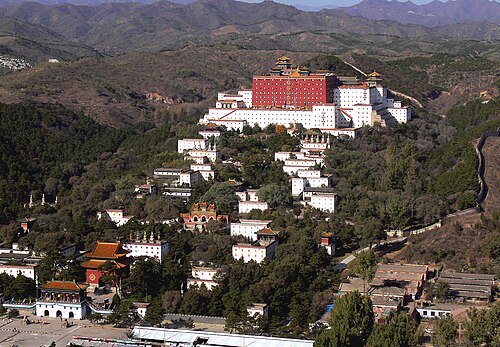 Putuo Zongcheng Temple · 普陀宗乘之庙
Putuo Zongcheng Temple普陀宗乘之庙
Putuo Zongcheng translates the visual language of Lhasa's Potala Palace into Chengde's imperial setting. A sequence of gateways and stepped white buildings rises towards the great red terrace, enclosing Wanfaguiyi Hall and its…
Read the place guide → Chengde Mountain Resort · 承德避暑山庄
Chengde Mountain Resort承德避暑山庄
Chengde Mountain Resort was both an imperial summer residence and a working Qing court. Its southern palace area leads into an expansive designed landscape of lakes, open ground and forested hills. The contrast is deliberate…
Read the place guide → Sledgehammer Peak (Qingchui Peak), a rock pillar on a ridge in Chengde · 承德磬锤峰,立于山脊之上的石柱 Source-recorded photograph date: 2004-01-01 00:00.
Qingchui Peak磬锤峰
Qingchui Peak is the conspicuous hammer-shaped rock rising east of Chengde’s Mountain Resort.
Read the place guide →Plan your visit
Getting there
Shuangqiao District is about 5 km in a straight line from central Chengde. Search for 双桥区 in a map app to find stations and your accommodation.
Where to stay →Build your route
Puning Temple (Chengde) and Putuo Zongcheng Temple are about 2 km apart in a straight line. The linked place guides have entrance and visit details.
Continue with Chengde →More in Chengde
Sources & geographic information
Administrative names and parent areas: Official geographic directory · Reference date 2026-09-06.
Some facts checked against 双桥区 — Wikipedia contributors, CC BY-SA 4.0.
Some facts checked against 承德避暑山庄及其周围寺庙 — Wikipedia contributors, CC BY-SA 4.0.
Some facts checked against 普陀宗乘之庙 — Wikipedia contributors, CC BY-SA 4.0.
Photo: Puning Temple (Chengde) · ScareCriterion12 · CC BY-SA 4.0. Proportionally resized and converted to WebP without cropping, retouching or changing the photographed subject.

Photo: Putuo Zongcheng Temple · Gisling · CC BY-SA 4.0. Wikimedia thumbnail; fitted to the ranking-card frame.

Photo: Chengde Mountain Resort · xiquinhosilva · CC BY 2.0. Wikimedia thumbnail; fitted to the ranking-card frame.
.jpg)
Photo: Qingchui Peak · Caitriana Nicholson from 北京 ~ Beijing, 中国 ~ China · CC BY-SA 2.0. Full frame retained; proportionally resized and converted to WebP. No retouching or changes to the photographed subject. Card displays may crop the view.
.jpg)
Map data © OpenStreetMap contributors. Pins mark approximate centres, not entrances or boundaries.