

Explore the region
Tap any red Chinese text to hear it in Mandarin.
Why visit
Longmen is a place to read a changing style of Buddhist art in the rock itself. The grottoes and niches stretch along the cliffs on both sides of the Yi River, south of Luoyang’s ancient capital area. UNESCO describes more than 2,300 caves and niches, almost 110,000 Buddhist statues, more than 60 stupas and about 2,800 inscriptions; the most intensive carving dates from the late fifth century to the middle of the eighth century.
The scale is impressive, but the details make the visit rewarding. Look for the relationship between a cave’s main image, its attendants, halos and donor inscriptions. The work records court patronage as well as changes in carving style, so a close look at a small niche can be as informative as the largest figure.
What to look for
- The Three Binyang Caves: On the West Hill, the Binyang group belongs to the earliest phase of the site. Binyang Middle Cave was commissioned by Northern Wei Emperor Xuanwu as a memorial cave for his father, Emperor Xiaowen; its lotus ceiling and surviving sculpture show the Northern Wei court style.
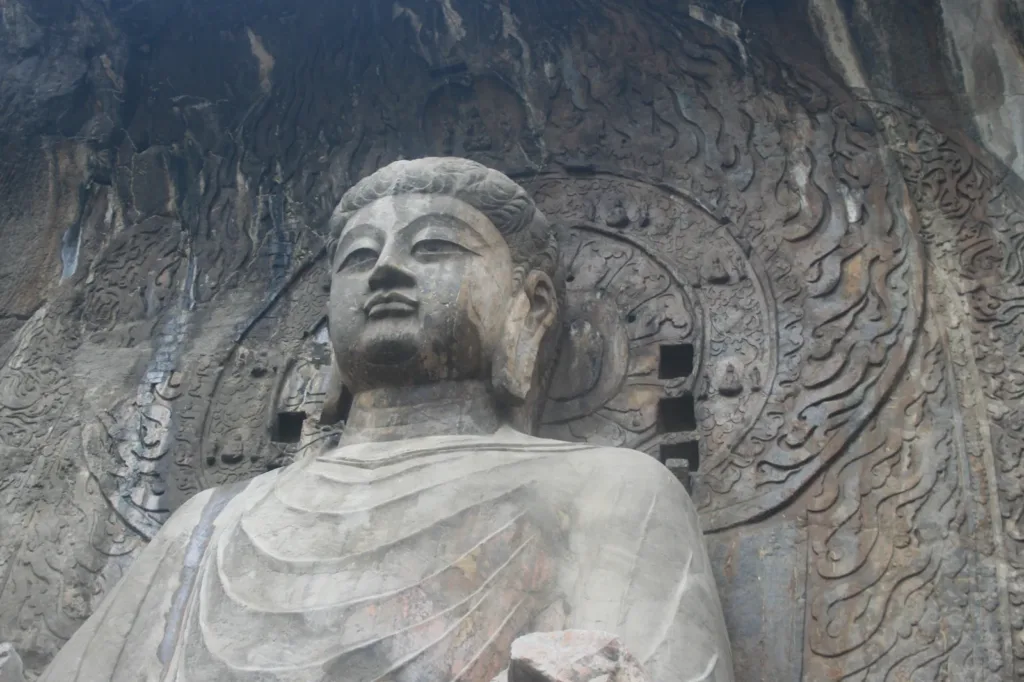
- Fengxian Temple: Climb to the monumental Tang composition around the 17.14-metre Vairocana, known in Chinese as 卢舍那大佛. The main figure and its attendant figures are the clearest single view of Longmen’s imperial-scale Tang carving.
- The smaller niches and inscriptions: Leave time to compare repeated small images, carved text and traces of weathering rather than moving only between headline figures. The inscriptions are part of the site’s historical evidence, not just labels for the sculptures.
- The East Hill and the river view: The official visitor list includes grottoes on both the West and East hills, as well as Xiangshan Temple and Baiyuan Garden. Crossing the river gives a different view of the cliff setting and helps explain why Longmen is a landscape as well as a collection of caves.
These are Buddhist works in a protected heritage site. Keep to visitor paths, do not touch carved surfaces, and give worshippers and other visitors space. The scale of the figures is best appreciated from below; a patient visit is more useful than trying to photograph every niche.
Planning the visit
The official English site gives the address as No. 13, Longmen Middle Street, Luolong District, Luoyang City. It currently lists daytime entry from 08:00. From March 1 to October 31, ticket sales close at 17:30, last admission is 18:00 and the site clears at 19:00. From November 1 to February 28 or 29, ticket sales close at 16:30, last admission is 17:00 and the site clears at 18:00.
The official site lists a full-price ticket at ¥90 and a half-price ticket at ¥45, with personal reservation and real-name ticketing. Its English page does not explain how a foreign passport is entered in the booking system. If you are travelling on a passport, confirm the current booking and ID-check procedure through the official reservation channel before setting out; do not assume that a domestic-ID workflow applies.
The listed open areas are the West Hill Grottoes, East Hill Grottoes, Xiangshan Temple and Baiyuan Garden. The site also lists an optional sightseeing shuttle between service areas and the grotto ticket checkpoint: the northeast service area is about a 25-minute walk, with a one-way shuttle listed at ¥10; the Chinese visitor page also gives about 20 minutes from the northwest service area and the same one-way shuttle price. Allow time for walking, steps and the river crossing. A pleasure boat is advertised as a scenic experience, but its boarding point, season and return arrangements are not specified on the pages used here, so it should not be treated as a guaranteed transport connection.
Getting there and back
From Luoyang Longmen Railway Station (洛阳龙门站), the official English site gives about 4 km and 10 minutes by car. It also lists bus 71 from the station to Longmen Grottoes, with a ride of about 42 minutes. The station and the grottoes are separate places: after arriving at the station, continue to the scenic-area entrance rather than walking out expecting the caves to be part of the rail complex.
From Luoyang Beijiao Airport (洛阳北郊机场), the same official page gives about 19 km and 30 minutes by car. For a taxi or ride-hailing car, show 龙门石窟 Lóngmén Shíkū and the Chinese address above. Before leaving the site, confirm the return pickup point and the last practical connection; opening hours and local road conditions do not guarantee a convenient late return.
Combine your visit
A suggested sequence linking the specific features of this visit.
-
Binyang cave group
Begin with the earlier sculptural tradition along the west bank.
-
Wanfo Cave area
Compare the scale and repetition of smaller Buddhist figures.
-
Fengxian Temple
Finish with the monumental Tang composition and its relationship to the river valley.
This order is editorial. Confirm access and any transfers between stops; it does not establish a walking route, same-day connection or common admission ticket.
Find Longmen Grottoes
龙门石窟 · 洛阳市
The pin marks the area, not the entrance.
More places nearby
Approximate straight-line distances between map pins, not travel distances.
Guanlin 关林
6 km awayGuanlin in Luoyang’s Luolong district is traditionally identified as the burial place of Guan Yu’s head. Its historical complex combines tomb, temple and commemorative grove.
View guide →Luoyang Museum · Nietai Road 洛阳博物馆·聂泰路馆址
10 km awayLuoyang Museum presents objects from the successive cultures and capitals of the Luo River valley. Its bronze collection is especially distinctive: a three-wheeled dove cart turns an animal into a small vehicle, while ritual…
View guide →Yingtian Gate 应天门遗址
14 km awayYingtian Gate marked the southern entrance to the palace city of Sui and Tang Luoyang. Today, a large protective reconstruction gives the gateway’s scale and projecting towers a visible form above the archaeological remains. The…
View guide →Sources & visit information
Sources checked on 23 October 2026. Hours, tickets, reservations and transport can change; confirm with the operator before you go.
Image credits & notes (1)
- Close view of the Vairocana Buddha at Fengxian Temple, Longmen Grottoes, Luoyang. Photo: Gary Lee Todd (Gary Todd)Photo: CC0 1.0