


Get to know Wujin District

Photo adjustments
Full frame retained; EXIF orientation normalized, proportionally resized to at most 800 pixels and converted to WebP. No generated pixels or subject changes. Cards may crop the display.
- Administrative area
- District · 市辖区
- Part of
- Changzhou
- Chinese name
- 武进区
- Local areas
- District guide
Area & population
- Area in the source
- 1,066.00 km²
- Population · 2020
- 1,697,380
Source: cited geographic source, as of the dates shown.
History
The district government dates settlement here to more than 5,000 years ago and cites Neolithic village finds at Qingdun (青墩) in Henglin (横林). In the Spring and Autumn and Warring States periods the area, then called Yanling (延陵), was the fief of Ji Zha (季札) of the state of Wu. The name Wujin, 'advance by arms', goes back to 234, when Sun Quan (孙权) of Eastern Wu renamed Dantu (丹徒); a Wujin County was set up in 281. Split into Wujin and Yanghu (阳湖) counties in 1726, it was reunited in November 1911. In 1949 its county town was separated off to form the city of Changzhou, and the county seat moved from the city to Hutang (湖塘) in 1993. Wujin became a county-level city in 1995 and a district in 2002, and in 2015 it absorbed the former Qishuyan District (戚墅堰区).
Wujin dialect belongs to the Changzhou group of northern Wu Chinese and keeps the old voiced initials, so that the words for 'freeze' (冻) and 'cave' (洞) sound different. The district government notes that some words in the east, around Henglin, carry a Wuxi accent, while some in the south, around Caoqiao (漕桥), sound close to Yixing (宜兴) speech.
What to see
The Yancheng site (淹城遗址), in Yancheng village of Hutang town, is a walled town of the Spring and Autumn period laid out as three nested enclosures, each with its own moat: a core enclosure, an inner city and an outer city. It became a national key heritage site in 1988 and a national 5A scenic area in 2017, with amusement facilities outside the ruins. The district government describes it as the best-preserved surface city site in China from the Western Zhou to the early Spring and Autumn period.
Food and local products
From Lake Tai come the 'three whites' (太湖三白): whitebait (银鱼), which has no bones, white fish (白鱼) with fine flesh and soft bones, and thin-shelled white shrimp (白虾). Green tea grows in the hills around Xueyan (雪堰), Panjia (潘家), Caoqiao and Hengshanqiao (横山桥), mainly biluochun (碧螺春) and the local Yanghu Xinyue (阳湖新月). Xueyan and Panjia have grown juicy peaches since the Republican era; being close to Wuxi, they are known as 'Wuxi honey peaches'. Grapes are grown across the district, and Lijia (礼嘉) grapes gained a geographical-indication trademark in April 2020.
Highlights
- Yancheng site 淹城遗址: Spring and Autumn walled town of three nested walls and moats; national key heritage site from 1988, 5A scenic area from 2017.
- Lake Tai three whites 太湖三白: Whitebait, white fish and white shrimp from Lake Tai.
- Yanghu Xinyue green tea 阳湖新月: Green tea from the Chengwan tea farm in Panjia.
- Lijia grapes 礼嘉葡萄: Geographical-indication trademark since April 2020.
Sources for this guide
武进概况 · Wujin District People's Government, Changzhou
概况(历史文化) · Wujin District People's Government, Changzhou
地方特产 · Wujin District People's Government, Changzhou
淹城遗址 · Wikipedia (Chinese) · CC BY-SA 4.0
Original English written from the listed sources and checked sentence by sentence against quoted extracts by a separate reviewer. Updated 2026-09-25.
Explore Wujin District
Core places to explore, with English and Chinese names.
Places to explore around Wujin District
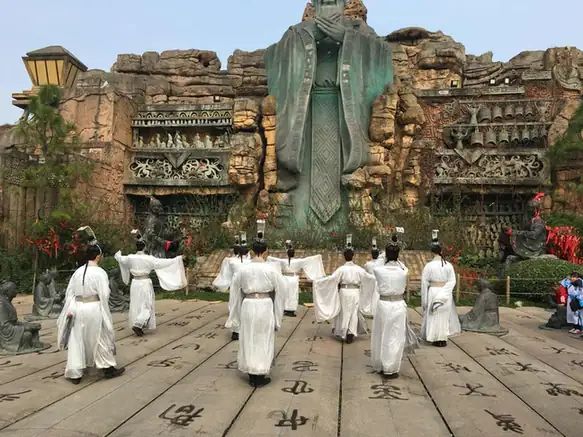 Yancheng Spring and Autumn Paradise · 淹城春秋乐园
Yancheng Spring and Autumn Paradise淹城春秋乐园
Yancheng Spring and Autumn Paradise is the themed amusement park beside Changzhou's ancient Yancheng archaeological site. It uses the culture and stories of the Spring and Autumn period for performances, landscaped settings and rides.
Read the place guide → AI illustration · AI 示意图(仅供参考,非该地点实拍)
Yancheng Ruins and Spring and Autumn Paradise淹城遗址与春秋乐园
Yancheng in Wujin pairs the remains of a Spring and Autumn-period city with a modern park inspired by the culture of that era.
Read the place guide →Plan your visit
Getting there
Wujin District is about 20 km in a straight line from central Changzhou. Search for 武进区 in a map app to find stations and your accommodation.
Where to stay →Build your route
Yancheng Spring and Autumn Paradise and Yancheng Ruins and Spring and Autumn Paradise are both listed here. The linked place guides have entrance and visit details.
Continue with Changzhou →More in Changzhou
Sources & geographic information
Administrative names and parent areas: Official geographic directory · Reference date 2026-09-06.
Some facts checked against 淹城遗址 — Wikipedia contributors, CC BY-SA 4.0.
Photo: Yancheng Spring and Autumn Paradise · Source photographer · License not provided. EXIF orientation normalized; resized without changing aspect ratio; converted to WebP. No subject edits.
Map data © OpenStreetMap contributors. Pins mark approximate centres, not entrances or boundaries.