

Explore the region
Nanjing Museum — 南京博物院, shortened in Chinese to 南博 — is the large comprehensive museum on Zhongshan East Road, on the north side of the road just inside Zhongshan Gate and at the southern foot of Purple Mountain. It was the first big comprehensive museum in China built with state funds and is rated a national first-class museum; it has been free to enter since 2008, but every visitor, foreign passports included, must book a timed slot in advance.
Two buildings, six halls
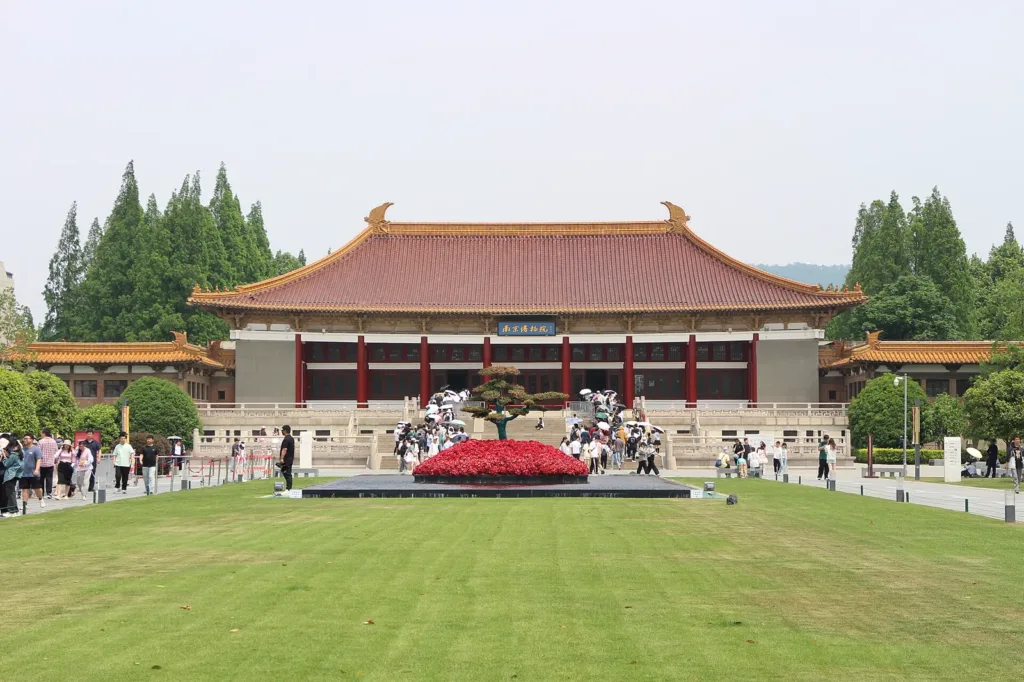
The museum is really two structures from different eras. The hall you see from the road is the old main building: a nine-bay hall in the manner of Liao-dynasty architecture, with brown glazed roof tiles, a low-pitched roof and heavy bracket sets, designed by Xu Jingzhi (徐敬直) and Li Huibo (李惠伯), with Liang Sicheng (梁思成) and Liu Dunzhen (刘敦桢) as consultants. It was begun in June 1936, halted by the war, finished as a first phase in April 1948 and completed as the museum’s history display hall in 1952. It stands at the end of a wide lawn on a three-tiered white stone platform, with Purple Mountain behind the roofline — walk the length of the lawn before you climb the steps, because that is the view the architects designed for. This building is the surviving part of the National Central Museum (国立中央博物院), whose preparatory office was set up in 1933 on Cai Yuanpei’s proposal, and it is listed as a Jiangsu provincial heritage site.
The 2009–2013 expansion kept the historic building as the History Hall and added the newer halls around and below it — the layout the museum calls “one museum, six halls” (一院六馆): History Hall, Special Exhibition Hall, Art Hall, Digital Hall, Republican-era Hall and Intangible Cultural Heritage Hall. Together they hold more than 430,000 objects, from the Palaeolithic to the present.
What to see, hall by hall
History Hall (历史馆) — the permanent Ancient Civilisations of Jiangsu exhibition runs in seven chronological sections from prehistory to the Qing, and it is the place to get the region’s story before you look at objects anywhere else in Nanjing. Gallery titles on the museum’s own pages include 远古印象, 史前神韵·吴越春秋 and 郡国华章·汉家故里. Three things to slow down for:
- The Southern Dynasties brick relief of the Seven Sages of the Bamboo Grove with Rong Qiqi (竹林七贤与荣启期砖画), found in a tomb at Gongshan, Xishanqiao, in 1960. It comes in two panels, each about 78 cm high and 242 cm long, assembled from almost 300 numbered bricks per panel. Eight figures sit in a row — Ji Kang, Ruan Ji, Shan Tao, Wang Rong, Xiang Xiu, Liu Ling, Ruan Xian and the earlier hermit Rong Qiqi — each captioned by name and separated by ginkgo, pine, locust and willow trees. Read the hands: Ji Kang plucks a five-stringed zither, Ruan Ji whistles, Liu Ling tastes wine.
- The Ming glazed archway from the Porcelain Tower of the Great Bao’en Temple (大报恩寺琉璃塔拱门), rebuilt from five-colour glazed components dug out of the kiln site outside the city’s south gate in 1958. Look for the creatures arranged around the arch in the Tibetan-Buddhist “six ornaments” (六拏具) scheme — Garuda, naga, flying sheep and white elephant — and for the glazed picture of the pagoda itself in the middle of the arch.
- The Western Han gold beast (金兽): 9,100 g of 99% gold, cast and then hammered with round markings, and still the heaviest ancient gold casting found in China, from a hoard found at Xuyi in the 1980s. The museum has called it its “treasure that guards the house”.
Display of individual treasures rotates. The museum’s 2007 selection of 18 “treasures of the museum” includes, besides the brick relief and the gold beast, the Neolithic jade string ornament from Huating in Xinyi, Warring States gold-and-silver inlaid bronze vessels and Ying yuan gold coins from the Xuyi hoard, the Eastern Han silver-thread jade suit (银缕玉衣) from Tushan in Xuzhou, the Western Jin celadon beast-shaped vessel from Yixing, the Ming underglaze-red plum vase with pine, bamboo and plum, and the Ming-dynasty world map 坤舆万国全图. Ask at the information desk which of them are out; as of a 2018 report the world map itself was not on public display, though the museum later built a ticketed VR show around it (that show ran to 11 October 2026).
Special Exhibition Hall (特展馆) — Hall 9 on the second floor is the museum’s “treasures” room (镇院之宝展厅), where one signature object is shown at a time; from February 2026 it holds a Qianlong revolving vase with an imperial hunting scene, a multi-layered porcelain with a carved ivory inner sleeve. Permanent displays of palace material fill the upper floors: Qing court objects in Hall 14 (陈设清宫), clocks and watches in Hall 13 (精准与华美) and Qing imperial porcelain in Hall 15 (盛世华彩). This is also where temporary shows are staged. At the time of writing: Western Han lacquerware from the Guangling tombs of Jiangsu (云飞扬, 15 August – 15 November 2026, third floor, Hall 11) and an exhibition on how Jiangsu’s Neolithic farmers ate (“食”光宝藏, opened 15 July 2026, third floor, Hall 12). Temporary exhibitions change, and a market-run temporary exhibition or performance can carry a ticket even though the permanent displays are free.
Art Hall (艺术馆) — west of the main hall, in a building finished in September 1999 that repeats the old hall’s Liao-style form. Its eleven galleries are arranged by material rather than by period — jade, bronze, porcelain, painting and calligraphy, textiles, lacquer, pottery and more — which makes it the place to compare how craftsmen worked the same material across centuries. It also contains the Fraternity Hall (博爱馆), which the museum describes as the first integrated barrier-free exhibition hall in a Chinese museum: touchable replicas, audio description, smells and games, built around a tactile version of the Ming-dynasty world map.
Digital Hall (数字馆) — the interactive, screen-based hall sits underground between the History Hall and the Special Exhibition Hall. Its sections — 敬畏自然, 历史断层, 歌颂神明, 开启文明 — take the beginnings of Chinese civilisation as their theme, and it works well with children or as a change of pace from case after case of objects.
Republican-era Hall (民国馆) — a reconstructed 1930s Nanjing street, underground on the east side of the Art Hall. The photographs displayed there show the city as it was rebuilt in the Republican period: Xiaguan railway station, the Sun Yat-sen Mausoleum, the assembly hall of Ginling College, the Ming city wall, the pagoda at Qixia Temple, Xuanwu Lake, the Qinhuai river and Fuzimiao, the Drum Tower and the newly laid-out Zhongshan East Road.
Intangible Cultural Heritage Hall (非遗馆) — a separate building nearest the south gate, opened on 6 November 2013, about 2,300 m², and built around living practice rather than objects: a Jiangsu intangible-heritage gallery with eight craft demonstration bays, a masters’ workshop where national-level inheritors work in residence, a folk-arts courtyard, a small theatre and an old teahouse for traditional music, storytelling and opera. Its exhibition galleries, however, have been closed for a display upgrade; the museum’s notice of 31 August 2026 said the work was continuing and the reopening date would be announced separately. Check before you plan around it.
Getting in: booking, hours, rules
Entry to the permanent displays is free, but the museum runs a full real-name booking system: everyone, including visitors entitled to concessions and their companions, has to book. Slots are released at 18:00 each day, up to seven days ahead and never for the same day, through the museum’s official WeChat mini-program; the museum states that it has authorised no third party to sell its tickets, so treat agents promising guaranteed entry with suspicion. The day is divided into a morning slot (9:00–13:00) and an afternoon slot (12:00–16:00). You must go in during your slot — morning-slot visitors have to be inside by 13:00 — and the same ID can enter and leave once only that day.
Foreign visitors: the automated face-check gates take mainland ID cards, Jiangsu’s third-generation social security cards and Hong Kong/Macau/Taiwan residence permits. If you book with a foreign passport, a foreign permanent-resident ID or a Hong Kong/Macau/Taiwan travel permit, take the original document and your booking confirmation to the green-channel service window at the service centre on the day, complete the formalities there and then enter.
Opening hours are Tuesday to Sunday 9:00–17:00, with the last ticket check at 16:00; the museum is closed on Mondays (if a Monday is a national holiday it opens all day) and closed on New Year’s Eve and the first day of the lunar new year. It extends its hours in peak periods — over the 2026 summer holidays, for example, it stayed open until 20:00 from Sunday to Thursday and 21:00 on Friday and Saturday — and it posts separate notices for public-holiday periods on its own site, most recently a mid-autumn and National Day notice dated 17 September 2026.
Rules worth knowing before you queue: large luggage is not allowed inside and must go to the left-luggage office on the right of the main gate before ticket check; no flash photography, and no selfie sticks, tripods or commercial camera gear; no eating in the galleries and no strong-smelling food — instant noodles, self-heating hotpots, boxed meals, durian — anywhere in the grounds; no smoking. Wheelchairs and pushchairs can be borrowed from the service centre, which sits west of the main gate entrance. Free guided tours run at 10:00 and 14:00 in the History Hall and the Special Exhibition Hall: register at the hall’s information desk 15 minutes beforehand with ID, and each session takes 30 people. Audio guides cost 20 yuan (Chinese, English, Japanese, Korean) and the Chinese-only “smart” guide 30 yuan. The service line is 025-84807923.
Getting there and getting back
Metro. Two lines meet at Minggugong station (明故宫站): Line 2 and Line 6. The museum’s own instruction is to leave by Exit 1 and walk about 300 m east. Line 6 only began initial operation on 29 September 2026, running from Nanjing South Railway Station in the south to Qixia Mountain in the north and through-running with Line S1 towards the airport; Minggugong is one of its six specially designed stations. Both lines call there, so check the platform signage for your direction on the way back.
Bus. Routes 5, 34, 36, 55, 59 and 80 stop at Zhongshanmen (中山门站), the stop the museum names.
Taxi and ride-hailing. Give the driver 南京博物院, 中山东路321号. The visitor gate is the main gate on Zhongshan East Road. If you are driving yourself, the car park entrance is at the west gate (西门) and parking runs Tuesday to Sunday 9:00–18:00.
One caveat at the gate: the Wenyuan Square (文渊广场) area in front of the museum has been under renovation since 9 March 2026. The museum’s notice says the square and its escalator entrance are closed, the way out has been moved to the upward staircase in the direction of the car park, and the pedestrian underpass is temporarily closed; the same notice said the “忆莼” public restaurant and the provincial museum shops had stopped trading until further notice. As of 22 October 2026 no reopening notice had been posted in the museum’s own notice list. Follow the on-site signs, and do not count on the underpass or on eating inside the museum.
Combining it with the rest of the day
The museum sits just inside Zhongshan Gate at the south foot of Purple Mountain, at the eastern end of Zhongshan East Road, so it belongs with that side of the city rather than with the Qinhuai river district. The complex is large — about 84,800 m² of floor space and 26,000 m² of exhibition halls — and the six halls are spread across the old building and the newer underground ones, so most visitors end up choosing two or three themes rather than trying to see everything. A workable order: the History Hall first for the region’s chronology, then the Special Exhibition Hall for whichever temporary show and treasure is on, then the Art Hall and the two underground halls. If the Intangible Cultural Heritage Hall reopens, finish there, because the craft demonstrations are the one part of the museum that is about people at work rather than objects in cases. Confirm the current gallery map, hall closures and any ticketed shows at the information desk when you arrive: a hall appearing on a map does not mean it is open on your date.
Combine your visit
A suggested sequence linking the specific features of this visit.
-
Historical Exhibition Hall
Start with the regional chronological story.
-
Art Exhibition Hall
Compare objects through artistic forms and materials.
-
Intangible Cultural Heritage Hall
Finish with the region’s living craft traditions.
This order is editorial. Confirm access and any transfers between stops; it does not establish a walking route, same-day connection or common admission ticket.
Find Nanjing Museum
南京博物院 · 南京市
The pin marks the area, not the entrance.
More places nearby
Approximate straight-line distances between map pins, not travel distances.
Presidential Palace (Nanjing) 南京总统府
3 km awayNanjing’s Presidential Palace is a layered political complex on Changjiang Road. It housed the office of the Republic of China’s president during the period when the government was based in Nanjing.
View guide →Ming Xiaoling 明孝陵
3 km awayMing Xiaoling is the mausoleum of the Hongwu emperor, founder of the Ming dynasty. It lies at the southern foot of Purple Mountain, where its processional route and burial precinct form a major imperial landscape.
View guide →Jiming Temple 鸡鸣寺
4 km awayJiming Temple rises on Jilong Hill beside the southern shore of Xuanwu Lake. Its present ensemble includes substantial modern reconstruction, including the seven-storey, eight-sided Medicine Buddha Pagoda. The Guanyin Hall is…
View guide →Sources & visit information
Sources checked on 22 October 2026. Hours, tickets, reservations and transport can change; confirm with the operator before you go.
- Nanjing Museum — official site (opening hours, transport, six halls) ↗
- 南京博物院 在线预约 / 参观须知 (booking, entry, visitor rules, parking) ↗
- 南京博物院简介 (museum introduction: history, buildings, collections) ↗
- 南京博物院关于非遗馆展厅延期开放的公告, 2026-08-31 ↗
- 关于南京博物院文渊广场升级改造期间暂停开放的通知, 2026-03-04 ↗
- 综合服务 (service centre, guided tours, audio guides) ↗
- 特展馆 (Special Exhibition Hall: galleries and current treasure display) ↗
- 展览 / 当前展览 (current exhibitions) ↗
- 历史馆 (History Hall gallery titles) ↗
- 竹林七贤与荣启期砖画 (object record) ↗
- 镇护天下——南京博物院藏金兽特展 (gold beast) ↗
- 南京博物院 (Wikipedia: buildings, hall locations, 18 treasures) ↗
- 南博国宝亮相《国家宝藏》, 扬州晚报, 2018-02-04 ↗
- 再见“大明盛世”——明代大报恩寺琉璃塔拱门 ↗
- 艺术馆 / Fraternity Hall (accessible exhibition hall) ↗
- “走进非遗展示馆”系列之三:南京博物院非遗馆 (中国非物质文化遗产网) ↗
- 明日开通!南京地铁6号线来了, 新华报业, 2026-10-01 ↗
- 全线开通!跟随规划视角读懂地铁6号线, 南京市规划和自然资源局, 2026-10-13 ↗
- 南京博物院暑期开放公告, 2026-06-24 ↗
- 南京博物院 最新公告 (notice list, checked 2026-10-22) ↗
- 民国馆 (Republican-era Hall: period photographs) ↗
- 数字馆 (Digital Hall sections) ↗
- 觀天下•坤輿萬國全圖——南京博物院VR大空间沉浸式展览, 2025-07-11 ↗
Image credits & notes (1)
- The 1930s main hall (History Hall) of Nanjing Museum behind its front lawn and three-tiered stone platform. Photo: SuicasmoPhoto: CC0 1.0