


Get to know Xuanwu District

Photo adjustments
Full frame retained; proportionally resized and converted to WebP. No retouching or changes to the photographed subject. Card displays may crop the view.
- Administrative area
- District · 市辖区
- Part of
- Nanjing
- Chinese name
- 玄武区
- Local areas
- District guide
Area & population
- Area in the source
- 81.00 km²
- Population · 2020 census
- 537,825
Source: cited geographic source, as of the dates shown.
History
In the Republican era the area was Nanjing's First District, so numbered because the Presidential Palace stood here; more than 130 offices of the Nationalist government and party were concentrated in it. It received the name Xuanwu in 1955, was renamed Yaowu (要武区) during the Cultural Revolution in 1967, and took back its old name in 1973. The district government notes that many palaces and imperial gardens of the ten dynasties that ruled from Nanjing were built within its bounds.
What to see
Ming Xiaoling (明孝陵) is the joint tomb of Zhu Yuanzhang (朱元璋), founder of the Ming, and Empress Ma; the tomb takes its name from her posthumous title Xiaoci (孝慈). Dr. Sun Yat-sen's Mausoleum (中山陵) was among China's first 5A scenic areas in 2007. The Presidential Palace (总统府) has served in turn as the mansion of the Ming Prince of Han, the office of the Qing Viceroy of Liangjiang, the Taiping Heavenly King's palace and the office of the provisional president of the Republic of China.
Nanjing Museum (南京博物院) stands at the southern foot of Purple Mountain inside Zhongshan Gate (中山门). It grew out of the National Central Museum, whose preparatory office the Nationalist education ministry set up in 1933, and holds more than 430,000 objects. Jiming Temple (鸡鸣寺), a Buddhist nunnery on the south shore of Xuanwu Lake, occupies the reputed site of Emperor Wu of Liang's Tongtai Temple of 527; Zhu Yuanzhang rebuilt it under its present name in 1387. Its seven-storey Medicine Buddha Pagoda (药师佛塔), built in 1991 and 44.8 metres high, holds a Ming bronze Medicine Buddha moved from the Yonghe Temple (雍和宫) in Beijing in 1972. East of the temple is an old well said to be the Rouge Well (胭脂井), where the last Chen emperor hid when Sui troops broke into the palace city.
Getting oriented
Nanjing Railway Station and the long-distance bus station form one hub in the district, and the Shanghai–Nanjing and Nanjing–Hangzhou expressways run into the city here. Metro Lines 1 to 4 serve it, and Lines 3 and 4 both reach Jimingsi station (鸡鸣寺站) for the temple. Universities in the district include Southeast University (东南大学), whose Sipailou campus is here, Nanjing University of Science and Technology (南京理工大学) and Nanjing Agricultural University (南京农业大学).
Highlights
- Ming Xiaoling 明孝陵: Joint tomb of the Ming founder Zhu Yuanzhang and Empress Ma.
- Dr. Sun Yat-sen's Mausoleum 中山陵: Among China's first 5A scenic areas in 2007.
- Presidential Palace 总统府: Ming prince's mansion, Qing viceroy's office, Taiping palace and Republican president's office.
- Nanjing Museum 南京博物院: Founded from the 1933 National Central Museum project; over 430,000 objects.
- Jiming Temple 鸡鸣寺: Nunnery by Xuanwu Lake, rebuilt in 1387, with a 1991 pagoda holding a Ming bronze Buddha.
- Xuanwu Lake 玄武湖: Lake at the foot of Purple Mountain that gives the district its name.
Sources for this guide
玄武区 - 维基百科,自由的百科全书 · Chinese Wikipedia · CC BY-SA 4.0
玄武简介 · Xuanwu District People's Government, Nanjing
南京博物院 - 维基百科,自由的百科全书 · Chinese Wikipedia · CC BY-SA 4.0
鸡鸣寺 - 维基百科,自由的百科全书 · Chinese Wikipedia · CC BY-SA 4.0
Original English written from the listed sources and checked sentence by sentence against quoted extracts by a separate reviewer. Updated 2026-09-25.
Explore Xuanwu District
Core places to explore, with English and Chinese names.
Places to explore around Xuanwu District
 Sun Yatsen Mausoleum (Zhongshan Ling) · 中山陵
Dr. Sun Yat-sen's Mausoleum中山陵
Sun Yat-sen’s Mausoleum occupies a slope of Purple Mountain east of central Nanjing. Completed in 1929 to a design by Lü Yanzhi, it combines a modern national memorial with elements of traditional Chinese tomb architecture.
Read the place guide → Nanjing Museum, photographed in December 2022.
Nanjing Museum南京博物院
Nanjing Museum combines a historic museum building with several major exhibition sections. Its architecture brings a traditional roofed front together with a more modern building arrangement.
Read the place guide → An aerial view of the Presidential Palace compound in Nanjing · 南京总统府建筑群航拍 Source-recorded photograph date: 2019-06-14 17:36:13.
Nanjing Presidential Palace总统府
Nanjing's Presidential Palace (总统府) is a compound of government buildings and gardens that records the city's transition from Qing provincial rule to Republican government.
Read the place guide →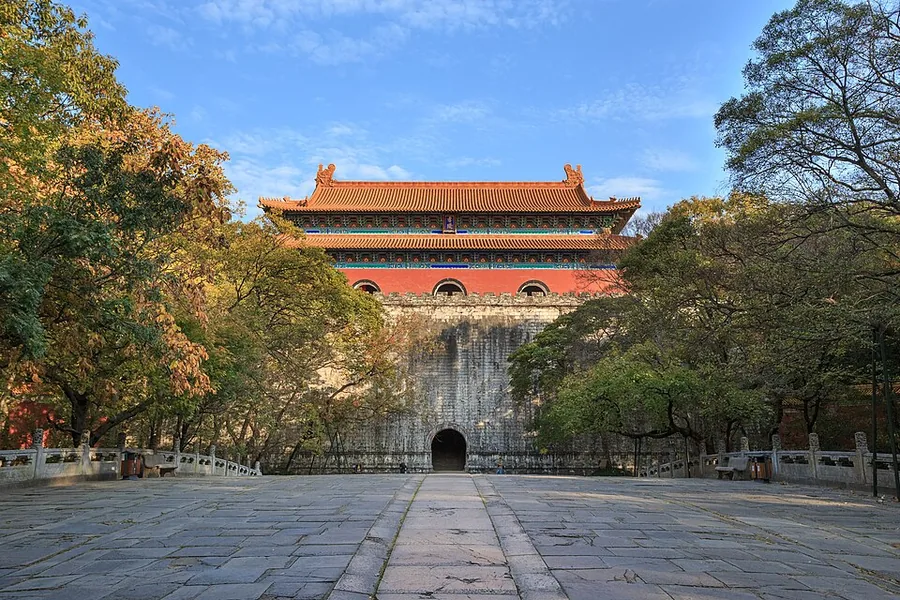 Minglou, the Soul Tower at Ming Xiaoling in Nanjing.
Ming Xiaoling明孝陵
Ming Xiaoling is the mausoleum of the Hongwu emperor, founder of the Ming dynasty. It lies at the southern foot of Purple Mountain, where its processional route and burial precinct form a major imperial landscape.
Read the place guide → Six Dynasties Museum (六朝博物馆), Xuanwu District. Photograph: "南京六朝博物馆".
Six Dynasties Museum六朝博物馆
Nanjing museum of the 3rd-6th-century Six Dynasties on the Jiankang site, with an in-situ palace wall and a building by Pei Partnership Architects.
Read the place guide → Xuanwu Lake seen from Nanjing's Taicheng city wall, May 2009.
Xuanwu Lake玄武湖
Xuanwu Lake lies beside the northeastern part of Nanjing’s historic centre. Its island-and-causeway landscape brings pavilions, planted gardens and open water together within the city.
Read the place guide → The main entrance gate of Nanjing Hongshan Forest Zoo, Xuanwu District · 南京红山森林动物园正门,玄武区 Source-recorded photograph date: 2026-08-24 16:17:04.
Hongshan Forest Zoo红山森林动物园
Nanjing zoo on 68 hectares of hills, founded in 1928 on Xuanwu Lake, with mixed-species themed zones and a regional wildlife rescue centre.
Read the place guide →Jiming Temple and pagoda seen from Taicheng, Nanjing · 南京台城远眺鸡鸣寺 Photograph date recorded by the source: 1 October 2009.Jiming Temple鸡鸣寺
Jiming Temple rises on Jilong Hill beside the southern shore of Xuanwu Lake. Its present ensemble includes substantial modern reconstruction, including the seven-storey, eight-sided Medicine Buddha Pagoda. The Guanyin Hall is…
Read the place guide →Plan your visit
Getting there
Xuanwu District is about 7 km in a straight line from central Nanjing. Search for 玄武区 in a map app to find stations and your accommodation.
Where to stay →Build your route
Dr. Sun Yat-sen's Mausoleum and Nanjing Museum are about 4 km apart in a straight line. The linked place guides have entrance and visit details.
Continue with Nanjing →More in Nanjing
Sources & geographic information
Administrative names and parent areas: Official geographic directory · Reference date 2026-09-06.
Some facts checked against 玄武区 — Wikipedia contributors, CC BY-SA 4.0.
Some facts checked against 南京博物院 — Wikipedia contributors, CC BY-SA 4.0.
Some facts checked against 鸡鸣寺 — Wikipedia contributors, CC BY-SA 4.0.
Photo: Dr. Sun Yat-sen's Mausoleum · Jiong Sheng from London, United Kingdom · CC BY-SA 2.0. Wikimedia thumbnail; fitted to the ranking-card frame.

Photo: Nanjing Museum · 西安兵马俑 · CC BY-SA 4.0. Proportionally resized and converted to WebP without cropping, retouching or changing the photographed subject.

Photo: Nanjing Presidential Palace · Legolas1024 · CC BY-SA 4.0. Proportionally resized and converted to WebP without cropping, retouching or changing the photographed subject.

Photo: Ming Xiaoling · Zhangzhugang · CC BY-SA 4.0. Proportionally resized and converted to WebP without cropping, retouching or changing the photographed subject.

Photo: Six Dynasties Museum · Yuchih · CC BY-SA 4.0. Full frame retained; EXIF orientation normalized, proportionally resized to at most 800 pixels and converted to WebP. No generated pixels or subject changes. Cards may crop the display.

Photo: Xuanwu Lake · Anna from Bat Country, California · CC BY 2.0. Proportionally resized and converted to WebP without cropping, retouching or changing the photographed subject.

Photo: Hongshan Forest Zoo · N509FZ · CC BY-SA 4.0. Full frame retained; proportionally resized and converted to WebP. No retouching or changes to the photographed subject. Card displays may crop the view.
.jpg)
Photo: Jiming Temple · Inhorw · Inhorw — Jiming_Temple.JPG — CC BY-SA 2.5 · CC BY-SA 2.5. Full frame retained; proportionally resized and converted to WebP. No retouching or changes to the photographed subject. Card displays may crop the view.

Map data © OpenStreetMap contributors. Pins mark approximate centres, not entrances or boundaries.