

Explore the region
Niushou Mountain (牛首山, “Ox Head Mountain”) is the wooded hill in Jiangning District, southern Nanjing, named for two summits that once faced each other like the horns of an ox. It is a mountain of two halves. The East Peak is the old one: a Ming brick pagoda, cliff carvings, a battlefield, an admiral’s tomb. The West Peak was destroyed — mined for iron in 1937 and again in 1958, leaving a pit more than 60 m deep — and has been rebuilt around a single object, a relic that Buddhist tradition identifies as the top of the Buddha’s skull.
The name comes from a piece of political theatre. When the Eastern Jin court settled at Jiankang (today’s Nanjing) in 317, the chancellor Wang Dao talked the founding emperor out of building ceremonial gate towers outside the palace by taking him out of the city gate to look south at these two peaks: “This is the heavenly watchtower — why build another?” The mountain kept the name 天阙山 (Tianque Shan, Heavenly Watchtower Mountain). Its Buddhist life runs from a cave monastery founded on the southern slope in 503, later renamed Hongjue Temple, to the Chan lineage established here by the monk Farong (法融), who built a meditation hut above the Youqi Temple after 643 and became first patriarch of the Niutou (Ox Head) school — a southern branch of Chan that Chinese Buddhist historians treat as one of the roots of Chan itself.
The modern chapter was written elsewhere in Nanjing and moved here. In 2008, archaeologists at the Dabaoen Temple site uncovered a Northern Song underground chamber belonging to the Changgan Temple and lifted out its iron casket; in 2010, inside the casket’s Ashoka pagoda, a gold and silver reliquary was opened and the parietal-bone relic came to light. On 27 October 2015 the relic was carried to Niushoushan and installed in the Foding Palace, built on the site of the old iron pit; the cultural scenic area opened the same day. It now holds a national AAAA rating, and the palace has won both the Luban Prize and the Zhan Tianyou Prize for construction.
What you are looking at
Foding Palace (佛顶宫)
The palace occupies the mining hollow on the West Peak and is the reason most visitors come. One building covers about 136,000 m² across nine levels — three above ground, six below — and the whole design is organised as an offering to the relic.
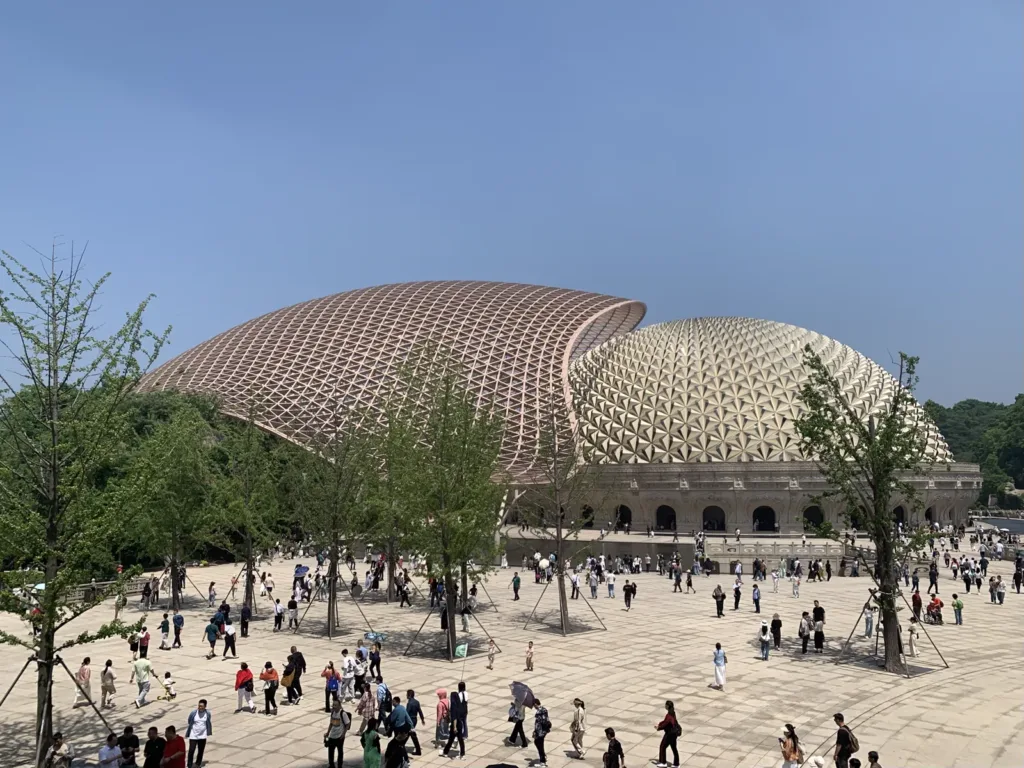
Read the exterior first, from the plaza. There are two domes: a long ridged shell shaped like a monk’s robe draped over the smaller dome, and the small dome itself, whose base is a lotus throne of gateways and pillars carrying a pearl-like crown — the park’s own phrase is “a lotus holding a jewel,” the outer dome the outer offering, the inner one the inner offering. The curved aluminium roof shell that closes the quarry spans roughly 250 m; the engineering literature on the project treats the stabilising and re-greening of the pit slope as part of the architecture, not a preliminary.
Inside, the sequence the park itself recommends is to begin in the Zen Grand View (禅境大观) on the upper level and then work downward through the underground floors — 5, 4, 3, 2, 1 — to the exit. The Zen Grand View is an oval hall about 112 m by 62 m and some 46 m high, arranged around the Buddha’s birth, enlightenment and parinirvana, with a lotus stage about 38 m across that can rise and rotate for the multimedia ceremony performed in it.
The floors below are the Relic Hall and the Relic Palace. The Thousand Buddhas Hall (千佛殿) is a vaulted room in red, yellow and dark gold, laid out as a mandala, with a 21.8 m stupa at its centre modelled on the Ashoka pagoda in which the relic was found; the Ten Thousand Buddha Corridor (万佛廊) carries the scripture corridors, lacquer paintings and displays on relic culture. The Relic Palace (舍利藏宫) is deliberately dark and quiet: a 7 m golden stupa, its inner glass case held at controlled temperature and humidity, ringed by marble mosaics showing scenes from the Buddha’s life.
The relic itself is put on public view seven times a year — around New Year’s Day, the Spring Festival and National Day, plus the four lunar anniversaries of the Buddha’s home-leaving, parinirvana, birth and enlightenment. The lunar dates shift each year and the park publishes the year’s timetable in advance; on ordinary days the relic is not shown.
Foding Tower (佛顶塔) and Foding Temple (佛顶寺)
Foding Tower stands beside the palace: about 88 m, nine storeys, four sides, in Tang style, with Buddhist murals on floors 1 to 7, a bronze bell on floor 8 that is rung for New Year and Spring Festival, and a Vairocana Buddha on floor 9. The upper floors give the widest view in the park, back over the domes and out across the wooded ridges. It is deliberately paired with the Ming Hongjue Temple Pagoda on the East Peak, restoring the “twin pagodas” the mountain was once known for.
Foding Temple sits on the south-west flank of the main peak, facing east and stepping up the slope: about 23,000 m² of halls in Tang style on the traditional seven-hall monastery plan, arranged along an axis, with worship, teaching, refectory, monks’ quarters and tea courtyard as separate zones.
The older mountain: pagoda, carvings, rampart, tomb
These are all on the East Peak, reached on foot through the Foding Front Garden or along the shuttle road.
Hongjue Temple Pagoda (弘觉寺塔) is the survivor. Octagonal, seven storeys, brick with timber floors, it measures 36.65 m from ground level to the top of its dome and about 45 m including the finial, and it is the oldest surviving imitation-wood brick pagoda in Nanjing. Tradition dates the first building to 774, when Emperor Daizong of Tang is said to have ordered it after a dream; war destroyed it, and the structure you see was rebuilt in the Ming Zhengtong era and has stood for roughly six centuries, its lime-and-glutinous-rice mortar still hard. In 1956 the underground chamber was found and excavated by the Nanjing Museum, yielding a gilded lama pagoda, a jade vase and Buddha figures; some scholars link the deposit to Zheng He, though that remains debated.
The Ming cliff carvings (明代摩崖石刻) are cut into the north face of a “几”-shaped rock outcrop on the East Peak. Five niches hold 133 figures — Amitabha, Maitreya, guardian kings, disciples and donors — carved between the Chenghua and Jiajing reigns, with Sanskrit and Tibetan inscriptions alongside. Look for how small the donor figures are compared with the Buddhas; the scale tells you who was paying.
Yue Fei’s stone rampart (岳飞抗金故垒) is a low wall of red-brown stones that runs along the hillside. In 1130, with the Jin army closing on Jiankang, Yue Fei set an ambush here and broke it; the Song History records him sending a hundred men in black into the Jin camp at night to make the enemy fight itself. About 200 m of the rampart survives, its base 0.5 m wide and about 1.5 m high.
Zheng He Cultural Park (郑和文化园) is the tomb of the Ming admiral who led seven voyages to the Indian Ocean between 1405 and 1433 and was buried here by imperial order. The approach has four terraces of seven steps each — 28 in all, for seven voyages across 28 years — and a small museum covers the fleets and the routes. It is on the western side of the park, near the Sanbao shuttle stop at the West entrance.
Li Ruiqing’s grave (李瑞清墓) lies on the eastern slope. Li, president of the Liangjiang Normal School from 1906 and a calligrapher, asked to be buried in Nanjing; his student Hu Xiaoshi planted 300 plum trees around the grave, and the slope is still planted as the Snow-Plum Ridge.
The landscape between them is part of the visit rather than filler. The Foding Front Garden, about 100,000 m² of ponds, bridges and 15 named viewpoints, is the walk up to the temple and palace; the East Chan Journey (东禅心旅) threads 32 historic remains and 15 building sites on the East Peak in three stages; the Peach Ravine (桃花溪) covers about 160,000 m² including 30,000 m² of water and some 2,000 peach trees of more than 30 varieties, best in March and April; the Chengjiang Terrace (澄江台) is the high point of the 3.7 km Chanlin Road, looking over Zheng He Lake and Baoxiang Lake to the palace, and on clear days to the Yangtze; and a stretch of the East Peak is fenced as habitat for the Chinese luehdorfia butterfly, a national second-class protected species first recorded in Nanjing here in 1982.
The mountain has its own season. “Spring Niushoushan” (春牛首) — the city emptying out to walk up the hill — is documented from the sixth century and was at its height in the Ming; the custom was added to Jiangsu’s provincial intangible-heritage list in 2023. The park cites 82% forest cover and more than 600 plant species.
Tickets, hours and booking
Admission is CNY 160, or CNY 80 at half price. The park opens 08:30–17:30; tickets are sold and checked 08:30–16:30, and both entrances (East and West) close for entry at 16:30. The internal shuttle runs 08:30–18:00, with ticket windows at the Niushou stop (East entrance), Foding Temple stop, Tianque stop and Sanbao stop (West entrance). In summer the park has extended its hours: its 2025 notice set 18 July–31 August at 08:30–20:30 on Fridays to Sundays, with the shuttle running to 21:00, and 08:30–17:30 Monday to Thursday — confirm the current year’s dates before you plan an evening.
Entry is by timed reservation: the park asks all visitors, including those on free tickets, to book online in advance through its own channels or the ticketing apps and to pay cashless.
Concessions are set by age, height and status, not nationality. Half price applies to ages 6–18, to visitors aged 60–69, and to full-time undergraduates and below. Free entry applies to children aged 6 or under or 1.4 m or under; visitors aged 70 and over; disabled visitors, with one companion free for grade 1–2 disability; serving military personnel, retired service members and certificate-holding veterans’ family members; firefighters; holders of Jiangsu blood-donation and courage awards; clergy and registered lay believers of the park’s own religion visiting its religious buildings; Taiwan Compatriot Card holders; and, under a scheme running to 31 December 2025, Nanjing medical staff with one or two immediate family members. Most free categories still need an online reservation, and several require the original documents to be checked or exchanged for a paper ticket at the East or West service window — bring the passport you booked with.
Prices at the gate are not always what you pay: local listings quote CNY 145 for an adult ticket bought the day before against CNY 160 on the day, and the park runs dated promotions of its own — a notice for 3–9 March 2025, for example, priced everyone booking ahead at CNY 135 and women at CNY 80. Once a year the park opens free: 11 July, China’s National Maritime Day, marking Zheng He’s first voyage. In 2026 the free day released 50,000 slots on 9 July at 10:00, split between booking apps, with five entry windows between 08:00 and 16:30 and no ticket sales at all on the day — a reminder that the free day needs planning, not a spontaneous arrival.
For foreign visitors, Niushoushan is one of the Nanjing sights that has been fitted out for inbound travel: multilingual self-service ticket machines, and online reservation channels opened for visitors from 39 countries, according to a November 2025 report on Nanjing’s inbound tourism. The city’s inbound-visitor PASS card, launched at the end of September 2025, bundles unlimited metro rides with 50% off admission at nine attractions including Niushoushan — worth checking whether the scheme is still running when you travel.
Two house rules matter. First, this is a provincial forest park and the repository of a first-class national artefact: lighters, matches, alcohol, drones, kites, skateboards, bicycles and roller shoes are not allowed in, and pets must be left at the pet desk in the East visitor centre. Second, the park is steep, with tight bends; powered mobility vehicles are refused, and the park recommends a manual wheelchair with a companion, with staff assistance on request.
Getting there and away
Niushoushan is in the southern suburbs, not the city centre. There is no metro station at the gate; every metro route finishes with a bus. The park publishes these combinations, and they are the ones to use.
- Metro Line 1 to 天隆寺 (Tianlongsi), Exit 2, then from the Tianlongsi metro-station bus stop: bus 712 (toward Fazhanlu Changzhan) or bus 755 (toward Zutangshan) to the 牛首山风景区 (Niushoushan Scenic Area) stop, which is the East entrance; or bus 710 (toward Guli) to 周村(牛首山风景区西), which is the West entrance.
- Metro Line 1 to 百家湖 (Baijiahu), Exit 2, then bus G70 (Baijiahu–Niushoushan Scenic Area) to the 牛首山风景区 stop, East entrance.
- Metro Line 3 to 天元西路 (Tianyuanxilu), Exit 3, then the same G70 to the East entrance.
- Metro S1 (the airport line) to 河海大学·佛城西路 (HHU / Fochengxilu), Exit 2, then G70 to the East entrance. This is the useful link if you are coming straight from Lukou airport or from Nanjing South Railway Station, which sits on Line 1, Line 3 and Line S1.
- Buses without the metro: 712 or 755 to 牛首山风景区 (East entrance); 710 or 866 (Hedingqiao West–Lulang) to 周村(牛首山风景区西) (West entrance); 754 (Yuhuatai South Gate–Linkeyuan South) stops at 佛城西路中, about 1.4 km from the East entrance, where you can walk or change to G70.
From Nanjing South Railway Station, Line 1 northbound reaches Tianlongsi after three stops (Huashenmiao, Ruanjiandadao, Tianlongsi), where the 712, 755 and 710 buses are waiting; Line 3 and Line S1 also pass through the station for the other connections above.
By taxi or ride-hailing, give the driver the Chinese name of the entrance, not just the mountain: 牛首山文化旅游区东入口 (East entrance), address 江宁区宁丹大道18号 — the East entrance has the main visitor centre and the large car parks. The West entrance (西入口, also signed 三宝站) is on the Guli side of the hill and is the closer of the two to the Zheng He Cultural Park and the Baoxiang Lake and Chengjiang Terrace stretch. The park’s own one-day itineraries all begin at the East entrance, and the walking version — front garden, Foding Temple, then the palace, tower and Niutou Chan park — is about 7 km and roughly 3.5 hours; using the shuttle to the Tianque stop cuts it to about 2.5 hours. A fuller loop that adds the Zheng He park, Baoxiang Lake, Chengjiang Terrace, Yinlong Lake and the Peach Ravine runs about 9 km and 6 hours on foot.
The internal shuttle is charged separately from admission and stops at the Niushou stop (East entrance), Foding Temple, Tianque and Sanbao (West entrance). The park’s own ticket page does not publish the fare; recent local listings and visitor accounts put it at CNY 20 for unlimited hops in a day and CNY 10 for a single ride, so treat those figures as indicative and confirm at the stop.
If you want to stay out here rather than return to the city, the park’s visitor material points to the adjoining 金陵小城 (Jinling Xiaocheng) quarter and its guesthouse, and to the Niushoushan Hilton — both separate from the scenic-area ticket.
Find Niushou Mountain Cultural Scenic Area
牛首山文化旅游区 · 江宁区
The pin marks the area, not the entrance.
Sources & visit information
Sources checked on 22 October 2026. Hours, tickets, reservations and transport can change; confirm with the operator before you go.
- 牛首山文化旅游区简介 — 中国南京牛首山官方网站(官方简介) ↗
- 牛首概况 — 中国南京牛首山官方网站(官方概况) ↗
- 票价及购票须知 — 中国南京牛首山官方网站(票务政策页) ↗
- 南京牛首山文化旅游区通告-票务信息(2025年2月5日官方通告) ↗
- 到达南京后市内交通 — 中国南京牛首山官方网站(官方交通页) ↗
- 佛顶骨舍利 — 中国南京牛首山官方网站(舍利专题页) ↗
- 夏季延时开闭园通告(2025年7月18日官方通告) ↗
- 这座仿木结构的砖塔你见过吗?— 中国南京牛首山官方网站(弘觉寺塔专文) ↗
- 弘觉寺塔 — 南京市江宁区人民政府(文保介绍) ↗
- 南京牛首山文化旅游区“三八”国际妇女节门票优惠政策的通告(江宁区政府,2025年3月4日) ↗
- 南京牛首山游玩攻略(含门票)— 南京本地宝 ↗
- 2026年南京牛首山免费开放日预约时间和开放时段 — 南京本地宝 ↗
- 南京牛首山佛顶骨舍利开放时间 — 南京本地宝(年度瞻礼时间表) ↗
- 打卡又刷卡,南京入境游全球圈粉 — 中国江苏网(2025年11月26日) ↗
- Nanjing Niushoushan Buddhist Park Travel Guide (China Discovery, English) ↗
- Line 1 (Nanjing Metro) — Wikipedia ↗
- Line 3 (Nanjing Metro) — Wikipedia ↗
- Line S1 (Nanjing Metro) — Wikipedia ↗
- 南京牛首山文化旅游区佛顶宫工程 — 中国土木工程学会(詹天佑奖工程记录) ↗
Image credits & notes (1)
- The Foding Palace on Niushou Mountain: the great ridged dome and the lotus-based small dome, seen from the esplanade. Photo: Chainwit. (Wikimedia Commons user)Photo: CC BY 4.0