

Explore the region
Niushoushan (牛首山, “Ox Head Mountain”) is the hill in Jiangning District, in Nanjing’s southern suburbs, where a very new Buddhist monument stands on much older Buddhist ground. The name comes from the east and west peaks, read as a pair of ox horns; locals also call it 牛头山, and its old literary name is Tianque Mountain (天阙山). The summit is 242.9 m, and the site address is No. 18 Ningdan Avenue (宁丹大道18号).
Two things set it apart from Nanjing’s other famous sights. The centre of the visit is a building finished in the 2010s — Foding Palace (佛顶宫) — sunk into an abandoned iron-mine pit, so the architecture and the broken land are the same subject. Around it, the mountain still holds older fabric: a Ming brick pagoda on the east peak, a Ming admiral’s tomb at the southern foot, Ming cliff carvings, and the remains of a Song-dynasty rampart.
What is old, what is new
The oldest layer here is a piece of political persuasion. When Emperor Yuan of the Eastern Jin planned a pair of ceremonial towers outside the palace in Jiankang, his chancellor Wang Dao took him out through the Xuanyang Gate, pointed south at the twin peaks of this mountain and said, “These are heaven’s towers; why trouble to build new ones?” The project was dropped and the mountain kept the name Tianque Mountain, 天阙山.
The hill has been a Buddhist site since the Southern Dynasties. Youqi Temple was built at the southern foot in 459, in the Liu Song period; Buddha Grotto Temple (佛窟寺) was founded on the mountain in 503 and later renamed Hongjue Temple (弘觉寺). In 643 the monk Farong (法融) built a thatched meditation cell under the north cliff of Youqi Temple, and the Niutou — “Ox Head” — school of Chan Buddhism grew from it. That lineage is why Niushoushan was counted in the Tang period, alongside Wutai and Emei, among China’s three great Buddhist way places.
What you see as a monument today was planned in one brief — “mend the heavenly gate, cut the sacred way, hide the underground palace, show twin pagodas, raise the temple, spread the culture” — and opened on 27 October 2015, the day the Buddha’s parietal-bone relic was installed here.
The west peak was never put back. Iron mining damaged it in 1937 and again in the 1950s, leaving a pit more than 60 m deep, and the palace was designed into that void.
Foding Palace, read from the outside in
The dimensions explain the first impression. The palace is 220 m long, 160 m wide and 89.3 m high overall, with about 136,000 m² of floor area — the official comparison is 19 football pitches. It has nine levels: three above ground, six below.
Outside there are three elements: a large dome, a small dome, and a carved cliff. The large dome is 120 m long and is shaped like a Buddha’s cassock draped over the smaller dome beneath it. The small dome reads as a hair bun and, from above, as two palms pressed together. Its base is a lotus throne made of 56 “flying apsara” Bodhi gates and 56 cloud-patterned ruyi columns, so the whole composition is described as a lotus holding a jewel. Under the cassock, the cliff called 佛顶摩崖·文殊圣山 is carved in two tiers — thirteen grottoes in the upper tier in the manner of northern cave temples, reliefs and sutra inscriptions below — and the two tiers together are meant to read as a giant Buddha’s hand.
Inside, follow the palace’s own recommended order: enter at Chan level 1, ride the escalators down through Fo levels 5 to 1, and leave.
Zen Grand View (禅境大观) is the first hall: an oval 112 m north to south and 62 m east to west, 46.5 m high, more than 6,000 m² of floor space. It is arranged in three parts — a garden of the Buddha’s birth, a garden of his enlightenment, and the Lotus Theatre between them — and holds a reclining Buddha about 7.5 m long that turns slowly while music and mist run.
Thousand Buddha Hall (千佛殿) is the one most visitors remember: a 28 m vault in red, yellow and dark gold, with 1,343 Buddha and bodhisattva figures arranged as a Vajradhatu mandala. At its centre stands a 21.8 m relic stupa modelled on the gilded seven-treasure Ashoka pagoda unearthed at the Da Bao’en Temple site in the city.
Ten Thousand Buddha Corridor (万佛廊) wraps the hall over underground levels three, four and five: Chinese Buddhist material and silk-mounted paintings on B3, Indian Buddhist teaching scenes on B4, the Buddha’s previous lives and relic culture on B5.
Relic Palace (舍利藏宫) lies 44 m below ground at the end of a 66 m corridor laid out on the six perfections. It is deliberately dark, and this is where the relic is kept.
Two small things help inside. Shoe covers are handed out before you step onto the marble of the relic hall, and if a door off the upper corridor is open it leads to a balcony looking down into the hall, which is the best place to take in its full height.
Foding Temple (佛顶寺) is the third building of the 2015 complex, on the south-western slope of the main peak: a Tang-style monastery rebuilt from 2012 and completed in 2015, laid out on the classical seven-hall plan (伽蓝七堂) along a central axis, with separate zones for worship, teaching, the refectory, monks’ quarters and a tea garden. It is the working religious counterpart to the palace’s exhibition spaces.
The palace took both the Luban Prize and the Zhan Tianyou Award for construction in 2017.
The relic, and the few days a year you can see it
The object at the centre of the site is a fragment of the Buddha’s parietal bone. It reached Nanjing in the Northern Song period, when the monk Shi Hu presented it to Changgan Temple; in 1011 it was sealed in gold and silver caskets inside a seven-treasure Ashoka pagoda and buried in the temple’s underground chamber. Archaeologists found that chamber at the Da Bao’en Temple site in 2008, opened the pagoda in 2009, and on 12 June 2010 the caskets were opened at Qixia Temple.
Public viewing happens on seven occasions a year: New Year’s Day, the Spring Festival holiday, the National Day holiday, and the Buddha’s renunciation day (eighth day of the second lunar month), parinirvana day (fifteenth day of the second month), birthday (eighth day of the fourth month) and enlightenment day (eighth day of the twelfth month).
On those days the relic is displayed in the Relic Palace; the palace asks visitors to avoid the 12:00–14:00 crush and to walk clockwise. The most recent round, 1–7 October 2026, was announced as the last viewing period of that year. The seven occasions are fixed in the calendar, but the days the relic is actually shown are announced each time, so confirm before you build a trip around it.
The twin pagodas and the eastern peak
Two pagodas stand in sight of each other, and the pairing is the point: the site’s plan was to “show twin pagodas” and restore the skyline the mountain once had.
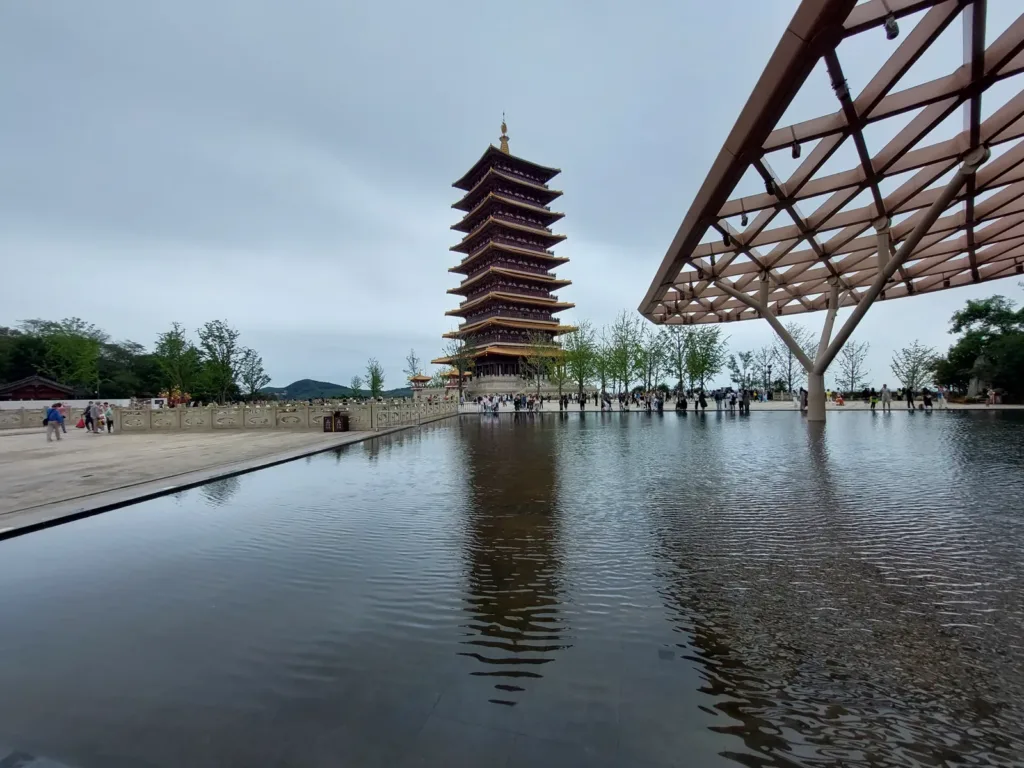
Foding Pagoda (佛顶塔) is the new one: 88 m, nine storeys, four sides, in Tang style, with about 5,065 m² of floor area. Floors one to seven carry murals of Buddhist stories; the eighth floor holds a bronze Vajra bell inscribed with the whole Diamond Sutra, rung for New Year and Spring Festival blessings; the ninth floor enshrines a Vairocana Buddha. The top is the best viewpoint on the site, over the east peak and, on a clear day, out towards the city.
Hongjue Temple Pagoda (弘觉寺塔) is the old one, on the east peak in the Niutou Chan Culture Park (牛头禅文化园), which was built on the ruins of Hongjue Temple. It is 45 m high, seven storeys and eight faces, and is described as the oldest surviving imitation-timber brick pagoda in Nanjing. Tradition dates the first pagoda here to 774, when Emperor Daizong was said to have ordered it after a dream; the present tower was rebuilt in the Ming Zhengtong period. When its underground chamber was opened in 1956 it yielded a gilt lamaist stupa — now one of the Nanjing Museum‘s prize pieces — along with jade bottles, a gold sleeping Buddha and celadon jars, and more than seventy inscriptions left by Ming and Qing visitors were recorded on the walls.
The culture park also has a statue of Farong and a small exhibition on the Niutou school, which is the reason the hill matters to Chan Buddhism.
Around the east peak the historical layer is thin but real. The Ming cliff carvings (明代摩崖石刻) at Doushuai Rock have five niches and 133 figures — Amitabha, Maitreya, heavenly kings, disciples and donors — cut between the Chenghua and Jiajing reigns, with Sanskrit and Tibetan inscriptions.
Then the Song-dynasty layer: in 1130 Yue Fei ambushed the Jin army on this mountain and built a stone rampart, of which about 200 m survives, 0.5 m wide at the base and about 1.5 m high. The scenic area’s own page says the rampart is currently closed to visitors while its surroundings are being reworked — worth knowing before you go looking for it.
Zheng He’s tomb at the south foot
The Zheng He Culture Park (郑和文化园) at the southern foot is the tomb of the Ming admiral who took seven fleets into the Indian Ocean between 1405 and 1433. The Tongzhi-era local gazetteer records “the tomb of the eunuch Zheng He… granted burial on the mountain slope”; villagers called the hill 回回山 and the tomb 马回回墓. The original mound was about 150 m long and 60 m wide, oriented north–south. What you see now was restored in 1985 in Hui and Muslim burial style: a horseshoe-shaped enclosure of bluestone, a cover stone carved with cloud-brocade and lotus motifs and Arabic script, and a tablet in the rear wall reading 郑和之墓 (“Tomb of Zheng He”). Four platforms of seven steps each — 28 steps — stand for the seven voyages and the 28 years.
The park also includes a display hall in a courtyard house, with a bust of Zheng He and interactive exhibits on the voyages. Zheng He’s deputy Hong Bao is buried on the same mountain, and both tombs are provincial protected sites.
One date to note if you are planning around it: the official introduction says the scenic area opens free of charge on 11 July, China’s National Maritime Day, the anniversary of the first fleet’s departure in 1405. Check that this still applies in the year you travel.
Tickets, hours and the reservation that governs your day
- Admission: full price 160 CNY, half price 80 CNY, set under Nanjing price document 宁价服〔2018〕272号. Half price covers visitors aged 6–18, students in full-time undergraduate programmes and below, and visitors aged 60–69. Free admission covers children under 6 or under 1.4 m, visitors aged 70 and over, disabled visitors (with one companion free where the disability grade is 1 or 2), serving and retired military personnel, firefighters, and holders of a Taiwan Compatriot Permit, among other categories.
- Hours: gates open 08:30–17:30, with ticket sales and entry checks 08:30–16:30, at the east and west entrances, which are themselves published as 08:30–16:30. Hours change seasonally — from 18 July to 31 August 2025, Friday to Sunday ran to 20:30 with entry checks to 19:00 — so check the current notice before travelling.
- Reservation: the scenic area is trialling full timed-entry reservation. Book online in advance and arrive in your slot; cashless payment is preferred. Concession and free-ticket visitors also have to reserve online first, and some categories must exchange a paper ticket at the service windows of the east visitor centre or the west entrance.
- Not included in the ticket: the internal shuttle, food and drink outlets, shops and any special exhibitions.
- Foreign passports: the published rules single out Taiwan Compatriot Permit holders and disabled visitors as groups who must exchange a paper ticket at a service window, while other visitors scan an ID at the gate. International platforms including Klook and Trip.com sell entry tickets for this site, which is the usual route for visitors without a mainland ID. Carry your passport and allow time at the window.
Getting there
Niushoushan has no metro station of its own, and the published routes all end with a bus or a taxi to one of two entrances. Both entrances serve the same ticket but lead to different parts of the site: the east entrance (东出入口) is the main one on Ningdan Avenue, and the west entrance (西出入口) is nearer the Zheng He park side.
East entrance by metro and bus. Take Metro Line 1 to 天隆寺 (Tianlongsi), exit 2, and from the 天隆寺地铁站 bus stop take bus 712 (towards 发展路场站) or bus 755 (towards 祖堂山总站) to 牛首山风景区, the stop at the east entrance. Two other combinations work: Metro Line 1 to 百家湖 (Baijiahu), exit 2, then bus G70 to 牛首山风景区; or Metro Line 3 to 天元西路 (Tianyuanxilu), exit 3, then bus G70. On the airport line, Metro S1 stops at 河海大学·佛城西路 (Hohai University–Fochengxilu), exit 2, where G70 also picks up. Bus 754 runs to 佛城西路中, about 1.4 km from the east entrance, with G70 as the onward connection.
West entrance. Metro Line 1 to 天隆寺, exit 2, then bus 710 (towards 谷里总站) to 周村(牛首山风景区西), the stop at the west entrance. Bus 866 (河定桥西→陆郎) reaches the same stop.
By rail. Nanjing South Railway Station (南京南站) is the high-speed gateway and the northern terminus of the S1 airport line, which also calls at 河海大学·佛城西路; Line 1 is another option from the same station. Either way the last leg is the bus combination above, or a taxi. Third-party guides put the site about 10 km from Nanjing South, about 13 km from the city centre and about 30 km from Lukou airport; a taxi from downtown takes around 40 minutes.
By taxi or ride-hailing. Give the driver 牛首山文化旅游区东入口 or the address 宁丹大道18号 for the east entrance, and 牛首山文化旅游区西出入口 for the west entrance.
Once inside. The site is large and hilly, and the palace sits on the west peak, well away from the east gate. Electric shuttles run 08:30–18:00 on the route 牛首站–隐龙湖站–天阙站–三宝站 (out and back, not a loop), with staffed ticket windows at 牛首站, 天阙站 and 三宝站 and a machine at 牛首站. A single ride is 10 CNY and a 20 CNY all-stop ticket allows one boarding at each stop; the fare is separate from admission.
The scenic area publishes three walking routes: the essentials loop from the east entrance through 佛顶前苑, 佛顶寺 and 佛顶圣境 (palace, pagoda, Niutou Chan park) and back, 7 km and about 3.5 hours; a Chan route on the east peak adding Li Ruiqing’s tomb, the Yue Fei rampart, the Ming cliff carvings and 隐龙湖, 6 km and about 4.5 hours, walking only; and a nature route out to the Zheng He park, 宝相湖 and 澄江台, 9 km and about 6 hours.
For orientation inside the core area, the signboard at the 佛顶圣境 entrance gives distances and walking times: 100 m to 天阙站, 1,300 m (about 15 minutes) to 佛顶寺, 2,300 m (about 23 minutes) back to the east entrance, 1,300 m to the Zheng He Culture Park at 三宝站, 2,100 m to 桃花溪 and 3,800 m to 澄江台.
Practical notes
- This is a mountain site with slopes and sharp bends, and the palace’s levels are linked by escalators and long corridors. Powered mobility scooters are not allowed; a manual wheelchair with a companion is workable, and staff can be asked for help.
- The palace and the mountain are two different visits on one ticket. If you mainly want the architecture, ride to 天阙站 and walk into 佛顶圣境; if you want the old fabric, plan the east-peak route and the Zheng He park as separate stretches rather than trying to combine everything on foot.
- Weather matters. The official description recommends April–May for mist and September–October for clear autumn days, and the region’s wet season runs from mid-June into July.
- Spring is the local season for this mountain: the “Niushoushan spring outing” custom entered Jiangsu’s provincial intangible heritage list in 2023, and the 桃花溪 valley is planted with about 2,000 peach trees of more than 30 varieties, best in March and April. The east peak also protects habitat for the Chinese luehdorfia butterfly (中华虎凤蝶), a Chinese endemic recorded here since 1982.
- Food inside is largely vegetarian, with several dedicated outlets; the adjoining 金陵小城 and the Hilton hotel next to the site are the obvious ways to extend the day. The official pairing list runs from Niushoushan to the Jiangsu Garden Expo Park and Tangshan’s hot springs on the Jiangning side, and in the city to the Da Bao’en Temple site, Laomendong and the Nanjing Museum — the Da Bao’en site being where the relic was found.
- Nearby, the Two Mausoleums of the Southern Tang (南唐二陵) — Li Bian with Empress Song in Qinling, Li Jing with Empress Zhong in Shunling — lie at the southern foot of the Zutang hill group in Guli. They were excavated by the Nanjing Museum in 1950 and listed as a national key cultural relic site in 1988. They are not part of the Niushoushan ticket, so treat them as a separate site with its own opening arrangements.
Combine your visit
A suggested sequence linking the specific features of this visit.
-
Mountain and palace approach
Read the modern complex against the former mining landscape.
-
Foding Palace exterior
Examine the relationship between the large and small domes.
-
Permitted palace interior route
Continue through the religious and architectural spaces open to visitors.
This order is editorial. Confirm access and any transfers between stops; it does not establish a walking route, same-day connection or common admission ticket.
Find Niushoushan
牛首山 · 南京市
The pin marks the area, not the entrance.
More places nearby
Approximate straight-line distances between map pins, not travel distances.
City Wall of Nanjing 南京城墙
12 km awayNanjing’s Ming city wall follows the terrain in an irregular circuit shaped by hills and waterways. Surviving sections preserve the brick-clad earthwork and several different gate arrangements.
View guide →Nanjing Fuzimiao 夫子庙
13 km awayNanjing Fuzimiao centres on the Confucius Temple by the Qinhuai River. Its historical setting also includes institutions associated with education and the imperial examinations.
View guide →Memorial Hall of the Victims in Nanjing Massacre by Japanese Invaders 侵华日军南京大屠杀遇难同胞纪念馆
14 km awayThe Nanjing Massacre Memorial Hall stands at Jiangdongmen near a burial site associated with the killings of 1937. It combines preserved archaeological evidence with documentary exhibitions and a commemorative landscape.
View guide →Sources & visit information
Sources checked on 22 October 2026. Hours, tickets, reservations and transport can change; confirm with the operator before you go.
- 牛首概况(中国南京牛首山官方网站) ↗
- 牛首山文化旅游区简介(中国南京牛首山官方网站,2024-01-01) ↗
- 票价及购票须知(中国南京牛首山官方网站,票务政策) ↗
- 南京牛首山文化旅游区通告·票务信息(中国南京牛首山官方网站,2025-02-05) ↗
- 佛顶宫(中国南京牛首山官方网站) ↗
- 佛顶骨舍利(中国南京牛首山官方网站) ↗
- 牛头禅文化园(中国南京牛首山官方网站) ↗
- 郑和文化园(中国南京牛首山官方网站) ↗
- 佛顶寺(中国南京牛首山官方网站) ↗
- 岳飞抗金故垒(中国南京牛首山官方网站) ↗
- 到达南京后市内交通(中国南京牛首山官方网站,交通线路) ↗
- 牛首山文化旅游区通告·暑期开放时间(中国南京牛首山官方网站,2025-07-18) ↗
- 儒家治道文化·王导“此天阙也”(中国南京牛首山官方网站) ↗
- 南京牛首山文化旅游区“三八”国际妇女节门票优惠政策的通告(江宁区人民政府网站,2025-03-04) ↗
- Niushoushan(English Wikipedia) ↗
- Nanjing Niushoushan Buddhist Park Travel Guide(China Discovery,英文) ↗
- Niushoushan Park in Nanjing: the travel guide(Fabio Nodari,英文) ↗
- 南京牛首山交通攻略(南京本地宝) ↗
- 南京牛首山景区交通车票价+线路+包车租赁服务(南京本地宝,2021-03-19) ↗
- 国庆期间佛顶骨舍利公开瞻礼安排(新浪,2026-09-21) ↗
- Niushou Mountain Cultural Tourism Zone(Klook,英文票务页) ↗
- 南京地铁S1号线(中文维基百科) ↗
Image credits & notes (1)
- Foding Pagoda (佛顶塔) above the reflecting pool at Foding Square, Niushoushan, September 2023. Photo: Jpbowen (Wikimedia Commons)Photo: CC BY-SA 4.0