

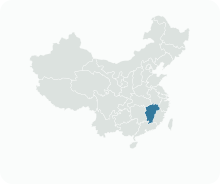
Get to know Zhangshu

Photo adjustments
Full frame retained; EXIF orientation normalized, proportionally resized to at most 800 pixels and converted to WebP. No generated pixels or subject changes. Cards may crop the display.
- Administrative area
- County-level city · 县级市
- Part of
- Yichun
- Chinese name
- 樟树市
- Local areas
- County-level city guide
Area & population
- Area in the source
- 1,291.00 km²
- Population · 2017
- 609,771
Source: cited geographic source, as of the dates shown.
Setting and landscape
Hills rise in the southeast and northwest, and a plain spreads along the Gan and the Yuan River (袁水), which joins the Gan west of the city centre. The Gan runs the length of the city, and the river port lies between the rail and road bridges in the urban area.
History
The Southern Tang created Qingjiang County in 938 from three townships of Gao'an (高安) and Xingan (新淦), with its seat at Xiaotan (潇滩), now Linjiang town (临江镇). From 992 Qingjiang was the seat county of Linjiang (临江军), a military prefecture that later became a Ming and Qing prefecture. The county and Zhangshu town were merged into Zhangshu city in 1988.
According to the national intangible-heritage register, medicine stalls appeared here in the Three Kingdoms period, a medicine fair in the Tang and a full market by the Song; in the Ming it was called a "medicine wharf", and under the Qing it gathered herbs from north and south, Sichuan and Guangdong. Its guild, the "Zhang bang" (樟帮), kept strict rules and refined herbal processing; the market customs were listed nationally in 2008 and the Zhangshu processing techniques in 2014. Chinese Wikipedia credits Ge Xuan (葛玄), revered by Taoists, with gathering, growing and preparing herbs on Gezao Mountain from 202 and treats him as the founder of the city's herb processing.
What to see
The Wucheng site (吴城遗址) in Wucheng township, found in 1973 and a national key cultural relic since 1996, was the first large Shang-dynasty settlement discovered south of the Yangtze; finds include proto-porcelain jars and a red pottery mask. Gezao Mountain (阁皂山), southeast of the city, is named for a shape like a pavilion and a dark colour; it is the ancestral mountain of the Lingbao school of Taoism and counts 99 peaks. Surviving remains there include Chongzhen Palace (崇真宫), the Jiexian Bridge (接仙桥) and Mingshui Bridge (鸣水桥).
Food and local products
Zhangshu gardenia (樟树黄栀子) and Zhangshu evodia fruit (樟树吴茱萸) are national geographical-indication products. The Site Tejiu (四特酒) distillery stands in the eastern suburbs, and a medicine trade fair is still held every year.
Highlights
- Wucheng site 吴城遗址: First large Shang settlement found south of the Yangtze; national key cultural relic since 1996.
- Gezao Mountain 阁皂山: Ancestral mountain of the Lingbao school of Taoism, with 99 peaks.
- Zhangshu medicine-market customs 樟树药俗: National intangible heritage since 2008; the market dates back to Song times.
- Zhangshu gardenia 樟树黄栀子: National geographical-indication product.
Sources for this guide
樟树市 - 维基百科,自由的百科全书 · Chinese Wikipedia · CC BY-SA 4.0
药市习俗(樟树药俗) - 中国非物质文化遗产网·中国非物质文化遗产数字博物馆 · China Intangible Cultural Heritage Network (ihchina.cn)
中药炮制技艺(樟树中药炮制技艺) - 中国非物质文化遗产网·中国非物质文化遗产数字博物馆 · China Intangible Cultural Heritage Network (ihchina.cn)
吴城遗址 - 维基百科,自由的百科全书 · Chinese Wikipedia · CC BY-SA 4.0
阁皂山 - 维基百科,自由的百科全书 · Chinese Wikipedia · CC BY-SA 4.0
Original English written from the listed sources and checked sentence by sentence against quoted extracts by a separate reviewer. Updated 2026-09-25.
Explore Zhangshu
Core places to explore, with English and Chinese names.
Places to explore around Zhangshu
 Mingshui Bridge, a stone arch bridge on Gezao Shan in Zhangshu ·
 Plan your visit
Getting there
Zhangshu is about 115 km in a straight line from central Yichun. Search for 樟树市 in a map app to find stations and your accommodation.
Where to stay →Build your route
Start with Gezao Mountain. The linked place guides have entrance and visit details.
Continue with Yichun →More in Yichun
Sources & geographic information
Administrative names and parent areas: Official geographic directory · Reference date 2026-09-06.
Some facts checked against 樟树市 — Wikipedia contributors, CC BY-SA 4.0.
Some facts checked against 吴城遗址 — Wikipedia contributors, CC BY-SA 4.0.
Some facts checked against 阁皂山 — Wikipedia contributors, CC BY-SA 4.0.
Photo: Gezao Mountain · Worldsy233 · CC BY-SA 4.0. Full frame retained; proportionally resized and converted to WebP. No retouching or changes to the photographed subject. Card displays may crop the view.

Map data © OpenStreetMap contributors. Pins mark approximate centres, not entrances or boundaries.