

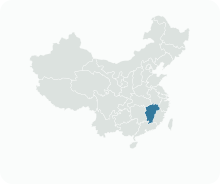
Get to know Fengcheng

Photo adjustments
Full frame retained; proportionally resized and converted to WebP. No retouching or changes to the photographed subject. Card displays may crop the view.
- Administrative area
- County-level city · 县级市
- Part of
- Yichun
- Chinese name
- 丰城市
- Local areas
- County-level city guide
Area & population
- Area in the source
- 2,845.00 km²
- Population · 2019
- 1,480,000
Source: cited geographic source, as of the dates shown.
History
The county was carved out of southern Nanchang County in 210 as Fucheng (富城), named for its position west of the Fu River (富水). It became Fengcheng in 280, with its seat at Rongtang (荣塘) on the west bank of the Feng River (丰水). In 651 the seat moved to Qudou (曲豆), east of the Gan, today's Jianguang Subdistrict (剑光街道), and has stayed there since. Zhu Wen (朱温) renamed the county Wugao (吴皋) in 905 to avoid his father's name; the old name returned in 923. The county became a city in 1988.
Fengcheng's nickname, "Jianyi" (剑邑, sword town), comes from a Jin-dynasty story: after a purple vapour was seen rising toward the stars of the Dipper and the Ox, the magistrate Lei Huan (雷焕) dug beneath the county jail and found the swords Longquan (龙泉) and Tai'e (太阿). Wang Bo (王勃) drew on the story in his "Preface to the Pavilion of Prince Teng" (滕王阁序).
What to see
The Hongzhou kilns, one of six famous kilns of the Tang dynasty, fired celadon from the late Eastern Han and flourished from the Jin to the mid-Tang. Archaeologists found old kiln sites in 1977 around Luohu village (罗湖村) in Qujiang (曲江) town; 29 kiln sites are now known across six townships in the north-central part of the city. The excavation was named one of China's ten major archaeological discoveries of 1993, and the site became a national key cultural relic protection unit in 1996. The Ganxi Evening News (赣西晚报) describes the Wanniling kiln (碗泥岭) in Beishang village (陂上村), Tielu town, as the only place where Hongzhou firing has carried on; its pottery craft entered Jiangxi's provincial intangible heritage list in 2013, and carvers in its workshop cut the lotus pattern typical of Hongzhou ware onto cups.
Baimazhai (白马寨村) in Zhangxiang (张巷) and Houbantang (厚板塘村) in Xiaotang (筱塘) are listed as Jiangxi historic and cultural villages.
Food and local products
Frozen-rice candy (冻米糖), a national geographical-indication product, is made after the Mid-Autumn Festival: glutinous rice is dried, puffed in tea-seed oil, bound with malt syrup and cut into small pieces, in about 20 steps. Fengcheng selenium-rich rice (丰城富硒大米) also holds a geographical indication, and snail sauce (田螺酱) is made from wild field-snail meat by the traditional method of sun-curing and simmering the paste, and tastes hot and savoury.
Getting oriented
The Shanghai–Kunming and Beijing–Kowloon railways and the Nanchang–Ji'an–Ganzhou passenger line all serve Fengcheng, and the Nanchang–Zhangshu expressway crosses it.
Highlights
- Hongzhou kiln sites 洪州窑遗址: Celadon kiln sites of the Eastern Han to Tang; national key cultural relic protection unit since 1996.
- Wanniling kiln 碗泥岭: Kiln in Beishang village where Hongzhou-style firing continues; provincial intangible heritage since 2013.
- Baimazhai Village 白马寨村: Jiangxi historic and cultural village in Zhangxiang town.
- Frozen-rice candy 冻米糖: Puffed glutinous-rice sweet bound with malt syrup; national geographical indication.
Sources for this guide
丰城市 - 维基百科,自由的百科全书 · Chinese Wikipedia · CC BY-SA 4.0
洪州窑 - 维基百科,自由的百科全书 · Chinese Wikipedia · CC BY-SA 4.0
丰城:古瓷新韵话非遗_赣西晚报_2024年06月13日 · Ganxi Evening News (Yichun)
Original English written from the listed sources and checked sentence by sentence against quoted extracts by a separate reviewer. Updated 2026-09-25.
Explore Fengcheng
Core places to explore, with English and Chinese names.
Fengcheng 丰城市
Plan your visit
Getting there
Fengcheng is about 140 km in a straight line from central Yichun. Search for 丰城市 in a map app to find stations and your accommodation.
Where to stay →More in Yichun
Sources & geographic information
Administrative names and parent areas: Official geographic directory · Reference date 2026-09-06.
Some facts checked against 丰城市 — Wikipedia contributors, CC BY-SA 4.0.
Some facts checked against 洪州窑 — Wikipedia contributors, CC BY-SA 4.0.
Map data © OpenStreetMap contributors. Pins mark approximate centres, not entrances or boundaries.