

Explore the region
Tap any red Chinese text to hear it in Mandarin.
Why this museum matters
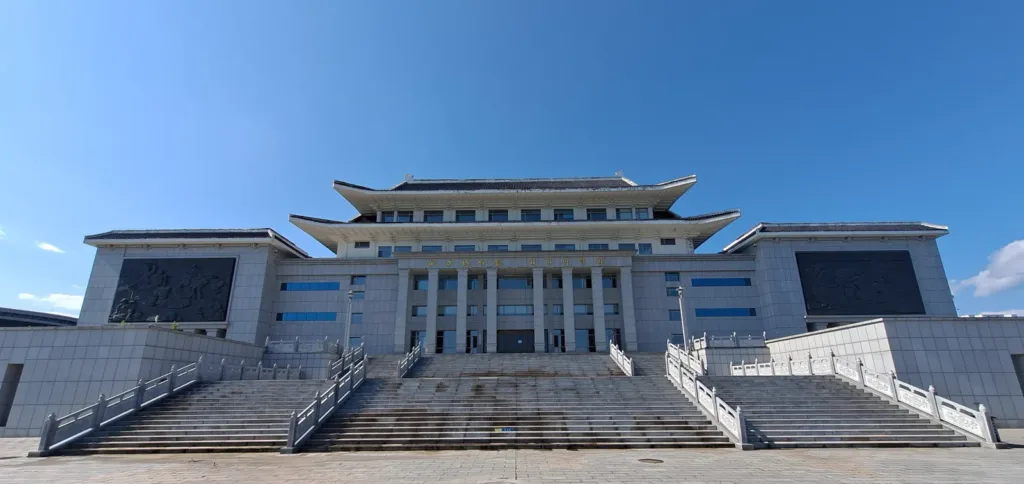
Yanbian Museum is a useful first stop for understanding how the prefecture tells its own story. Its current permanent display links material traces from ancient communities with the region’s later settlement, shared resistance, folk life and recent development, rather than treating Korean Chinese customs as an isolated decorative theme. The museum describes the 2024 renewal as a five-part historical-cultural display built around the idea of a shared Chinese national community.
The five sections move from “Dawn in the Eastern Frontier of Chinese Civilization” (《中华文明 东疆曙光》), through “Crossing Passes and Rivers, Building a Home Together” (《闯关越江 共建家园》) and “Fighting Together Against the Enemy” (《浴血奋战 共同抗敌》), to “Folk Culture in Full Colour” (《民俗文化 共放异彩》) and “One Heart with the Party, an Enduring Future” (《一心向党 永续辉煌》).
That sequence gives a visitor a practical way to read Yanbian: start with the archaeological record, follow the stories of communities making a home in the region, then look at how customs and modern public history are presented together. The museum is especially useful when you want context for the food, language, clothing and public spaces you will encounter elsewhere in Yanji and across the prefecture.
What to look for
The first three sections are the historical backbone. Look for objects and documents that place Yanbian’s early inhabitants, later migration and regional development into a longer timeline, then for material connected with the resistance history of the twentieth century. The 2024 relaunch combines original objects with documentary material, reconstructed scenes and multimedia interpretation, so it is not only a cabinet-by-cabinet archaeological visit.
Give the folk-culture section enough time. A People’s Daily report describes it through production customs, household life, life-cycle rituals, seasonal festivals and folk arts. It also records reconstructed domestic scenes, traditional clothing and displays of Korean Chinese craft. Those details are a better guide to what to observe than a general promise of “ethnic flavour”: look at how work, rooms, clothing and ceremony are arranged as parts of everyday life.
The fifth section continues into recent public history and the prefecture’s contemporary effort to present its communities as connected. Together, the five sections make the museum more than a collection of isolated objects: they offer a compact orientation before you visit Yanbian’s villages, border landscapes or living food culture.
Plan the visit
Admission is free. The museum’s current visitor notice lists opening from Tuesday to Sunday, with Monday closed except on national statutory holidays. Summer hours are 09:00–16:30, with entry stopping at 16:00; winter hours are 09:00–16:00, with entry stopping at 15:30.
The same notice asks visitors to bring valid identification for registration. Individual visitors may register on site, and the museum also provides WeChat reservation; schools, travel agencies and other groups are asked to make an advance telephone reservation. The page does not explain the registration procedure for foreign passports, so visitors travelling on a passport should confirm acceptance and any reservation requirement before setting out. The published contact numbers are 0433-4311030 and 0433-4311027.
The museum asks visitors to keep quiet, not smoke, and not touch non-interactive exhibits. Photography and filming require permission. A free locker area is listed beside the west side of the south gate for large bags; this is useful on arrival, but the visitor notice does not explicitly identify the south gate as the currently open visitor entrance. Follow the museum’s on-site signs rather than treating a map pin or an older photograph as an entrance instruction.
Getting there and back
Use the full Chinese destination 延边博物馆,吉林省延边州延吉市长白西路8627号 when arranging a taxi or ride-hailing trip. The official visitor page lists bus 28 to 延边博物馆站 (Yanbian Museum stop), and buses 9, 12 and 39 to 人民体育场站 (People’s Stadium stop). It does not publish route directions, timetables or an exit number, so check the live route and the stop on Amap/Gaode Maps on the day.
For the final leg, use the museum’s current signed visitor entrance at the address above. If you arrive at 人民体育场站, confirm the walking approach locally rather than assuming the map marker is the door. For the return, verify the opposite-direction stop in Amap or ask the driver to use the same Chinese museum name; do not assume that a route’s outbound and return stops are on the same side of the road.
The official visitor notice does not give a railway or coach terminal connection. If Yanji is your arrival point from another city, treat the museum as a local Yanji stop: arrange the last leg to the Chinese address, then confirm the return connection before leaving the galleries.
Combine your visit
Suggested order within this visit:
-
Excavated-relics galleries
Begin with the region's archaeological background.
-
Korean folk-customs display
Move from early material history to household and community life.
-
Farmers' dance exhibition
Finish with a focused performing tradition if that gallery is open.
This sequence is an editorial suggestion based on the features described in the sources. Access to individual buildings or areas should be checked locally; no travel time or shared admission is implied.
Find Yanbian Museum
延边博物馆 · 延边朝鲜族自治州
The pin marks the area, not the entrance.
More places nearby
Approximate straight-line distances between map pins, not travel distances.
Korean Folk Customs Park of China 中国朝鲜族民俗园
6 km awayThe Korean Folk Customs Park in southern Yanji is a purpose-built cultural landscape arranged around traditional-style homes, food and performance spaces. It presents the appearance of a village while accommodating restaurants…
View guide →Head Mountain 延吉帽儿山
6 km awayMao'er Mountain takes its name from a hat-like profile above Yanji's southern outskirts. The approach moves from a forest boardwalk to a long stair climb, ending at a lookout over the city, river valleys and surrounding rice…
View guide →Yanji Dinosaur Museum 延吉恐龙博物馆
6 km awayYanji's dinosaur museum grew from fossil discoveries made at Longshan on Mao'er Mountain's southern slope. Its six Korean-style buildings divide the visit between a broad Dinosaur Planet introduction and the Dragon Rising in…
View guide →Sources & visit information
Sources checked on 1 November 2026. Hours, tickets, reservations and transport can change; confirm with the operator before you go.
Image credits & notes (1)
- The front elevation of Yanbian Museum in Yanji, seen from the forecourt. Photo: EditQPhoto: CC BY-SA 4.0