

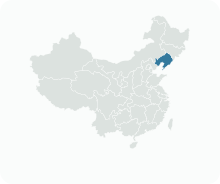
Get to know Nanpiao District

Photo adjustments
EXIF orientation normalized; resized without changing aspect ratio; converted to WebP. No subject edits.
- Administrative area
- District · 市辖区
- Part of
- Huludao
- Chinese name
- 南票区
- Local areas
- District guide
Area & population
- Population · 2020 census
- 182,135
Source: cited geographic source, as of the dates shown.
History
Under the Jin dynasty the seat of Anchang County (安昌县) stood at today's Nuanchitang (暖池塘). From 1906 most of the present district belonged to the Jinxi sub-prefecture (锦西厅), which became Jinxi County in 1913. Mount Dahongluo (大虹螺山), inside the district, is linked by the district to the Yuan-era rising of Zhang Jing (张鲸) and to Sun Chengzong's (孙承宗) late-Ming inspection of the frontier defences beyond the pass.
Nanpiao District itself was formed in January 1983 from Nanpiao town and Shaguotun commune (沙锅屯) under Jinzhou. In June 1989 it passed to the new prefecture-level city of Jinxi, gaining Nuanchitang, Gangyaoling (缸窑岭) and Huangtukan (黄土坎); Jinxi was renamed Huludao in 1994. In May 2012 Gaoqiao (高桥), Hongluoxian (虹螺岘), Jinxing (金星) and three townships moved over from Lianshan District. Nanpiao appears among China's second group of resource-depleted areas.
What to see
The Shaguotun Stone Pagoda (沙锅屯石塔), east of Shaguotun village, was built in 1206 under the Jin dynasty: a solid six-sided stone tower about five metres high with five tiers of close-set eaves. It joined the seventh batch of national key protected sites in 2013. The district also names the Neolithic Shaguotun cave site, Bronze Age rock carvings at Xianglu Mountain (香炉山), Liao tombs at Aijiagou (艾家沟) and Mingxing Temple (明性寺), which it calls a fine Qing building group of western Liaoning.
Gaoqiao Town Station (高桥镇站) on the Shenyang–Shanhaiguan railway was built in 1899 and was one of three Beijing–Fengtian railway stations in late-Qing Jinxi.
Food and local products
When the boundaries changed, Lianshan District handed six of its listed heritage items to Nanpiao, three of them foods. Gaoqiao pickles (高桥小菜), on Huludao's city list, date from 1868; their founder, Liu Yongpeng (刘永鹏), came to steep vegetables in shrimp oil he made himself, which gave them a fresh, crisp taste in place of the bitter saltiness of salt-cured pickles. There are seafood and plain kinds. Kaoshantun dried tofu (靠山屯干豆腐) from Hongluoxian has workshops recorded from 1733; its sheets are thin enough to read print through and are eaten rolled, stir-fried or stewed. Gaoqiao mature vinegar (高桥陈醋) dates from 1842 and is brown, fragrant and sweet-sour. The three performing arts that moved with them are the Bawang whip dance (霸王鞭), the three-piece clappers (三节板), a sung and spoken art, and the Taiping drum (太平鼓).
Highlights
- Shaguotun Stone Pagoda 沙锅屯石塔: Solid hexagonal Jin-dynasty stone pagoda of 1206, a national key protected site since 2013.
- Gaoqiao pickles 高桥小菜: Pickles steeped in home-made shrimp oil, dating from 1868; on Huludao's city heritage list.
- Kaoshantun dried tofu 靠山屯干豆腐: Thin tofu sheets from Hongluoxian, made by village workshops recorded since 1733.
- Gaoqiao mature vinegar 高桥陈醋: Brown, fragrant sweet-sour vinegar first brewed in 1842.
Sources for this guide
南票义勇军 - 其他-纪录小康工程-辽宁数据库 · Nanpiao District Committee Propaganda Department, published in the Liaoning Daily database
连山区非物质文化遗产资源介绍-连山区人民政府 · Lianshan District People's Government (Culture, Tourism, Radio and Television Bureau)
沙锅屯石塔 - 维基百科,自由的百科全书 · Wikipedia (Chinese) · CC BY-SA 4.0
高桥镇站 - 维基百科,自由的百科全书 · Wikipedia (Chinese) · CC BY-SA 4.0
南票区 - 维基百科,自由的百科全书 · Wikipedia (Chinese) · CC BY-SA 4.0
Original English written from the listed sources and checked sentence by sentence against quoted extracts by a separate reviewer. Updated 2026-09-25.
Explore Nanpiao District
Core places to explore, with English and Chinese names.
Nanpiao District 南票区
Plan your visit
Getting there
Nanpiao District is about 45 km in a straight line from central Huludao. Search for 南票区 in a map app to find stations and your accommodation.
Where to stay →More in Huludao
Sources & geographic information
Administrative names and parent areas: Official geographic directory · Reference date 2026-09-06.
Some facts checked against 沙锅屯石塔 — Wikipedia contributors, CC BY-SA 4.0.
Some facts checked against 高桥镇站 — Wikipedia contributors, CC BY-SA 4.0.
Some facts checked against 南票区 — Wikipedia contributors, CC BY-SA 4.0.
Map data © OpenStreetMap contributors. Pins mark approximate centres, not entrances or boundaries.