

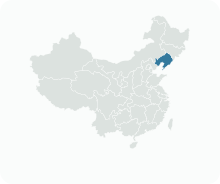
Get to know Liaoyang County

Photo adjustments
Full frame retained; proportionally resized and converted to WebP. No retouching or changes to the photographed subject. Card displays may crop the view.
- Administrative area
- County · 县
- Part of
- Liaoyang
- Chinese name
- 辽阳县
- Local areas
- County guide
Area & population
- Area in the source
- 2,443.00 km²
- Population · 2020 census
- 372,131
Source: cited geographic source, as of the dates shown.
Setting and landscape
The county belongs to the Qian Mountains (千山) range and counts 126 peaks. The highest, Dahei Mountain (大黑山) near Shuiquan (水泉), rises to 1,181.2 m and is the highest point in Liaoyang prefecture; Motian Ridge (摩天岭), at 968.8 m on the Benxi border, carries large forests. The Taizi River (太子河) flows through the county. The county government gives a mean annual temperature of 8.4°C and about 572 mm of rain a year.
History
From the Warring States to the Later Yan the area belonged to Xiangping county (襄平县) of Liaodong. In 1653 the Qing set up Liaoyang Prefecture and Liaoyang County, and in 1664 the county was raised to a zhou; it became a county again in 1914. After being merged into the city in 1968, the county was restored on 15 April 1980 from Liaoyang's Shoushan district. It has since given up land to its neighbours: Gongchangling (弓长岭) became a district in 1984, and Lanjia town (兰家镇) passed to Hongwei (宏伟区) in 2009. The celebrated scholar Wang Erlie (王尔烈) was born in the county.
What to see
Mount Shou (首山), at the county seat, is described locally as the first peak of the Qian Mountains, and is linked with a halt by the Tang emperor Li Shimin (李世民). Battles fought here include Sima Yi's (司马懿) campaign against Gongsun Yuan (公孙渊), the Tang campaign against Goguryeo and fighting in the Russo-Japanese War. Qingfeng Temple (清风寺) on the southern slope was rebuilt in 1571 on a Tang site and repaired in 1779 and 1857. Its gate, main hall and side halls are Ming and Qing buildings; the main hall keeps a Ming hip-and-gable roof, and a lacebark pine grows behind it. Wang Erlie wrote the plaque "昙花香远" ("the scent of the night-blooming cereus carries far"). The temple has been a provincial protected site since 1988.
Local products
Shoushan stone (首山石), formerly called soapstone (皂石), comes mainly from Jidongyu Manchu Township (吉洞峪满族乡) next to Xiuyan (岫岩). It is soft and oily in texture, close to Fujian's Shoushan stone (寿山石), and is cut for seals and carvings; the name was adopted in September 2016.
Getting oriented
The Changchun–Dalian railway and the Shenyang–Dalian expressway run north–south through the county, and the Benxi–Liaoyang–Liaozhong expressway and the Liaoyang–Benxi railway cross it east–west. The county lies about 15 km from Liaoyang city and 20 km from Anshan (鞍山).
Highlights
- Qingfeng Temple 清风寺: Rebuilt in 1571 on Shoushan; provincial protected site since 1988.
- Mount Shou 首山: Called the first peak of the Qian Mountains; scene of several historic battles.
- Dahei Mountain 大黑山: 1,181.2 m, the highest peak in Liaoyang prefecture.
- Shoushan stone 首山石: Soft carving stone from Jidongyu used for seals.
Sources for this guide
辽阳县概况-辽阳县网站欢迎您! · Liaoyang County People's Government
历史沿革-辽阳县网站欢迎您! · Liaoyang County People's Government
地形地貌-辽阳县网站欢迎您! · Liaoyang County People's Government
首山清风寺风景区-辽阳县网站欢迎您! · Liaoyang County People's Government
首山石 —来自吉洞峪满族乡的特产玉石-辽阳县网站欢迎您! · Liaoyang County People's Government
Original English written from the listed sources and checked sentence by sentence against quoted extracts by a separate reviewer. Updated 2026-09-25.
Explore Liaoyang County
Core places to explore, with English and Chinese names.
Liaoyang County 辽阳县
Plan your visit
Getting there
Liaoyang County is about 10 km in a straight line from central Liaoyang. Search for 辽阳县 in a map app to find stations and your accommodation.
Where to stay →More in Liaoyang
Sources & geographic information
Administrative names and parent areas: Official geographic directory · Reference date 2026-09-06.
Map data © OpenStreetMap contributors. Pins mark approximate centres, not entrances or boundaries.