


Get to know Helan County
- Administrative area
- County · 县
- Part of
- Yinchuan
- Chinese name
- 贺兰县
- Local areas
- County guide
Area & population
- Administrative seat
- Xigang
Source: English Wikipedia, as of the dates shown.
Helan County feels less like a separate town than a wide northern landscape around Yinchuan. The dry wall of the Helan Mountains rises to the west, while the lower plain is shaped by irrigation, canals, fields and the Yellow River. The county government places the county south of Pingluo County, east of the mountains, and immediately north of Yinchuan’s Xingqing District; the county seat is listed as about 10 km from central Yinchuan.
The strongest reason to come is the way several layers of northern Ningxia meet here. At Helankou, carved faces, animals and scenes of herding, hunting, ritual and dance are cut into exposed mountain rock. At Baisikou, two Western Xia pagodas stand on a mountain terrace, while the separate Hongfo Pagoda preserves another Western Xia monument in the county. These are not one walkable museum complex: they are distinct mountain and rural stops, so plan around the exact place you want to enter.
A newer rural landscape sits below the heritage sites. Helan’s eastern foothills are part of Ningxia’s wine country, with vineyards, cellar visits and tasting experiences at particular estates and complexes such as Turandot Wine Town. The county also describes saline-alkali aquaculture and rice-fish systems, including inland farming of fish associated with coastal cuisine. This gives the county a useful contrast: ancient rock and brick above, working agriculture and wine tourism below.
What to see and do
Helankou rock art and the museum cluster
The Helan Mountain Rock Art Scenic Area is at Helankou on the eastern side of the Helan Mountains, about 56 km from Yinchuan, and is listed by the county government as a national 4A tourist attraction and a nationally protected major historical and cultural site. The county’s description counts nearly 6,000 carvings and presents them as a broad record of prehistoric pastoral, hunting, ritual, conflict and dancing scenes. The same visit can include the Yinchuan World Rock Art Museum and the Han Meilin Art Museum, whose collection interprets the ancient carvings through modern painting, sculpture, ceramics and other media.
Read the rock surfaces slowly rather than treating them as a single monumental image. Faces, animals and repeated marks become easier to notice when you compare one exposed panel with the surrounding cliff and keep your distance from the carvings. Do not touch, chalk or mark the rock: the images are open to weather and human damage.
The county government’s September 2026 visitor listing gives adult admission as CNY 60 and student admission as CNY 30, with listed hours of 08:30–17:30 and the scenic-area phone number 0951-3948808. These are venue details to recheck before departure. The listing does not explain passport-specific ticketing or reservation rules, so international visitors should confirm those points with the venue rather than infer them from domestic student or ID categories.
Baisikou Twin Pagodas
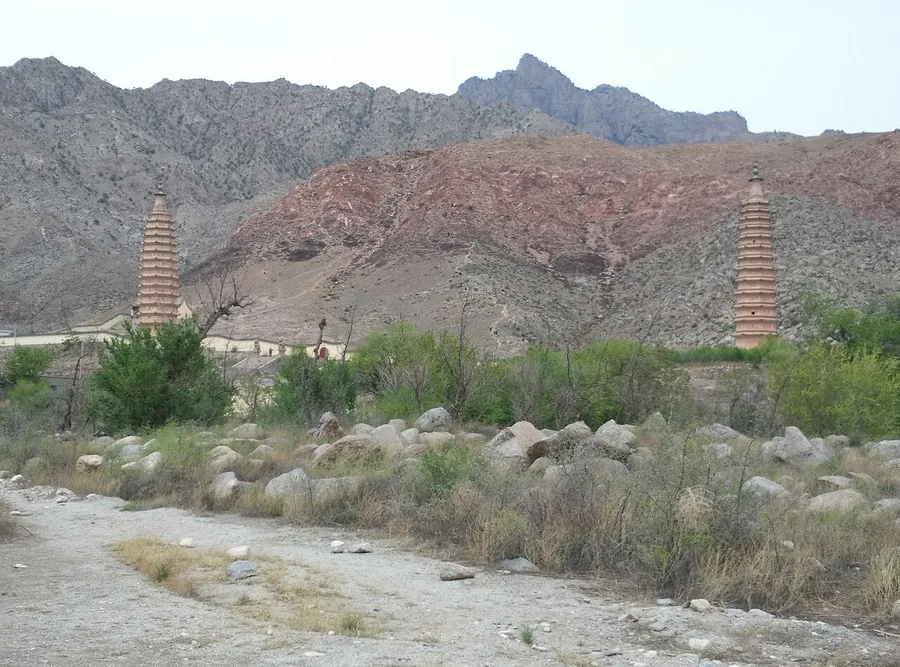
Baisikou Twin Pagodas (拜寺口双塔) occupy a terrace on a Helan Mountain slope, with the two towers about 100 m apart. They are attributed to the Western Xia period, underwent later Yuan and Ming repairs, and were listed as a National Major Historical and Cultural Site Protected at the National Level in 1988. The eastern tower is described as a 13-tier octagonal brick pagoda about 39 m high; the western tower has a slightly different form and silhouette.
The value of Baisikou is comparative: stand back far enough to see the pair, then look for the differences in their taper, tiering and surface decoration. This is protected outdoor architecture, not a tower to climb. The sources read for this county guide do not establish a current ticket, opening schedule, passport policy or a formal visitor entrance, so use the Chinese destination name 拜寺口双塔 and verify access locally before making it the only purpose of a long drive. The pagodas are a separate stop from Helankou rock art even though both sit in the Helan foothills.
Hongfo Pagoda
Hongfo Pagoda (宏佛塔), also called Wangcheng Pagoda (王澄塔), is another distinct monument in Helan County. Its surviving structure is associated with the late Western Xia period, it was extensively repaired in 1990–1992, and it was listed nationally in 2013. Its 28.29 m form combines an octagonal brick lower section with a large finial described in the source as resembling the form of a Tibetan-style stupa, making it useful for understanding the region’s layered Buddhist architecture.
Do not treat Hongfo Pagoda as a third tower at Baisikou. The source describes a former temple site around Hongfo rather than a packaged scenic area, and it does not provide a current visitor timetable or ticketing route. If you want to see it, confirm the exact approach and whether the monument is open to casual visitors before setting out.
Vineyards, wine tourism and working water
Helan’s county profile describes 17 wineries with production, storage and sales functions and highlights Turandot Wine Town (图兰朵葡萄酒小镇) as one of the county’s wine-tourism complexes. A county report describes the Jinshan production area as a concentration of vineyards, cellars, tasting and hospitality, while a Xinhua report records vineyard views, a tasting room and visitor-oriented slow-travel experiences at Turandot Wine Town.
For a visitor, the practical distinction is between a wine region and a guaranteed walk-in attraction. Choose a named winery or complex, then confirm whether a cellar tour, tasting, hotel or meal is available on your date. The county’s saline-alkali aquaculture and rice-fish projects are better understood as working-food landscapes than as a single signature dish; ask what is actually being served and how it was raised instead of assuming that every fish or rice dish is a fixed local recipe.
Getting around Helan County
Helan County has no single tourist entrance and is too spread out for a useful walking itinerary. Treat the western foothill heritage sites and the lower wine-and-farm landscape as different clusters. The county seat is close to Yinchuan, but the mountain stops are much farther out; allow time for the outward journey and arrange the return before entering a rural site.
A local transport guide published on 30 September 2026 lists Tourist Bus Y2 (游2路) from Beimen Bus Station (北门公交车场) at 09:30. Its listed stops include Yinchuan Railway Station East Square (银川火车站东广场), Gunzhongkou (滚钟口), Baisikou Twin Pagodas (拜寺口双塔), Suyukou (苏峪口) and Helan Mountain Rock Art (贺兰山岩画), with a listed 15:00 departure back from the rock-art site. The same guide lists Tourist Bus Y3 (游3路) at 09:20 from Beimen and 14:00 back from the rock-art site, passing Zhenbeibu Western Film Studio (镇北堡西部影城). It also lists a railway-station-east-square shuttle to the rock-art site, with departures during 08:30–11:30 and listed returns during 13:30–17:00 when seats fill.
Those times and routes are useful planning leads, not a substitute for a same-day operator check. If the tourist bus is not running or does not match your plan, use a taxi or ride-hailing car with the exact Chinese destination. For the rock-art area, use 贺兰山岩画景区; the county listing gives the address as the eastern foothills of the Helan Mountain National Nature Reserve at Helankou (贺兰县-贺兰山国家自然保护区东麓贺兰山口). For the pagodas, use 拜寺口双塔, listed in Ningxia Hui Autonomous Region, Yinchuan, Helan County, Baisikou. Do not use “Helan County” as if it were the entrance to either site.
There is no verified metro journey to these rural foothill entrances in the sources used here. Keep the exact Chinese names, venue phone number and a return plan saved offline. For wineries and Hongfo Pagoda, ask the host or driver to confirm the final approach and pickup point before you leave the city.
Access notes for international visitors
The rock-art listing gives adult and student categories but does not state whether a foreign passport can be used in the same booking channel or whether advance reservation is required. Confirm the venue’s current passport, payment and reservation procedure before travel. The sources read for Baisikou, Hongfo Pagoda and the wineries likewise do not establish a uniform foreign-visitor rule. None of these limits changes the county’s identity or the value of its landscape, but they do affect whether a planned stop can be entered on a particular day.
Explore Helan County
Core places to explore, with English and Chinese names.
Places to explore around Helan County
 Baisikou Twin Pagodas viewed from the entrance steps, with the Helan Mountains behind. Photo: BabelStone · CC BY-SA 3.0
Baisikou Twin Pagodas拜寺口双塔
Baisikou Twin Pagodas are a pair of Western Xia-period brick pagodas on a terrace in the Helan Mountains, within Helan County, Yinchuan. Their appeal is comparative: the eastern and western towers share an octagonal, close-eaved form but differ in silhouette and surviving surface detail, while the larger Buddhist setting has largely disappeared.
Read the place guide →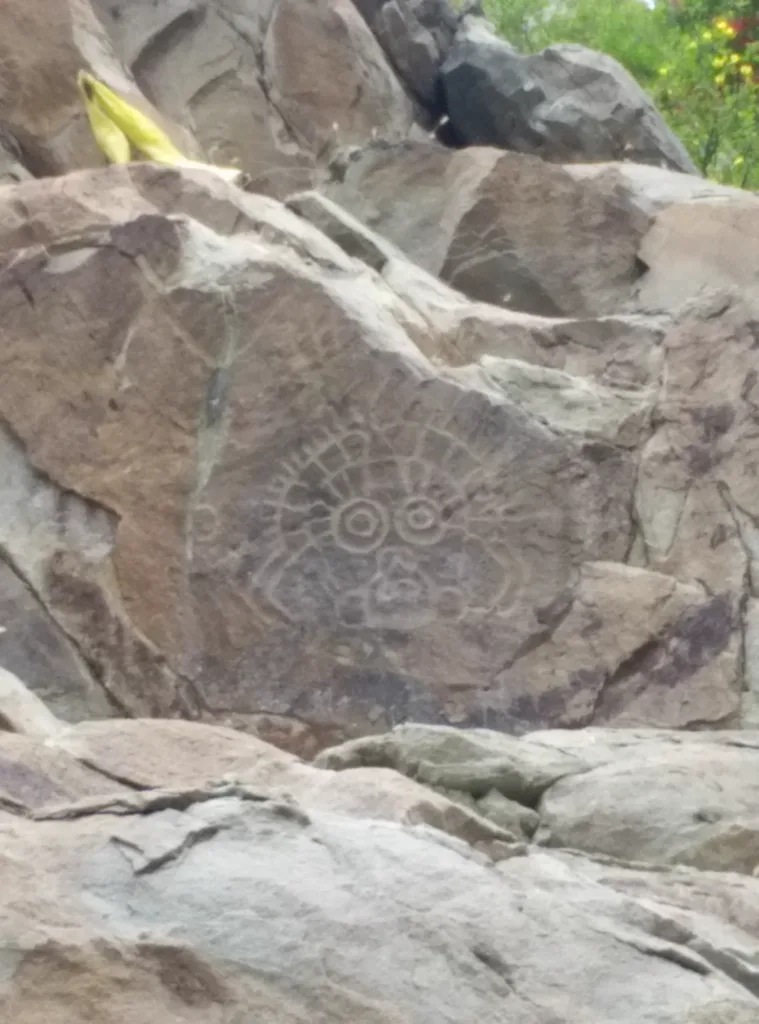 The ‘Sun God’ human-face petroglyph at Helankou in the Helan Mountains, west of Yinchuan. Photo: 霧島聖 (Wikimedia Commons username: 霧島聖) · CC BY-SA 4.0
Helan Mountain rock art贺兰山岩画
At Helankou, west of Yinchuan, a managed archaeological landscape brings visitors close to one of the Helan Mountains’ densest rock-art areas. Look for the famous “Sun God” face, animals, handprints and scenes linked to herding, hunting and ritual life, then use the interpretation spaces to understand why these exposed carvings need careful protection.
Read the place guide →Plan your visit
Getting there
Helan County is about 15 km (straight-line distance) from central Yinchuan. Search for 贺兰县 in a map app to find stations and your accommodation.
Where to stay →Build your route
Baisikou Twin Pagodas and Helan Mountain rock art are about 9 km apart (straight-line distance). The linked place guides have entrance and visit details.
Continue with Yinchuan →More in Yinchuan
Sources & geographic information
Administrative names and parent areas: Official geographic directory (dmfw.mca.gov.cn) · Reference date 2026-09-06.
Background text adapted from Helan County — Wikipedia contributors, under CC BY-SA 4.0. Text has been shortened and reorganized; source revision 1339837257.
Map data © OpenStreetMap contributors. Pins mark approximate centres, not entrances or boundaries.
Image credits & notes (1)
- Twin Pagodas at Baisikou, Helan County · 贺兰县拜寺口双塔Photo: 霧島聖 · CC BY-SA 4.0 · taken 2015-05-02Resized for the web; the photo itself has not been edited.
