


Get to know Lingwu

- Administrative area
- County-level city · 县级市
- Part of
- Yinchuan
- Chinese name
- 灵武市
- Local areas
- County-level city guide
Area & population
- Population · 2010 census
- 261,677
- Administrative seat
- Chengqu Subdistrict
Source: English Wikipedia, as of the dates shown.
Lingwu lies on the east bank of the Yellow River, at the meeting point of the irrigated Yinchuan Plain and the Ordos tableland. It is a county-level city administered by Yinchuan, but the name can mislead: today’s urban seat is not the same site as the ancient Lingzhou. Official local history records repeated moves after flooding and identifies the present Lingwu city as the settlement built in 1428; the county-level city was established in 1996.
That history is easier to understand as a landscape than as a list of dates. The western side is a flat, irrigated agricultural plain; farther east, the ground rises into dry low hills, sand and desert-edge country. Ningdong adds a major industrial zone to the same administrative area. The city government gives the whole jurisdiction as 4,010 square kilometres including Ningdong, so do not plan Lingwu as one compact downtown walk.
An orchard-and-canal side of Lingwu
For a close-to-town view of everyday Lingwu, head to Ancient Jujube Stream Garden (古枣溪园) in Guoyuan Village, Dongta Town. The official tourism page places it about 3 kilometres from Lingwu’s urban area and describes a 300-mu core orchard with 11,996 old jujube trees aged roughly 120–300 years. The garden sits within a wider rural landscape shaped by the Qin Canal (秦渠) and the nearby Zhenhe Pagoda (镇河塔). Walk slowly among the trees and irrigation channels rather than treating the orchard as a single monument; the public page also describes camping, study and other farm-tourism facilities whose opening arrangements should be checked for your date.
The fruit associated with this landscape is Lingwu long jujube (灵武长枣). A recent local report describes a late-September to mid-October harvest window for field-grown fruit and explains the crisp texture through the area’s light, irrigation and day–night temperature range. That is a seasonal tasting cue, not a promise that fresh jujubes will be available on every visit; ask what is in season and how it was grown.
Separate archaeological and fossil outings
Shuidonggou (水洞沟) is in Linhe Town and belongs in a longer outing, not in a downtown walking route. The Lingwu government describes the area as China’s earliest excavated Palaeolithic site, with more than 30,000 stone artefacts and 67 animal fossils from excavations, alongside Ming defensive walls, beacon towers, forts, trenches, yardang landforms and the cliff-cut Cangbing Caves (藏兵洞). The same official page identifies it as a national key cultural relic protection site, national geopark and 5A scenic area. Check the scenic area’s current entrance, tickets, transport and return arrangements separately.
The Ningxia Lingwu Dinosaur Geopark (宁夏灵武恐龙地质公园) is another outlying stop, in Yongli Village, Ningdong Town. Its official tourism description centres on the fossil site, the Lingwu Dinosaur Relics Hall, three excavation pits and eight displayed dinosaur fossil individuals. It is a science-and-family attraction as well as a protected fossil landscape; do not assume that its activities, museum rooms or visitor services operate on the same schedule as Shuidonggou.
Getting there and moving between areas
Lingwu has no verified metro segment in the sources used for this guide. For the city area or the named rural sites, search the exact Chinese destination in Amap or Apple Maps—灵武市 Língwǔ Shì, 古枣溪园 Gǔzǎo Xīyuán, 宁夏水洞沟旅游区 Níngxià Shuǐdònggōu Lǚyóuqū or 宁夏灵武恐龙地质公园 Níngxià Língwǔ Kǒnglóng Dìzhì Gōngyuán—and use a taxi or ride-hailing car for the final leg. A city-region article cannot supply a reliable fixed fare or journey time for every village and attraction.
If you are travelling by rail, a government-published report on the Yinchuan–Zhongwei high-speed corridor lists Lingwu North Railway Station (灵武北站) among the stops. Check the actual date-specific service and ticket on China Railway 12306 before building your day around it. From the station, arrange the last leg to the exact Chinese destination rather than expecting a station-side walk. For the return, check the reverse 灵武北站 → 银川 Língwǔ Běi Zhàn → Yínchuān service before leaving, or pre-arrange a taxi/ride-hailing transfer back to Yinchuan; do not rely on an unverified late connection.
Explore Lingwu
Core places to explore, with English and Chinese names.
Places to explore around Lingwu
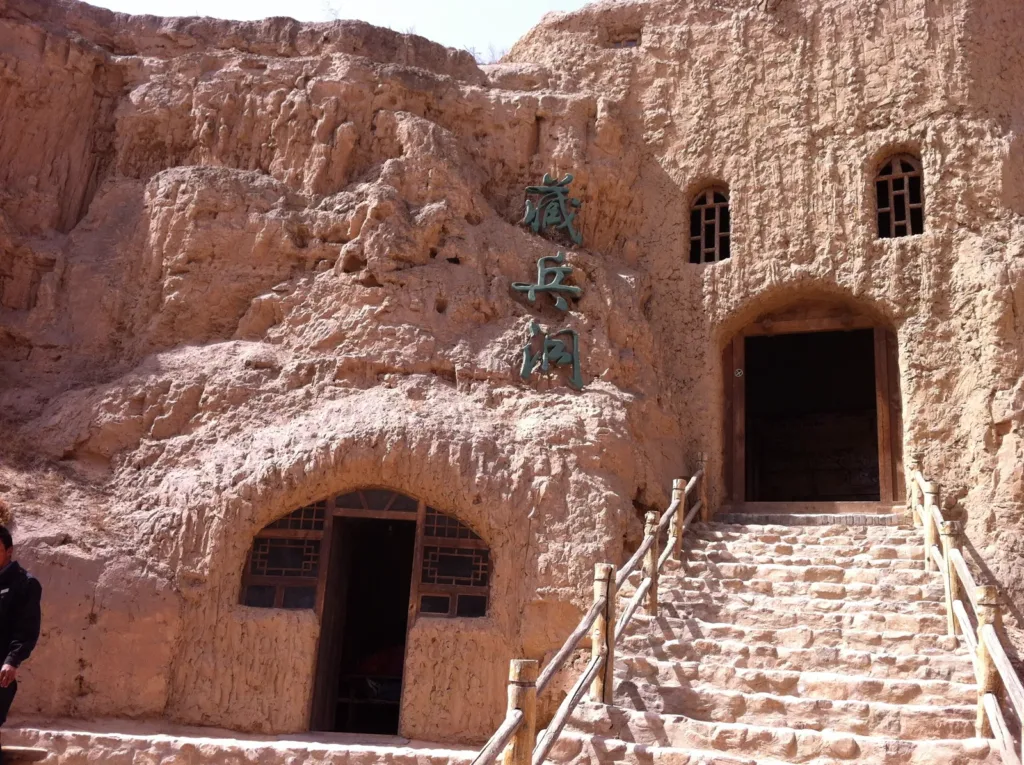 Shuidonggou's troop-hiding cave façade in a loess cliff, with the Chinese sign
Plan your visit
Getting there
Lingwu is about 45 km (straight-line distance) from central Yinchuan. Search for 灵武市 in a map app to find stations and your accommodation.
Where to stay →Build your route
Start with Shuidonggou. The linked place guides have entrance and visit details.
Continue with Yinchuan →More in Yinchuan
Sources & geographic information
Administrative names and parent areas: Official geographic directory (dmfw.mca.gov.cn) · Reference date 2026-09-06.
Background text adapted from Lingwu — Wikipedia contributors, under CC BY-SA 4.0. Text has been shortened and reorganized; source revision 1363650644.
Map data © OpenStreetMap contributors. Pins mark approximate centres, not entrances or boundaries.
Image credits & notes (1)
- A railway bridge over the Qingdao-Yinchuan Expressway in Lingwu, Ningxia. Photograph date recorded by the source: 2024-08-20 15:49:32.Photo: Liuxingy · CC BY-SA 4.0Resized for the web; the photo itself has not been edited. Thumbnails may show a cropped view.
