

Photo adjustments
Converted to WebP and resized without changing the subject or cropping the source frame.
Explore the region
About Guangren Temple
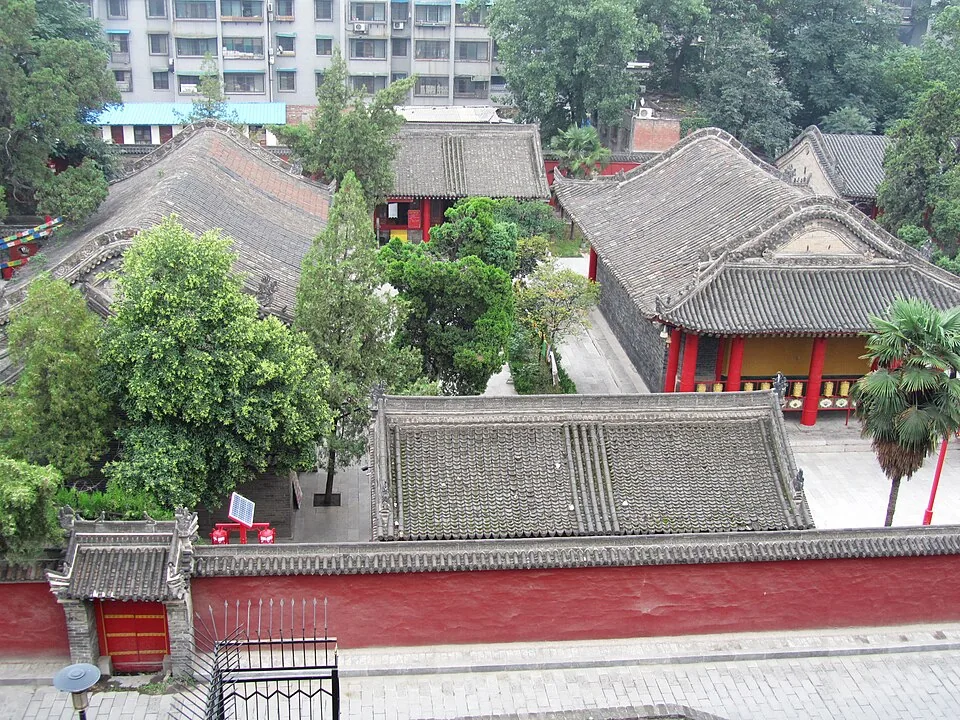
Established under the Kangxi emperor in 1705, it belongs to the Gelug tradition and has a particular association with Green Tara. Its enclosed sequence of halls makes a compact visit: the Green Tara Hall and the Thousand Buddha Hall reward attention to their different devotional images, rather than a hurried circuit of the courtyard.
The temple was built by imperial decree during the Kangxi Emperor's (康熙帝) western inspection tour, with construction beginning in 1703 and completed in 1705. It served as a lodging for lamas and living Buddhas from Tibet, Qinghai and Gansu travelling to Beijing, linking the Qing court with religious leaders of the northwest, Tibet and Mongolia; a stele inscribed in the Kangxi Emperor's own hand survives there. After the Qing fell in 1911 the temple became a local government office, and in 1931 bombing destroyed the abbot's room, which was later rebuilt with Yang Hucheng's support.
The complex is divided into front, middle and east courtyards. The front courtyard's iron flagpoles carry coiled dragons and inscriptions in Mongolian and Chinese. The east courtyard housed the Panchen and Dalai Lamas (班禅、达赖), with rooms for meditation, rest and religious practice, together with accommodation and storage for accompanying lamas. In 1952 the temple was renovated with state funding, and in 1983 the State Council designated it a National Key Buddhist Temple in Han Chinese Areas. It continues to function as a Tibetan Buddhist place of worship.
What to look for
- Green Tara Hall, the temple’s principal devotional focus.
- Thousand Buddha Hall and the many Buddhist images surrounding its central shrine.
Location & getting there
Getting to Guangren Temple
Go to 152 Xibei First Road in Lianhu District, inside the northwest corner of the city wall.
- Yuxiangmen is a useful metro approach; continue to the temple’s Xibei First Road entrance.
Combine your visit
Suggested order within this visit:
-
Green Tara Hall
Begin with the shrine central to Guangren’s Tibetan Buddhist identity.
-
Thousand Buddha Hall
Continue along the temple axis to compare the arrangement of images.
This sequence is an editorial suggestion based on the features described in the sources. Access to individual buildings or areas should be checked locally; no travel time or shared admission is implied.
Find Guangren Temple
广仁寺 · 莲湖区
The pin marks the area, not the entrance.
More places nearby
Approximate straight-line distances between map pins, not travel distances.
Lianhu Park 莲湖公园
1 km awayLianhu Park preserves a pocket of water and garden space within Xi’an’s old city. Its lotus pond traces a long history of cultivation and later public-park use, giving the surrounding district its name. Today, winding bridges…
View guide →Eighth Route Army Xi’an Office Memorial 八路军西安办事处纪念馆
2 km awayThe Eighth Route Army’s Xi’an office occupied the western courtyard of Qixianzhuang, a compact residential compound near Beixin Street. From 1937 to 1946 it served as a liaison and supply base connecting Communist forces with…
View guide →Muslim Quarter 回民街
2 km awayXi’an’s Hui neighbourhood is a network of residential and commercial lanes northwest of the Bell Tower, rather than a single food street. Beiyuanmen is its best-known visitor approach, with other streets such as Xiyangshi and…
View guide →Sources & visit information
The sources below support the place-specific description and arrival information. Suggested combinations are editorial planning ideas; confirm current opening, entry arrangements and transport services for your date.
- Wikivoyage: Xi'an ↗
- Shaanxi Buddhist Association: Guangren Temple ↗
- Beijing Labor Daily: visit to Guangren Temple ↗
- Chinese Wikipedia: 广仁寺 (revision 94116074, 2026-08-31) ↗
- English Wikipedia: Guangren Temple (revision 1372300266, 2026-08-31) ↗
Visitor information adapted and edited from Wikivoyage contributors · CC BY-SA 4.0. Source revision 5329865.
Background paragraphs translated and condensed from Wikipedia contributors, "广仁寺", Chinese Wikipedia · CC BY-SA 4.0. Source revision 94116074.
Background paragraphs condensed from Wikipedia contributors, "Guangren Temple", English Wikipedia · CC BY-SA 4.0. Source revision 1372300266.