

Explore the region
Tap any red Chinese text to hear it in Mandarin.
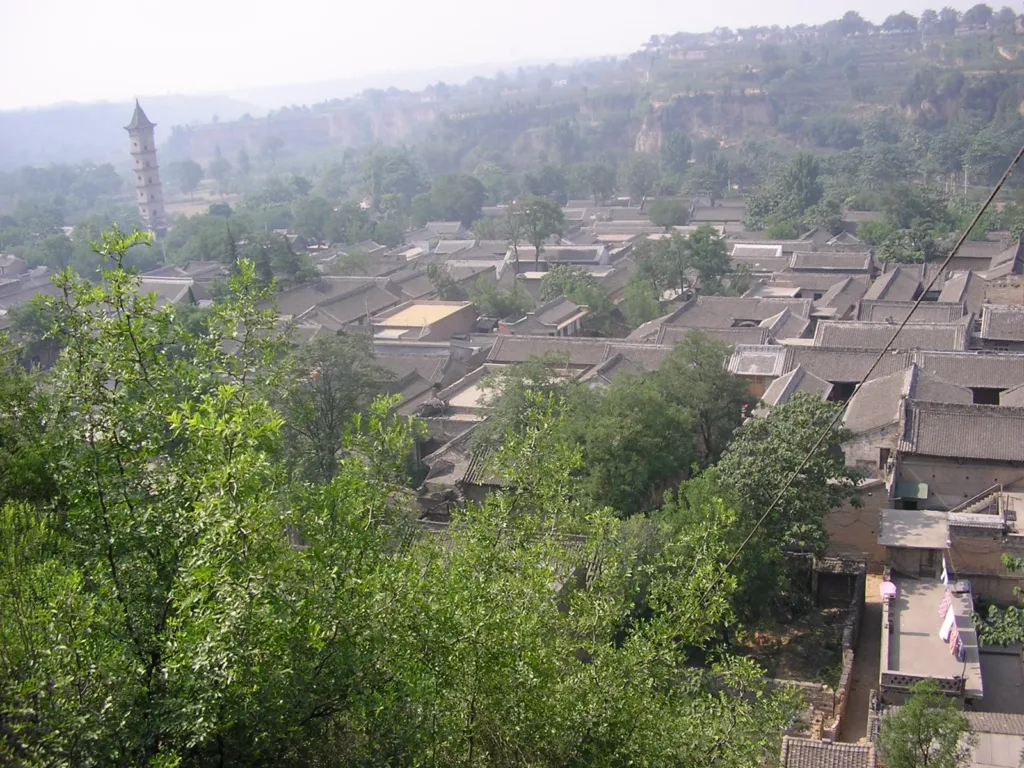
Dangjia Village is a residential historic settlement in Xizhuang Town, Hancheng, in Weinan, Shaanxi. It was founded in 1331 and grew through the Ming and Qing periods around households of the Dang and Jia surnames. Its importance is not a single restored house: the village still reads as a connected settlement of courtyard homes, lanes, ancestral spaces and defensive structures. It was listed as a national key cultural relic protection unit in 2001 and as a Chinese Historical and Cultural Village in 2003.
The visit is rewarding when you slow down. More than a hundred surviving courtyard houses sit along stone- and cobble-paved lanes, while the wider village includes ancestral halls, watchtowers, the Wenxing Pavilion and the Biyang Fort. The arrangement is part of the exhibit: a lane narrows into a gateway, a gateway frames an enclosed courtyard, and the thick grey-brick walls reveal only a controlled view of domestic space.
Read the village on foot
Start at the designated visitor arrival point or visitor centre and orient yourself before entering the old lanes. Look first at the street-facing gateways: door platforms, stone door bases, brick and wood carving, and the short inscriptions above the doors. In the courtyards that are explicitly open to visitors, compare the hall, side rooms and entrance building as a working domestic plan rather than as isolated decorative rooms. The hall traditionally carried the most public and ancestral role, while the side rooms and entrance rooms served everyday living.
Then look for family instructions carved into brick near the courtyard walls and doorways. Their position matters: the words were placed where residents and visitors would repeatedly encounter them, turning architecture into a reminder of conduct. Read the calligraphy, the brick surface and the threshold together, and do not treat a photographed slogan as a complete explanation of the family that lived there. The surviving family-instruction tradition is one of Dangjia Village’s clearest links between building craft, education and everyday ethics.
Keep an eye on the village’s defensive vocabulary as you walk. The watchtowers, walls and Biyang Fort make the settlement more than a collection of handsome courtyards; they show how residence, lineage and protection were planned together. The six-sided Wenxing Pavilion in the southeast is another useful orientation point where visible. Some buildings and courtyards may be closed or privately occupied. Ask before entering, do not photograph residents or domestic interiors without permission, and keep to marked visitor areas.
Getting there and getting back
Use the full Chinese destination in a map app: 党家村景区 Dǎngjiā Cūn Jǐngqū or 党家村游客中心 Dǎngjiā Cūn Yóukè Zhōngxīn, Xizhuang Town, Hancheng, Shaanxi. Make Hancheng your transport base rather than treating Dangjia Village as a station-area attraction. One published English travel reference describes reaching Hancheng from Xi’an by bus via Xi’an Fangzhicheng Bus Station or Xi’an Bus Station, or by train from Xi’an Railway Station, then taking a taxi or local car directly to the village. Its fare and schedule information is not a current operator timetable.
A travel listing updated in January 2026 describes a possible local sequence from 韩城客运中心 Hánchéng Kèyùn Zhōngxīn on the 韩城—西庄 Hánchéng — Xīzhuāng rural bus to Xizhuang Town, followed by a 西庄—党家村 Xīzhuāng — Dǎngjiā Cūn minibus to the visitor centre. This is a useful lead for checking locally, not a verified fixed schedule: confirm the actual boarding point, last departure and whether the second leg is running on your date.
The dependable final leg is a taxi or ride-hailing car to 党家村游客中心 Dǎngjiā Cūn Yóukè Zhōngxīn. Arrange the return before walking into the village, or ask at the visitor centre for the last available local vehicle; a current fixed return timetable and fare could not be independently verified. There is no applicable metro station at the village, and no metro exit or travel time is claimed here.
Opening information to check
A travel reference last updated on 22 July 2026 lists 08:00–18:00 opening with entry stopping at 17:30 and a CNY 50 admission fee. These details are not confirmed here by a current official operator page, so check the day’s opening, ticket purchase, reservation and any passport-related procedure before setting out.
Combine your visit
Suggested order within this visit:
-
Village lane entrance
Orient yourself to the valley settlement before entering the narrow streets.
-
Open courtyard-house group
Study the transition from gateway to enclosed domestic space.
-
Stone-paved residential lanes
Finish by comparing the house frontages and street pattern.
This sequence is an editorial suggestion based on the features described in the sources. Access to individual buildings or areas should be checked locally; no travel time or shared admission is implied.
Find Dangjia Village
党家村 · 渭南
The pin marks the area, not the entrance.
More places nearby
Approximate straight-line distances between map pins, not travel distances.
Hancheng 韩城
8 km awayHancheng’s old city brings its history into a compact network of streets, courtyard houses and temples on the Yellow River’s western side. The strongest starting point is the three-temple group in the eastern old town, where the…
View guide →Hukou Waterfalls 壶口瀑布
67 km awayAt Hukou, the broad Yellow River is squeezed into a rocky gorge, producing the waterfall’s kettle-spout shape. This page concerns the Shaanxi bank in Yichuan County, facing the separate Shanxi-side attraction across the river…
View guide →Tong Pass 潼关
104 km awayTong Pass guarded the eastern approach to Guanzhong where the Yellow River, Wei River and mountain terrain constrained travel. Much of the old fortified town was dismantled during the Sanmenxia reservoir works, so the present…
View guide →Sources & visit information
Sources checked on 2 November 2026. Hours, tickets, reservations and transport can change; confirm with the operator before you go.
Image credits & notes (1)
- A high view over Dangjia Village’s dense grey-tiled courtyard roofs and lanes, with the surrounding loess landscape beyond. Photo: Cshcts (User Cshcts on zh.wikipedia)Photo: CC BY-SA 3.0