

Explore the region
Tap any red Chinese text to hear it in Mandarin.
Tong Pass is best understood as a landscape of military geography rather than a perfectly preserved walled town. It stands on the south bank of the Yellow River, just below the Wei River confluence, where a narrow passage links the Guanzhong basin with the plains to the east. The pass’s appeal is the way water, escarpment and road corridor explain its history at a glance: from an elevated part of the visitor area, look across the river country and then read the exhibits before walking through the newer defensive-themed precinct.
The old town did not survive as an intact historic city. The county seat was moved south after the Sanmenxia reservoir project, and the old fortified town was dismantled during that period. Today’s Tongguan Ancient City visitor area therefore mixes surviving historical context, modern reconstruction and interpretation. Treat its towers, streets and defensive displays as a way to understand the former pass, not as an untouched Ming–Qing fortress.
What to see
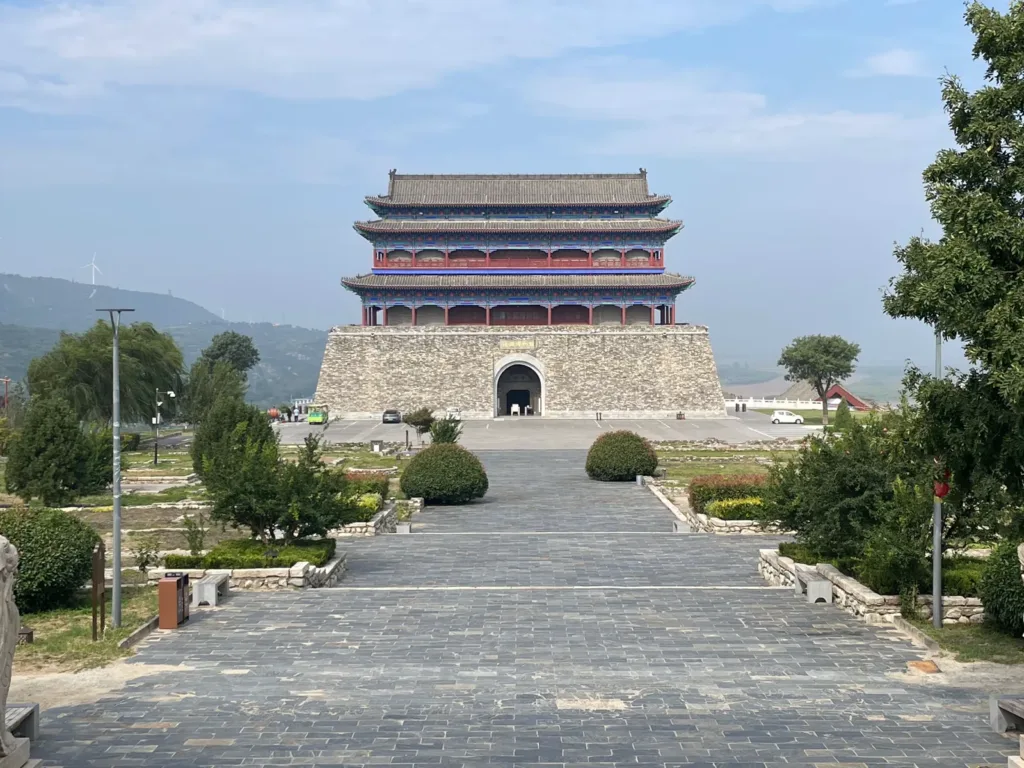
Start at Tongguan Museum (潼关博物馆) inside the east-hill section of the ancient-city precinct. Its building recalls the historic Shanhe Yilan Tower, and the public guide describes viewing platforms on the third and fourth floors. Use the high vantage point to connect the museum’s maps and displays with the Yellow River, the Wei River and the surrounding defensive corridor. The exhibition is arranged around local history, pass culture, water transport and folk life, so it gives the modern visitor a more useful orientation than a quick photo stop at a reconstructed gate.
Continue through the visitor precinct slowly. Look for the difference between a building that is a modern interpretation and a fragment with a documented historical setting. The most rewarding observation here is not a checklist of reconstructed façades, but the relationship between the pass and its terrain: the river to the north, the Qinling side to the south, and the constrained route through which armies, officials and goods once moved. Historical accounts describe Tong Pass as a key eastern gateway into the Wei River valley; the later town’s position on the Longhai railway also shows how the corridor remained a communications route after its main defensive role faded.
Allow extra time for the museum and for the elevated river view rather than assuming that the whole precinct is a compact surviving old town. If weather, road conditions or local programming changes access, follow the day’s notices. A July 2026 reopening notice confirms that the scenic area resumed full operation after a rain-related closure, but that dated announcement is not a permanent timetable.
Entry and practical access
Search for 潼关古城景区 Tóngguān Gǔchéng Jǐngqū or 潼关博物馆 Tóngguān Bówùguǎn, not just “Tongguan County.” The museum guide places the museum inside 潼关县港口镇 G30 潼关古城 and lists free entry, Tuesday–Sunday 09:00–16:00, with Monday closed. Because that guide was published earlier and the broader scenic-area schedule is not consistently exposed on the public pages I could read, confirm the museum, galleries and current entry arrangement for your date before setting out.
For public transport, one published local guide gives this workable pattern: take an intercity coach from 渭南汽车站 Wèinán Qìchē Zhàn to 潼关县 Tóngguān Xiàn, then take a taxi to the museum/ancient-city precinct. The same page does not provide a current coach timetable, so check the departure station on the day. Rail travellers can use 潼关站 (Tongguan Railway Station) as the county-side arrival point and then take a taxi or ride-hail to the exact Chinese destination above; the pass is not a station-front attraction. Check 12306 for a date-specific train and reserve a return connection before visiting.
Show the driver the Chinese name “潼关古城景区(潼关县港口镇G30潼关古城)” or 潼关博物馆 Tóngguān Bówùguǎn. Current direct bus routes from 潼关站 to the scenic area were not confirmed consistently in the sources read, so do not rely on an unverified route number. Arrange the return ride back to 潼关站, 潼关县客运站 or your onward accommodation before leaving the precinct; no reliable return timetable should be inferred from a general map pin.
Combine your visit
Suggested order within this visit:
-
Old-city visitor precinct
Understand which buildings are modern interpretations.
-
River-confluence viewpoint
See the geography that made the pass strategically important.
-
Defensive-landscape view
Read the narrow corridor between river and mountain.
This sequence is an editorial suggestion based on the features described in the sources. Access to individual buildings or areas should be checked locally; no travel time or shared admission is implied.
Find Tong Pass
潼关 · 渭南
The pin marks the area, not the entrance.
More places nearby
Approximate straight-line distances between map pins, not travel distances.
Huashan 华山
23 km awayHuashan’s granite peaks rise abruptly above Huayin, with narrow ridges linking a group of five named summits. West Peak has the lotus-like rock form, South Peak is the highest, and East Peak is known for its sunrise outlook. The…
View guide →Shuilu Temple 水陆庵
96 km awayShuilu Temple in Lantian preserves an extraordinary interior of colored clay sculpture within a compact east-facing courtyard. Its main hall contains thousands of figures arranged across walls and partitions: large Buddhas are…
View guide →Terracotta Army 秦始皇兵马俑
96 km awayThe Terracotta Army is an excavated part of Qin Shi Huang’s burial complex, where life-size soldiers, horses and chariots were arranged in underground military formations. The roofed pits show both reconstructed figures and the…
View guide →Sources & visit information
Sources checked on 2 November 2026. Hours, tickets, reservations and transport can change; confirm with the operator before you go.
Image credits & notes (1)
- Tongguan Museum, a pass-style building in the Tongguan Ancient City precinct, seen from the landscaped approach. Photo: MNXANLPhoto: CC BY-SA 4.0