

Explore the region
Tap any red Chinese text to hear it in Mandarin.
A city read through temples, lanes and the river
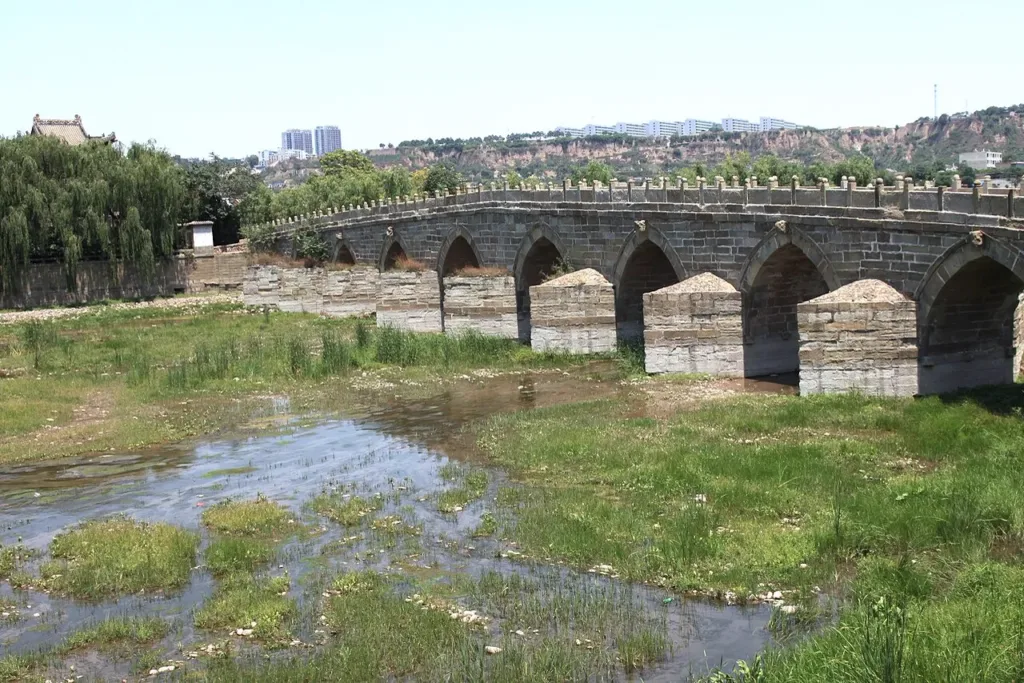
Hancheng is a county-level city administered by Weinan, on the western side of the Yellow River where the river corridor meets the Guanzhong Plain. Its identity is unusually concentrated: stories of Yu the Great and Longmen sit beside the home landscape of Sima Qian, while the old city keeps historic streets, courtyard houses and religious buildings close to everyday urban life. Hancheng was designated a National Historic and Cultural City in 1986.
The best first experience is not to rush between distant attractions. Begin in the eastern part of Hancheng Old City at the museum complex formed by the Confucian Temple, Dongying Temple and City God Temple. The three buildings let you compare different kinds of public life: education and ritual at the Confucian Temple, military devotion at Dongying Temple, and civic protection at the City God Temple. The local tourism material describes the complex as a large historic group with buildings from several periods, including national-level protected Confucian and City God temples and the provincially protected Dongying Temple.
What to notice on foot
In the Confucian Temple, slow down in the successive ceremonial courtyards. Look for the ordered axis, glazed decoration, carved and painted details, and the old trees that soften the formal layout. At Dongying Temple, notice the smaller, more restrained scale and the connection between a former eastern military camp and worship of Guan Yu. The City God Temple is a useful contrast: its larger courtyards and rich glazed roofs express a community’s hopes for protection and order. These are observations for a respectful visit, not an invitation to treat active religious spaces as a stage.
After the temple complex, continue into the surrounding lanes instead of returning immediately to a vehicle. Hancheng’s main north–south street and its side lanes still combine old shopfronts, courtyard-house façades and ordinary local activity. The point is to read how a protected town works as a neighbourhood: doorways, walls, rooflines and small businesses matter as much as a single photograph. The central old-city walk should remain separate from excursions to Dangjia Village north of town and the Shrine and Tomb of Sima Qian to the south; those are different destinations, not stops that can be assumed to lie along this temple circuit.
Hancheng also makes more sense when you keep the Yellow River in mind. Longmen, on the city’s northern side, is tied to local stories of Yu the Great and the “carp leaping over the Dragon Gate”; the river gorge and the old crossings explain why this area has long been a corridor between Shaanxi and Shanxi. Treat the legend as part of the landscape’s cultural language, while letting the old streets and buildings supply the physical evidence you can actually inspect.
Getting in and getting back
For a rail arrival, search for 韩城站 (Hancheng Railway Station), not for a generic “Hancheng” map pin. The station is a passenger station on the Houyan Railway in Xincheng Subdistrict, on Puzhao Road. From the station, take a taxi or ride-hailing car to 韩城市博物馆(三庙) or 韩城古城东部 Hánchéng Gǔchéng Dōngbù. The checked sources identify the station and the museum’s eastern-old-city setting, but do not provide a current, reliable city-bus route to a confirmed temple entrance, so no bus number or travel time is given here.
Before leaving the museum complex, arrange the return pickup in the old city and confirm the departure time for 韩城站 Hánchéng Zhàn in 12306 or with the railway operator. Reverse the taxi or ride-hailing journey rather than assuming that a historic-lane entrance is the same as the station-side drop-off. There is no relevant metro station for this visit. Individual buildings, exhibitions, opening hours, tickets and any reservation requirement should be checked for your date; a historic complex or map result does not guarantee that every hall is accessible.
Hancheng is rewarding when treated as a place to observe rather than a checklist. Give the eastern temple complex enough time for comparison, then let the lanes show how the monuments sit inside a real city. Plan Dangjia Village and Sima Qian’s shrine as separate outings if you add them, and keep their transport and return arrangements independent.
Combine your visit
Suggested order within this visit:
-
Confucian Temple
Begin with the old city’s educational and ceremonial centre.
-
Dongying Temple
Compare the military temple with the first courtyards.
-
City God Temple
Complete the connected temple group before exploring nearby lanes.
This sequence is an editorial suggestion based on the features described in the sources. Access to individual buildings or areas should be checked locally; no travel time or shared admission is implied.
Find Hancheng
韩城 · 渭南
The pin marks the area, not the entrance.
More places nearby
Approximate straight-line distances between map pins, not travel distances.
Dangjia Village 党家村
8 km awayDangjia Village preserves a concentrated group of Ming and Qing courtyard houses in a valley northwest of Hancheng. Stone-paved lanes weave between the enclosed homes, making the relationship between street, doorway and inner…
View guide →Hukou Waterfalls 壶口瀑布
74 km awayAt Hukou, the broad Yellow River is squeezed into a rocky gorge, producing the waterfall’s kettle-spout shape. This page concerns the Shaanxi bank in Yichuan County, facing the separate Shanxi-side attraction across the river…
View guide →Tong Pass 潼关
97 km awayTong Pass guarded the eastern approach to Guanzhong where the Yellow River, Wei River and mountain terrain constrained travel. Much of the old fortified town was dismantled during the Sanmenxia reservoir works, so the present…
View guide →Sources & visit information
Sources checked on 2 November 2026. Hours, tickets, reservations and transport can change; confirm with the operator before you go.
Image credits & notes (1)
- View from Hancheng's old bridge toward the old city in the foreground and the modern city on the ridge, Shaanxi. Photo: ChlukoePhoto: CC0 1.0