

Photo adjustments
Converted to WebP and resized without changing the subject or cropping the source frame.
Explore the region
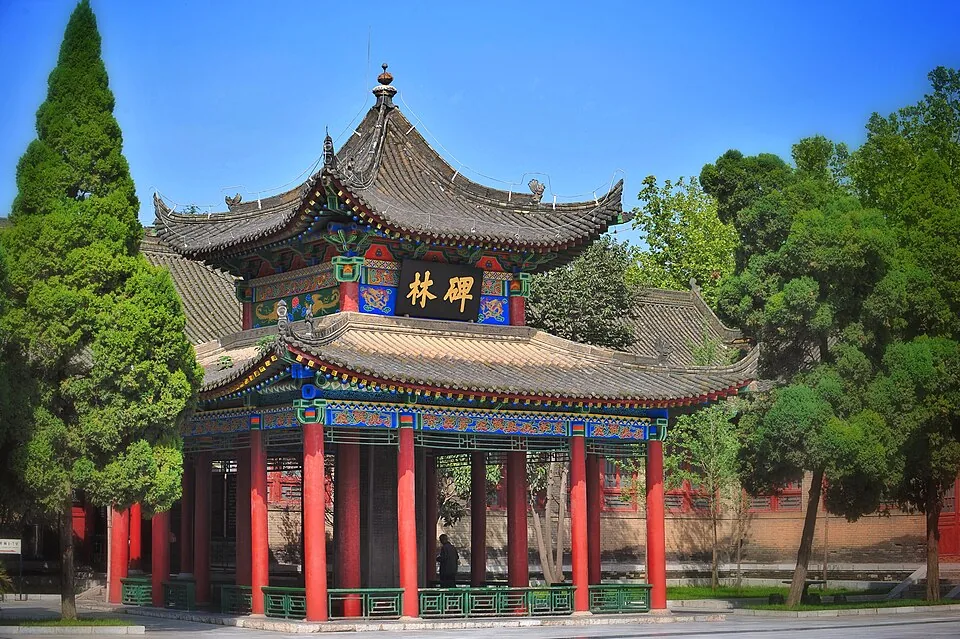
About Stele Forest
The Kaicheng Stone Classics turn canonical books into carved monuments, while later steles reveal the development of Chinese calligraphy. Religious inscriptions and sculpture broaden the story beyond Confucian learning. The museum’s expanded display includes celebrated objects such as the Jingyun Bell and the surviving Zhaoling horse reliefs; use the current gallery plan instead of older room-number descriptions.
The museum's collection developed around Tang-dynasty stone texts, chiefly the Kaicheng Stone Classics, twelve Confucian classics commissioned under Emperor Wenzong of Tang and engraved between 833 and 837 on 114 stones carrying more than 650,000 characters, first erected at the Imperial College in Chang'an. After the fall of the Tang the stones were moved several times within the reduced city, and their installation at the prefectural school in 1087 is generally treated as the foundation of the present Stele Forest. The site remained a Confucian temple and school through the imperial period, and most of its surviving buildings date from the Ming and Qing dynasties.
The museum holds nearly 3,000 steles and a large collection of carved stone. Calligraphic works include the Eastern Han Cao Quan Stele, a Song recarving of the Qin Mount Yi Stele that transmits a version of the small-seal script attributed to Li Si, and Tang works associated with Ouyang Xun, Yan Zhenqing, Huaisu and Liu Gongquan, including Yan Zhenqing's original Yan Family Temple Stele. Also in the collection is the Xi'an Stele, erected in 781 with Chinese and Syriac text recording the Church of the East in Tang China; it was transferred to the museum in 1907 after a Danish visitor sought to remove it abroad.
What to look for
- The Kaicheng Stone Classics and major calligraphic steles, showing text preserved in stone.
- Religious inscriptions, including the eighth-century record of Christianity in Tang China.
- Stone sculpture and the museum’s Jingyun Bell collection.
Location & getting there
Getting to Stele Forest
Go to Beilin Museum at 15 Sanxue Street, just inside the southern city wall near Wenchang Gate.
- Use the current entrance and gallery map for the expanded museum; older guidebooks describe a previous display layout.
Combine your visit
Suggested order within this visit:
-
Historic temple and stone classics
Begin with the collection’s Confucian origins.
-
Calligraphy and religious inscriptions
Compare the uses and forms of carved writing.
-
Sculpture and expanded collection galleries
Finish with the broader stone and bronze collection.
This sequence is an editorial suggestion based on the features described in the sources. Access to individual buildings or areas should be checked locally; no travel time or shared admission is implied.
Find Stele Forest
碑林博物馆 · 碑林区
The pin marks the area, not the entrance.
More places nearby
Approximate straight-line distances between map pins, not travel distances.
Wolong Temple 卧龙禅寺
Less than 1 km awayWolong Temple is an active Chan Buddhist monastery in Xi’an’s Baishulin neighborhood. Its name recalls a monk known as the ‘reclining dragon,’ but the material interest lies in the temple courts and inscribed stone monuments…
View guide →Shuyuanmen Cultural Street 书院门
Less than 1 km awayShuyuanmen is an art-supplies and calligraphy street just inside Xi’an’s South Gate. Its name comes from Guanzhong Academy, established here in the Ming period. Today’s shopfronts largely reflect a modern rebuilding in…
View guide →Xi'an City Wall 西安城墙
Less than 1 km awayXi’an’s city wall encloses the later imperial city in a near-rectangular circuit. Its main fabric dates from the Ming period, built partly on earlier city foundations. The interest is in the whole defensive system: projecting…
View guide →Sources & visit information
The sources below support the place-specific description and arrival information. Suggested combinations are editorial planning ideas; confirm current opening, entry arrangements and transport services for your date.
- Wikipedia: Stele Forest ↗
- Wikivoyage: Xi'an ↗
- Beilin Museum: current exhibitions and collection ↗
- Beilin Museum: collection highlights ↗
Visitor information adapted and edited from Wikipedia contributors · CC BY-SA 4.0. Source revision 1371786628.
Visitor information adapted and edited from Wikivoyage contributors · CC BY-SA 4.0. Source revision 5329865.
Background paragraphs condensed from Wikipedia contributors, "Stele Forest", English Wikipedia · CC BY-SA 4.0. Source revision 1371786628.