

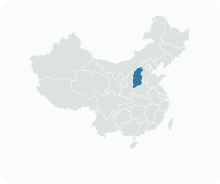
Get to know Xiaoyi

- Administrative area
- County-level city · 县级市
- Part of
- Lüliang
- Chinese name
- 孝义市
- Local areas
- County-level city guide
Area & population
- Area in the source
- 946.00 km²
- Population · 2017
- 492,000
Source: cited geographic source, as of the dates shown.
History
Chinese Wikipedia counts Xiaoyi among the first places in Shanxi to have a county: the Zuo Zhuan (左传) records Duke Jing of Jin granting the 'county of Guayan' (瓜衍) to his minister Shi Bo (士伯), which dates a county here to 594 BC. The Northern Wei split off Yong'an County (永安县) in 493, with its seat at the site of Xiaoyi's old town. In 627 Emperor Taizong of Tang changed the name to Xiaoyi, 'filial and righteous', because another Yong'an already existed in what is now Fengjie (奉节) in Chongqing; the new name honoured a local man, Zheng Xing (郑兴), known at court for cutting flesh from his thigh to feed a parent. Xiaoyi was merged into Jiexiu (介休) in 1958, restored in 1961 and became a city in 1992.
What to see
Zhongyang Tower (中阳楼) stands on Gucheng Street (古城大街) in Zhongyanglou subdistrict. A tower on the site goes back to the Han and Wei periods and was rebuilt many times; the present wooden building dates from 1909. It is square, four storeys high under a cross-shaped hip-and-gable roof, and rises 23.14 metres in all. It became a national key protected site in 2006. The city's other national protected sites are the Sanhuang Temple (三皇庙), Tianqi Temple (天齐庙) and Cisheng Temple (慈胜寺).
Shadow play, puppets and film
Xiaoyi wanwanqiang shadow play (孝义碗碗腔皮影戏) and the wanwanqiang (碗碗腔) singing style were both on the first national intangible-heritage list in 2006. Local shadow play has two vocal styles: piqiang (皮腔), sung behind paper-window screens and accompanied mainly by the suona, and wanwanqiang, sung behind gauze screens and named after a bowl-shaped bronze bell in the band, with singing that mixes natural and falsetto voice. Xiaoyi rod puppetry (孝义木偶戏), listed in 2008, reached the area in the Song. Puppet troupes later joined shadow troupes as 'lamp-shadow troupes' (灯影班) that played puppets by day and shadows by night.
The 2006 film Walking on the Wild Side (赖小子), directed by Han Jie (韩杰) and set in Xiaoyi, won the Tiger Award at the Rotterdam film festival.
Highlights
- Zhongyang Tower 中阳楼: Four-storey wooden tower of 1909 in the old town, 23.14 metres high; national protected site since 2006.
- Xiaoyi wanwanqiang shadow play 孝义碗碗腔皮影戏: Shadow theatre on the first national intangible-heritage list, 2006.
- Xiaoyi rod puppetry 孝义木偶戏: Rod-puppet theatre introduced in the Song; national intangible heritage since 2008.
Sources for this guide
孝义市 - 维基百科,自由的百科全书 · Chinese Wikipedia · CC BY-SA 4.0
中阳楼 - 维基百科,自由的百科全书 · Chinese Wikipedia · CC BY-SA 4.0
皮影戏(孝义皮影戏) · China Intangible Cultural Heritage Network (ihchina.cn)
碗碗腔(孝义碗碗腔) · China Intangible Cultural Heritage Network (ihchina.cn)
木偶戏(孝义木偶戏) · China Intangible Cultural Heritage Network (ihchina.cn)
Original English written from the listed sources and checked sentence by sentence against quoted extracts by a separate reviewer. Updated 2026-09-26.
Explore Xiaoyi
Core places to explore, with English and Chinese names.
Plan your visit
Getting there
Xiaoyi is about 165 km in a straight line from central Lüliang. Search for 孝义市 in a map app to find stations and your accommodation.
Where to stay →More in Lüliang
Sources & geographic information
Administrative names and parent areas: Official geographic directory · Reference date 2026-09-06.
Some facts checked against 孝义市 — Wikipedia contributors, CC BY-SA 4.0.
Some facts checked against 中阳楼 — Wikipedia contributors, CC BY-SA 4.0.
Map data © OpenStreetMap contributors. Pins mark approximate centres, not entrances or boundaries.