

Explore the region
Tap any red Chinese text to hear it in Mandarin.
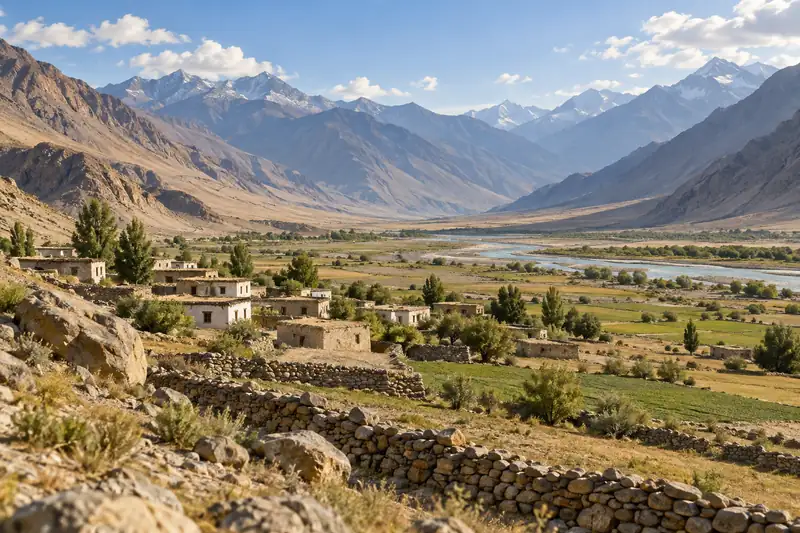
Ganbao sits in eastern Lixian, about 8 km from the county seat and beside National Highway 317. Its name is a Chinese rendering of the Jiarong Tibetan Gongpu, explained by the Sichuan local-history office as “village on the slope”. The setting is unusually legible: a dense stone settlement rises on the hillside while the Zagunao River runs through the wider valley.
The village is not an untouched museum piece. The 2008 Wenchuan earthquake destroyed it, and a Hunan–Lixian reconstruction project rebuilt homes and landscape while trying to retain the settlement’s cultural character. The Ministry of Culture’s contemporary account describes the work as a combination of repairing heritage, rebuilding homes, restoring the village landscape and improving visitor functions. Read the present village as a living, reconstructed settlement rather than assuming every wall or house is original.
What makes it distinctive
Ganbao’s visual identity comes from stonework and slope. Sources describe houses built from stone, with local building skill visible in straight, tightly laid walls and interconnected lanes. Older descriptions of the traditional houses place storage or livestock areas on the lower level, living space above, and a shrine or scripture room toward the upper part of the house; these details describe the architectural tradition, not a promise that every interior is open to visitors.
Its history is also unusually concrete. In 1752 the Qing administration replaced the Zagu chieftaincy with the “five garrisons and four chieftaincies” system, and Ganbao became one of the five garrisons. The Gou and Sang families held garrison posts, and the Sang family’s office is part of the village’s remembered heritage. Look for the way the settlement’s military past is explained in public displays or markers, but do not enter a closed building or assume that a historic house is a museum.
Ganbao is closely associated with Boba Sengen, a narrative guozhuang dance that local accounts connect with the garrison soldiers’ later fighting in Ningbo during the First Opium War. It is listed in the sources as a national-level item of intangible cultural heritage. A 2023 report saw it performed in the village square during a local media visit; that is evidence of a real cultural practice, not a daily show timetable.
How to visit
Walk slowly through the public lanes and around the village square. Notice how the stone walls, rooflines, slope and valley fit together rather than treating the settlement as a single photo stop. The village is home to residents: ask before entering a courtyard or house, ask permission before photographing people, and do not turn a dance, prayer object or household activity into a staged performance. Keep to paths that are open to visitors and follow local instructions around any protected building.
The confirmed approach is by road. Public descriptions place Ganbao beside National Highway 317 and about 8 km from Lixian county town. Search for 甘堡藏寨 Gānbǎo Zàngzhài in Amap or Apple Maps, and keep the Chinese name ready for a driver. No current official source I could read confirms a fixed local-bus number, a named visitor gate, an admission charge, a parking tariff or a regular Boba Sengen performance schedule. Confirm those details locally before setting out, and arrange your return from the village rather than assuming late rural transport will be available.
Find Ganbao Tibetan Village
甘堡藏寨 · 理县
The pin marks the area, not the entrance.
Sources & visit information
Sources checked on 24 October 2026. Hours, tickets, reservations and transport can change; confirm with the operator before you go.