

Explore the region
Tap any red Chinese text to hear it in Mandarin.
Why this place is different
“Langmusi” is not the name of one monastery. It is the name used for a small settlement straddling the Sichuan–Gansu border. The Bailong River, described by the Ruo’ergai county government as less than two metres wide at the settlement, separates the Gansu bank from the Sichuan bank. Gerdi Temple is on the south bank in Hongxing Township, Ruo’ergai County; Saichi Monastery is the separate Tibetan Buddhist monastery on the north bank in Gansu. A mosque and Muslim communities are also part of the settlement’s religious and social landscape.
Gerdi Temple is a working Gelug monastery, not a reconstructed heritage display. Accounts from the China Tibet Network and a study published by the China Tibetology Research Center trace its foundation to 1413 and describe its growth into an influential monastery in the region. The main complex climbs the hillside: look for the Wensi Yuan, which contains the main Great Hero Hall, together with the Medical College, Kalachakra Hall and Dharma Protector Hall. Roof-top dharma wheels and golden deer are especially legible when viewed from the lower lanes or across the stream.
A stupa beside the main hall is described by the China Tibet Network as holding the preserved body of the fifth Gerdi Living Buddha. Treat this as a sacred religious object, not a spectacle: whether the hall is open, whether photography is permitted and how close visitors may approach are matters for the monastery’s current rules. The same source describes the first lunar month as the busiest period, with a Monlam prayer assembly, cham dancing, Tibetan opera and a thangka display. These are seasonal descriptions, not a current event calendar.
How to visit respectfully
Keep the distinction between the two monasteries clear. This page covers only the Sichuan-side Gerdi Temple; the Gansu-side Saichi Monastery is a separate institution with its own access arrangements. At Gerdi Temple, dress and behave as you would at an active place of worship. Keep your voice low, ask before entering a hall or photographing people and interiors, do not touch religious objects, and stay out of monk quarters or any area marked for worship or management. Do not cross barriers or follow an attractive path into an unmarked hillside or gorge area.
Current opening hours, admission, reservation rules, passport-specific ticketing and access to individual halls were not confirmed in a recent official visitor notice. Check with the monastery or the local tourism authority before setting out, especially if your visit depends on seeing the relic hall or attending a seasonal ceremony.
Getting there
Use the full Chinese search name 郎木寺四川侧格尔底寺 Lángmùsì Sìchuān Cè Gé’ěrdǐ Sì, together with 阿坝藏族羌族自治州若尔盖县红星乡 Ābà Zàngzú Qiāngzú Zìzhìzhōu Ruò’ěrgài Xiàn Hóngxīng Xiāng. Searching only for “Langmusi” or “郎木寺” can lead you to the Gansu-side monastery instead. At the settlement, confirm that you are on the south-bank Sichuan side before getting out. The Ruo’ergai county page identifies the two banks and the two institutions; the Gannan government page, updated in July 2026, also describes Langmusi as a cross-provincial settlement.
This is a road destination. An Aba transport-government page published in 2013 lists the Ruo’ergai Bus Station (若尔盖汽车客运中心站) in Dazha Temple Town and a Ruo’ergai–Langmusi county bus, with a 14:30 departure in that historical timetable. A local Langmusi information page lists a similar connection but is undated. Neither is reliable evidence of a current departure, fare or drop-off point, so confirm the live service at the bus station before travelling. No current official reverse timetable to Ruo’ergai was confirmed in the sources reviewed; arrange your return before entering the monastery area.
The exact visitor entrance and vehicle drop-off point for the Sichuan-side monastery were not established by a current official notice. Keep the Chinese name visible on your phone, verify 格尔底寺 Gé’ěrdǐ Sì rather than a generic 郎木寺 Lángmùsì sign, and follow on-site directions once in the settlement.
Find Langmusi Kirti Monastery Sichuan Side
郎木寺四川侧格尔底寺 · 若尔盖县
The pin marks the area, not the entrance.
Sources & visit information
Sources checked on 24 October 2026. Hours, tickets, reservations and transport can change; confirm with the operator before you go.
Image credits & notes (1)
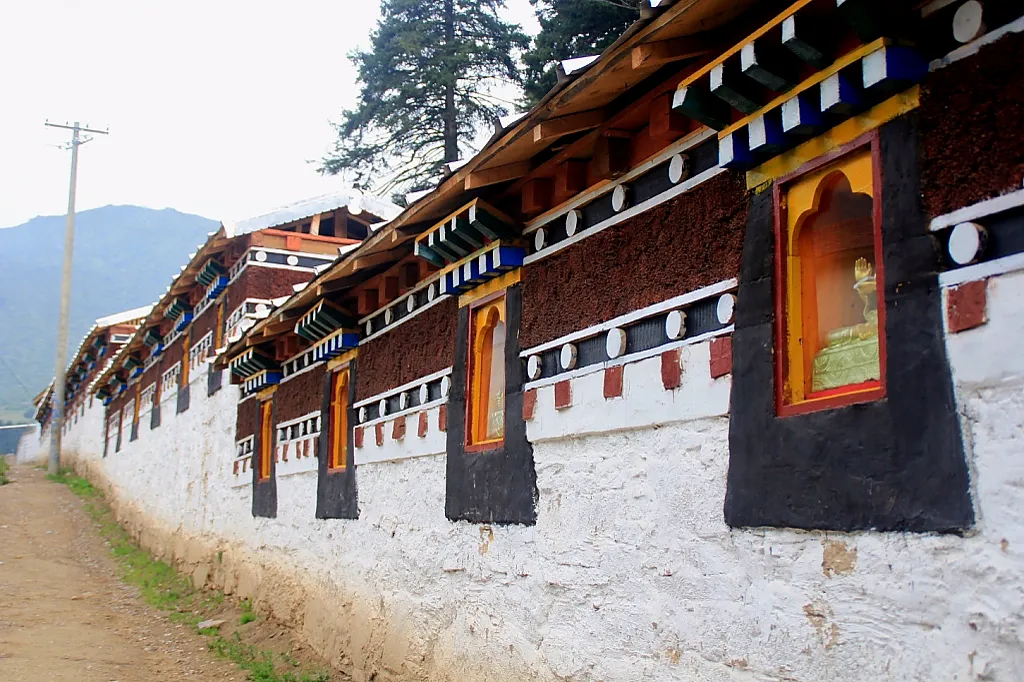
- A painted monastery building in the Ruoergai (Sichuan-side) part of Langmusi, Sichuan. Photo: 蔡锴Photo: CC BY-SA 3.0