

Explore the region
What to see and how to explore
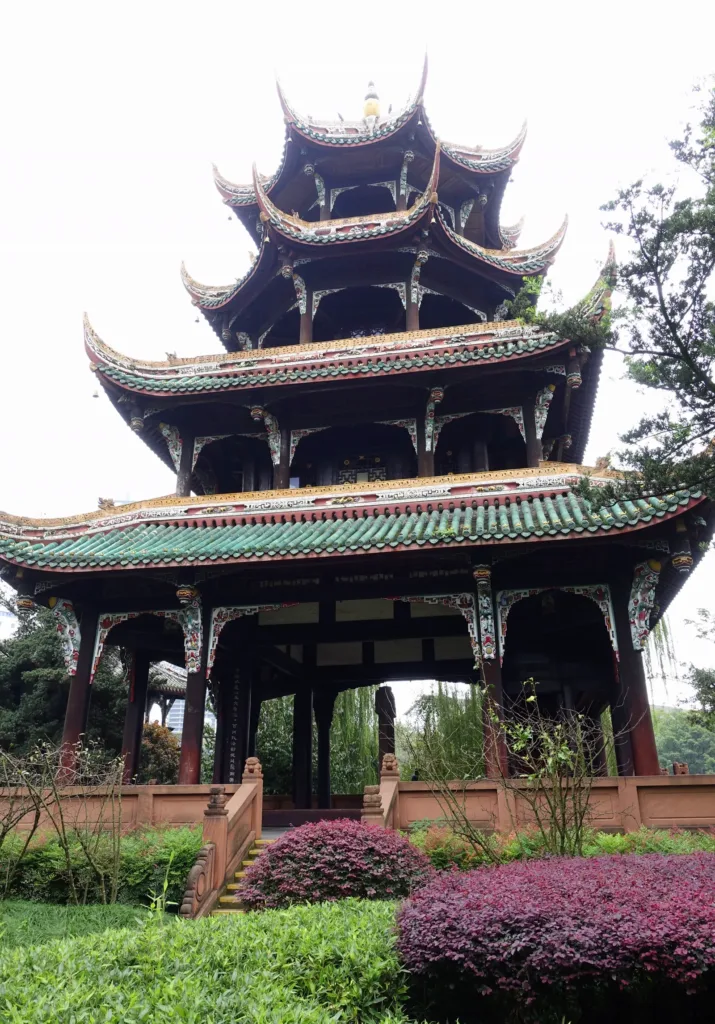
Wangjianglou Park sits on the Jin River in Chengdu’s Wuhou District. Its best-known landmark is Chongli Pavilion (崇丽阁), popularly called Wangjiang Tower (望江楼). The multi-storey wooden pavilion rises beside the water; its name comes from a phrase in the Rhapsody on the Capital of Shu by the Jin-dynasty writer Zuo Si. The park’s other historic structures include Zhuojin Tower (濯锦楼), Yinshi Tower (吟诗楼), Huanjian Pavilion (浣笺亭), Wuyun Hall (五云仙馆) and the winding-cup pool (流杯池). Rather than treating the tower as a stand-alone monument, walk the paths between these buildings and the river to see how the garden, bamboo and literary memorials form one setting.
The park commemorates Xue Tao (薛涛), a Tang-dynasty poet who lived in Chengdu. Look for Xue Tao Well (薛涛井), the memorial hall and displays about her life and poetry. The well is a later memorial site associated with the story of Xue Tao paper; it should not be presented as proof that the surviving well was her personal workshop. The refurbished memorial hall uses historical materials alongside modern interpretive displays. Nearby, the bamboo garden makes the link between the poet’s celebrated affection for bamboo and the park’s landscape visible: follow the shaded paths, notice how different clumps and forms make distinct corridors, and pause at openings toward the Jin River.
A practical visit is to begin with a slow loop through the bamboo and river-side garden, then spend time in the heritage quarter and memorial displays if they are open. Spring blossoms are seasonal, not a year-round feature. The official sources describe distinct garden and heritage areas, but do not provide an accessible current visitor tariff or reliable opening schedule. A recent visitor post reports separate free garden access and a paid heritage area, but that is not an official current notice; check the gate or call the park before planning around a fee, opening time, guided talk or building interior.
Getting there
Metro: Chengdu Metro Line 6 serves Sanguantang (三官堂) Station, near the park. A visitor guide identifies Exit B and describes an approximately eight-minute walk; follow the station and park signs along the public sidewalks toward the Wangjiang Road entrance. The exit and walking estimate come from a non-official visitor guide, so allow for local wayfinding and do not assume a step-free route.
Bus: A recent visitor guide lists routes 19, 35 and 335 to the Wangjianglou Park stop (望江楼公园站). Bus routes and stopping patterns can change; check the live stop display before boarding. Another Line 6 station guide lists routes including 3 and 18 at Sanguantang, but does not verify that these buses stop at the park gate.
Taxi or ride-hail: Enter 望江楼公园游客入口,成都市武侯区望江路30—50号 as the destination. The park’s own contact page gives the address as 望江路30号—50号 but does not identify a single taxi bay or gate number. Ask to be let out at the signed public entrance where stopping is permitted; do not ask the driver to stop in a traffic lane or assume a particular gate is open.
The park’s official contact number is 028-85223389; use it to check current access, ticketing and any temporary closures before setting out.
Combine your visit
Choose from these complementary stops when planning your visit.
-
Bamboo gardens竹类园林
Start with the varied bamboo planting.
-
Xue Tao’s Well and poetry displays薛涛井与诗歌展陈
Follow the literary theme through the garden.
-
Chongli Pavilion崇丽阁
Finish with the historic riverside architecture.
This is a suggested combination, not a timed route; confirm the opening and transport arrangements for your date.
Find Wangjianglou Park
望江楼公园 · 武侯区
The pin marks the area, not the entrance.
More places nearby
Approximate straight-line distances between map pins, not travel distances.
Sichuan University Museum 四川大学博物馆
Less than 1 km awaySichuan University Museum combines natural history, archaeology, everyday life and art in its rebuilt riverside museum. Specimens and recreated environments follow southwest China from the Sichuan Basin into the highlands…
View guide →Anshun Bridge 安顺廊桥
2 km awayAnshun Bridge is a covered structure crossing the Jin River, with a restaurant occupying the space above the arches. The present bridge is a reconstruction following the loss of earlier versions to floods, so its value for a…
View guide →Shuijingfang Museum 水井坊博物馆
2 km awayShuijingfang Museum centres on excavated remains of a historic baijiu distillery. The archaeological site and the production interpretation show how a working industry became a heritage subject, while the modern distillery…
View guide →Sources & visit information
Sources checked on 21 October 2026. Hours, tickets, reservations and transport can change; confirm with the operator before you go.
Image credits & notes (1)
- Chongli Pavilion, popularly known as Wangjiang Tower, in Wangjianglou Park. Photo: DaderotPhoto: CC0 1.0