

Explore the region
Tap any red Chinese text to hear it in Mandarin.
Why it is worth a stop
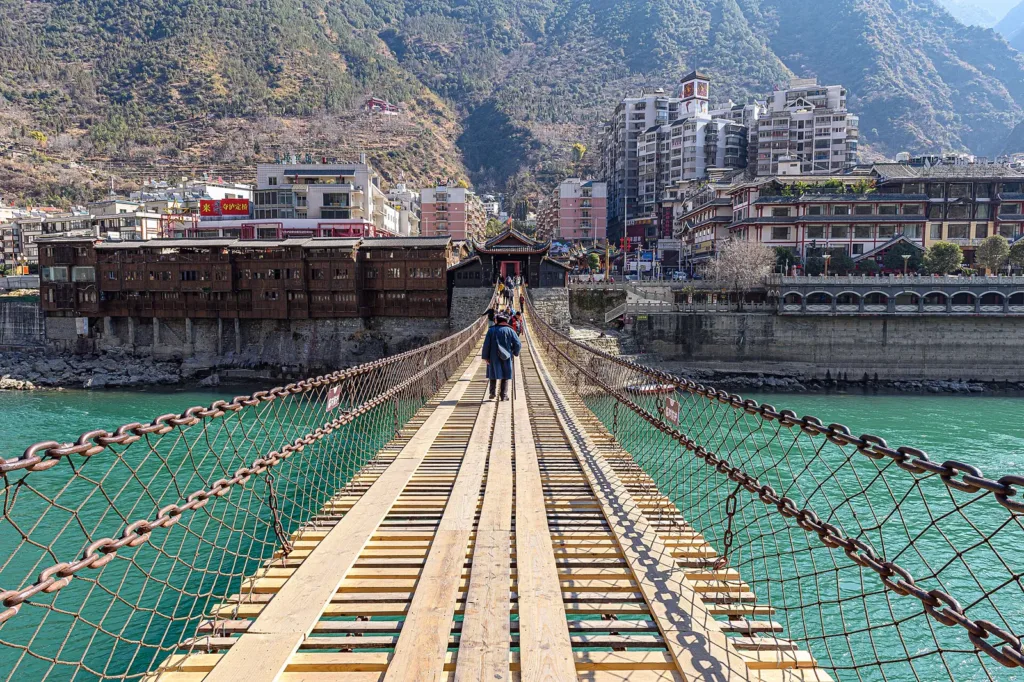
Luding Bridge is best understood as both a surviving piece of bridge engineering and a historical site. The operator dates its construction to 1705–1706 and describes it as one of the first batch of National Key Cultural Relic Protection Units announced by the State Council. The structure is compact enough to read in one visit, while the river below makes the original problem clear: how a narrow chain crossing carried people across the Dadu River before modern road bridges changed the route.
Its 1935 story is not just a caption beside an old structure. CCTV’s English report describes 22 Red Army soldiers crossing the thirteen chains in May 1935 under fire. That event is why the bridge is remembered in China’s Long March history as well as in local transport history. Treat the setting as a memorial place, not as an amusement ride: look closely, keep to the marked route, and let the river and the chains convey the scale.
What to look for
Start from the riverside approach and read the bridge as a suspension system. The operator’s description identifies nine lower chains supporting the deck and four chains on the two sides as handrails. The repeated iron links, the narrow deck and the gap over the Dadu River explain the bridge more clearly than a distant photograph does.
If bridge-crossing access is open on your date, use only the designated visitor route. Do not treat a map pin or an old photograph as proof that every part of the site is accessible. Local travel guidance asks visitors not to cross barriers or enter areas that are not open to the public, and to follow on-site safety instructions.
The Red Army Flying Capture of Luding Bridge Memorial Museum is a separate facility, listed by the operator about 600 metres from the bridge. It is useful for the Long March context, but it should not be assumed to be part of the bridge ticket or the same entrance. Check its own opening and admission arrangements if you plan to visit both.
Tickets and timing
The official booking page lists the Luding Bridge scenic-area ticket at RMB 10. It gives seasonal hours of 08:00–18:00 in winter and spring, and 07:00–19:00 in summer and autumn; ticket sales stop 15 minutes before closing. The same page warns that operating hours can change with weather, so confirm the day’s arrangement before setting out.
The pages read for this entry do not state whether a foreign passport can be used for purchase or admission, or whether a reservation is required for an international visitor. If you are travelling on a passport, contact the scenic area before departure rather than assuming that a domestic-ID or local booking rule applies. The operator lists 0836-3128266 as its consultation number.
Getting there
For a road approach, the operator’s directions describe reaching Luding from Ya’an on National Highway 318 via Tianquan, or from the Yaxi Expressway at Shimian followed by Provincial Highway 211 to Luding.
Within Luding, the same official page lists local route 1 as 沙坝—广场—城区 and route 2 as 沙坝—客运站—城区. These are town connections, not a promise of a bridge-gate drop-off: the page does not identify a dedicated bridge entrance or a current walking link from each stop. Confirm the final stop locally on the day.
For a taxi, show the driver 泸定桥景区 Lúdìng Qiáo Jǐngqū and the operator’s address: 甘孜藏族自治州泸定县泸桥镇泸定桥广场西100米. The official page supplies this destination and address but does not name a separate gate, so confirm the controlled visitor entrance after arrival rather than asking to be dropped at an unverified map pin.
Combine your visit
Suggested order for the visit:
-
Eastern bridgehead
Look at the pavilion and inscribed stone.
-
Riverbank view of the chains
Understand the suspension structure.
-
Bridge crossing, when admitted
Use the designated visitor route across the wooden deck.
This is an editorial sequence of named spaces or places. It does not imply a verified walking connection or promise opening, ticket availability or a journey time.
Find Luding Bridge
泸定桥 · 泸定县
The pin marks the area, not the entrance.
More places nearby
Approximate straight-line distances between map pins, not travel distances.
Hailuogou 海螺沟
47 km awayHailuogou is the glacier-and-forest landscape on the eastern side of Mount Gongga, approached from Moxi. Its visitor route combines scenic buses, forest viewpoints and the cable-car area at Camp Four, now also called Gongga…
View guide →Wawu Mountain 瓦屋山
75 km awayWawu Mountain has a broad, wooded summit plateau, with firs, bamboo and rhododendrons around the raised visitor paths. Yuanyang Pool provides a quiet water-level scene on top, while the Lanxi waterfall area exposes the abrupt…
View guide →Bifengxia 碧峰峡
75 km awayBifengxia combines a forested gorge landscape with a separate panda-research visitor area. The gorge paths pass beneath steep rock walls and through a setting of streams and waterfalls; the rebuilt Qingyun Elevator makes the…
View guide →Sources & visit information
Sources checked on 1 November 2026. Hours, tickets, reservations and transport can change; confirm with the operator before you go.
Image credits & notes (1)
- Luding Bridge from the west, showing the wooden deck and iron-chain handrails over the Dadu River toward the town. Photo: N509FZPhoto: CC BY-SA 4.0