

Photo adjustments
Wikimedia thumbnail; fitted to the ranking-card frame.
Explore the region
About Ancient Culture Street
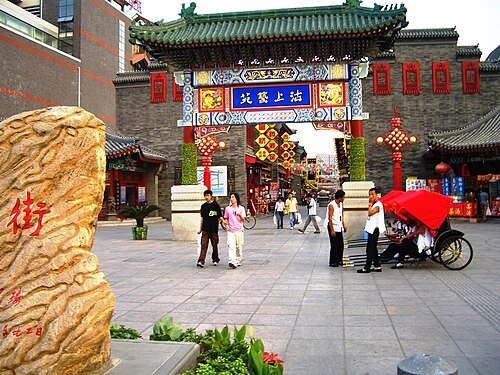
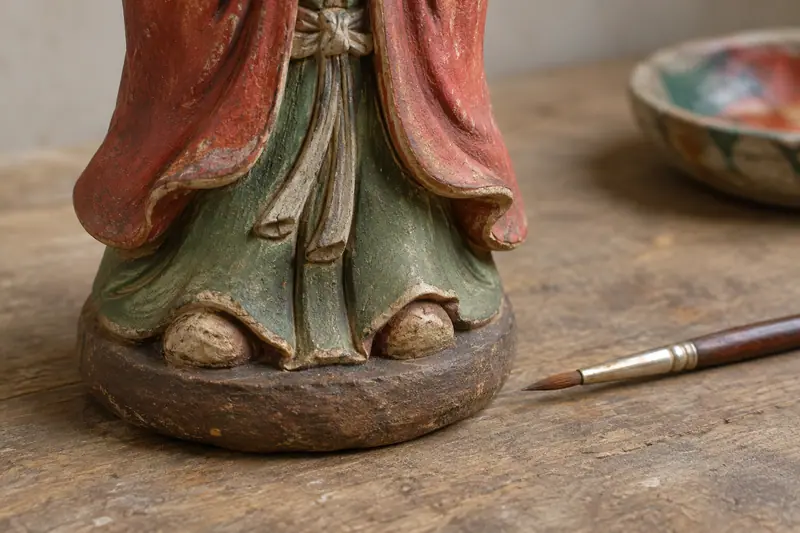
Its best-known traditions include Yangliuqing New Year prints and the painted clay figures associated with Clay Figure Zhang. The temple at the center connects the commercial street with the city's maritime past and worship of Mazu. Treat the shopping architecture and the historic religious buildings as different layers: the precinct opened in 1986, while the temple's history reaches much further back.
The area developed around Gongnan Street (宫南大街) and Gongbei Street (宫北大街). During the grain-transport era, these streets housed banking businesses and provided a gathering place for sailors. Commerce later moved to Tianjin's concessions, and the streets gradually became an area of ordinary housing. Renovation on New Year's Day in 1986 introduced more than a hundred small buildings in Qing-style forms, creating the modern precinct. In 2011, the area was included in the city's historic-cultural district planning as Ancient Culture Street Historic and Cultural District (古文化街历史文化街区).
Shops along the street sell old books, folk items, musical instruments and traditional crafts. The area also functions as a market for New Year goods, and the Tianjin Huanghui festival (天津皇会) is held here during the Spring Festival period each year. On 8 May 2007, the Ancient Culture Street tourist area was approved as a national 5A tourist attraction (国家5A级旅游景区).
What to look for
- Yangliuqing New Year prints and painted clay-figure crafts in the shops.
- Tianhou Temple, the Mazu shrine anchoring the street.
- The Qing-style storefronts and gates arranged along Gongbei and Gongnan avenues.
Location & getting there
Getting to Ancient Culture Street
Approach Ancient Culture Street along Gongbei Avenue or Gongnan Avenue in Nankai, on the west bank of the Haihe.
- Set the temple or a particular street gate as your destination if meeting others in the precinct.
Combine your visit
Suggested order within this visit:
-
Gongnan Avenue shops
Begin with the precinct's local crafts.
-
Tianhou Temple天津天后宫
Examine the older maritime shrine at the center.
-
Gongbei Avenue
Continue through the northern part of the commercial street.
This sequence is an editorial suggestion based on the features described in the sources. Access to individual buildings or areas should be checked locally; no travel time or shared admission is implied.
Find Ancient Culture Street
古文化街 · 南开区
The pin marks the area, not the entrance.
More places nearby
Approximate straight-line distances between map pins, not travel distances.
Tianhou Temple (Tianjin) 天津天后宫
Less than 1 km awayTianhou Temple is the Mazu shrine at the heart of Ancient Culture Street. Its origins in the Yuan period reflect Tianjin's long relationship with sailors, navigation and river trade. Unlike the surrounding modern shopping…
View guide →Wanghailou Church 望海楼教堂
Less than 1 km awayWanghailou Church, dedicated to Our Lady of Victory, stands beside Shizilin Bridge on the Haihe's northern bank. Its history includes repeated destruction and rebuilding during the violence of 1870, the Boxer period and later…
View guide →Liang Qichao Former Residence 梁启超故居
Less than 1 km awayLiang Qichao's Tianjin residence and the neighboring Yinbingshi study connect an Italian-style villa with one of modern China's influential reformers and scholars. The domestic building and study served different purposes…
View guide →Sources & visit information
The sources below support the place-specific description and arrival information. Suggested combinations are editorial planning ideas; confirm current opening, entry arrangements and transport services for your date.
- Wikipedia: Guwenhua Jie ↗
- Wikivoyage: Tianjin/Central Districts ↗
- Chinese Wikipedia: 古文化街 (revision 90882577, 2025-12-28) ↗
Visitor information adapted and edited from Wikipedia contributors · CC BY-SA 4.0. Source revision 1338816463.
Visitor information adapted and edited from Wikivoyage contributors · CC BY-SA 4.0. Source revision 5266584.
Background paragraphs translated and condensed from Wikipedia contributors, "古文化街", Chinese Wikipedia · CC BY-SA 4.0. Source revision 90882577.