

Entry & permits for Tibet (Xizang)
Foreign tourists need Tibet entry approval, commonly called a Tibet Travel Permit, and an organised visit arranged through a specialist travel agency in China. Confirm your approved route before booking transport. Requirements differ for Taiwan residents and for travellers using mainland or Hong Kong/Macao Chinese resident documents; check the document guide before you book.
Check the travel-document requirements →Policy scope verified: 2026-09-06. UK FCDO: China regional travel advice ↗ State Council Taiwan Affairs Office: Tibet entry approval ↗ Xizang Department of Culture and Tourism: Medog border permit notice ↗
Explore the region
Tap any red Chinese text to hear it in Mandarin.
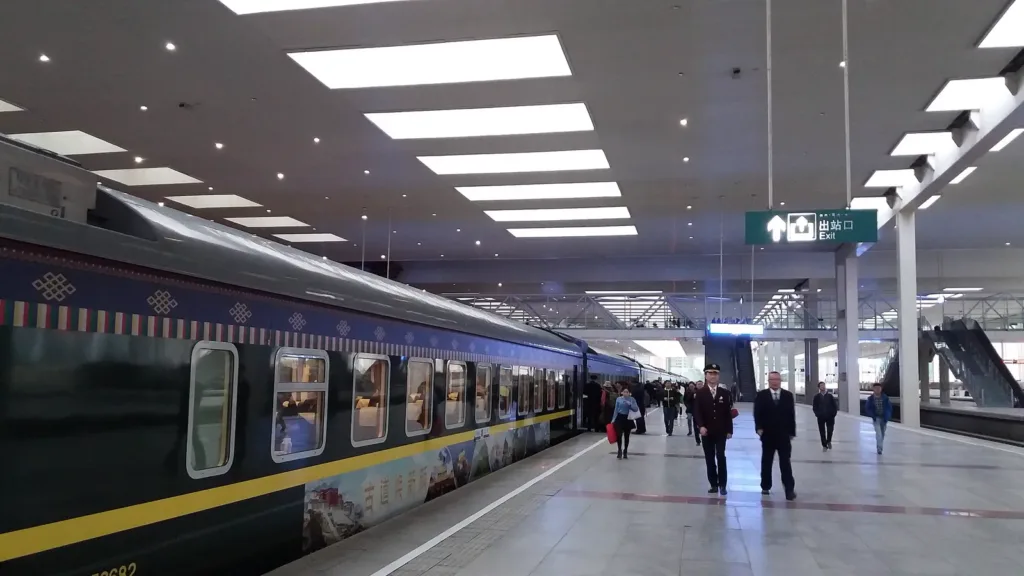
Lhasa Railway Station (拉萨站) is the city’s principal passenger-rail gateway. It opened on 1 July 2006 as the terminal of the Golmud–Lhasa section of the Qinghai–Tibet Railway and is described by People’s Daily as the largest passenger station in Xizang. This is a working transport hub, not a sightseeing ticketed attraction.
Where it is
The station sits in Liuwu New Area (柳梧新区) on the south bank of the Lhasa River, outside the old centre. Liuwu Bridge links the station area directly with central Lhasa; the same area connects by road toward Gonggar International Airport. Address searches and ride-hailing are less error-prone if you use 拉萨站 Lāsà Zhàn or 拉萨火车站 Lāsà Huǒchēzhàn plus 柳梧新区 Liǔwú Xīnqū, rather than confusing it with 柳梧汽车站 (the coach terminal).
Getting between the station and Lhasa
For public transport, the China Railway 12306 station guide lists a 火车站 Huǒchēzhàn stop for bus routes 89 and 86. Route 89’s listed corridor includes the Tibet Museum, Potala Palace and central streets; route 86’s listed corridor runs via Zha-ji Temple and other city stops. The guide does not provide a live timetable, so confirm the route and direction at the station on the day you travel.
A taxi or app ride is the simplest option with luggage. Give the driver 拉萨站(柳梧新区) and your hotel’s Chinese name or address. The practical road movement is across Liuwu Bridge into the central districts. Do not assume a fixed fare, journey time or airport shuttle: the local government’s airport-bus notice that used the railway-station area as a stop was explicitly a temporary arrangement for 20 August 2025 until the end of the 60th-anniversary celebrations. Gonggar International Airport is a separate air gateway in Gonggar County, outside Lhasa proper, not a railway facility; a temporary airport-bus stop at the station does not turn the station into an airport or prove a current service.
Tickets and entry permissions
For trains, use China Railway 12306 or the station ticket office for the current train, ticket and departure information. 12306 lists a foreign passport as a valid identity document for real-name railway tickets. Passengers using documents that are not automatically readable normally complete identity checking and gate procedures through a staffed channel, so carry the same original passport used for the booking.
A train ticket is not permission to enter Tibet. Foreign visitors should arrange the current Tibet entry permission/confirmation and the required reception or itinerary through an authorized Tibet travel agency before setting out. The Chinese Embassy’s visa guidance says visitors to Tibet may join a tourist group organized by an authorized travel agency, while its individual-travel wording directs applicants to obtain prior contact/notification from the Tibet Tourism Administration. A January 2026 notice from the Xizang tourism authority also requires a 进藏确认函 for foreign tourist teams in the context of local tourism-subsidy documentation. These documents and procedures are separate from any admission ticket for a palace, monastery or other attraction. Do not assume that a normal China visa, a rail ticket, or an attraction reservation makes independent travel in Tibet lawful. Ask an authorized agency and the relevant Chinese consular/immigration authorities for the current rule for your nationality and itinerary; do not try to bypass checks.
At the station
Allow time for security screening, ticket and identity checks, and finding the correct waiting area. The station’s 2024 report describes staffed guidance at security and gates, luggage assistance, charging and storage services. After a long ascent by rail, make the first transfer an easy one: go to your accommodation, hydrate, and rest before scheduling strenuous sightseeing at Lhasa’s altitude.
Find Lhasa Railway Station
拉萨站 · Liuwu New Area (柳梧新区), south bank of the Lhasa River, Lhasa, Xizang
The pin marks the area, not the entrance.
Sources & visit information
Sources checked on 23 October 2026. Hours, tickets, reservations and transport can change; confirm with the operator before you go.
- China Railway 12306: Lhasa Station station guide ↗
- Liuwu New Area: From a Remote Village to a Sub-Centre ↗
- Lhasa Railway Station: Smarter Travel, More Considerate Service ↗
- China Railway 12306: Real-name railway tickets ↗
- Notice on the Temporary Adjustment of Lhasa Gonggar International Airport Bus Routes ↗
- Visa for China (Mainland Only) ↗
- 2026 First-Quarter Tourism Consumption Subsidy Policy for Shigatse ↗
- Lhasa Railway Station: The Most Useful Travel Guide for Tourists ↗
- External Transportation in Lhasa ↗
Image credits & notes (1)
- A Qinghai–Tibet Railway train at a platform inside Lhasa Railway Station, Tibet. Photo: 钉钉Photo: CC BY-SA 4.0