

Entry & permits for Tibet (Xizang)
Foreign tourists need Tibet entry approval, commonly called a Tibet Travel Permit, and an organised visit arranged through a specialist travel agency in China. Confirm your approved route before booking transport. Requirements differ for Taiwan residents and for travellers using mainland or Hong Kong/Macao Chinese resident documents; check the document guide before you book.
Check the travel-document requirements →Policy scope verified: 2026-09-06. UK FCDO: China regional travel advice ↗ State Council Taiwan Affairs Office: Tibet entry approval ↗ Xizang Department of Culture and Tourism: Medog border permit notice ↗
Explore the region
Tap any red Chinese text to hear it in Mandarin.
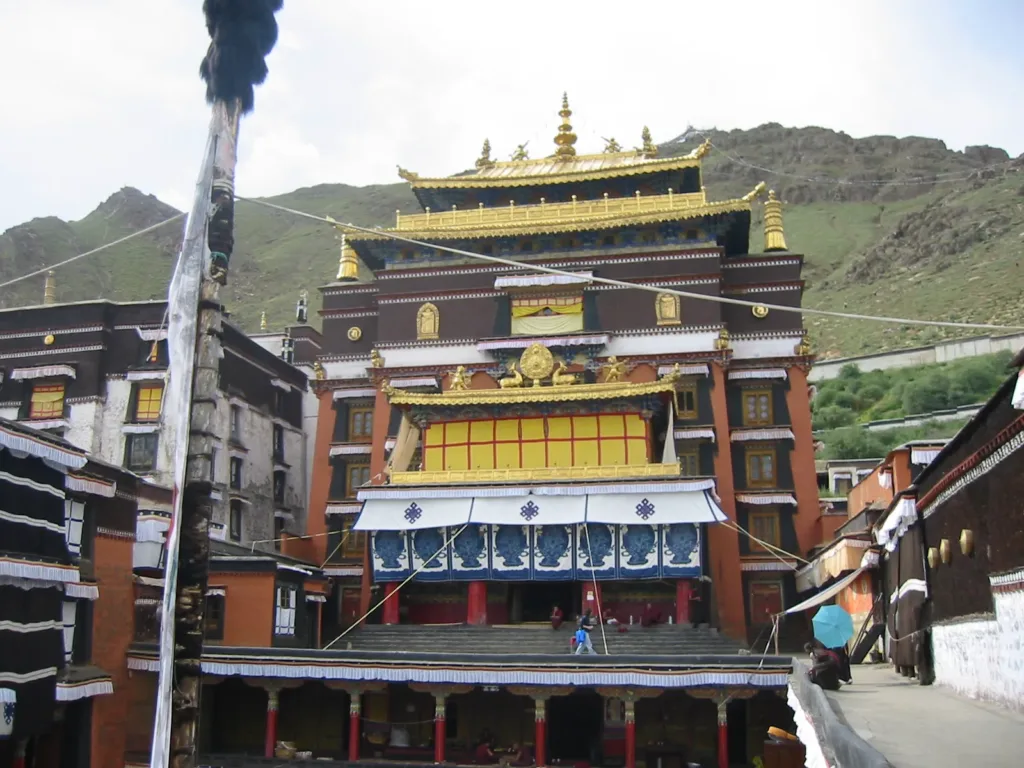
Shigatse is best approached as a compact city visit, not as a label for every road destination in the wider prefecture. The first impression is the scale of Tashilhunpo Monastery against the hill: white walls, dark timber, painted halls and the steady movement of worshippers give the western side of the city a rhythm that is both ceremonial and practical. Outside the monastery, shops selling devotional objects serve visitors and local religious life. The city feels more rewarding when these details are read together rather than reduced to a single viewpoint.
Start with Tashilhunpo
Tashilhunpo was founded in 1447 and became the traditional seat of the Panchen Lamas. Its Gelugpa identity is visible in the monastery’s sequence of courtyards, halls, stupas, murals and sculptural images rather than in one isolated building. The large Maitreya image, memorial stupas and hillside setting are useful anchors for a first visit; the exact halls open to visitors, photography rules and religious-event arrangements can change, so follow on-site instructions and ask before photographing inside a Buddhist monastery.
Walk slowly and look at how the complex is built into the slope. Notice the contrast between the painted upper structures and the plain, thick perimeter walls. On the approach and return, take time to observe the devotional-goods streets: what is displayed, how objects are handled and which purchases seem intended for daily practice. Do not photograph people without permission, and do not treat worshippers as part of a performance. The older streets below Shigatse Dzong are best used as an urban view and orientation point; do not assume that the fortress interior is open simply because it is visible from the city.
A visit here can comfortably anchor a day in central Shigatse. Gyantse, Sakya and the Everest area are separate road journeys, not nearby add-ons to the monastery visit. They may involve different route permissions, longer travel and border or protected-area controls.
Entry and altitude come first
Foreign passport holders must arrange Tibet travel through a specialist travel agent in China and travel on an organised tour, according to the UK government’s current China travel advice. Authorities may pause permit issuance or restrict travel without notice, so confirm that your approved itinerary specifically includes Shigatse before buying a non-refundable ticket.
A city visit does not automatically authorise travel to Everest, the China–Nepal border or other sensitive destinations in Shigatse. The route guidance checked for this draft describes additional border-pass and foreign-traveller-document requirements for sensitive border areas. It is a commercial guidance source rather than a substitute for an official approval; ask the qualified agency to confirm every permit for your exact route, dates and document type before departure.
This is a high-altitude arrival. A railway travel guide lists Shigatse Railway Station at about 3,836 metres, and CDC guidance notes that unacclimatised travellers sleeping above 2,450 metres are at risk of altitude illness. Keep the first outing easy, avoid treating the monastery walk as a fitness test, and allow time to acclimatise before adding a higher or more remote road journey. If symptoms are severe or worsening, stop ascending and seek medical help rather than pushing on.
Arrive and leave
The Lhasa–Shigatse Railway has connected Lhasa and Shigatse since 2014. Use the named destination 日喀则站 (Shigatse Railway Station) when booking and check the current date-specific service in 12306; an old railway notice is not a current timetable.
The station is not the monastery entrance. Published travel references place Tashilhunpo roughly 7–9 kilometres from the station, so the exact distance and driving time should not be promised. Take a taxi or an arranged vehicle and show this destination in Chinese: 扎什伦布寺,西藏自治区日喀则市桑珠孜区几吉朗卡路1号. Keep the return train or onward road transfer in view before committing to a distant excursion, especially if your organised Tibet itinerary has a fixed vehicle and guide.
Current opening hours, ticketing, hall access and any temporary closure are not stated here as fixed facts. Confirm them with the monastery or your qualified operator for the date of travel. The same applies to onward routes: return to the approved itinerary rather than improvising toward a border road.
Combine your visit
Suggested order for this visit:
-
Tashilhunpo Monastery扎什伦布寺
Start with the city's principal monastic complex.
-
Tashilhunpo's adjoining pilgrim-shopping streets
Continue outside the monastery to see the trade serving visitors and religious communities.
-
Old town below Shigatse fortress
Extend the visit towards the hill's older urban setting if time and access allow.
This is an editorial sequence based on the features described in the sources. Confirm access locally; no walking time, shared admission or guaranteed interior access is implied.
Find Shigatse City Centre
日喀则 · 桑珠孜区
The pin marks the area, not the entrance.
More places nearby
Approximate straight-line distances between map pins, not travel distances.
Tashilhunpo Monastery 扎什伦布寺
3 km awayTashilhunpo rises against a hill in central Shigatse. Founded in 1447, it became the traditional seat of the Panchen Lamas, whose memorial stupas form an important part of the complex. The huge gilded Maitreya image gives the…
View guide →Shalu Monastery 夏鲁寺
17 km awayShalu brings Tibetan wall construction together with green glazed roofs, projecting eaves and timber brackets associated with Chinese architecture. The combination is especially clear at the main Shalu Lhakhang. Inside, the…
View guide →Gyantse Dzong 江孜宗山
77 km awayGyantse Dzong crowns the rocky spur above Gyantse, with defensive walls following the shape of the hill. The fortress controlled an important approach towards the Tsangpo Valley and Lhasa and became a major site of the 1904…
View guide →Sources & visit information
Sources checked on 2 November 2026. Hours, tickets, reservations and transport can change; confirm with the operator before you go.
Image credits & notes (1)
- A richly decorated hall of Tashilhunpo Monastery sits against the rocky hillside in Shigatse. Photo: MongolPhoto: CC BY-SA 3.0