

Explore the region
In brief: Baihaba is a Tuvan-associated working village in Habahe County, within the Kanas scenic area near China’s border with Kazakhstan. Its appeal is the chance to read a mountain settlement at walking pace: pitched log houses, fenced yards, forested slopes and a closely managed frontier landscape.
What makes it worth the detour
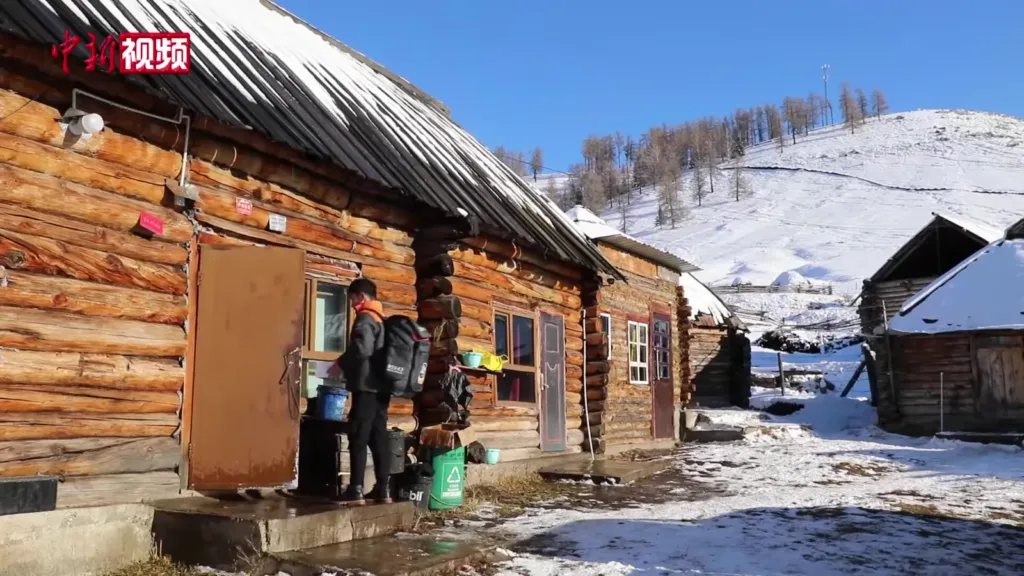
Baihaba is best approached as a residential village rather than a staged ethnic show. Look at how the houses sit against the valley, how roofs are pitched for snow, and how yards, wood stores and grazing space fit into everyday mountain life. A 2023 account of the Tuvan communities around Kanas describes traditional log houses built by stacking straight timber and filling the joints with dry moss for insulation; it also records Tuvan as a rare local language and places Baihaba among the area’s Tuvan settlements. These details are a reason to observe carefully, not an invitation to enter someone’s home.
Walk the public lanes and the edge of the settlement, pausing to compare the older wooden forms with newer guesthouse buildings and to watch how the forest, streams and pasture shape the village. Ask before entering a yard, photographing residents, recording a family conversation or accepting a private-home visit. The public notices I read do not promise a daily museum, performance or family-hosted activity, so treat any such offer as locally arranged and subject to permission rather than as a guaranteed programme.
The border is part of the setting but not a photo prop. Stay on signed visitor routes, do not cross fences or approach guard posts, and do not photograph military facilities. Leave the village quieter than you found it, and do not turn residents, livestock or religious spaces into a backdrop.
Getting in and getting out
Baihaba is accessed through the Kanas scenic-area system. The latest summer notice I found, issued for 2026, says that Kanas, Hemu and Baihaba use a green-transport model of scenic sightseeing buses plus village buses. It gives the general summer entry and exit window as 08:00–20:00 and village-bus service as 08:00–24:00; it does not publish a Baihaba-specific departure timetable. Buy or reserve through the official “Kanas Scenic Area” or “原行网” channels, or confirm at a visitor-centre window before setting out.
A Kanas authority FAQ dated 14 July 2021 names the relevant inter-area links as Kanas ↔ Baihaba and 铁热克提门票站 (Tiereketi Ticket Station) → Baihaba, with the return leg Baihaba → 铁热克提门票站. That page listed 09:00–18:30 for the Kanas–Baihaba link, 09:00–20:00 for the outward Tiereketi link and 09:00–18:30 for the return. Those times are historical, not a current timetable: confirm the day’s last bus and the correct boarding point before entering, and do not assume a late service will bring you back.
The latest winter notice publicly available in the sources checked here covered 16 October 2025 to 30 April 2026. It said that winter self-driving to Baihaba could be allowed with designated parking, and required a four-wheel-drive vehicle fitted with snow tyres; it also warned that weather or traffic controls could change access. Do not carry those winter arrangements forward to the 2026–27 season without a new notice.
Baihaba is a border-management area, so a scenic-area ticket is not the whole access question. For the Kanas-side approach, that winter notice named the integrated police service centre of the Kanas Border Police Station beside the Kanas Visitor Service Centre for border-pass handling. For the Tiereketi-side approach, it named the Habahe County Visitor Service Centre, the Baihualin Scenic Area Visitor Service Centre and the Tiereketi Visitor Service Centre. The precise local workflow can change with the season.
Foreign-passport holders need an extra check before paying for transport or accommodation. The 2026 National Immigration Administration guide says foreigners apply in person for an electronic border-management pass at a county-level public-security exit-and-entry administration office or designated police station, using a valid passport or other accepted travel document. The general regulation also says that a foreigner entering a border-management area not open to foreigners needs a Foreign Travel Permit (外国人旅行证). The public Kanas notices read for this article do not state whether Baihaba is currently open to foreign visitors or which route is approved for a particular nationality. Ask the Kanas service hotline (400-111-0906) and the relevant Habahe public-security office to confirm eligibility, the required document and the current entry side before you travel.
For a safe return, plan around the confirmed final Baihaba → Kanas or Baihaba → 铁热克提门票站 service, not around an estimated driving time. Keep your passport or other valid identity document with you, allow time for checks, and obey any same-day border, weather and scenic-area instructions.
Find Baihaba Village
白哈巴村 · 哈巴河县
The pin marks the area, not the entrance.
Sources & visit information
Sources checked on 2 November 2026. Hours, tickets, reservations and transport can change; confirm with the operator before you go.
Image credits & notes (1)
- A winter lane in Baihaba Village, showing log houses, fenced yards and snow-covered hills. Photo: China News ServicePhoto: CC BY 3.0