

Explore the region
About Astana Tombs
Its underground chambers preserved textiles, documents, painted objects and human remains in the dry environment, providing unusually detailed evidence of daily life and burial customs. Only a small part of the cemetery forms a visitor route. Much of the excavated material belongs in museum collections, so combine the site with interpretation rather than expecting every well-known object to remain inside a tomb.
The cemetery was organised into family burial areas separated by natural gravel boundaries, with graves ordered by generation within each paternal family. Sloping passages descend 4 or 5 metres to entrances leading into square or rectangular chambers. Some tombs have narrow antechambers with niches containing guardian figures, combining animal features with occasional human faces. The burial grounds contain more than 500 tombs across 10 square kilometres.
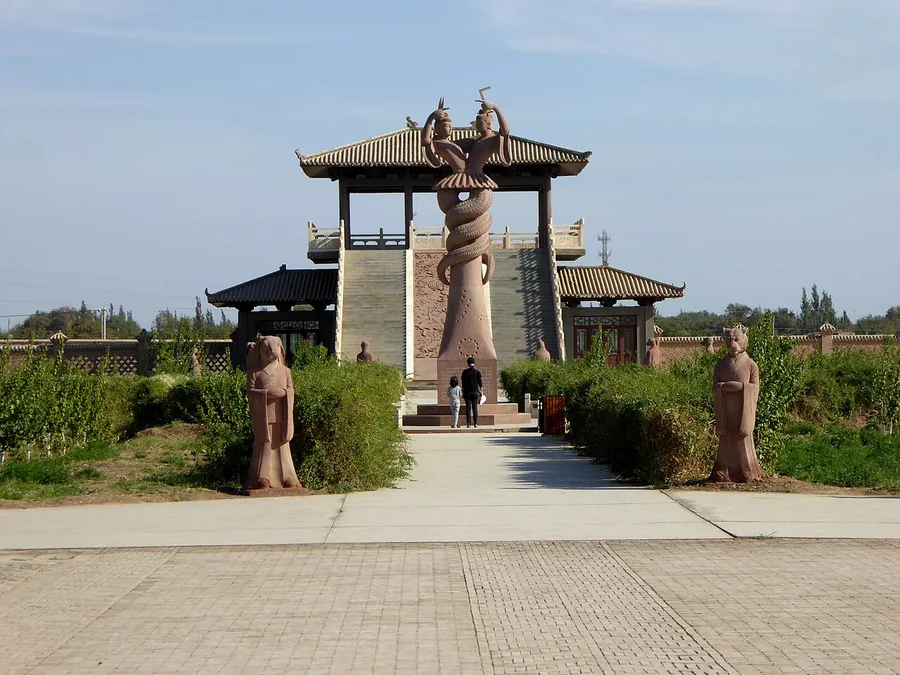
Written inventories accompanied models of belongings intended for use after death, including clothing, ornaments, animals and musical instruments. Wooden or pottery vessels held offerings near the head of the coffin; some were painted with white dots and red lines. Preserved food includes grapes, pears, meat, wheat and pastries. Epitaph tablets and funerary banners depicting Fuxi (伏羲) and Nuwa (女娲) provide further evidence of local funerary practice.
What to look for
- Sloping passages lead to compact underground burial chambers.
- Excavated objects reveal clothing, food, exchange and funerary customs.
Background & history
The Astana Cemetery (Chinese: 阿斯塔那古墓; pinyin: Āsītǎnà Gǔmù) is an ancient cemetery 37 kilometers (23 mi) southeast of Turpan, in Xinjiang, China, 6 kilometres (3.7 mi) from the ancient city of Gaochang. It served mainly as the cemetery for the descendants of Chinese settlers in Gaochang from the 4th century to the first half of the 8th century. The complex covers 10 square kilometres (3.9 sq mi) and contains over 1,000 tombs. Due to the arid environment many important artifacts have been well preserved at the tombs, including natural mummies.
Excerpt from Wikipedia: Astana Cemetery · Wikipedia contributors · CC BY-SA 4.0. Selected introductory sentences; formatting simplified. Background information, not current visitor-service advice.
Location & getting there
Getting to Astana Tombs
Navigate to Astana Ancient Tombs near Gaochang east of Turpan. Check the opened chambers and whether their stairs and low passages suit your group; use the designated route only.
Combine your visit
Choose from these complementary stops when planning your visit.
-
Cemetery interpretation墓群解说区
Understand the relationship with Gaochang.
-
Open tomb chamber开放墓室
Visit only the chambers included in the current route.
-
Gaochang ruins高昌故城
Compare the burial evidence with the nearby city remains.
This is a suggested combination, not a timed route; confirm the opening and transport arrangements for your date.
Find Astana Tombs
阿斯塔那古墓群 · 吐鲁番
The pin marks the area, not the entrance.
More places nearby
Approximate straight-line distances between map pins, not travel distances.
Gaochang ruins 高昌故城
3 km awayGaochang was an important oasis city and trading centre east of Turpan. Its surviving earthen walls, inner enclosures and religious ruins reveal a much broader urban footprint than a single monument. The city’s history includes…
View guide →Bezeklik Thousand Buddha Caves 柏孜克里克千佛洞
8 km awayBezeklik’s Buddhist caves sit above the Mutou valley in the Flaming Mountains. Surviving painted surfaces and repeated Buddha imagery recall the patronage of the Uyghur kingdom of Qocho, while damaged and missing sections are an…
View guide →Flaming Mountains 火焰山
9 km awayThe Flaming Mountains are a band of eroded red sandstone hills east of Turpan. Deep gullies and strong sunlight create the flame-like appearance behind their name. The landscape also became famous through Journey to the West…
View guide →Sources & visit information
The linked encyclopedia sources support background and place descriptions. Current opening hours, ticket prices, booking rules and transport schedules have not been independently verified for this guide. Confirm them with the venue or operator before travelling.
- Astana Cemetery — Wikipedia geographic and historical reference ↗
- Chinese Wikipedia: 阿斯塔那古墓群 (revision 87397714, 2025-05-22) ↗
- English Wikipedia: Astana Cemetery (revision 1364727566, 2026-07-18) ↗
Geographic and historical facts selectively adapted from Wikipedia contributors, Astana Cemetery · CC BY-SA 4.0. Source revision 1364727566.
Background paragraphs translated and condensed from Wikipedia contributors, "阿斯塔那古墓群", Chinese Wikipedia · CC BY-SA 4.0. Source revision 87397714.
Background paragraphs condensed from Wikipedia contributors, "Astana Cemetery", English Wikipedia · CC BY-SA 4.0. Source revision 1364727566.
Image credits & notes (1)
- The visitor entrance and landscaped approach at the Astana Tombs, Turpan, Xinjiang; exact photograph date unknown (source upload recorded in November 2015).Photo: Hiroki Ogawa · CC BY 3.0Resized for the web; the photo itself has not been edited.
