

Explore the region
Tap any red Chinese text to hear it in Mandarin.
Why visit
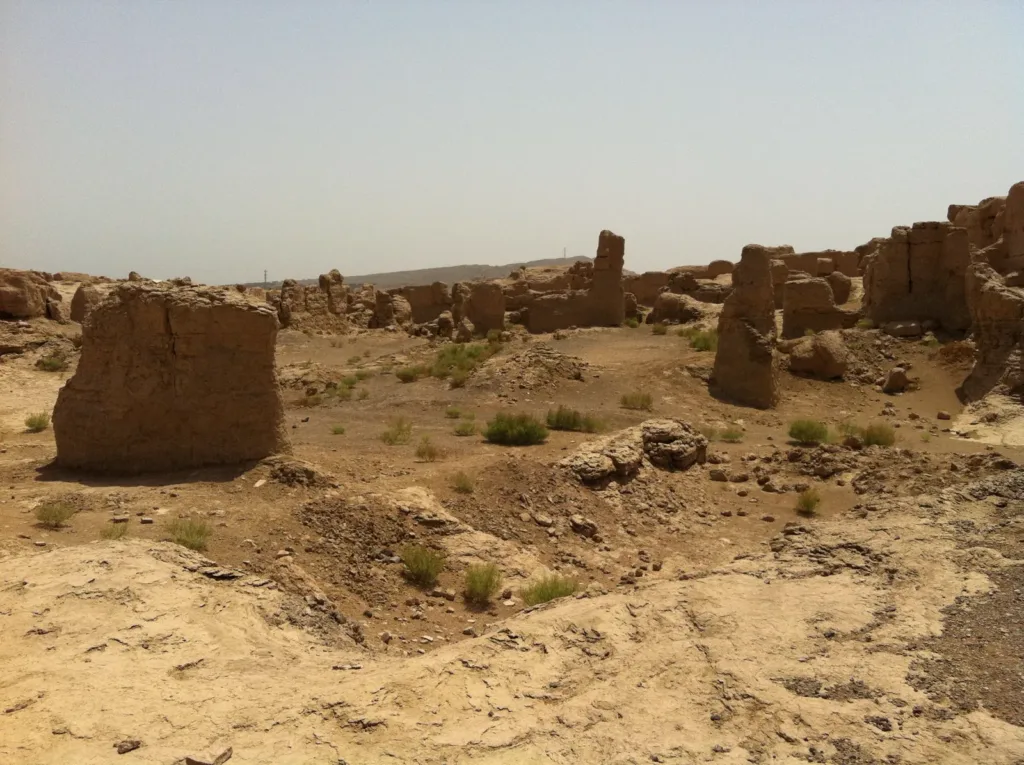
Gaochang is best understood as an archaeological city rather than one landmark. The National Cultural Heritage Administration dates the site from the 1st century BC to the 14th century and identifies three main parts: the outer city, inner city and Khan’s Fort. Religious buildings and house remains are spread through the site.
The setting explains its importance. The ruins lie below the Flaming Mountains in Turpan’s eastern countryside, on the old east–west corridor through the Turpan Basin. An official Xinjiang description records a rammed-earth outer wall, a large outer-city enclosure and traces of religious and workshop areas. The place is therefore valuable for the scale of its urban layout and for the evidence of different communities and beliefs that once used the city, not because many buildings remain complete.
Gaochang is also one component of the transnational Silk Roads: the Routes Network of Chang’an–Tianshan Corridor, inscribed on the UNESCO World Heritage List in 2014. UNESCO describes the wider property as a network of capitals, trading settlements, religious buildings, tombs and other sites that carried goods, beliefs, knowledge and artistic practices across Asia.
What to look for
Start by reading the outline of the city before moving toward the more concentrated ruins. Long earthen walls and nested enclosures make the city’s scale legible from the ground. Look for changes in wall thickness, gateways and the relationship between open courts and built-up areas rather than searching for a single “main temple.”
The three-part plan is the useful mental map: outer city, inner city and the fortified Khan’s Fort. The official descriptions also record religious remains, house foundations and possible craft areas. Where the authorised visitor route allows, pause at the edges of the ruins and imagine the difference between a walled city, a political centre and the smaller spaces where people worked and worshipped.
This is an exposed outdoor archaeological site. Allow about two to three hours if you want to walk slowly and read the landscape; both current visitor listings use that as a suggested visit length. Bring water, sun protection and shoes suitable for uneven ground. Stay on the signed route, do not climb earthen walls, and do not enter cordoned-off rooms or touch fragile surfaces.
Planning your visit
The public visitor listings read on 31 October 2026 both describe Gaochang as a ticketed attraction and publish the same two ticket-office numbers: +86 995 8687885 and +86 995 8687666. Qunar states that advance reservation is required, but the pages I could access did not display a current ticket price or a passport-specific booking path.
Opening information is not fully consistent. Qunar lists 09:30–19:00, with entry stopping at 19:00; Trip.com lists 10:00–19:00, also with ticket sales and entry ending at 19:00. Treat 19:00 as the published cutoff shown by both listings, but call before setting out to confirm the opening start, same-day availability and any conservation closure.
If you are travelling on a non-Chinese passport, carry the original passport and ask the ticket office which reservation or manual-verification channel accepts it. Do not assume that a Chinese-ID mini-program flow also works for passport holders: I found no Gaochang-specific passport procedure in the public listings above. This is a narrow ticketing uncertainty, not a reason to skip the site, but it is worth resolving before travelling to the outskirts.
Getting there and getting back
There is no metro service to Gaochang Ruins. Search the Chinese name 高昌故城 Gāo Chāng Gù Chéng in Amap/Gaode Maps and check that the result is in Sanbao Township, Gaochang District, Turpan, at the public-listed address 003乡道. The site is outside the urban centre, so a pre-arranged taxi, ride-hail or private car with a return pickup is the simplest option. Agree the pickup point and waiting arrangement before entering; do not count on finding a fresh car at the ruins.
For a public-transport option, Qunar’s current visitor guide describes taking a coach from Turpan Coach Station toward Shanshan, getting off at Huoyanshan Coach Station, then taking a taxi for the final approximately 7 km. Its guide also describes returning toward Turpan by taxi. This is a third-party route description, not a live operator timetable: confirm the correct coach, stop name, road conditions and return car on the day. The guide does not establish a fixed departure interval, fare or guaranteed last service, so none is quoted here.
If you arrive at Turpan North Railway Station, Turpan Railway Station or Turpan Jiaohe Airport, treat that as the start of the road journey rather than as an arrival at the ruins. Arrange the onward road transfer to the Chinese destination name above and keep the return plan with the same driver or booking channel.
Combine your visit
Choose from these complementary stops when planning your visit.
-
City walls and plan城墙与城市格局
Begin with the outline of the site.
-
Open inner ruins开放内城遗址
Follow the authorised route through the surviving structures.
-
Astana Cemetery阿斯塔那古墓群
Add the associated burial site as a separate visit.
This is a suggested combination, not a timed route; confirm the opening and transport arrangements for your date.
Find Gaochang ruins
高昌故城 · 吐鲁番
The pin marks the area, not the entrance.
More places nearby
Approximate straight-line distances between map pins, not travel distances.
Astana Tombs 阿斯塔那古墓群
3 km awayAstana Cemetery served communities associated with nearby Gaochang. Its underground chambers preserved textiles, documents, painted objects and human remains in the dry environment, providing unusually detailed evidence of daily…
View guide →Flaming Mountains 火焰山
9 km awayThe Flaming Mountains are a band of eroded red sandstone hills east of Turpan. Deep gullies and strong sunlight create the flame-like appearance behind their name. The landscape also became famous through Journey to the West…
View guide →Bezeklik Thousand Buddha Caves 柏孜克里克千佛洞
11 km awayBezeklik’s Buddhist caves sit above the Mutou valley in the Flaming Mountains. Surviving painted surfaces and repeated Buddha imagery recall the patronage of the Uyghur kingdom of Qocho, while damaged and missing sections are an…
View guide →Sources & visit information
Sources checked on 31 October 2026. Hours, tickets, reservations and transport can change; confirm with the operator before you go.
Image credits & notes (1)
- Earthen wall and room remains within the Gaochang Ruins, Turpan, photographed in July 2011. Photo: Matthew SummertonPhoto: CC BY-SA 3.0