

Photo adjustments
Proportionally resized and converted to WebP without cropping, retouching or changing the photographed subject.
Explore the region
About Bezeklik Thousand Buddha Caves
Surviving painted surfaces and repeated Buddha imagery recall the patronage of the Uyghur kingdom of Qocho, while damaged and missing sections are an important part of the site’s history. Many famous murals were removed and are now held elsewhere. A visit should focus on the currently opened caves and the relationship between the shrines and their cliff setting.
Excavation of the caves began under the Qu rulers of Gaochang. During the Tang period the complex was known as Ningrong Temple (宁戎寺), and it later became a royal monastery under the Uyghur kingdom. Eighty-three caves survive, with murals in more than forty covering over 1,200 square metres. The site became a Major Historical and Cultural Site Protected at the National Level (全国重点文物保护单位) in 1982.
The paintings are mainly Buddhist, with some Manichaean imagery. Artists commonly laid out figures in pale ink, added colour and completed outlines in vermilion. Ochre grounds and warm colours predominate. To compensate for viewing conditions in confined interiors, painters enlarged heads and feet while reducing the proportions of waists and hands. Excavations also recovered more than a thousand manuscript fragments in languages including Chinese, Uyghur and Sogdian, alongside sculptures, textiles and wooden architectural elements.
What to look for
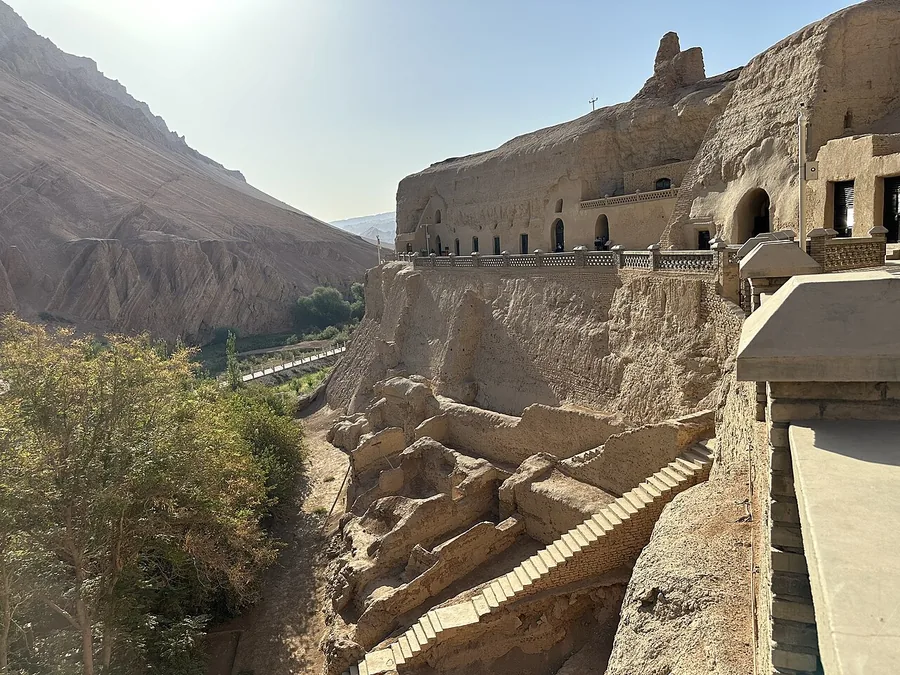
- Rock-cut shrines occupy a terrace above the Mutou valley.
- Surviving murals and painted ceilings preserve parts of a much larger Buddhist programme.
Background & history
The Bezeklik Thousand Buddha Caves (Chinese: 柏孜克里克千佛洞; pinyin: Bózīkèlǐkè Qiānfódòng; Uyghur: بزقلیق مىڭ ئۆيى) is a complex of Buddhist cave grottos dating from the 5th to 14th century between the cities of Turpan and Shanshan (Loulan) at the north-east of the Taklamakan Desert near the ancient ruins of Gaochang in the Mutou Valley, a gorge in the Flaming Mountains, in the Xinjiang region of western China. They are high on the cliffs of the west Mutou Valley under the Flaming Mountains, and most of the surviving caves date from the West Uyghur kingdom around the 10th to 13th centuries.
Excerpt from Wikipedia: Bezeklik Thousand Buddha Caves · Wikipedia contributors · CC BY-SA 4.0. Selected introductory sentences; formatting simplified. Background information, not current visitor-service advice.
Location & getting there
Getting to Bezeklik Thousand Buddha Caves
Use the Bezeklik Thousand Buddha Caves entrance in Mutou Valley, east of Turpan. Confirm the day’s cave selection and follow the staff’s photography and conservation instructions; a site ticket does not imply access to every cave.
Combine your visit
Choose from these complementary stops when planning your visit.
-
Cliffside approach崖壁游览通道
See how the shrines relate to the valley.
-
Open painted caves开放壁画洞窟
Study the surviving surfaces with the site’s interpretation.
-
Flaming Mountains landscape火焰山地貌
Add a permitted valley viewpoint before returning.
This is a suggested combination, not a timed route; confirm the opening and transport arrangements for your date.
Find Bezeklik Thousand Buddha Caves
柏孜克里克千佛洞 · 吐鲁番
The pin marks the area, not the entrance.
More places nearby
Approximate straight-line distances between map pins, not travel distances.
Astana Tombs 阿斯塔那古墓群
8 km awayAstana Cemetery served communities associated with nearby Gaochang. Its underground chambers preserved textiles, documents, painted objects and human remains in the dry environment, providing unusually detailed evidence of daily…
View guide →Flaming Mountains 火焰山
11 km awayThe Flaming Mountains are a band of eroded red sandstone hills east of Turpan. Deep gullies and strong sunlight create the flame-like appearance behind their name. The landscape also became famous through Journey to the West…
View guide →Gaochang ruins 高昌故城
11 km awayGaochang was an important oasis city and trading centre east of Turpan. Its surviving earthen walls, inner enclosures and religious ruins reveal a much broader urban footprint than a single monument. The city’s history includes…
View guide →Sources & visit information
The linked encyclopedia sources support background and place descriptions. Current opening hours, ticket prices, booking rules and transport schedules have not been independently verified for this guide. Confirm them with the venue or operator before travelling.
- Bezeklik Thousand Buddha Caves — Wikipedia geographic and historical reference ↗
- Chinese Wikipedia: 柏孜克里克千佛洞 (revision 91878632, 2026-03-14) ↗
Geographic and historical facts selectively adapted from Wikipedia contributors, Bezeklik Thousand Buddha Caves · CC BY-SA 4.0. Source revision 1372632702.
Background paragraphs translated and condensed from Wikipedia contributors, "柏孜克里克千佛洞", Chinese Wikipedia · CC BY-SA 4.0. Source revision 91878632.