

Explore the region
Tap any red Chinese text to hear it in Mandarin.
What makes it worth the trip
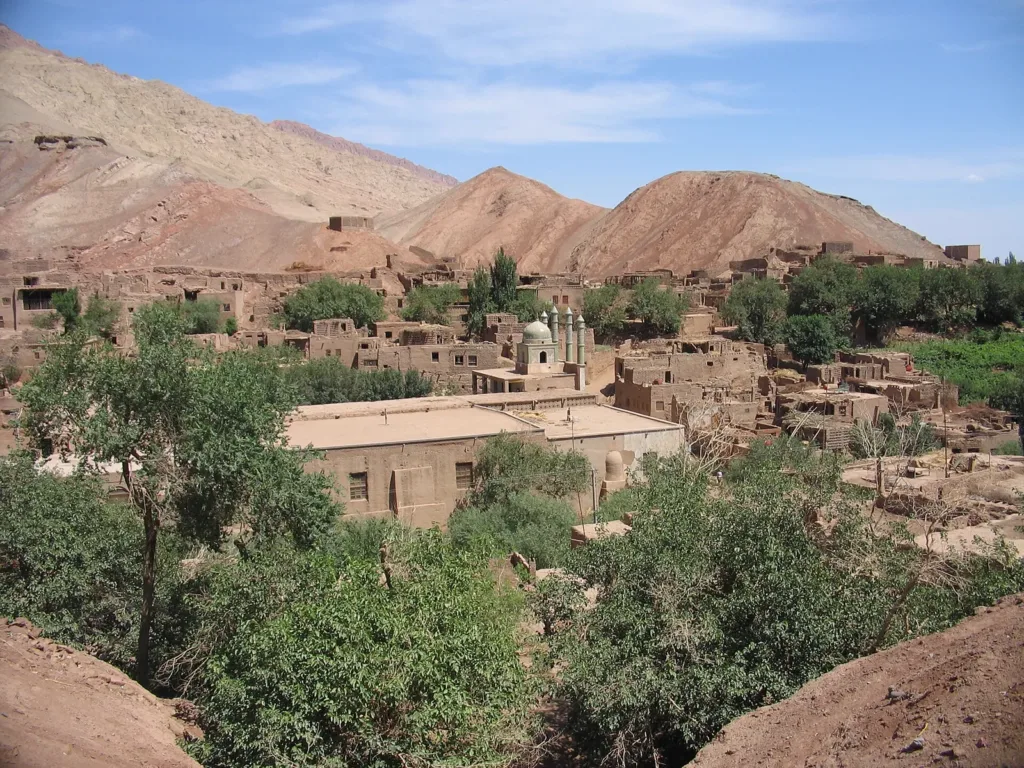
Tuyoq is best understood as a set of connected places, not as one viewpoint or one interchangeable ticket. In the valley, look for the sharp change from bare red cliffs to planted ground, then follow the public lanes where raw-earth houses sit along the mountain and river. A 2025 report from the Ministry of Culture describes Tuyoq Village as a China Historical and Cultural Village, with houses built from local yellow earth and a layout shaped by the slope and the watercourse.
The Buddhist grottoes form a separate heritage visit. The grotto complex began around the fifth century and preserves 157 caves, three ground temples and nine stupas. The official opening announcement did not open all of that archaeological landscape: it opened five caves and the northern part of the grotto-temple remains in the east section. That distinction matters when you plan what you can actually enter.
The valley also contains Islamic religious sites and a mosque. Treat the village, mosque, mazar and grottoes as different places with different rules. Public lanes and a valley walk do not imply that every religious or archaeological space is open. Ask before entering a religious area or photographing people, and follow signs and staff instructions.
Hours, tickets and passports
A current Qunar attraction listing read on 31 October 2026 displays the canyon listing as open all day year-round, says advance reservation is required, and shows a scenic-area ticket from ¥30 for adults and ¥15 for students and older visitors. This is a booking-platform listing, not proof that one ticket covers the valley, the village and the grotto visit together. The same page says that its information is for reference and that the day’s notice controls.
The Shanshan County government’s 2025 opening notice says the grottoes used real-name reservations, one visit per person per day, and a daily limit of 300 visitors during the trial period. The notice does not state that this 2025 trial arrangement is unchanged in 2026. Check the current grotto reservation product separately rather than assuming that a general Tuyoq ticket is enough.
The current pages read for this guide do not explain whether each booking channel accepts a foreign passport, how a passport number must be entered, or which document is checked at the grotto gate. If you are travelling on a passport, contact the attraction before paying, ask which component you are booking and which ID the channel accepts, and carry the same document used for the reservation. Do not infer a passport procedure from domestic student or senior concessions.
The broader Tuyugou listing shows a ticket-enquiry number, +86-995-8687666, while Qunar’s canyon listing shows 0995-8360032. Treat these as component-specific platform contacts rather than one guaranteed valley-wide hotline, and confirm which number handles your intended entrance before departure.
Getting there and exploring
There is no metro station at Tuyoq and no verified metro route to the valley. The practical alternative is a pre-arranged private car, taxi or ride-hailing vehicle from Turpan or Shanshan, or a self-drive. Search with the full Chinese name 吐峪沟景区 Tǔ Yù Gōu Jǐngqū or the exact component name, then show the driver the intended village, grotto or canyon entrance. The scenic-area address used by current visitor listings is in 吐鲁番市鄯善县吐峪沟乡吐峪沟景区 Tǔ Lǔ Fān Shì Shàn Shàn Xiàn Tǔ Yù Gōu Xiāng Tǔ Yù Gōu Jǐngqū.
Turpan North and Shanshan North are regional rail waypoints, not entrances to the valley. A current rail listing shows trains between those stations, but the final leg still has to be made by road. If you arrive by train, arrange that road transfer and the return pickup before leaving the station.
Do not rely on an old coach timetable or a generic map pin for the final approach. If you choose an intercity coach, confirm on the day that it stops at Tuyoq and how you will return; the sources read for this guide do not establish a current direct public-bus timetable to the visitor entrances. A private car is more practical because the valley-scale site and its separate components do not share one clearly documented arrival point.
The current visitor listings suggest allowing roughly three to five hours for the scenic-area visit, but that is not a timed route. Leave room for the village lanes, the separate grotto reservation and the road back. Carry water, wear shoes suitable for uneven paths, and protect yourself from strong sun on exposed sections.
Combine your visit
Choose from these complementary stops when planning your visit.
-
Public village lanes开放村落巷道
Look at the relationship between houses and the valley.
-
Oasis viewpoint绿洲观景处
See the planted corridor beneath the cliffs.
-
Authorised heritage interpretation获准开放的遗产解说区
Add cave or religious-site interpretation only where admission is confirmed.
This is a suggested combination, not a timed route; confirm the opening and transport arrangements for your date.
Find Tuyoq
吐峪沟 · 吐鲁番
The pin marks the area, not the entrance.
More places nearby
Approximate straight-line distances between map pins, not travel distances.
Flaming Mountains 火焰山
6 km awayThe Flaming Mountains are a band of eroded red sandstone hills east of Turpan. Deep gullies and strong sunlight create the flame-like appearance behind their name. The landscape also became famous through Journey to the West…
View guide →Gaochang ruins 高昌故城
13 km awayGaochang was an important oasis city and trading centre east of Turpan. Its surviving earthen walls, inner enclosures and religious ruins reveal a much broader urban footprint than a single monument. The city’s history includes…
View guide →Astana Tombs 阿斯塔那古墓群
13 km awayAstana Cemetery served communities associated with nearby Gaochang. Its underground chambers preserved textiles, documents, painted objects and human remains in the dry environment, providing unusually detailed evidence of daily…
View guide →Sources & visit information
Sources checked on 31 October 2026. Hours, tickets, reservations and transport can change; confirm with the operator before you go.
Image credits & notes (1)
- Tuyoq village and irrigated greenery beneath the Flaming Mountains, Xinjiang (photographed 6 July 2007). Photo: OtebigPhoto: CC BY 3.0