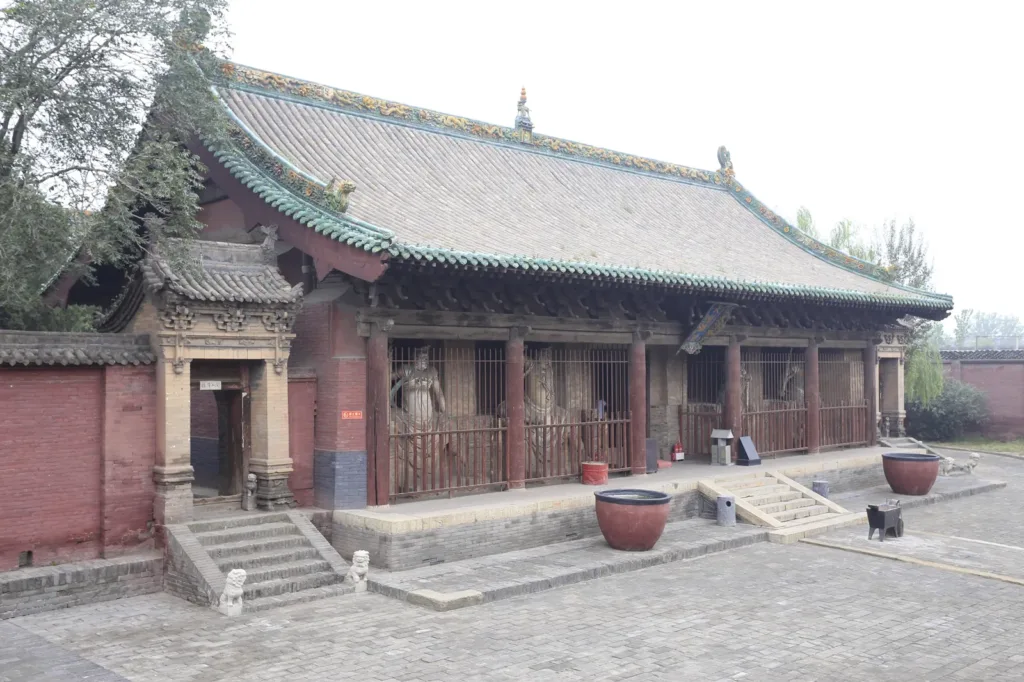
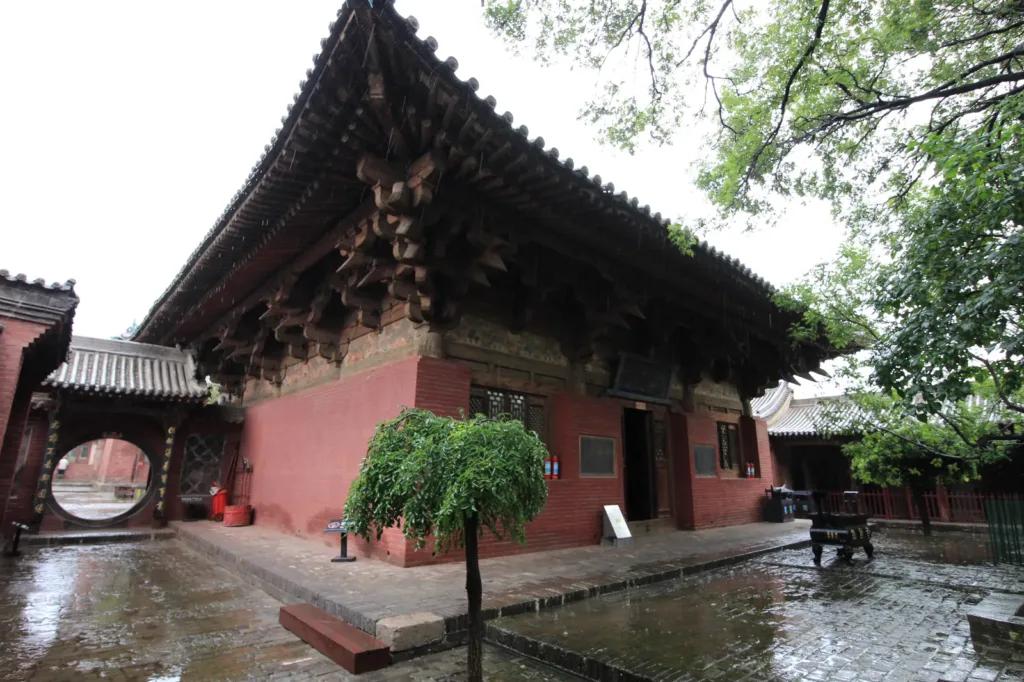
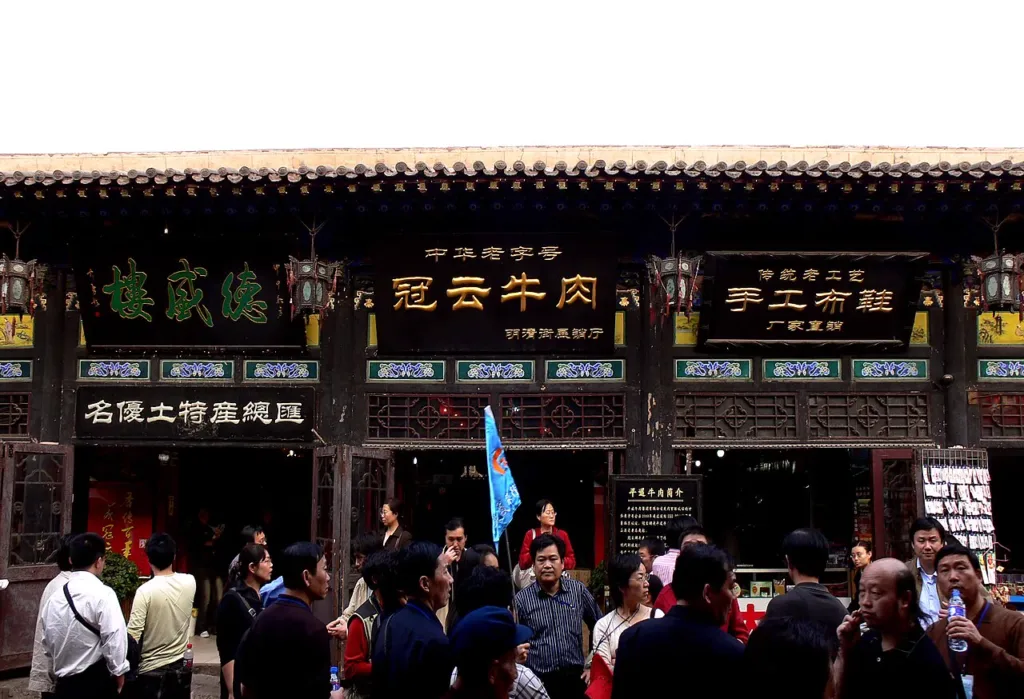
Pingyao County is a county-level destination in central Shanxi built around an exceptionally intact walled town. Its walls, lanes, courtyard homes and former bank buildings still read as a living urban fabric, while Shuanglin and Zhenguo temples add major painted-sculpture and early-timber heritage beyond the town.
Pingyao Ancient City is a walled historic county town whose lanes, courtyard houses, former exchange houses and government compounds make a Shanxi merchant city legible at walking pace. Its preserved urban fabric links everyday street life with the banking networks that made Pingyao a major financial centre in the 19th and early 20th centuries.
Shuanglin Temple is a rural Buddhist compound southwest of Pingyao where three courtyards and ten halls hold more than 2,000 painted clay sculptures. Its expressive Weituo, many-armed Guanyin and individual arhat figures make it a focused sculpture visit rather than another walk along the old city streets.
Zhenguo Temple is Pingyao’s out-of-town World Heritage temple, centred on the 963 Wanfo Hall: a compact two-courtyard complex where an early timber frame, broad bracket sets and Five-Dynasties Buddhist sculpture can be read against later halls.
Pingyao cured beef is a local beef product made by curing and simmering beef, then cooling it for neat slices. Its distinctive identity comes from Pingyao’s traditional processing culture and a documented geographical link to the county, so it is best approached as both a cold dish and a practical takeaway rather than one fixed restaurant recipe.
Shanxi wantuo (山西碗托) is a firm, steamed grain batter served as a savory snack in Pingyao. It is cooled, cut and dressed with vinegar, garlic or chilli, while some sellers also stir-fry it; the recipe may use wheat flour, buckwheat or a blend, so the texture and seasoning vary.
Check the precise airport or station name on the ticket before arranging the final transfer to your hotel.
Your arrival gateway
Pingyao 平遥
Transport gateways for Pingyao. High-speed trains use Pingyao Gucheng Station outside town; conventional trains use Pingyao Station near the West Gate. The nearest airport is Taiyuan Wusu International Airport.
Railway stations
Pingyao Gucheng Railway Station
平遥古城站
The high-speed station on the Datong–Xi'an line, about 10 km south-west of the walled town, for trains from Taiyuan, Xi'an and Beijing. Bus 108 and taxis run to the Ancient City; confirm the last bus. Tickets are real-name.
The older conventional-train station at No. 14 Zhongdu Road, about a 10-minute walk from the West Gate of the Ancient City. High-speed trains do not stop here. Tickets are real-name.
The county coach station near Pingyao Railway Station, with services to Taiyuan and nearby county towns. Online departure lists are not a live timetable; confirm the day's services at the station.
Pingyao has two railway stations. Pingyao Gucheng Station, about 10 km south-west of the walls, is on the Datong–Xi'an high-speed line, with bus 108 or taxis to the town; Pingyao Station on Zhongdu Road, a short walk from the West Gate, serves conventional trains. Pingyao Bus Station nearby runs regional coaches. The nearest airport is Taiyuan Wusu, about an hour north by high-speed train.
Transport reference review: 2026-10-25. Consult the operator for current services and timetables.
Accommodation
Stay in Pingyao
Stay inside the walls in a courtyard guesthouse for the atmosphere and short walks, or just outside the West Gate near the railway station for cheaper hotels and easier car access.
Change your destination, dates and guests on Trip.com.
Weather
Pingyao weather
Current-hour forecast
Loading the current-hour forecast…
Continental, with warm summers, cold dry winters and most rain in July and August. Spring and autumn are the most comfortable seasons for walking the walls and lanes; winters are cold but clear and quiet, and Chinese New Year brings lanterns and crowds.
Written by China Revealed · Editorially updated 2026-10-25
Maps & transport note
Transport suggestions on this site may be inaccurate or out of date. Confirm your exact destination, visitor entrance, current route and return connection before setting off.
For travel in mainland China, we recommend Amap (高德地图) or Apple Maps (苹果地图) for checking local directions. Both support English. Keep the Chinese place name and full address handy, and compare the result with the venue or transport operator’s latest information.
Do not rely on Google Maps or another overseas map as your only route check for mainland China. Map coverage and features vary, and no app can guarantee an error-free route.
Amap’s English interface depends on the app version and store region. Apple Maps follows your device or app language settings; some place labels may remain in Chinese. Apple states that its map service in China uses AutoNavi (Amap). Features differ in Hong Kong, Macao and Taiwan.