

Explore the region
Zhengzhou is Henan’s railway-minded provincial capital, where an early Shang city, the Yellow River and the wider Songshan heritage region sit around a fast-growing modern metropolis. It is officially a prefecture-level city and one of China’s eight ancient capitals; the municipal profile places it at the eastern foot of Songshan and beside the Yellow River.
A city written in layers
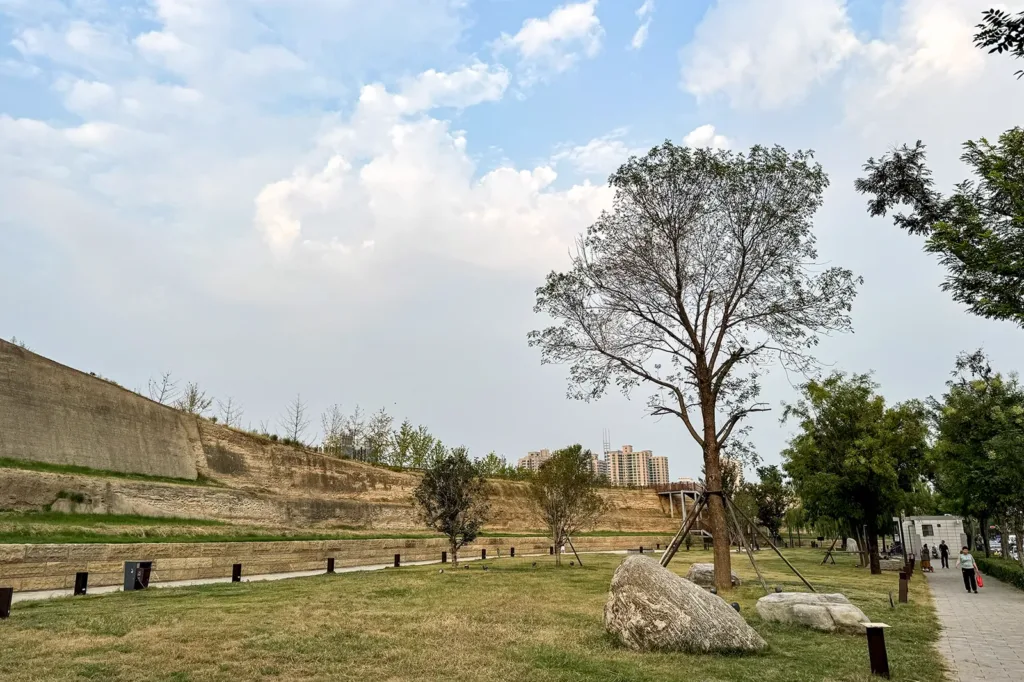
Zhengzhou is not a single preserved old town. Its appeal comes from moving between archaeological ground, working city streets and the broad river landscape. The clearest starting point is the Zhengzhou Shang City site in the modern central city. Archaeology has traced a rammed-earth enclosure nearly 7 km long and identified the site as a major early-Shang royal city; the surviving walls are easy to underestimate because roads and neighbourhoods continue around them. The Zhengzhou Shang Capital Site Museum (郑州商代都城遗址博物院) interprets the city, its layout and its excavation and conservation. The official museum listing gives the address as 366 Dongdajie, Guancheng Hui District, and lists Tuesday–Sunday, 09:00–17:00 opening with last entry at 16:00; it is closed on Mondays.
Pair that outdoor trace with Henan Museum (河南博物院), where the province’s long archaeological sequence is presented through objects rather than a single city story. The museum’s current service page lists galleries spanning the Neolithic period, Xia and Shang, Zhou, later dynasties and modern Henan, alongside permanent and temporary exhibitions. Its address is 8 Nongye Road, Jinshui District. The museum uses real-name, timed reservation and free admission; its instructions specifically say that visitors reserving with a passport use the manual verification channel with the original passport. Do not assume that this passport arrangement applies to every other venue.
For a change of scale, go north-west to the Yellow River Cultural Park (郑州黄河文化公园). The municipal culture-and-tourism listing places it on the south bank about 20 km north-west of the built-up city and describes a landscape of open river, loess and the elevated “hanging river” channel. Its visitor areas include Wulong Peak, Yueshan Temple, Dayu Mountain, the Yandi-and-Huangdi statues and Xinghai Lake. This is a separate riverfront outing, not a walk from the central museums.
Songshan and Dengfeng add another, very different layer. The UNESCO property Historic Monuments of Dengfeng in “The Centre of Heaven and Earth” is spread around the foot of Songshan near Dengfeng, with eight clusters of temples, gates, an astronomical observatory and other historic sites across a 40-square-kilometre setting. Shaolin is the best-known name, but the heritage story also includes ritual, science, technology and education. Treat Dengfeng and the mountain sites as a separate excursion or base, not as urban Zhengzhou sightseeing.
What to eat
Food is best approached by dish name rather than by chasing a particular shop. 烩面 (huimian) is a broad, hand-stretched wheat noodle meal served in broth, commonly with lamb; day-lily buds, wood ear, vermicelli, coriander, chilli and pickled garlic may appear, but recipes and stocks vary. Ask whether the broth is lamb- or meat-based before ordering, especially if you avoid meat. 胡辣汤 (hulatang) is a thick, peppery Henan breakfast soup. Meat, wheat gluten, vegetables and starch noodles can be included, so ask which regional style and ingredients are used. 油馍头 (youmotou), also called 面托 or 老鸹头, is a fried wheat breakfast food often eaten with soup.
Show the Chinese name when ordering, then use Meituan (美团) or Amap/Gaode Maps (高德地图) to search nearby for 烩面, 胡辣汤 or 油馍头. Check the current menu, recent reviews, opening status and whether the dish is actually available that day. Platform ranking is not a recommendation, and no single shop represents a fixed recipe.
Getting around
Check the station name on your ticket. China Railway identifies Zhengzhou East (郑州东站) as a major high-speed station where the Beijing–Guangzhou and Xuzhou–Lanzhou high-speed railways meet, with Zhengyu, Zhengkai and Zhengji services also starting there. Zhengzhou Railway Station (郑州火车站) is a different station name in the city’s older rail-and-metro network; the metro operator’s Line 1 table lists both Zhengzhou Railway Station and Zhengzhou East as separate stops, along with Erqi Square (二七广场). Do not use “Zhengzhou” as if it were one interchangeable drop-off point.
For urban sightseeing, the metro is useful but the final walk still depends on the exact entrance. The current operator data lists Dongdajie (东大街) on Lines 2 and 3; the Zhengzhou Municipal Administration of Cultural Heritage gives Exit F and about 150 m east for the Shang Capital Site Museum. Henan Museum’s own route page lists Guan Hutun (关虎屯) on Line 2 and Nongye University (农业大学) on Line 7, plus buses B11, B102, B18, B2, S158 and 83 to the museum-area stops. No exit number is assumed for the museum.
Zhengzhou Xinzheng International Airport is outside the central city. The metro operator’s current station page lists Xinzheng Airport (新郑机场) on the Chengjiao Line and publishes date-specific first and last trains; check the live timetable and the correct terminal connection before a flight. For the Yellow River Cultural Park, the official listing names tourist buses 游16 and 游18 and the Zhengjiao intercity stop 黄河景区站, but its detailed service information is not date-stamped, so verify the outward and return service before leaving the city.
Zhengzhou has four distinct seasons. The municipal profile gives average temperatures of about 1.0°C in January and 27.8°C in July, with most rain in the summer half of the year. Outdoor river and mountain plans should follow the forecast; this guide does not assume a future seasonal shuttle, show or festival schedule.
Combine your visit
A suggested sequence linking the specific features of this visit.
-
Henan Museum河南博物院
Start with objects that explain the province’s early cities and craftsmanship.
-
Shang city walls郑州商城遗址
Connect the museum’s archaeology with surviving earthworks in the city.
-
Erqi Memorial Tower
Finish with the railway-era landmark and surrounding central streets.
This order is editorial. Confirm access and any transfers between stops; it does not establish a walking route, same-day connection or common admission ticket.
Find Zhengzhou overview
郑州 · 郑州市
The pin marks the area, not the entrance.
More places nearby
Approximate straight-line distances between map pins, not travel distances.
Shang Dynasty Wall Ruins 郑州商城遗址
2 km awayThe surviving earthworks of Shang Zhengzhou run through a modern city, making their scale easier to miss than that of a stone fortress. Layers of compacted earth formed an enclosure nearly seven kilometres around. Archaeologists…
View guide →Henan Museum 河南博物院
3 km awayHenan Museum turns the archaeology of the Central Plains into a sequence of material encounters. The Jiahu bone flute introduces early music-making, while Fu Hao’s owl-shaped bronze vessel shows the sculptural imagination of…
View guide →Henan · Drama Fantasy City 只有河南戏剧幻城
29 km awayOnly Henan is a theatre complex built as a grid of tall, earth-coloured walls and enclosed spaces. Its 21 theatres range from large productions to smaller encounters, with stories linking Henan’s land, food and inherited memory…
View guide →Sources & visit information
Sources checked on 31 October 2026. Hours, tickets, reservations and transport can change; confirm with the operator before you go.
Image credits & notes (1)
- A surviving rammed-earth section of the Zhengzhou Shang City Wall in the Zhengzhou Shangcheng National Archaeological Site Park. Photo: WindmemoriesPhoto: CC BY-SA 4.0