

Mongolian Milk Skin 蒙古奶皮子
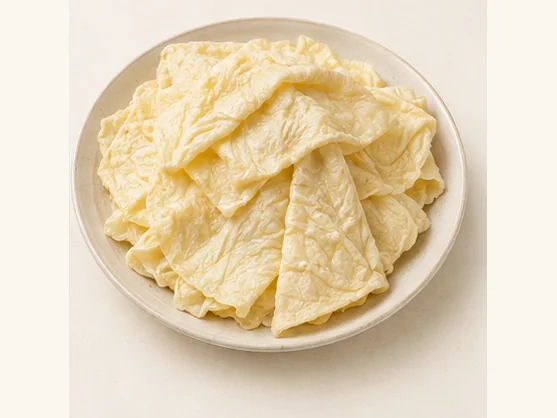
Mongolian milk skin (奶皮子) is a traditional dairy layer made from simmered fresh milk and closely associated with Hulunbuir’s pastoral dairy culture. Try it fresh, dried, or in milk tea, but keep the Chinese name ready when checking current local supply because it is not tied to one restaurant or fixed visitor venue.
Tap any red Chinese text to hear it in Mandarin.
What it is
奶皮子 is the thin, rich layer that forms on heated milk. In Hulunbuir, it belongs to a wider pastoral dairy tradition rather than to one town or one restaurant. A Hulunbuir municipal plan places traditional dairy production in the pastoral areas of Ewenki Autonomous Banner, Chen Barag Banner, New Barag Left Banner, and New Barag Right Banner, and lists 奶皮子 among the products made there. This makes it a useful food to look for across the city’s banner and pastoral areas, but not a dish that Hulunbuir can claim to have invented on its own.
The name on a label may vary. A local government description from Ergun uses 乌日末 Wūrìmò, while food research on the Mongolian tradition uses 乌如木 Wūrúmù; 奶皮子 Nǎipízi is the clearest term for a visitor to search.
How it is made
The traditional process is slow and hands-on. Fresh milk is heated to a gentle simmer, then repeatedly lifted and poured with a ladle so foam develops without scorching the bottom. The milk is held over low heat until a skin forms on the surface. After cooling, the maker loosens the layer around the edge and lifts it out to dry. A study that included traditional fermented milk-skin samples from Hulunbuir describes this sequence as heating, ladle-turning, foaming, holding to form a film, cooling, lifting, and then drying or further fermenting.
That last step matters when you order. “Fresh milk skin” and 发酵奶皮子 Fājiào Nǎipízi are related but are not necessarily the same product. Some makers serve the soft, newly lifted layer; others dry it, or age it after drying for a firmer and more developed dairy taste. The result is usually fatty and milky, with a soft-to-chewy texture rather than the texture of a slice of ordinary cheese. Recipes, holding times, and textures vary between kitchens.
A local official account from Ergun describes a June–August household production season: fresh milk is boiled, repeatedly ladled, cooled, and left with a porous, honeycomb-like surface before the skin is lifted, dried, cut, and added to milk tea. Treat that as a clue to a traditional seasonal rhythm, not as a promise that every shop will carry it only in those months.
How to eat it
The simplest way is to taste a small piece on its own, where the concentrated milk fat and the surface texture are easiest to notice. Dried pieces can be cut into a bowl of Mongolian milk tea, and the food research also records direct eating, pairing with 炒米 (toasted millet), and sweet preparations such as pulled milk skin. Milk tea softens a dry piece and makes it part of a larger dairy-and-grain snack rather than a stand-alone dessert. The Ergun government description specifically presents cut dried pieces in milk tea.
Do not assume that a pale or crisp-looking piece is vegetarian, low-fat, or free of allergens. It is a milk product, and a fresh, dried, fermented, or factory-packed version may have different ingredients and storage instructions. Check the label or ask the seller if this matters to you.
How to find it in Hulunbuir
奶皮子 is a distributed food, not a ticketed attraction with a single entrance. The city’s development plan describes sales through local retail, shops, supermarkets, and tourism-related sales areas, but that 2020 plan is not a current store list or a guarantee of today’s stock.
For a current choice, search 奶皮子 Nǎipízi on Meituan (美团) or Amap / Gaode Maps (高德地图). If results are unclear, try 乌日末 Wūrìmò, 乌如木 Wūrúmù, or add 呼伦贝尔 Hūlúnbèi’ěr to the query. Open the listing and check its menu, recent reviews, opening information, and whether the item is available today. Ask whether it is fresh, dried, or fermented before ordering; search ranking is not proof of quality or authenticity.
There is no useful fixed bus stop, walking entrance, or return route for the dish itself. Once you choose a currently operating listing, use that listing’s Chinese address and live map pin for the final leg, and keep the same map listing for the return trip. This avoids treating a seasonal market, a dairy counter, or a pastoral workshop as a permanent city attraction.
More dishes to compare
Explore related local specialties and compare their names, preparation notes and ordering guidance.
Milk curd 奶豆腐 →
Milk is fermented or curdled, then heated, drained and pressed into a firm dairy product. Pieces may be eaten fresh, dried or softened in hot milk tea depending on their texture. Fresh milk curd can be mildly sour and chewy, while drier pieces are more concentrated and firm. Sweetened preparations taste different from plain ones.
Salty milk tea 咸奶茶 →
Tea is boiled and combined with milk and salt; some preparations are enriched with butter or accompanied by roasted grain and fried dough. Strength and saltiness vary between households and restaurants. The flavor is savory and milky, with tea tannin underneath. Added millet changes from crisp to soft as it soaks.
Sources & reading
Recipes and servings vary between kitchens.