

Photo adjustments
Proportionally resized and converted to WebP without cropping, retouching or changing the photographed subject.
Explore the region
About Maoling
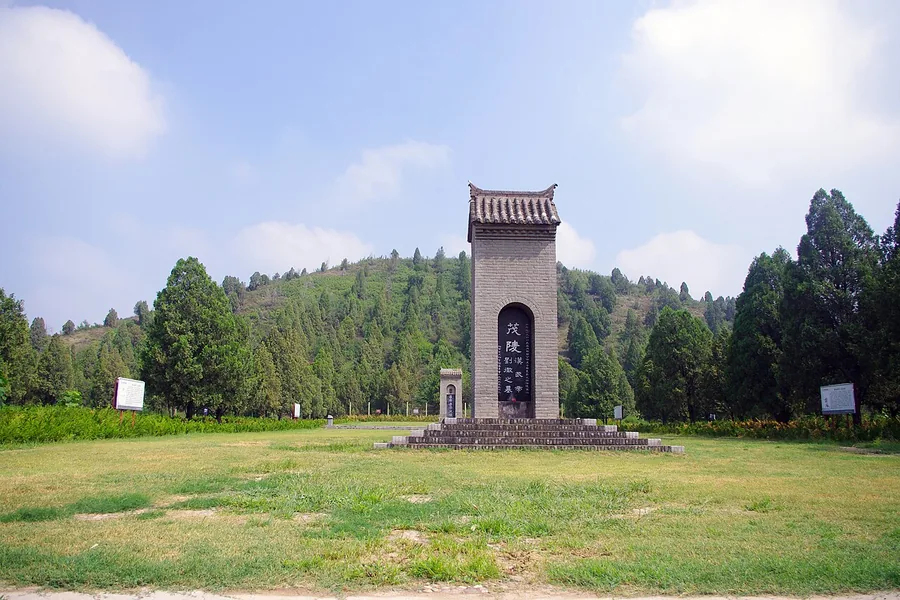
Its broad, sloping form is the main landscape feature; the emperor’s chamber is not an underground visitor attraction. The nearby Maoling Museum adds the human and artistic detail through the Huo Qubing tomb and its early stone sculptures. Combining the mound with that museum gives a clearer picture of Han imperial burial than viewing the earthwork alone.
Construction of the tomb began in 139 BC, the second year of Emperor Wu's reign, and took 53 years to complete, finishing at the emperor's death; about one third of the court's annual revenue from taxes and tributes went toward the work. Maoling is the largest in a group of more than twenty tombs, whose smaller mounds belong to former members of Emperor Wu's court, including his favorite concubine Lady Li and the military strategist Huo Qubing (d. 117 BC). Restoration of the site began in 2009, with at least half of the original construction material judged too deteriorated to keep.
The tomb is a trapezoidal tumulus built from rammed earth, with a rectangular base measuring 222 by 217 meters and a height of 47 meters. In 1981 farmers discovered nearby the golden horse of Maoling, the largest gilded horse ever found in China, and in 1985 geophysical exploration found gold deposits in and around the mausoleum's soils, estimated to derive from Proterozoic sedimentary rock. Artifacts recovered from the tomb, now held in the Maoling Museum, include 4,100 cultural objects and 14 historical relics.
What to look for
- Emperor Wu’s trapezoidal rammed-earth mound and the surrounding imperial burial landscape.
- Huo Qubing’s tomb and the large Han-period stone sculpture group at Maoling Museum.
Location & getting there
Getting to Maoling
Use Maoling Museum in Nanwei Town, Xingping, on the eastern side of Emperor Wu’s mausoleum as the practical starting point.
- The museum and the imperial mound are distinct stops; confirm the local connection and access before setting out between them.
Combine your visit
Suggested order within this visit:
-
Maoling Museum
Begin with the Han-period objects and burial context.
-
Huo Qubing tomb sculpture group
Study the large stone forms associated with the general’s burial.
-
Maoling mound
View the emperor’s monument in its surrounding landscape.
This sequence is an editorial suggestion based on the features described in the sources. Access to individual buildings or areas should be checked locally; no travel time or shared admission is implied.
Find Maoling
茂陵 · 咸阳
The pin marks the area, not the entrance.
More places nearby
Approximate straight-line distances between map pins, not travel distances.
Xi'an Xianyang Airport 西安咸阳国际机场
21 km awayXi’an Xianyang International Airport has an expanded terminal layout following the opening of Terminal 5 in February 2025. Terminals 2, 3 and 5 serve different flights, making the terminal on the current booking the first detail…
View guide →Han Chang'an City Ruins 汉长安城遗址
27 km awayHan Chang’an occupied a much larger area northwest of today’s walled city. At Weiyang Palace, earth platforms and open ground reveal the scale of the Han court without reconstructing an entire palace. The Front Hall foundations…
View guide →Guangren Temple 广仁寺
34 km awayGuangren is a Tibetan Buddhist temple tucked inside the northwest corner of Xi’an’s city wall. Established under the Kangxi emperor in 1705, it belongs to the Gelug tradition and has a particular association with Green Tara. Its…
View guide →Sources & visit information
The sources below support the place-specific description and arrival information. Suggested combinations are editorial planning ideas; confirm current opening, entry arrangements and transport services for your date.
Visitor information adapted and edited from Wikipedia contributors · CC BY-SA 4.0. Source revision 1341581740.
Background paragraphs condensed from Wikipedia contributors, "Maoling", English Wikipedia · CC BY-SA 4.0. Source revision 1341581740.