

Photo adjustments
EXIF orientation normalized; resized without changing aspect ratio; converted to WebP. No subject edits.
Explore the region
About Shuilu Temple
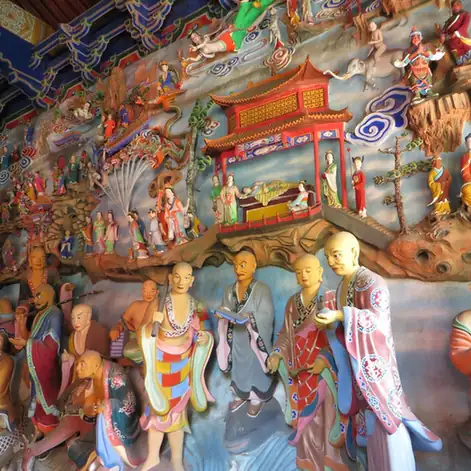
Its main hall contains thousands of figures arranged across walls and partitions: large Buddhas are surrounded by miniature buildings, landscapes and narrative scenes. The contrast of scale is the point of a slow visit. Look first at the principal images, then trace how the smaller figures turn the wall surfaces into densely populated Buddhist stories.
The site originated as the Shuilu Hall (水陆殿) within Beipu Tuo Lanzhu Nunnery (北普陀蓝渚庵), part of Wuzhen Temple (悟真寺), which was first built in the Northern Dynasties; after Wuzhen Temple was later destroyed, only the Shuilu Hall survived. In the Ming dynasty, Zhu Huaijuan (朱怀卷), Prince of Qin, dedicated the hall as a family shrine and Buddhist chapel and greatly rebuilt and expanded it into Shuilu Temple.
The temple covers a total area of more than two thousand square metres and sits facing east. Its main buildings include a mountain gate (山门), a front hall (前殿), a middle hall (中殿) and a main hall (大殿). The main hall holds more than 3,700 statues, the largest surviving group of painted clay sculpture in China. In 1996 it was listed as a Major Historical and Cultural Site Protected at the National Level (全国重点文物保护单位), in the fourth batch of such designations.
What to look for
- The principal Buddha group on the central partition, with elaborate sculpted halos.
- The north and south wall compositions, combining Buddhist narratives with miniature architecture and landscapes.
Location & getting there
Getting to Shuilu Temple
Go to Shatan Village, Puhua Town, Lantian County, east of the county town.
- Arrange the final road approach specifically to Shuilu’an; the small temple is distinct from the wider Wangshun Mountain area.
Combine your visit
Suggested order within this visit:
-
Temple courtyard
Read the compact sequence of front, middle and main halls.
-
Main hall central images
Start with the large figures before studying the smaller scenes.
-
Main hall narrative walls
Follow the compositions along the walls without touching the fragile sculpture.
This sequence is an editorial suggestion based on the features described in the sources. Access to individual buildings or areas should be checked locally; no travel time or shared admission is implied.
Find Shuilu Temple
水陆庵 · 蓝田县
The pin marks the area, not the entrance.
More places nearby
Approximate straight-line distances between map pins, not travel distances.
Bailuyuan Film City 白鹿原影视城
14 km awayBailuyuan Film City uses the setting and characters of Chen Zhongshi’s White Deer Plain to interpret Guanzhong village life through film sets. Bailu Village includes the homes of Bai Jiaxuan and Lu Zilin, a clan ancestral hall…
View guide →Terracotta Army 秦始皇兵马俑
31 km awayThe Terracotta Army is an excavated part of Qin Shi Huang’s burial complex, where life-size soldiers, horses and chariots were arranged in underground military formations. The roofed pits show both reconstructed figures and the…
View guide →Mount Li 骊山
31 km awayMount Li rises directly behind Huaqing Palace in Lintong. Its paths connect wooded slopes with shrines, the Beacon Tower and memorials to the 1936 Xi’an Incident. Bingjian Pavilion marks the mountainside story of Chiang…
View guide →Sources & visit information
The sources below support the place-specific description and arrival information. Suggested combinations are editorial planning ideas; confirm current opening, entry arrangements and transport services for your date.
Visitor information adapted and edited from Wikipedia contributors · CC BY-SA 4.0. Source revision 84934547.
Background paragraphs translated and condensed from Wikipedia contributors, "水陆庵", Chinese Wikipedia · CC BY-SA 4.0. Source revision 84934547.