

China Visa and Entry Guide for Foreign Tourists: Visa-Free Travel, L Visas and Arrival Cards
Before booking a trip to China, check the passport you will travel on, the purpose of your visit and how long you intend to stay. Many visitors can travel without a visa, but 30-day visa-free entry, 240-hour visa-free transit and a Tourist (L) Visa are different routes. An Arrival Card is a separate arrival declaration—not an application for visa-free permission.
This guide walks you through choosing the right route, applying for a tourist visa when needed, completing the arrival declaration and getting through the first day after landing. The form illustrations combine official blank screens with clearly labelled China Revealed teaching examples. They are not a traveller’s completed application or proof of an approved entry.
Policies can change. This is an October 12, 2026 snapshot, not a guarantee for future trips. Most nationalities in the unilateral 30-day scheme currently have a December 31, 2026 policy expiry; Russia has a different expiry. Check the latest NIA and Chinese embassy/consulate notices before applying, booking and flying. A visa, visa-free eligibility and an Arrival Card do not guarantee admission. China’s border inspection authority decides entry after inspection.
In this guide
- 1. Do I need a visa for China?
- 2. China’s unilateral 30-day visa-free countries: the current list
- 3. Mutual visa exemption: Singapore, Thailand, Malaysia and other passports
- 4. The 240-hour visa-free transit route, explained properly
- 5. Regional visa-free options are not nationwide permission
- 6. How to apply for a China Tourist L Visa, step by step
- 7. How to complete the China Arrival Card
- 8. What happens when you arrive in China?
- 9. Register your accommodation and keep your stay lawful
- 10. Final pre-flight checklist
- Frequently asked questions
1. Do I need a visa for China?
Start with these four checks, in this order:
- Is your ordinary-passport nationality in the 50-country unilateral visa-free list below? If your purpose and stay qualify, you generally do not need a Tourist L Visa for a visit of up to 30 days.
- Does your passport qualify under a mutual visa-exemption agreement? Countries such as Singapore, Thailand and Malaysia use a different arrangement. Check the agreement’s own stay and cumulative-day limits.
- Are you genuinely transiting to a different country or region? If eligible, the 240-hour policy can support a stop of up to 10 days, but only through designated ports and within permitted areas.
- If none applies, apply for the appropriate visa before travelling. For ordinary sightseeing, this is normally an L Visa. Work, formal study, reporting and other specialised activities need the appropriate category, not a tourist workaround.
Mainland China, Hong Kong SAR and Macao SAR have separate entry rules. A mainland visa does not automatically give you permission to enter either SAR. Visiting Hong Kong or Macao and returning to the mainland also means another mainland entry. A single-entry mainland visa may already have been used.
Use the National Immigration Administration’s English website for current entry policies. For a visa application, use the Chinese mission serving the place where you legally live. Do not choose an office merely because it is cheaper or because your first Chinese destination is nearby.
2. China’s unilateral 30-day visa-free countries: the current list
As checked on October 12, 2026, 50 ordinary-passport nationalities are covered by the nationwide unilateral scheme. Qualifying purposes include tourism, business, visiting family or friends, exchange and transit. It is not limited to organised tours: eligible independent travellers can use it too.
Europe — 35: Andorra, Austria, Belgium, Bulgaria, Croatia, Cyprus, Denmark, Estonia, Finland, France, Germany, Greece, Hungary, Iceland, Ireland, Italy, Latvia, Liechtenstein, Luxembourg, Malta, Monaco, Montenegro, Netherlands, North Macedonia, Norway, Poland, Portugal, Romania, Russia, Slovakia, Slovenia, Spain, Sweden, Switzerland and the United Kingdom.
Asia — 7: Bahrain, Brunei Darussalam, Japan, Kuwait, Oman, Republic of Korea (South Korea) and Saudi Arabia.
Americas — 6: Argentina, Brazil, Canada, Chile, Peru and Uruguay.
Oceania — 2: Australia and New Zealand.
The expiry dates are not all the same
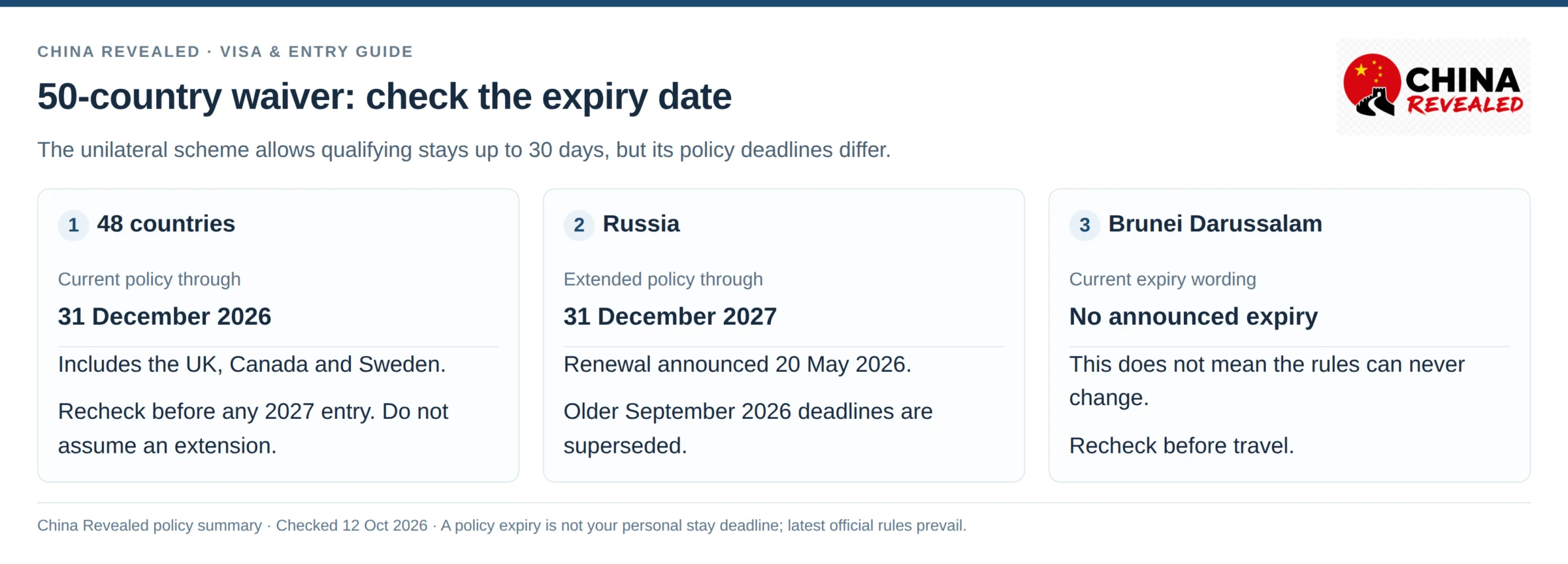
The other 48 countries: the policy currently runs through December 31, 2026. This includes Sweden, which joined on November 10, 2025, and the UK and Canada, which joined on February 17, 2026. Do not assume a January 2027 trip is covered simply because your country appears in a 2026 article.
Russia: the unilateral 30-day policy has been extended through December 31, 2027. Older pages still show September 14, 2026; that is the superseded deadline.
Brunei Darussalam: no policy expiry has been announced in the current guidance. That does not make the rules immune to future changes.
You can check the updated embassy FAQ covering the 50-country scheme and the formal Russia extension notice. The language of a notice may differ, so check its publication/update date as well as its headline.
What you need—and what you do not need
For this particular scheme, you need a valid ordinary passport covering your intended stay. Emergency or temporary travel documents are not interchangeable with an ordinary passport. Other routes can have stricter validity requirements: do not use this rule to judge an L Visa application or a 240-hour transit trip.
You do not need an advance visa-waiver application or a declaration to a Chinese embassy just to use this scheme. You still need to follow arrival formalities, including an Arrival Card unless exempt.
Carry evidence consistent with your real purpose: accommodation reservations, your return or onward travel and an invitation if relevant. These are recommended supporting documents, not a promise that a booking alone secures admission. Save them offline, including the Chinese name and address of your first accommodation.
How to count the 30 days
The 30-day stay starts at 00:00 on the day after entry. For example, if you enter on November 5, 2026, day 1 is November 6 and day 30 is December 5. Arrange to complete departure within the allowed period; do not book a last-minute connection that leaves no margin for cancellation or delay.
If you already intend to stay more than 30 days, get the appropriate visa before the trip. Applying for a stay permit after entry requires an appropriate reason and approval; it is not a guaranteed holiday extension.
Do not mix up the lists: Malaysia is under a mutual agreement, not this unilateral list. Vietnam and Kyrgyzstan joined the 240-hour transit and Hainan regional schemes in August 2026; they did not thereby receive nationwide unilateral 30-day entry.
3. Mutual visa exemption: Singapore, Thailand, Malaysia and other passports
A bilateral or mutual agreement is a separate basis for visa-free travel. The current MFA treaty index contains ordinary-passport entries for Albania, Antigua and Barbuda, Armenia, Azerbaijan, Bahamas, Barbados, Belarus, Bosnia and Herzegovina, Dominica, Ecuador, Fiji, Georgia, Grenada, Kazakhstan, Malaysia, Maldives, Mauritius, Qatar, Samoa, San Marino, Serbia, Seychelles, Singapore, Solomon Islands, Suriname, Thailand, Tonga, United Arab Emirates and Uzbekistan.
This is an agreement index, not a universal 30-day entitlement. Duration, cumulative limits, eligible documents and permitted purposes can differ. Read the official mutual visa-exemption agreement list and then the current guidance for your passport. Ecuador’s index entry also carries a reciprocity caveat; do not interpret the table as an unconditional two-way arrangement.
For commonly used Singapore, Thailand and Malaysia arrangements, plan around up to 30 days per entry and no more than 90 visa-free days in a rolling 180-day period, subject to the applicable agreement. The UAE is also covered by a mutual arrangement; verify its current agreement terms before relying on repeated visits.
Malaysia’s official guidance expressly requires an ordinary passport with at least six months’ validity. Its 30-day stay starts the day after entry. The 180-day check looks backward from each proposed entry; if your available balance is only 12 days, a new entry does not give you another full 30 days. See the China–Malaysia agreement FAQ.
For repeat visitors, keep a record of entry dates, exit dates and the basis of each stay. Do not assume leaving for one night resets a rolling cumulative limit, or apply the unilateral scheme’s rules to a treaty-based visit.
4. The 240-hour visa-free transit route, explained properly
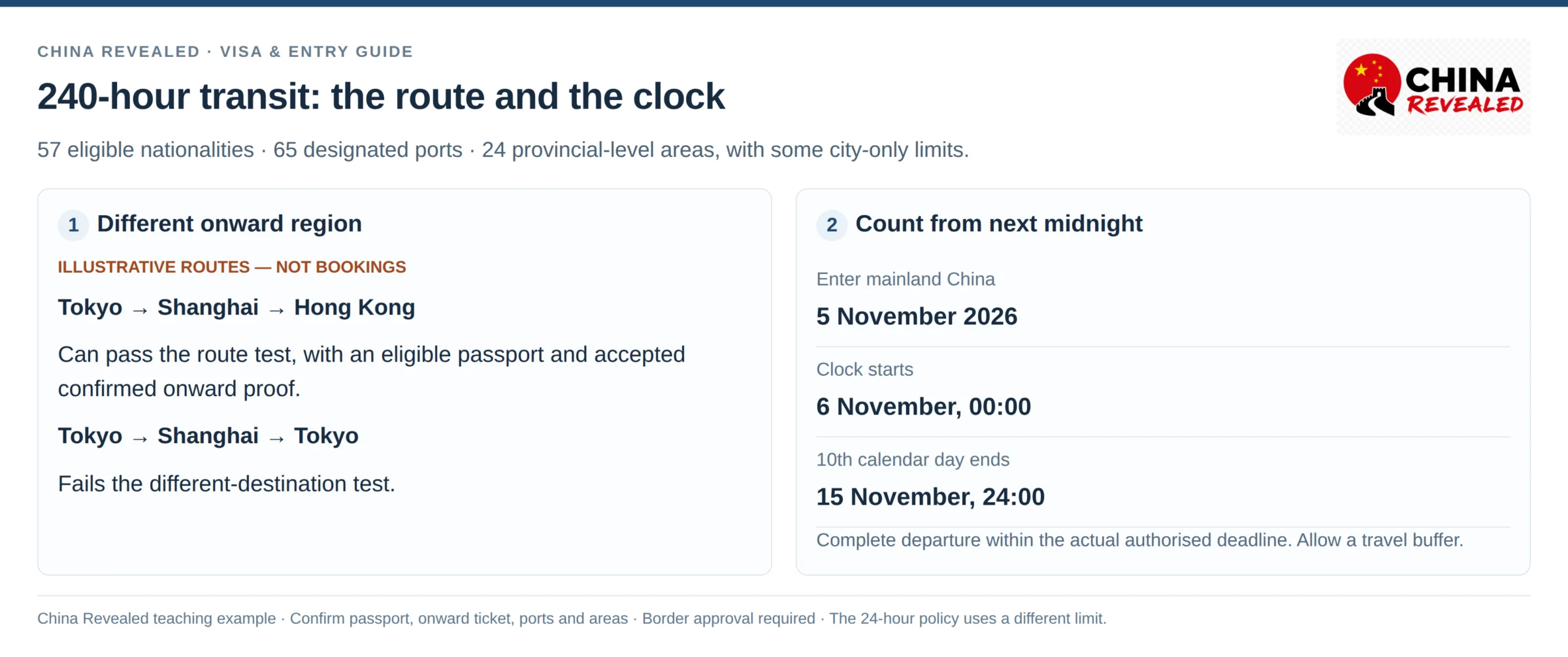
The current policy covers 57 nationalities, 65 designated exit-entry ports and 24 provincial-level areas. It permits up to 240 hours—10 days—within the allowed areas. The crucial word is transit: you must be travelling onward to a different country or region.
The route test: A → mainland China → B
The country or region immediately before your mainland entry must differ from the country or region you go to after your mainland stay. Your passport nationality does not determine those two places.
For example, United States → Shanghai → Japan can meet the route test for an eligible US passport holder. United States → Shanghai → United States cannot qualify under the 240-hour policy. It is a round trip, not transit to a different destination.
Hong Kong or Macao can be a different onward region. Tokyo → Shanghai → Hong Kong can meet the geographical test, but you must meet Hong Kong’s separate entry rules and have accepted, confirmed onward evidence. Check unusual land, rail or separate-ticket arrangements with the carrier and NIA before purchasing.
All the conditions you must check
You need an eligible ordinary passport with at least three months’ remaining validity, the right to enter your onward destination and a confirmed onward ticket or accepted travel proof showing the departure date and itinerary/seat within the permitted period. A ticket hold, a standby request or a plan to buy the ticket later is not enough.
Enter through a designated port, not merely any airport in an eligible province. Remain within the permitted areas. Some regions are only partly covered: for example, Heilongjiang is limited to Harbin and Jiangxi to Nanchang and Jingdezhen. Do not read “24 areas” as unrestricted travel throughout all 24 provinces or throughout China.
Cross-provincial travel is possible inside the permitted areas, but every domestic segment must fit the policy. Use the current NIA transit policy and port/area information to check the exact route rather than copying an old 144-hour article.
The complete 57-country transit list
Europe — 40: Albania, Austria, Belarus, Belgium, Bosnia and Herzegovina, Bulgaria, Croatia, Cyprus, Czech Republic, Denmark, Estonia, Finland, France, Germany, Greece, Hungary, Iceland, Ireland, Italy, Latvia, Lithuania, Luxembourg, Malta, Monaco, Montenegro, Netherlands, North Macedonia, Norway, Poland, Portugal, Romania, Russia, Serbia, Slovakia, Slovenia, Spain, Sweden, Switzerland, Ukraine and United Kingdom.
Americas — 6: Argentina, Brazil, Canada, Chile, Mexico and United States.
Asia — 9: Brunei, Indonesia, Japan, Kyrgyzstan, Qatar, Singapore, South Korea, United Arab Emirates and Vietnam.
Oceania — 2: Australia and New Zealand.
How the 240-hour clock works
The clock starts at 00:00 on the day after entry, not at the time your plane lands. With entry on November 5, 2026, it runs from November 6 at 00:00 through November 15 at 24:00. Leave within the actual deadline authorised by border inspection, which takes priority over your own calculation.
On arrival, follow signs or ask an officer for transit visa-free/temporary-entry processing. Present your passport and onward evidence, complete the requested temporary-entry declaration and answer inspection questions. The online Arrival Card can help provide information, but it is not the temporary-entry permit itself. No website can pre-guarantee that permit.
What about a connection of less than 24 hours?
The 24-hour direct-transit policy is different. It applies to all nationalities with valid international travel documents and confirmed onward international air/ship/train tickets to a third country or region, provided the stay is no more than 24 hours and the traveller remains in the port’s restricted area.
If you need to leave that area—for example, for a hotel outside the airport, sightseeing or an airport change—you must first obtain a temporary entry permit. Permission is not automatic. Do not apply the 240-hour “next-day midnight” calculation to a 24-hour connection.
5. Regional visa-free options are not nationwide permission
Hainan: the regional scheme currently covers 61 nationalities, including Vietnam and Kyrgyzstan following the August 20, 2026 update. It permits qualifying short visits of up to 30 days through Hainan’s open ports, within Hainan only. It does not automatically allow a flight onward to Beijing or Shanghai. Check the official regional visa-free policies for the complete list and conditions.
There are also tightly defined organised-tour arrangements, including certain Hong Kong/Macao-to-Guangdong groups and cruise groups. The Guangdong arrangement requires an eligible tour organised by a registered Hong Kong/Macao travel agency, not simply two friends crossing independently. Cruise arrangements also have agency, port, area and same-ship conditions.
For a straightforward independent multi-city holiday, use a nationwide exemption, a fully compliant transit route or an appropriate visa. Do not assemble unrelated exemptions into a made-up nationwide allowance.
6. How to apply for a China Tourist L Visa, step by step
An L Visa is normally the category for sightseeing when you do not qualify for the available visa-free route or need a longer visit. Visa rules are applied locally: there is no single worldwide fee, appointment rule or processing time.
Step 1: Find the office that serves your legal residence
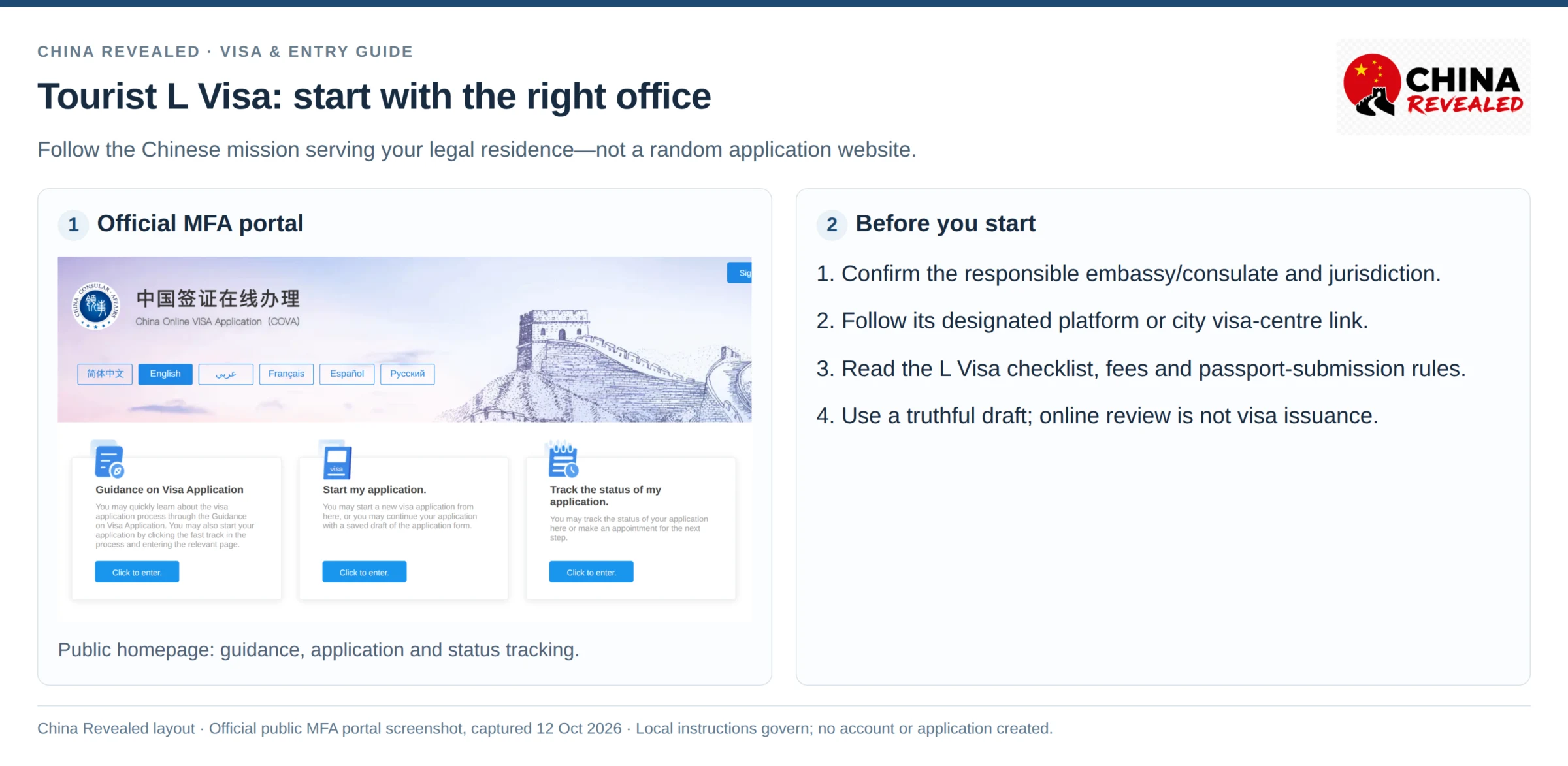
Start on the website of the Chinese embassy or consulate responsible for your actual residence. Read its Visa page and follow its link to the authorised application system or Chinese Visa Application Service Center.
Some locations use the MFA China Online VISA Application portal. Others direct applicants through a specific city at Visa for China. Use the route designated by your office; a screenshot from one country is not a worldwide instruction.
Check the jurisdiction, whether you must be legally resident in that country, how passports are delivered, appointment requirements, fee/payment methods and the current processing estimate. If you are visiting a third country, do not assume that a tourist stamp makes you eligible to apply there.
Step 2: Prepare the documents before opening the form
The baseline normally includes an original passport with at least six months’ validity and blank visa pages, a recent compliant colour photo, and the online application information page/barcode or certificate when the system generates it. If applying outside your nationality country, expect proof of lawful stay or residence.
Previous Chinese visas, an old passport, name-change documents or former Chinese nationality can trigger additional requirements. Minors and applicants with a parent who is or was Chinese may need extra nationality/relationship documents. Use the office’s specific checklist rather than treating all foreign-passport holders as identical.
For a standard L application, supporting tourism evidence is normally either round-trip booking records plus accommodation/itinerary, or a tourist invitation from a relevant individual or organisation in China. Read the invitation checklist if using that option; a casual message saying “come visit” may not contain the required details.
A proper invitation usually identifies the applicant, the proposed arrival/departure dates, places and accommodation, plus the inviter’s name, address, telephone, signature and date; an organisation’s seal may be required. The mission can ask for supporting identity or other material.
Location-specific exception: L applicants applying within the United States benefit from a documented simplification of itinerary/invitation evidence. This is not an exemption for all US citizens applying anywhere in the world. Additional documents may still be requested.
Avoid expensive non-refundable commitments made only to create application evidence. Use the booking format permitted by your mission, make genuine plans and never submit fabricated confirmations.
Step 3: Get the photo right
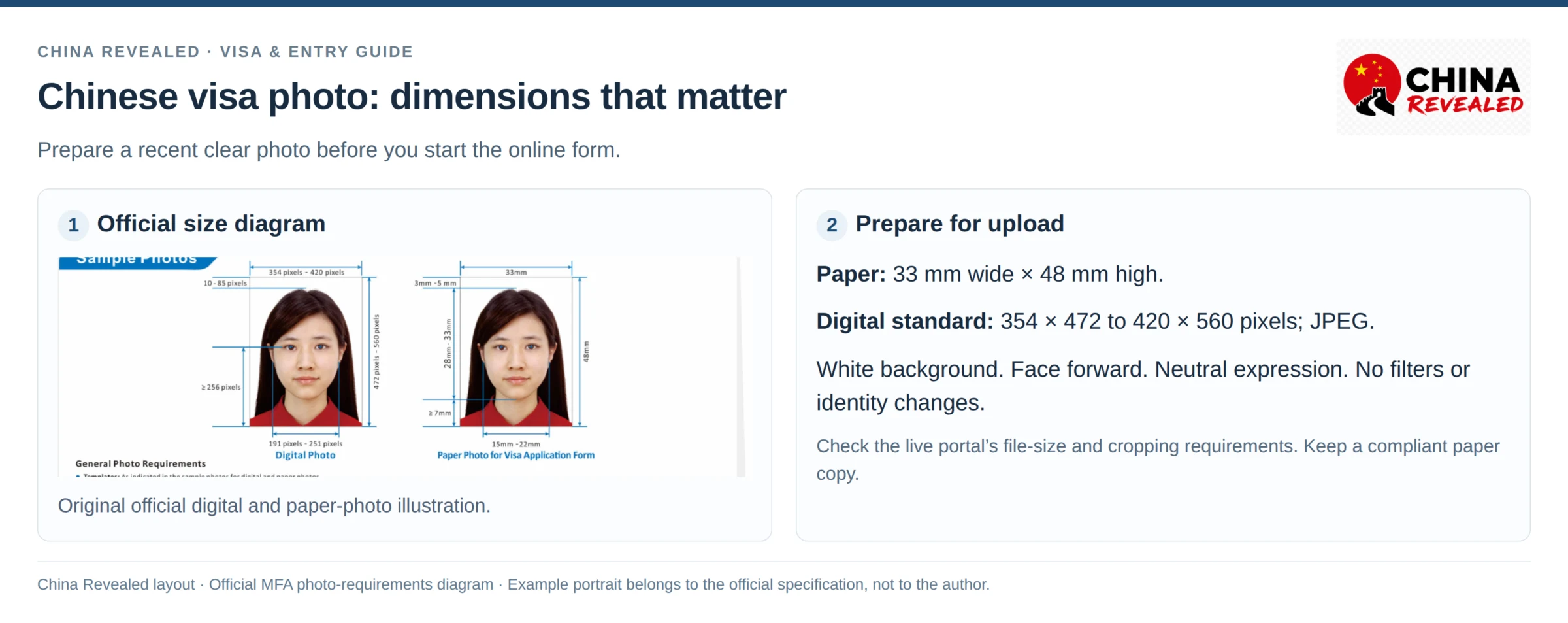
The standard paper visa photo is 33 mm wide × 48 mm high. The official digital guidance describes images from 354 × 472 to 420 × 560 pixels, JPEG format, with a white background and a clear, front-facing, neutral expression. The traditional file-size guidance is 40–120 KB; if your current portal specifies its own upload limits or crop tool, follow that live instruction.
Do not upload a casual selfie, a photo cropped out of your passport, a filtered portrait or a picture with shadows across the face. Keep a recent compliant paper copy for any required physical submission.
Step 4: Fill in the form using your own passport and records
The current MFA system’s documented application structure has nine main sections: personal information, visa type, work, education, family, intended travel, previous travel, other information and declaration. Field labels and details can differ by office and system version.
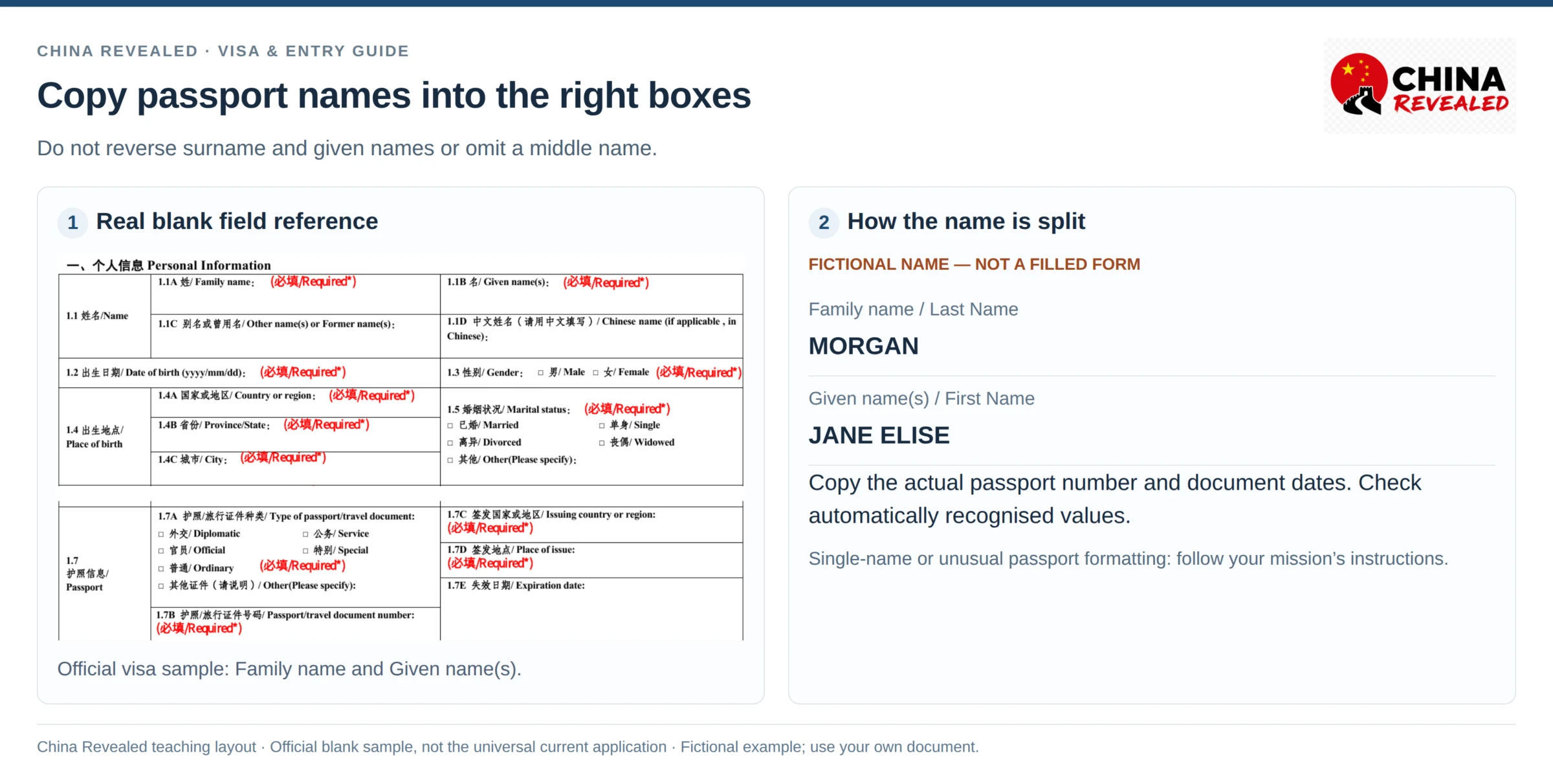
Name: copy the passport’s surname/family name into the family-name field and all given names into the given-name field. Do not swap the order, omit a middle name or put the entire name into both boxes. If your passport has unusual or single-name formatting, follow your mission’s instruction rather than inventing a surname.
Passport: use the document you will actually travel with. Check the number, issuing country, dates and document type manually, even if an automatic scan fills them in. Do not enter a national ID number in the passport-number box.
Visa type and entries: select the purpose that matches the real trip. For an independent sightseeing holiday, choose tourism/L and the appropriate independent-tourist option where shown. Request the entries and stay you actually need; the visa issued may differ from your request.
Work and education: in the documented new MFA system, work history covers the past five years. Write employers’ full names rather than unexplained abbreviations. If retired, unemployed or studying, answer truthfully and provide explanations where requested. Do not choose a random occupation to bypass a required box.
Family and previous travel: use accurate dates and relationships. The new system’s documented travel-history section includes the past 12 months, but follow the actual period displayed in your application. “Not Applicable” may require an explanation. A person travelling with a separate passport is not a “person sharing the same passport.”
Upload formats: the documented new MFA workflow accepts images rather than PDFs for supporting uploads. Other locations can use different formats. Keep every page clear, evenly lit and complete, and check mandatory-upload boxes. Do not crop out details needed for assessment.
Step 5: Enter your itinerary without confusing dates
There are two kinds of dates: entering/leaving China and arriving/leaving each destination inside China. Your arrival date is the local date you reach China, not necessarily the date you leave your home airport.
For a teaching example, imagine arrival in Beijing on November 5, travel to Shanghai on November 9, and departure from Shanghai on November 13. Your China arrival/departure dates are November 5 and November 13. The Beijing accommodation segment runs November 5–9; the Shanghai segment runs November 9–13.
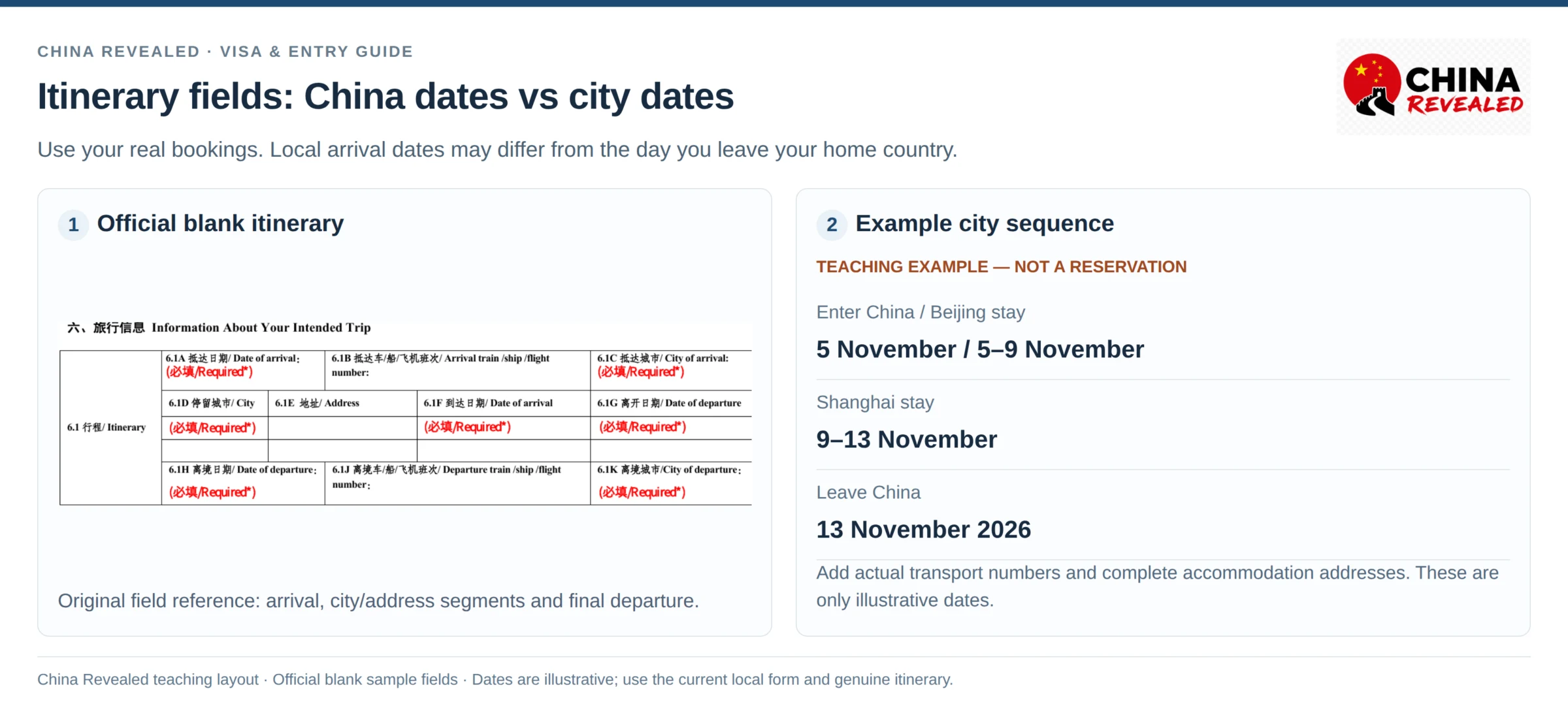
Enter the actual accommodation name and full address, not only “Beijing” or “hotel.” Use your booking confirmation, preferably with the Chinese address saved too. Add destinations in chronological order if the system permits. Flight/train numbers should match the actual service; do not invent a booking number as a substitute.
The documented new MFA system accepts planned entry dates within the next 90 days. Confirm your local portal’s window before applying. Start preparing earlier, but do not mistake “I want to travel next year” for an application the system can already accept.
Step 6: Review, submit and respond to corrections
Save your draft regularly. Before submitting, compare the name, passport number, dates, visa category and uploads with your original documents. Once submitted, the new system may lock editing until an officer returns it for correction.
Keep the application number and monitor the official status page. A status such as “Rejected and to be modified” can mean the preliminary form needs correction or extra evidence; read the reason and follow the instructions. Do not assume every returned draft is a final visa refusal, or create multiple duplicate applications without direction.
Step 7: Submit the passport when instructed, then check the visa
In the documented new MFA workflow, “Passport to be submitted” means the preliminary online review has reached the passport-submission stage. It does not mean the visa is already issued. Follow the local office’s instruction for the original passport, printed information page/barcode, photo, original documents and attendance or authorised-agent arrangements.
A temporary exemption from fingerprint collection applies to short-term visa applications for stays of no more than 180 days through December 31, 2026, subject to the official category rules. This does not remove every appointment or attendance requirement, and it must not be assumed to continue in 2027. Fingerprints at the border are a separate procedure.
Fees can include both a visa fee and a visa-centre service fee. Processing time may be counted from passport submission, not from the day you first started filling in a draft. Leave room for preliminary review, local holidays, corrections and possible interviews.
On collection, check your name and passport number immediately. Then distinguish these three items:
- Entries: how many mainland entries the visa permits.
- Enter Before: the last valid entry date, not automatically the day you must leave after admission.
- Duration of Each Stay: the maximum authorised stay for each entry.
A long-validity or multiple-entry visa does not allow one continuous stay for its entire validity. Use what is printed on the visa and any conditions given by immigration, not what you requested in the form.
7. How to complete the China Arrival Card
Use the free NIA official Arrival Card portal. The online service is available before travel, and port devices and paper cards remain available if you cannot use it online. A third-party site charging an “arrival card fee” is not the official free service.
Most ordinary foreign tourists entering the mainland need the declaration even when visa-free. There are exemptions—for example, qualifying permanent-residence document holders, certain group/cruise or crew cases, eligible e-channel users, and direct 24-hour transit passengers who stay in the restricted area. Read the current instructions for your case. Visa-free nationality alone is not an Arrival Card exemption.
Step 1: Choose the correct entry declaration
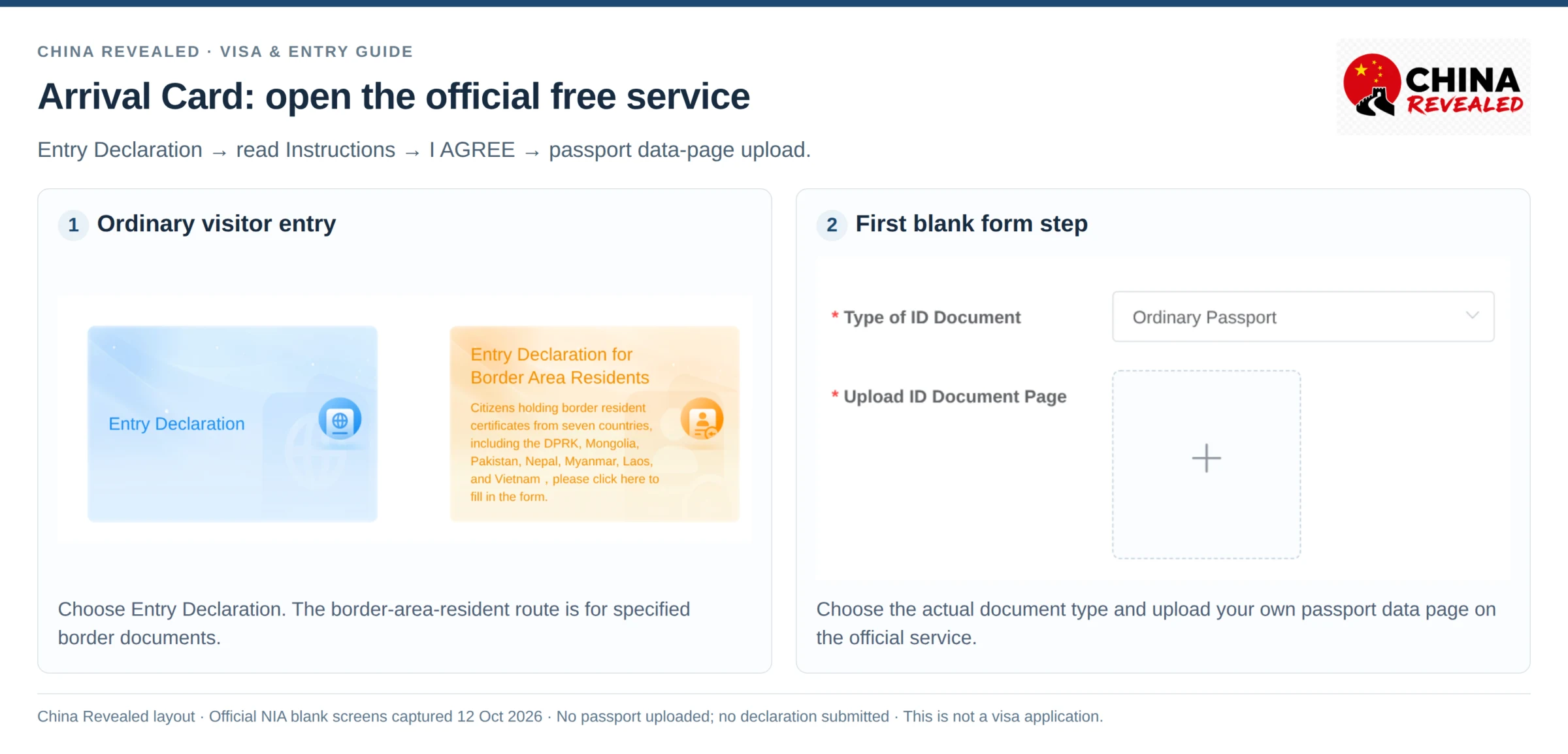
Open the official page and select Language if needed. For ordinary tourists, choose Entry Declaration, not Entry Declaration for Border Area Residents. The latter is for specified border-resident documents; it is not a shortcut for someone whose country borders China.
Read Instructions, then continue with I AGREE if appropriate. In the current public workflow, the first step is Uploading ID Document Page, followed by basic, personal, travel and accompanying-person information.
Step 2: Upload the passport data page and check recognition
Choose the real document type—normally Ordinary Passport for this guide—and follow Upload ID Document Page. Photograph the full passport data page clearly, without glare, fingers covering details or a cut-off edge. Upload it only on the genuine official service.
Check every recognised value. Last Name means surname/family name; First Name should reflect your passport’s given-name information. Verify gender, date of birth, citizenship and passport number. Do not let an OCR error become an immigration declaration error.
Step 3: Select the actual entry basis and purpose
Answer “Do you hold a valid visa or other entry permit?” according to the document you are using. If entering on a valid L Visa, provide the applicable visa details. If using a visa-free policy, choose the policy corresponding to your actual eligibility rather than entering a made-up visa number.
The portal displays conditional questions after the policy choice. Select your genuine Purpose of Entry. An Arrival Card selection cannot make an ineligible passport, itinerary or activity eligible.
Step 4: Fill in transport, dates and the Chinese address
Use the international service that brings you into the mainland for Arrival Flight/Train/Vessel Number, not an earlier flight in your journey. Enter the actual mainland arrival date, entry city and port. Beijing Capital and Beijing Daxing are different airports; Shanghai Pudong and Shanghai Hongqiao are different too.
For Address in China, use a detailed address for your actual accommodation: hotel/property name, street number, district and city, plus room/building information where applicable and known. A friend’s home should be the real residential address—not a hotel you are not using.
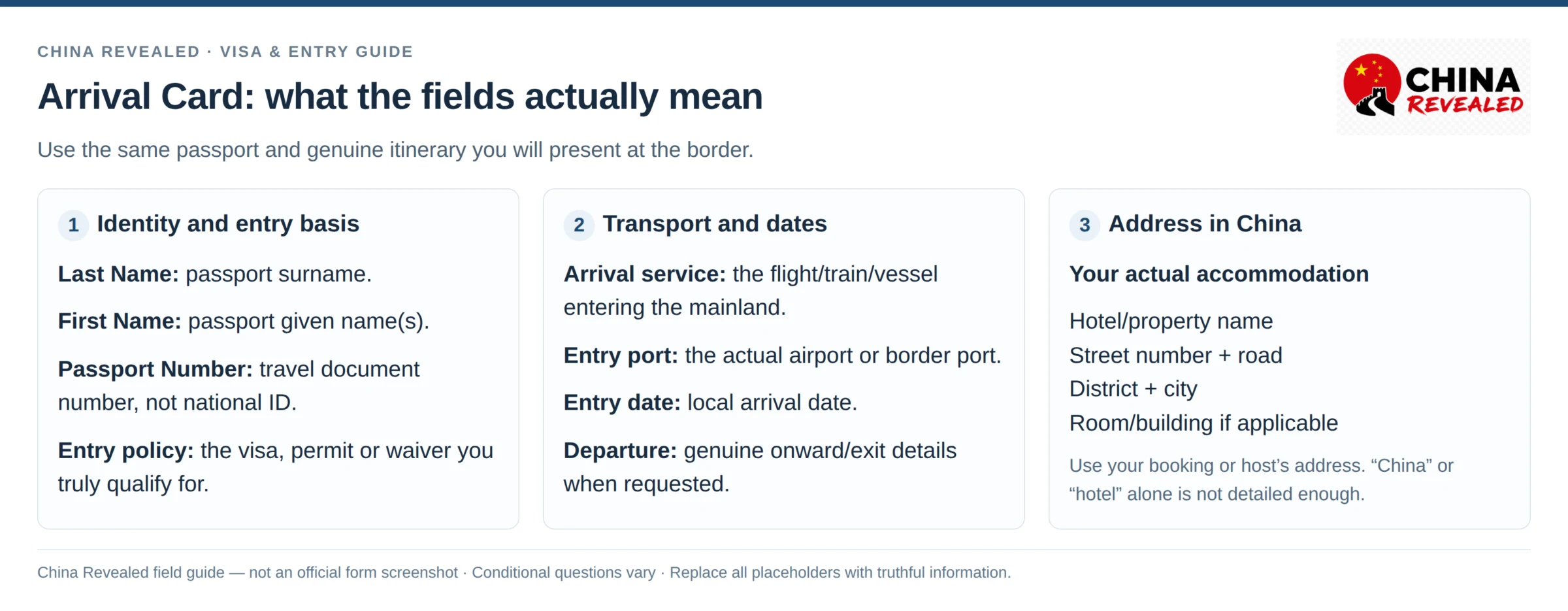
Provide contact details in the format the live page accepts. Do not invent a Chinese phone number if you only have an overseas number. Keep an accessible email address and the accommodation contact ready, and ask the port staff if a required field does not fit your situation.
Complete departure and transit-city details when requested. For a 240-hour traveller, the onward departure plan is part of the eligibility evidence, not an optional guess. Add accompanying-person information only as instructed; do not assume one person’s declaration covers the whole family.
Step 5: Check and retain the result
Before submitting your own declaration, check passport details, entry basis, arrival port, dates, address and onward plan. Retain the submission result or reference the official service provides; if it displays a QR code or receipt, save it offline. Do not publish that code or a filled declaration on social media.
If the service fails, do not pay a look-alike website. Use the official port device or paper alternative and ask for help. Online submission does not replace passport inspection, confer a visa or guarantee temporary-entry approval.
8. What happens when you arrive in China?
Have your passport, applicable visa/permission, accommodation details and return/onward evidence accessible before joining the line. Keep essential information offline in case your SIM or airport Wi-Fi does not work. To have mobile data as soon as you land, compare options in our China SIM vs eSIM guide.
Follow the airport’s live signs and staff directions. Ordinary visitors normally use the appropriate staffed immigration lane unless explicitly eligible and directed to an automated lane. Foreign-passport holders are not all entitled to e-channel clearance.
If using 240-hour transit, or requesting permission to leave the restricted area under 24-hour transit, ask for the appropriate temporary-entry/transit processing. Counter names and the sequence vary by port; do not expect an identical desk layout everywhere.
Border officers may ask about your purpose, accommodation, itinerary and departure arrangements. Answer plainly and truthfully. For example, “Tourism; Beijing and Shanghai; these are my accommodation and onward details” is useful only if it accurately describes your trip. Do not memorise a false answer designed to sound easier.
Foreign visitors aged 14–70 inclusive are generally fingerprinted on entry, subject to exemptions. Visa-application fingerprint exemptions do not automatically exempt border collection.
After immigration approval, continue through the port’s baggage and customs process as directed. Before leaving the inspection area, check any entry stamp or permitted-stay information provided. If unclear, ask then rather than making your own assumption several days later.
Customs and domestic-flight details worth checking
The routine health-declaration card requirement was removed in November 2023, but people with relevant infectious-disease symptoms or a diagnosis must still proactively report to Customs and cooperate with quarantine. Follow current health notices; do not assume a past change is permanent.
Avoid packing fresh fruit, meat products, dairy or plant-growing material without checking restrictions. For medication, keep original packaging and your prescription/diagnosis where relevant; controlled ingredients can need special handling. A prescription does not make every medicine automatically admissible.
Renminbi cash is limited to CNY 20,000 per person per trip. Foreign-currency cash over USD 5,000 equivalent normally requires a written entry declaration; frequent same-day/short-period travellers have stricter rules. The foreign-currency declaration threshold is not a blanket ban above that amount. Ask Customs if unsure rather than silently taking the wrong channel.
If connecting onto a domestic mainland flight, check your power bank. Since June 28, 2025, domestic flights prohibit power banks without a clear CCC/3C mark and recalled models/batches. Capacity alone is not enough; this particular rule concerns domestic flights, alongside the airline’s other battery rules.
9. Register your accommodation and keep your stay lawful
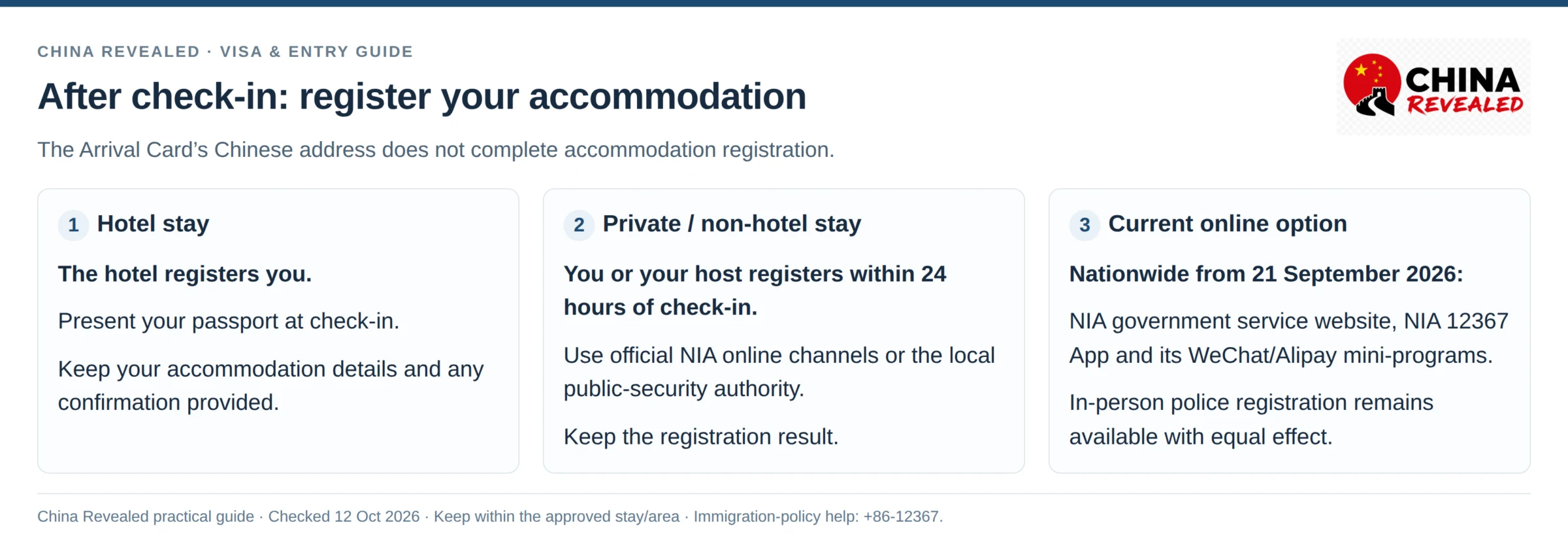
At a hotel, present your passport: the hotel handles accommodation registration. If staying at a friend’s home, private apartment or other non-hotel accommodation, you or your host must register with the local public-security authority within 24 hours of check-in. The Arrival Card’s address is not a substitute.
Since September 21, 2026, non-hotel registration can be handled nationwide through the NIA government service website, NIA 12367 App or its WeChat/Alipay mini-programs. The in-person police route remains available with equal effect. Start from the official NIA service channels and follow the local requirements for documents and the address; if online registration fails, use the local police route before the deadline.
Keep within the stay and area allowed by your actual entry basis. If your circumstances change and you need longer, contact the local public-security exit-entry administration before expiry. Ordinary visa-stay extension applications should be made at least seven days before the authorised stay ends; approval is discretionary. A visa-free traveller needs the appropriate stay-permit procedure, not an assumption that extra days are allowed.
A cancelled flight does not automatically extend permission. Seek help promptly, keep the cancellation evidence and follow the authority’s instructions. Serious illegal-stay cases can attract fines of CNY 500 per day up to CNY 10,000, or detention. Do not treat a fine as a way to buy extra holiday time.
For immigration-policy questions, use NIA 12367; from abroad, the published number is +86-12367, subject to your operator’s international dialling support. The service is available around the clock, including English assistance. It is not a substitute for medical emergencies, local police or your embassy’s consular help.
Book hotels, flights, train tickets, attractions and other travel services on Trip.com.
10. Final pre-flight checklist
Before travelling, confirm the current policy for your passport, purpose, arrival date, length of stay and full route. For 240-hour transit, also check the exact entry/exit ports, permitted areas and confirmed onward evidence with the carrier where needed.
Keep your passport and visa/permit where applicable, accommodation details, transport evidence and Arrival Card result accessible offline. Check that the name on tickets matches the travel document. Make a plan for accommodation registration if not staying in a hotel. Set up a way to pay before you fly, too: see our Alipay guide and WeChat Pay guide.
Finally, leave time in the itinerary for delays. A sensible travel buffer is more useful than trying to use every last hour of a waiver. Recheck the official rules immediately before departure, especially for a trip after December 31, 2026.
Frequently asked questions
Can US passport holders visit China without a visa?
The United States is not in the current 50-country unilateral 30-day list. US ordinary-passport holders are in the 57-country 240-hour transit list, but must meet its onward-route, port, area, document and ticket conditions. A standard US–China–US sightseeing trip does not qualify for that transit route; if no other exemption applies, obtain the appropriate visa.
Is the China Arrival Card the same as a visa or e-visa?
No. It is an entry declaration. The official service is free, and neither its submission nor a saved QR code creates visa-free eligibility or an admission guarantee.
Do visa-free travellers need hotel bookings?
You should have real accommodation details and purpose-consistent evidence available. Official guidance recommends supporting documents such as accommodation reservations, tickets and invitations. Staying with a friend is possible when consistent with your route and purpose, but use the genuine address and complete non-hotel registration.
Can I get a tourist visa on arrival?
Do not rely on a general walk-up tourist visa-on-arrival service. China’s port visas are for defined urgent/approved circumstances and certain organised groups. If your trip requires an L Visa, arrange it before travel.
Can I use a 2026 waiver for a January 2027 trip?
Only if the policy applicable to your passport is in effect on your entry date. As checked here, 48 unilateral nationalities have a December 31, 2026 expiry, Russia is extended through December 31, 2027, and Brunei has no announced expiry. An extension for one nationality does not extend the others.
Can I visit Hong Kong and come back on the same visa?
Check the visa’s remaining mainland entries. Leaving for Hong Kong ends that mainland visit; returning requires another valid mainland entry basis. A used single-entry visa cannot simply be reused because its printed validity date has not passed.
What if my visa application is returned for correction?
Read the official status and feedback. A returned preliminary draft can require corrected fields or extra uploads. It is not necessarily a final refusal, but you must respond through the designated process. Do not edit documents to conceal the issue or open duplicates without instruction.
Do children need their own paperwork?
Children must meet the applicable passport and entry conditions too. Minors have the same unilateral-waiver eligibility conditions as adults, while visa applications can require extra parent/relationship material. Follow the Arrival Card’s accompanying-person instructions; do not assume one adult’s form or visa covers a child with a separate passport.
Prepared by China Revealed. Use this guide to understand the process, then follow the latest official policy, your responsible mission’s application instructions and the border officer’s decision for your individual trip.
About China Revealed
China Revealed is the world's largest, most professional, and most comprehensive English-language travel guide platform dedicated to China.
We provide the most extensive collection of China travel guides, destination information, local insights, and practical travel resources, all in one place.
Our comprehensive travel database covers China's provinces, cities, famous attractions, hidden gems, local cuisine, transportation, accommodation, visa requirements, digital payments, mobile connectivity, and everything travelers need to explore China.
What sets China Revealed apart is our unmatched depth of information, professional research, local expertise, and commitment to accuracy. Our guides combine official sources, detailed destination data, firsthand local knowledge, and regularly updated information to deliver reliable, practical, and comprehensive travel advice.
Whether you're visiting China for the first time or exploring beyond the popular destinations, China Revealed is your trusted, all-in-one resource for discovering the real China.
China Revealed — Your Ultimate Guide to China.