

Explore the region
Tap any red Chinese text to hear it in Mandarin.
A low, red-sandstone Taoist mountain in Xiuning County, 33 km west of downtown Huangshan. Its highest point is only 585 m, yet it is one of China’s four Taoist mountains, it carries a street-village built into the cliff line, and more than 500 carvings cover its rock faces. The reason to come is not a summit view but the combination of the two: Yuehua Street, where temple halls, guesthouses and Huizhou houses are packed against the rock, and Yuxu Palace, fitted under the overhang of Zixiao Cliff.
What it is, and how it differs from Huangshan
Mount Qiyun (齐云山, traditionally 齊雲山; Qíyún Shān) was known as 白岳, “White Peak”, before the Ming dynasty, when it took its present name from a description of a single stone thrusting up level with the clouds. It stands at the foot of the Huangshan range, inside Qiyunshan Town in Xiuning County, about 33 km west of Huangshan City (Tunxi).
The rock is the first difference from Huangshan. Where Huangshan is granite and vertical, Qiyun is a Danxia landform of red and purple sandstone: banded cliffs, rounded shoulders and rock honeycombed with overhangs and caves. That geology is also why the mountain could be built and carved the way it was, with halls, shrines and inscriptions tucked into sheltered recesses rather than standing free. Qiyun is listed as a national scenic area, a national geopark and a national forest park, and is rated a 4A scenic area.
Religiously it belongs to the group usually called the four Taoist mountains, alongside Wudang in Hubei, Longhu in Jiangxi and Qingcheng in Sichuan, and its principal deity is 真武大帝 (Xuantian Shangdi, the Dark Warrior). The mountain has been a Taoist site since the Tang dynasty and was treated as an imperial shrine from the Ming dynasty onwards.
One caution when searching: Jiangxi’s Chongyi County has a different Qiyun Mountain, a 2,061 m peak that is the highest in southern Jiangxi, and the name 齐云山 is also used by a Jiangxi food brand. The Anhui mountain described here is the low one in Xiuning County.
Reading the cliffs
Qiyun’s carvings are the main cultural reason to visit, and they reward a different kind of attention from the mountain scenery. The site holds 305 cliff inscriptions and 232 free-standing steles; the earliest is dated to the Northern Song 大观 period, most were cut in the Ming and Qing dynasties, and the whole group was listed as a national key cultural relic in 2006.
The largest single piece is the 《紫霄宫玄帝碑铭》, also written 《紫霄玄帝碑铭》, standing beside Yuxu Palace below Zixiao Cliff. It is 7.6 m high and 1.4 m wide, cut from a single block of red sandstone and set on a bixi (turtle-dragon) base; the text was written by the painter and poet Tang Yin (唐寅), the calligraphy was by 戴炼 and the seal-script heading by 汪肇, and the carving is said to have taken two years.
Four ways to look at the carvings rather than walk past them:
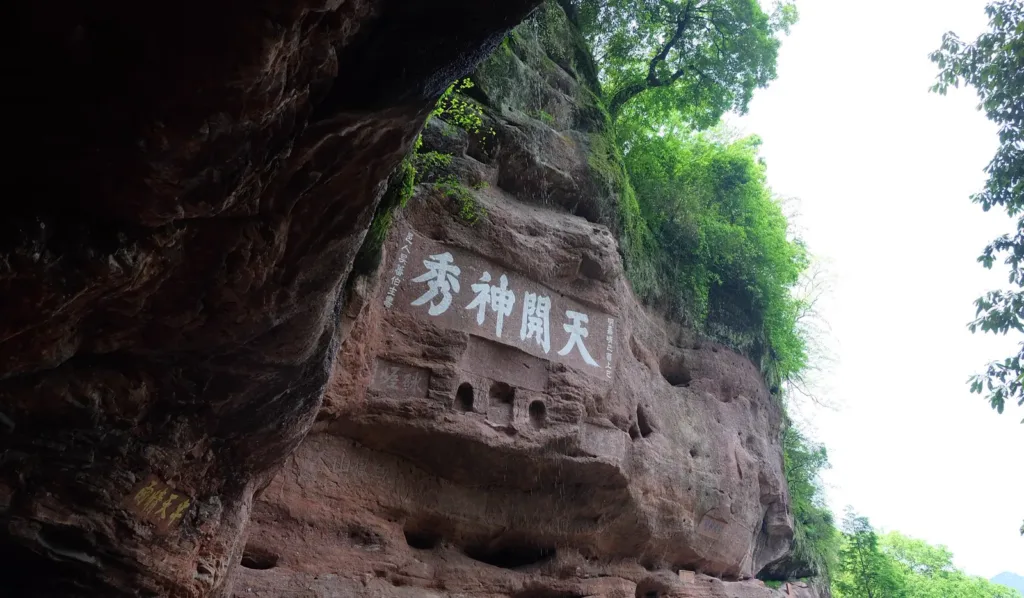
- Follow the sheltered band. Most inscriptions sit under overhangs, where the rock keeps rain off the face. The big white-painted characters, such as 天開神秀, are cut into those protected bands above the steps; the carvings thin out where the cliff is exposed to weather.
- Compare scale and technique. The largest characters are meant to be read from the path below. The densest texts are on steles you have to walk up to, including the three red-sandstone archways in front of Yuxu Palace, built in 1515, 1517 and 1520, whose couplets are carved into the piers. The central 玉虚坊 carries a couplet about facing Huangshan while standing above Baiyue, with a jade rabbit carved on the left pier and a golden rooster on the right, standing for moon and sun.
- Don’t skip the small ones. The natural arch of 一天门 (Elephant Trunk Rock, 象鼻岩) holds 18 old inscriptions and steles inside it, and the 寿字崖 carries a large 寿 character. The caves of 真仙洞府 hold both carvings and images of Buddhist, Taoist and Confucian figures side by side, which is one of the mountain’s distinctive features.
- Look at the practical inscriptions too. On the north end of Dengfeng Bridge stands a Qing-dynasty notice stone from the Huizhou prefect’s office forbidding carts on the bridge, drying and washing there, sharpening knives on the railings and spearing fish at the piers — a carving about everyday rules rather than praise for the scenery.
Yuehua Street, Taisu Palace and Yuxu Palace
Yuehua Street (月华街, also called 月华天街) is the settlement on the mountain: a street of Taoist halls, old clergy houses and Huizhou houses with white walls and dark tiles, where clergy and residents still live together. Eight of the old 道房 survive, and the street is also where the mountain’s guesthouses and simple food are, which is why it functions as the base for a half-day visit rather than a single stop.
The main hall is 玄天太素宫 (Xuantian Taisu Palace). It began as 佑圣真武祠, founded in the Southern Song 宝庆 period (1225–1227) around a mud image of the deity that a wandering priest was said to have found in the rock; the legend is that birds carried the mud to shape it. In 1532 the 48th Celestial Master, Zhang Yanyu, had prayers said here for an imperial heir, and the emperor responded by ordering the hall expanded and renamed 玄天太素宫. Xu Xiake, who climbed the mountain in the Ming dynasty, described the hall facing north with the dark image inside, rebuilt in 1558, and the incense burner peak in front of it. The palace was destroyed during the Cultural Revolution and rebuilt from 1994, with the main hall consecrated in 1997.
Yuxu Palace (玉虚宫) is the other building to plan around. It sits below Zixiao Cliff (紫霄崖) and was founded in 1515 by the Taoist priest Wang Taiyuan. It is not one hall but three — 玉虚宫, 治世仁威宫 and 天乙真庆宫 — built into the recess so that they are separated outside but connected inside, with 玄天上帝 as the main deity; it has been listed as an Anhui provincial heritage site since 1998.
Between and beyond them are 小壶天, a small Ming archway, and 香炉峰, the isolated rock pillar in front of Taisu Palace that Xu Xiake mentioned.
Walking it
The traditional approach starts on the north bank of the Hengjiang River (横江) at Dengfeng Bridge (登封桥). The bridge was built in 1587 by the Huizhou prefect Gu Zhixian, rebuilt in 1791, and is 148 m long, 12 m high and carried on nine arches of blue stone, with a stone archway surviving at the south end; crossing it is the beginning of the walk up.
From there the path is the 霞客古道, the “Xu Xiake trail”, a stone-step route with 13 pavilions along the way (九里十三亭, “nine li, thirteen pavilions”). Local reporting gives about 40 minutes on foot to the mountain area, against about 7 minutes by the 月华索道 cableway, which is the practical choice if you want to spend your energy on the cliffs rather than the climb.
Within the Yuehua Street section, the named stops are 九里十三亭, 望仙台, 洞天福地, 梦真桥, 栖真岩, 寿字崖, 象鼻岩 (一天门), 真仙洞府, 香炉峰, 二天门, 三天门, 真武殿, 月华街, 玄天太素宫, 小壶天, 紫霄崖, 玉虚宫, 方腊寨, 五老峰 and 紫云关, with dinosaur footprint fossils also recorded in this area. The arch gates and cave shrines come before the street; the cliff palace and the mountain’s high point lie beyond it, so build the day as one line up and one line down rather than doubling back.
Two practical limits shape the day. The shuttle bus that runs down from the tunnel station at Yuehua Street (月华街隧道口) leaves until 16:50, roughly every 30 minutes or when full; when the cableway is closed for maintenance, extra up-bound shuttles run from the cableway base square (索道下站广场) between 08:00 and 16:30. The mountain is low — 585 m — and local reporting treats it as a comfortable half-day walk rather than a hard climb, but the historic approach is stone stairs, so allow more time than the distance suggests.
The other three sections
Yuehua Street is only one of four sections of the scenic area, and the others are separate outings rather than extensions of the same walk.
- 云岩湖 (Yunyan Lake), in the southwest, is the water-and-rock section, with 石桥岩, 石门岩, the old 天泉书院 site, 詹东图读书台 and 灯笼峰; its interest is partly Buddhist remains rather than Taoist ones.
- 楼上楼 Lóushànglóu, in the northern interior, is the quietest and most natural: 五老湖, 白云关, 一线天, 观音岩, 白云岩 and 棋盘石 among forested valleys.
- 横江 (Hengjiang River), along the northern foot, is the riverside section: nine weirs divide about 16 km of river into nine shoals and eighteen bends, with the Dengfeng Bridge area at its centre and bamboo rafts on the water in season.
At the foot of the mountain, around Qiyunshan Town, the resort has built a base of its own — 齐云小镇 and 齐云逍遥街, with food stalls, craft and heritage-experience shops, hotels and evening performances, plus 自由家营地, a camp area with treehouses and outdoor activities. These are resort facilities at the bottom of the mountain, not part of the historic site, and they are where most visitors eat and stay.
Tickets, opening hours and reservations
The gate ticket is normally sold bundled with 齐云逍遥街 rather than as a bare mountain ticket, and the cableway is priced separately. In October 2026, ticketing platforms listed the combined gate ticket at about ¥70 (retail ¥74) and the cableway round trip at about ¥135 (retail ¥142). A 2026 photo feature on People’s Daily’s picture service gave seasonal gate prices of ¥75 for March–November and ¥55 for December–February, with the cableway at ¥60 up and ¥35 down and the shuttle bus at ¥35. The two sets of figures do not match, which is normal here: treat any number as indicative and confirm at the window or in the operator’s own booking channel.
Qiyun also runs unusually heavy free-admission campaigns, so the gate price may not apply at all on your dates. In 2026 the resort gave free admission, including 逍遥街, to residents of Anhui’s 16 cities and Jiangsu’s 13 cities in monthly rotations, to residents of Jiangxi, Guangdong and Guangxi between 1 January and 16 February, to Shanghai, Jiangsu, Zhejiang and Anhui residents throughout August, and to under-18s for a month in the autumn. Free tickets are booked as ¥0 tickets, usually through the 祥源旅行 mini-program, and entry is checked against the original ID card or residence permit, one ticket per person per day. If you do not hold a Chinese ID card, assume you are paying the standard price and ask the operator directly.
Opening hours are commonly listed as 08:00–17:30 with last entry at 16:00. The operator’s own notice gives the last downward shuttle at 16:50. The resort’s published service line is 0559-2677777.
Getting there and back
There is no metro in Huangshan, so the practical choices are bus, taxi or a self-drive.
By high-speed rail. 黄山北站 (Huangshan North Railway Station), in Tunxi District, is the usual arrival point; the county’s own visitor guide puts it about 20 km and 20–30 minutes from Xiuning county town. From the station, 休宁1路 (Xiuning Line 1) runs to the resort and terminates at the 齐云山站 stop, roughly every 25 minutes from about 07:10 to 17:20; older local guides list the fare at about ¥2, and the whole ride takes around an hour. 休宁站 (Xiuning Station) itself, on the old 皖赣 railway, is not an option: passenger service there was withdrawn in May 2007 and the station now handles freight only.
By bus from other directions. 5007路 runs between 花鸟市场 and the resort with three departures a day (07:20, 11:30, 15:30). The 黄山旅游专线 links 东岭换乘中心, the transfer centre on the Huangshan Scenic Area side, with Qiyun Mountain, passing 黟县东站, with departures at 10:00 and 16:00. From Tunxi, local guides describe taking 5001路 to 休宁客运西站 and changing to 休宁1路. All of these end at the 齐云山站 stop at the resort. Schedules on these rural lines change; the county guide points readers to the 黄山公交 and 休宁公交 accounts for current times.
From 黟县东站 (Yixian East Railway Station). The station is close enough to Qiyun that the resort runs a direct custom tourist bus to the visitor centre, ¥10 one way, seats reserved through the 黟出行 mini-program: departures from Yixian East at 09:30, 11:30, 13:30 and 14:40, and from the Qiyun Mountain visitor centre at 10:10, 12:10, 14:10 and 15:10, boarding in front of the visitor centre. This line started as a trial operation in July 2026, so confirm it before relying on it.
By taxi or ride-hailing. Set the destination as 齐云山景区游客中心 (Qiyun Mountain Scenic Area Visitor Centre) or 齐云山度假区游客中心; that is the drop-off the resort itself uses for its own buses. The resort is about 30 km from Huangshan North, and the county guide lists roughly ¥25–35 and 20 minutes for the shorter run from Huangshan North to Xiuning county town, so expect more for the full distance to the mountain. Driving yourself is straightforward: the resort has more than 800 parking spaces and is signed from the 屯溪西 and 休宁 exits of the expressways.
Coming back. The last downward shuttle from Yuehua Street leaves at 16:50, the last 休宁1路 from the resort is around 17:20, and the last custom bus back to Yixian East leaves the visitor centre at 15:10. If you plan to stay for the evening performances at 齐云小镇, plan to sleep nearby rather than catch a bus out.
Combine your visit
A suggested sequence linking the specific features of this visit.
-
Yuehua Street
Begin with the mountain settlement and its religious buildings.
-
Yuxu Palace and Zixiao Cliff
Study the building’s cliff setting and large inscription.
-
Xianglu Peak viewpoint
Look towards the isolated rock pillar and its small iron pavilion.
This order is editorial. Confirm access and any transfers between stops; it does not establish a walking route, same-day connection or common admission ticket.
Find Mount Qiyun
齐云山 · 黄山市
The pin marks the area, not the entrance.
More places nearby
Approximate straight-line distances between map pins, not travel distances.
Xidi 西递
11 km awayXidi’s stone lanes wind among whitewashed merchant houses, with carved entrances and enclosed courtyards marking the transition from public street to private home. Three streams run through the settlement and converge near…
View guide →Hongcun 宏村
22 km awayHongcun’s water system threads between whitewashed houses and links the central Moon Pond with South Lake. These two pools give the village its most recognisable open spaces, but the smaller channels beside the lanes are equally…
View guide →Qiankou 潜口民宅
26 km awayQiankou’s historic residences form a collection of Huizhou buildings in Qiankou village. From the 1980s, threatened Ming-period structures from surrounding settlements were dismantled and reconstructed here.
View guide →Sources & visit information
Sources checked on 22 October 2026. Hours, tickets, reservations and transport can change; confirm with the operator before you go.
- Mount Qiyun - Wikipedia (English) ↗
- 齐云山(黄山山脉)- 维基百科 ↗
- 齐云山石刻 - 维基百科 ↗
- 玉虚宫(齐云山)- 维基百科 ↗
- 齐云山 - 中国文化研究院 ↗
- 齐云山有哪些传说?- 中国文化研究院 ↗
- 齐云山太素宫 - 道教文化中心资料库 ↗
- 齐云山四大胜景区 - 中国文化研究院 ↗
- 登封桥 - 维基百科 ↗
- 来齐云山散“班味” 开启“充电”之旅 - 中新社安徽 ↗
- 出行有福!新春畅游休宁保姆级交通攻略请收好 - 安徽新闻网 ↗
- 齐云山风景区交通指南(附时间+票价)- 合肥本地宝 ↗
- 黟县东站齐云山定制旅游专线即日起试运行 - 祥源齐云山度假区(搜狐转载) ↗
- 关于齐云山月华索道维护停运的公告 - 祥源·齐云山生态文化旅游度假区(凤凰网转载) ↗
- 休宁站 - 维基百科 ↗
- 齐云山门票与开放时间 - Klook ↗
- 齐云山丹霞秘境 霞客古道全览 - 人民图片 ↗
- 门票“归零”后齐云山的“留量账本” - 中安在线 ↗
- 8月游齐云山景区,江浙沪皖居民免门票 - 上观新闻 ↗
- 2026年齐云山对安徽江苏江西广东广西免票时间表 - 合肥本地宝 ↗
- Qiyun Mountain - Huangshan Tour Guide ↗
- 齐云山(消歧义)- 维基百科 ↗
Image credits & notes (1)
- A large inscription, 天開神秀, cut into the sandstone above the steps at Mount Qiyun. Most carvings sit in the sheltered band under the overhangs, where rain cannot reach the stone. Photo: PoorjohnnyPhoto: CC BY-SA 4.0