

When to Visit China: Weather, Holidays and Crowds

The best time to visit China for foreigners is usually spring or autumn, with dates chosen around the holiday calendar—not just the weather. For a first sightseeing trip, I’d choose a comfortable week outside the big domestic travel breaks. You get more choice of hotels and transport, and spend less time in queues.
But if you want to join a Water Splashing Festival, a Torch Festival or a local celebration, the busy dates may be exactly why you’re going. Avoid the crowds when they add nothing to your trip; join them when the festival is the experience.
Quick takeaways
- My first choices: April after Qingming, mid-to-late May after the Labour Day break, September outside Mid-Autumn, or mid-to-late October after National Day.
- For ordinary sightseeing, avoid the biggest holiday rushes: Spring Festival, the Labour Day break and National Day Golden Week.
- For festivals, plan around the actual local programme: the right town, venue and evening matter more than a generic holiday date.
- Check your route, not “China weather”: a winter beach trip to Hainan and a winter visit to Beijing need very different plans.
- Public holidayFri, Jan 1New Year's Day 元旦Fixed on January 1. Don’t assume a January 1–3 break until the official notice is out.
- Traditional festivalFri, Jan 15Laba Festival 腊八节Day 8 of the 12th lunar month, known for Laba porridge.
- Traditional festivalSat, Jan 30Little New Year (north) 小年Day 23 of the 12th lunar month. Customs vary from place to place.
- Traditional festivalSun, Jan 31Little New Year (south) 小年Day 24 of the 12th lunar month. Not a nationwide day off.
- Public holidayFri, Feb 5Chinese New Year's Eve 除夕Family reunion night. It is the day before Spring Festival, not the same day.
- Public holidaySat, Feb 6Spring Festival (Chinese New Year) 春节The biggest travel rush of the year starts well before this date and continues after it. Some small family-run shops close for a few days.
- Traditional festivalSat, Feb 20Lantern Festival 元宵节Day 15 of the 1st lunar month. Lantern shows and their dates are announced by each city or scenic area.
- Traditional festivalTue, Mar 9Longtaitou (Dragon Raises Its Head) 龙抬头Day 2 of the 2nd lunar month. Some cities and villages hold dragon-themed events.
- Public holidayMon, Apr 5Qingming Festival (Tomb-Sweeping Day) 清明节The 2027 Qingming solar term falls on April 5.
- Regional & ethnicFri, Apr 9Zhuang Sanyuesan (3rd of the 3rd Month) 壮族三月三Song fairs and ethnic performances run at many venues. Check the 2027 programme for the town you want.
- Regional & ethnicFri, Apr 9Li & Miao Sanyuesan 黎族苗族三月三The main venue and county venues are announced each year.
- Regional & ethnicMid-April (usually Apr 13–15)Water Splashing Festival (Dai) 傣族泼水节Public celebrations in Xishuangbanna are usually on April 13–15; Dehong and village dates can differ. Book accommodation early and keep your phone and passport dry.
- Regional & ethnicFrom Apr 21 (traditional dates)Dali Third Month Fair (Bai) 大理三月街Traditionally starts on day 15 of the 3rd lunar month and runs about a week. Check the 2027 notice for the actual fair dates.
- Regional & ethnicApr 21–23 (traditional dates)Nu Flower Festival (Fairy Festival) 怒族鲜花节Opens on day 15 of the 3rd lunar month and usually lasts three days. Ask which village rituals visitors may watch.
- Regional & ethnicApr 21–23 (traditional dates)Miao Sisters’ Meal Festival 苗族姊妹节Silver costumes, “sisters’ rice”, songs and dances. City events may add extra days.
- Public holidaySat, May 1Labour Day 劳动节Fixed on May 1. The early-May break is one of the busiest travel periods of the year.
- Regional & ethnicThu, May 13Miao Siyueba (8th of the 4th Month) 苗族四月八Each venue announces its own song, dance and lusheng events. One prefecture’s holiday does not apply across the province.
- Public holidayWed, Jun 9Dragon Boat Festival 端午节Day 5 of the 5th lunar month. Local dragon-boat races may be held on other days.
- Regional & ethnicJuly–August (season)Naadam (Mongolian) 那达慕Horse racing, wrestling and archery are scheduled venue by venue. There is no single date for all of Inner Mongolia, and Mongolia’s national Naadam dates don’t apply.
- Regional & ethnicJul 9; some areas Jul 19 or Jul 29Bouyei Liuyueliu (6th of the 6th Month) 布依族六月六July 9 is the 6th of the 6th lunar month, the typical date in Hefeng. Some areas celebrate on the 16th or 26th instead (Jul 19 or 29). These are separate local dates, not one three-day event.
- Regional & ethnicTue, Jul 27Torch Festival (Yi) 彝族火把节Day 24 of the 6th lunar month: bonfires, songs, dances and contests. Main venues may run over several days.
- Regional & ethnicWed, Jul 28Torch Festival (Bai) 白族火把节Day 25 of the 6th lunar month, one day after the usual Yi date.
- Regional & ethnicJuly–August (season)Naadam (Mongolian) 那达慕Horse racing, wrestling and archery are scheduled venue by venue. There is no single date for all of Inner Mongolia, and Mongolia’s national Naadam dates don’t apply.
- Traditional festivalSun, Aug 8Qixi Festival (Chinese Valentine’s Day) 七夕Day 7 of the 7th lunar month. Look out for local evening events.
- Traditional festivalMon, Aug 16Zhongyuan Festival (Ghost Festival) 中元节Day 15 of the 7th lunar month. Local customs and rituals vary.
- Regional & ethnicAbout September–November (in batches)Shui Duan Festival 水族端节Held in batches by the Shui calendar and by area, roughly Sep 1–Nov 27 in 2027. It is a season, not one continuous festival.
- Public holidayWed, Sep 15Mid-Autumn Festival 中秋节Day 15 of the 8th lunar month. In 2027 it is two weeks before National Day.
- Regional & ethnicLate September–December (village dates)Miao New Year 苗年Villages choose their dates in the 9th–11th lunar months (Sep 30–Dec 27 in 2027). There is no single Guizhou-wide date.
- Regional & ethnicAbout September–November (in batches)Shui Duan Festival 水族端节Held in batches by the Shui calendar and by area, roughly Sep 1–Nov 27 in 2027. It is a season, not one continuous festival.
- Regional & ethnicLate September–December (village dates)Miao New Year 苗年Villages choose their dates in the 9th–11th lunar months (Sep 30–Dec 27 in 2027). There is no single Guizhou-wide date.
- Public holidayFri, Oct 1National Day 国庆节Start of the Golden Week travel peak. Don’t treat an estimated Golden Week as the official 2027 break.
- Traditional festivalFri, Oct 8Double Ninth Festival 重阳节Day 9 of the 9th lunar month. Hill-climbing and events for older people vary by place.
- Regional & ethnicOct 29–Nov 27 (lunar month)Hani October New Year 哈尼十月年Oct 29–Nov 27 is the 10th lunar month, not a month-long festival. New Year usually starts on the first Dragon day of the month; check county notices for the Long Street Banquet.
- Regional & ethnicFri, Oct 29Qiang New Year 羌年Day 1 of the 10th lunar month. Celebrations usually last 3–5 days; some villages continue to Nov 7.
- Regional & ethnicAbout September–November (in batches)Shui Duan Festival 水族端节Held in batches by the Shui calendar and by area, roughly Sep 1–Nov 27 in 2027. It is a season, not one continuous festival.
- Regional & ethnicLate September–December (village dates)Miao New Year 苗年Villages choose their dates in the 9th–11th lunar months (Sep 30–Dec 27 in 2027). There is no single Guizhou-wide date.
- Regional & ethnicOct 29–Nov 27 (lunar month)Hani October New Year 哈尼十月年Oct 29–Nov 27 is the 10th lunar month, not a month-long festival. New Year usually starts on the first Dragon day of the month; check county notices for the Long Street Banquet.
- Regional & ethnicSat, Nov 13Panwang Festival (Yao) 瑶族盘王节Day 16 of the 10th lunar month. Village rituals may choose other dates.
- Regional & ethnicAround Nov 20 (typical)Yi New Year (Liangshan) 彝族年Villages choose an auspicious date after the harvest. Around November 20 is only the typical period.
- Regional & ethnicSun, Nov 28Dong New Year 侗年Nov 28 is Qiandongnan’s holiday reference date, not every village’s celebration. Southern Dong villages often celebrate in late Oct–early Nov, northern Dong in late Nov–early Dec.
- Regional & ethnicLate September–December (village dates)Miao New Year 苗年Villages choose their dates in the 9th–11th lunar months (Sep 30–Dec 27 in 2027). There is no single Guizhou-wide date.
- Regional & ethnicMon, Dec 20Kuoshi Festival (Lisu) 傈僳族阔时节Fixed on December 20 in Nujiang. Other areas may set dates by the lunar calendar or the seasons.
- Traditional festivalWed, Dec 22Winter Solstice 冬至Dumplings in the north, tangyuan in the south.
4 festivals with 2027 dates still to be confirmed
- Losar (Tibetan New Year) 藏历新年Day 1 of the Tibetan calendar year, which is not the same as Spring Festival. Check the 2027 Tibetan almanac and local holiday notice.
- Eid al-Fitr 开斋节Depends on the moon sighting and official notices; it cannot be converted from the Chinese lunar calendar. Some regions give local days off.
- Eid al-Adha (Corban Festival) 古尔邦节Xinjiang gives a local holiday. The China date and days off follow official notices.
- Shoton Festival 雪顿节Traditionally the 30th day of the 6th Tibetan month. Thangka unveiling and Tibetan opera dates follow Lhasa’s 2027 notice.
In this guide
1. The dates I’d choose for a first trip
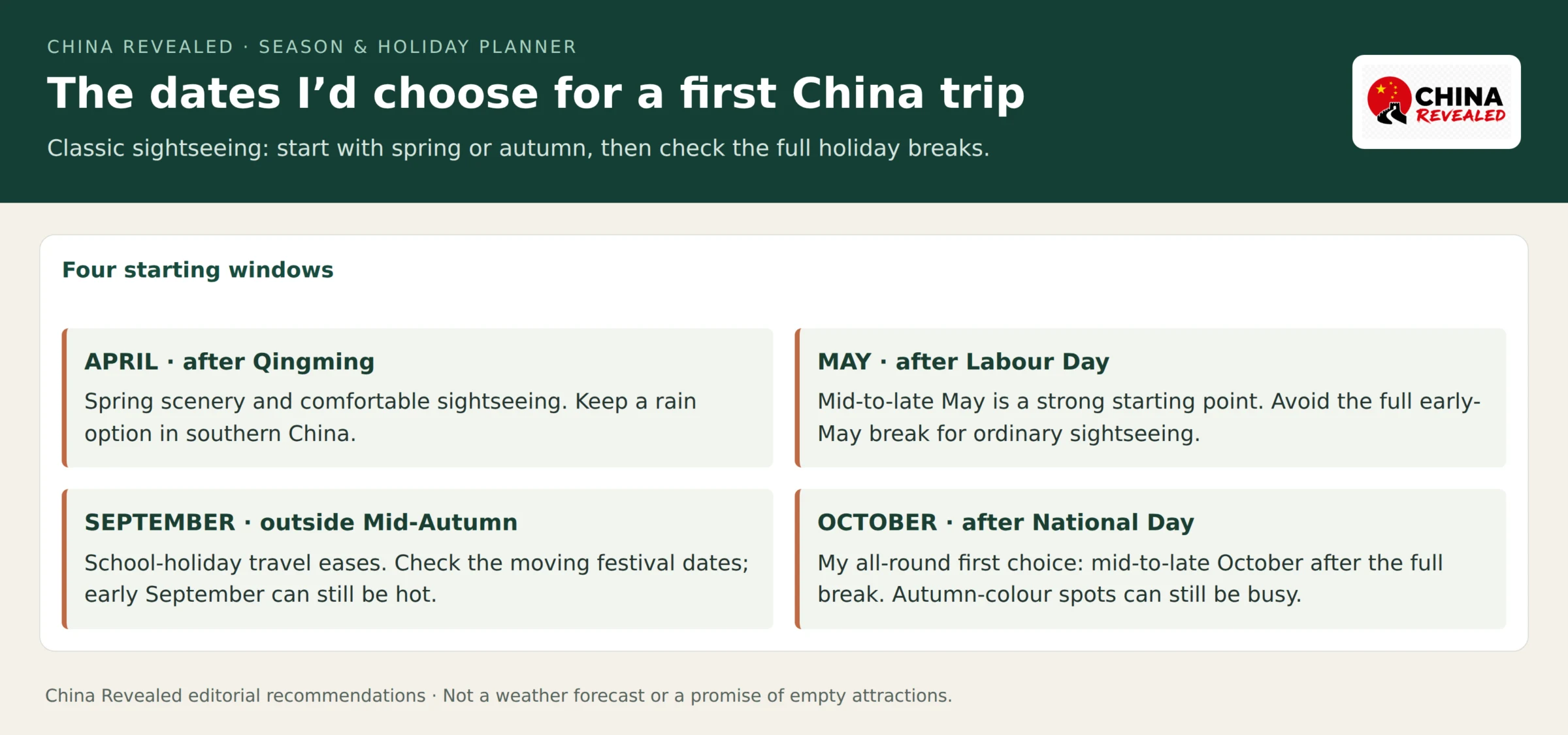
For a Beijing–Xi’an–Shanghai-style sightseeing route, I’d start with these four windows:
| Travel window | Why I’d choose it | What to work around |
|---|---|---|
| April, after the Qingming break | Comfortable walking weather and spring scenery | Rain in the south; busy blossom-viewing spots |
| Mid-to-late May, after the Labour Day break | Warm days without the worst summer heat in many classic destinations | Southern rain and warmer days as summer approaches |
| September, outside Mid-Autumn | School holidays are largely over and autumn travel becomes more comfortable | Early September can still be hot; the festival dates move each year |
| Mid-to-late October, after National Day | One of my favourite all-round choices for city sights and outdoor trips | Autumn-colour destinations can still be very popular |
If I had to pick just one, I’d choose mid-to-late October after the full National Day break. For a spring trip, April after Qingming is a strong starting point. Neither means empty sights: choose ordinary weekdays for your busiest attractions.
2. When crowds and costs are hardest to avoid
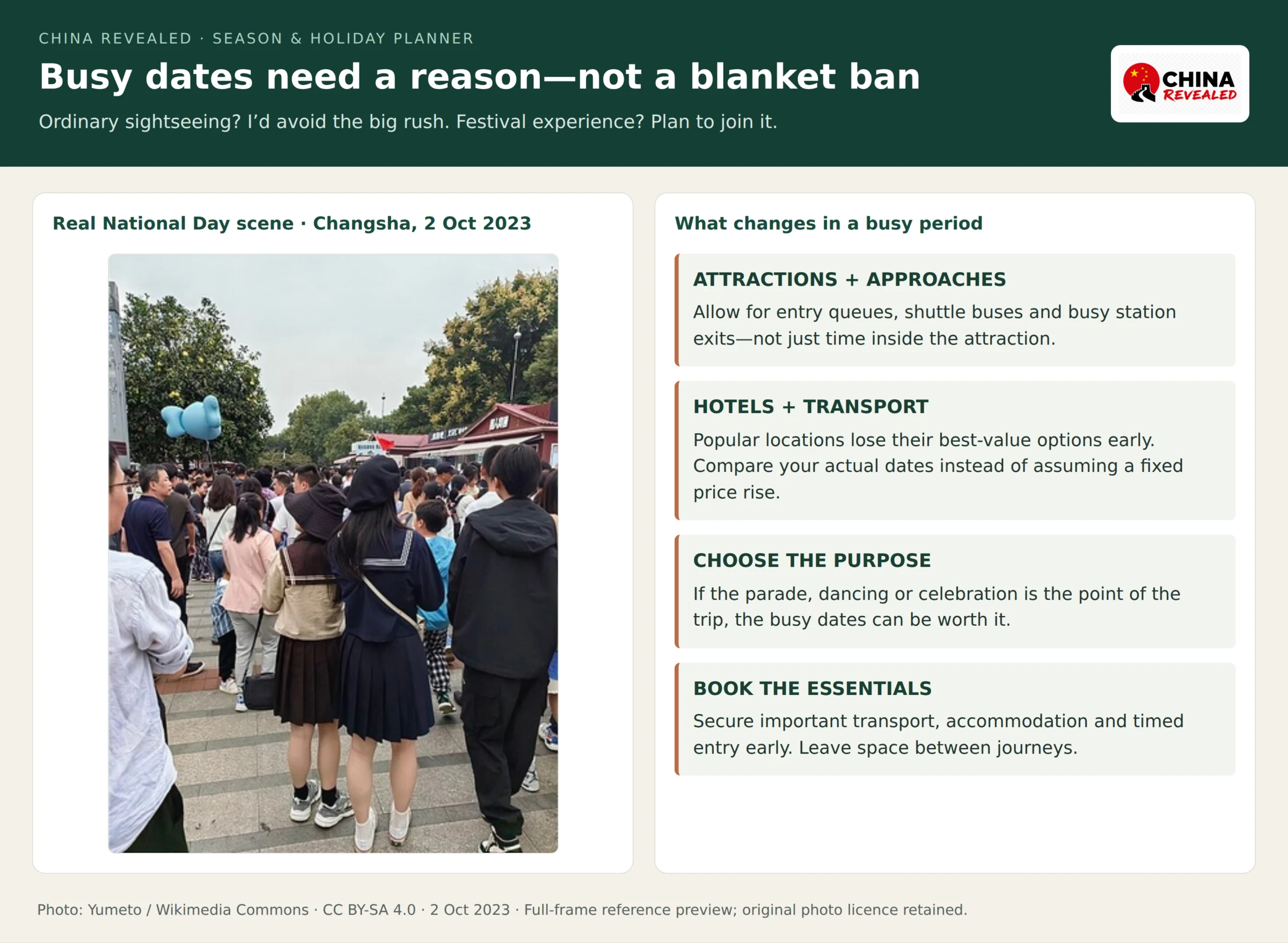
For straightforward sightseeing, I’d avoid the full Labour Day break around May 1 and the National Day break starting October 1. Popular attractions, scenic-area shuttle buses, hotel locations and intercity transport all face extra demand at the same time. A famous viewpoint becomes less enjoyable when most of your day is spent reaching it.
Hotels and flights can cost more on popular holiday routes, and the best-value options disappear early. The useful comparison is your actual hotel and route on holiday dates versus ordinary dates—not a claim that everything in China becomes a fixed percentage more expensive. Attraction admission itself may remain unchanged; the bigger difference can be accommodation, transport and waiting time.
Spring Festival is a different kind of busy. The travel rush extends beyond the official days off as people go home and return to work. Some small restaurants and family-run shops close for part of the festival, while major tourist areas, winter resorts and warm-weather destinations can be lively. I’d choose it for a deliberate New Year experience, not for the simplest first multi-city trip.
July and August are also busy, especially at family attractions, major museums and cooler summer destinations. They are school-holiday months, even when your dates are not national public holidays.

3. China’s holiday calendar: which dates to flag
China’s main national breaks are New Year’s Day, Spring Festival, Qingming, Labour Day, Dragon Boat Festival, Mid-Autumn Festival and National Day. A festival’s date is not necessarily the full holiday. Weekends and make-up working days are used to build longer breaks, so an ordinary Saturday can be a working day.
Planning a trip in 2027
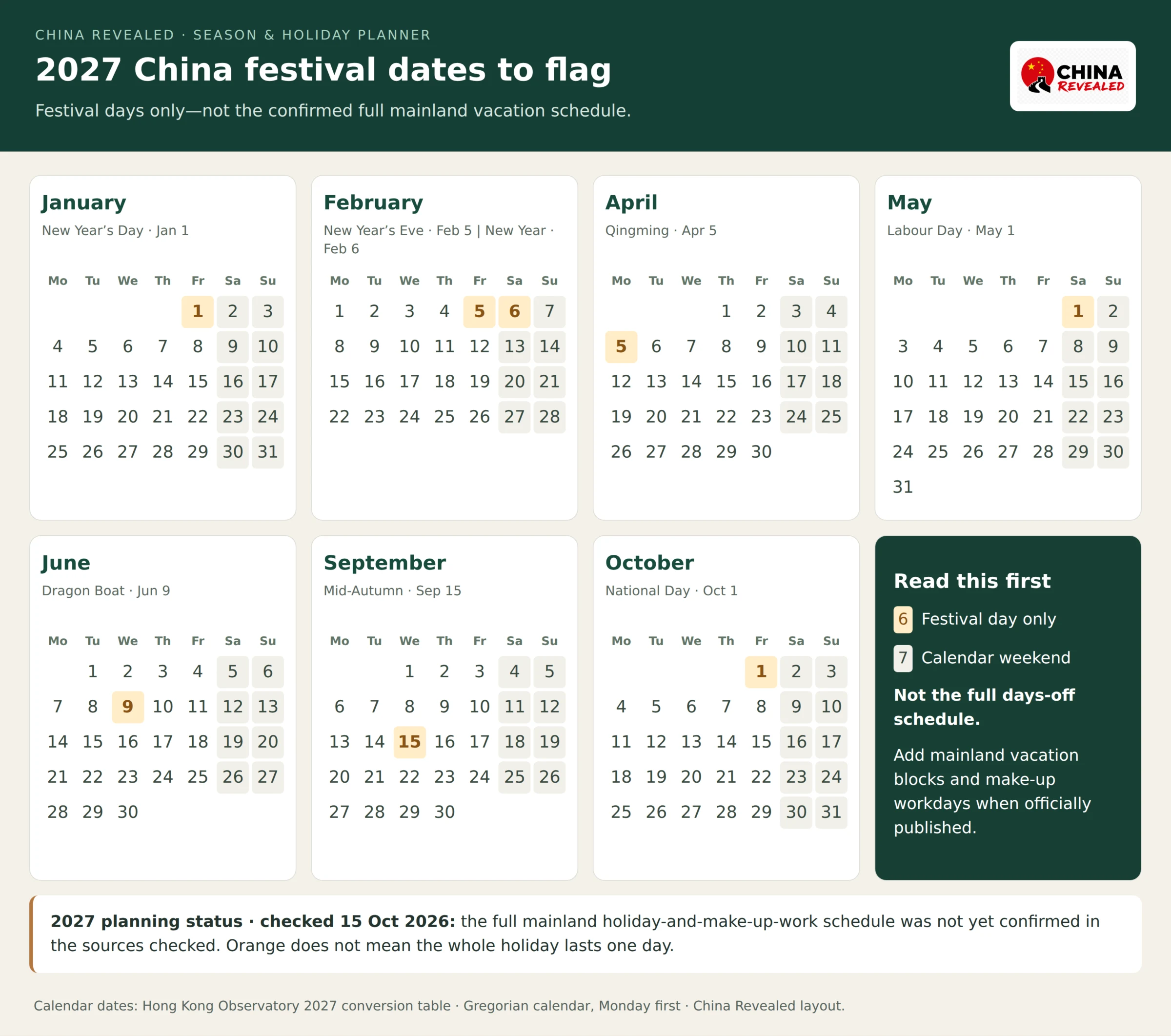
These are the 2027 festival dates, not a confirmed list of all days off. As of our 15 October 2026 check, the full mainland 2027 holiday-and-make-up-work schedule had not been confirmed in the sources available. Check the official annual notice before fixing your dates.
| Festival | 2027 festival date | How I’d use it when planning |
|---|---|---|
| New Year’s Day — 元旦 | January 1 | Check the surrounding break and popular city celebrations |
| Spring Festival — 春节 | February 6; New Year’s Eve is February 5 | Allow for travel pressure before and after the full break |
| Qingming — 清明节 | April 5 | Put an April sightseeing trip after the surrounding break |
| Labour Day — 劳动节 | May 1 | Keep an ordinary sightseeing trip outside the full early-May break |
| Dragon Boat Festival — 端午节 | June 9 | Check the local break and any races you want to attend |
| Mid-Autumn Festival — 中秋节 | September 15 | Work around the actual break, or join a local celebration |
| National Day — 国庆节 | October 1 | Prefer dates after the full Golden Week break for ordinary sightseeing |
What a confirmed annual calendar looks like
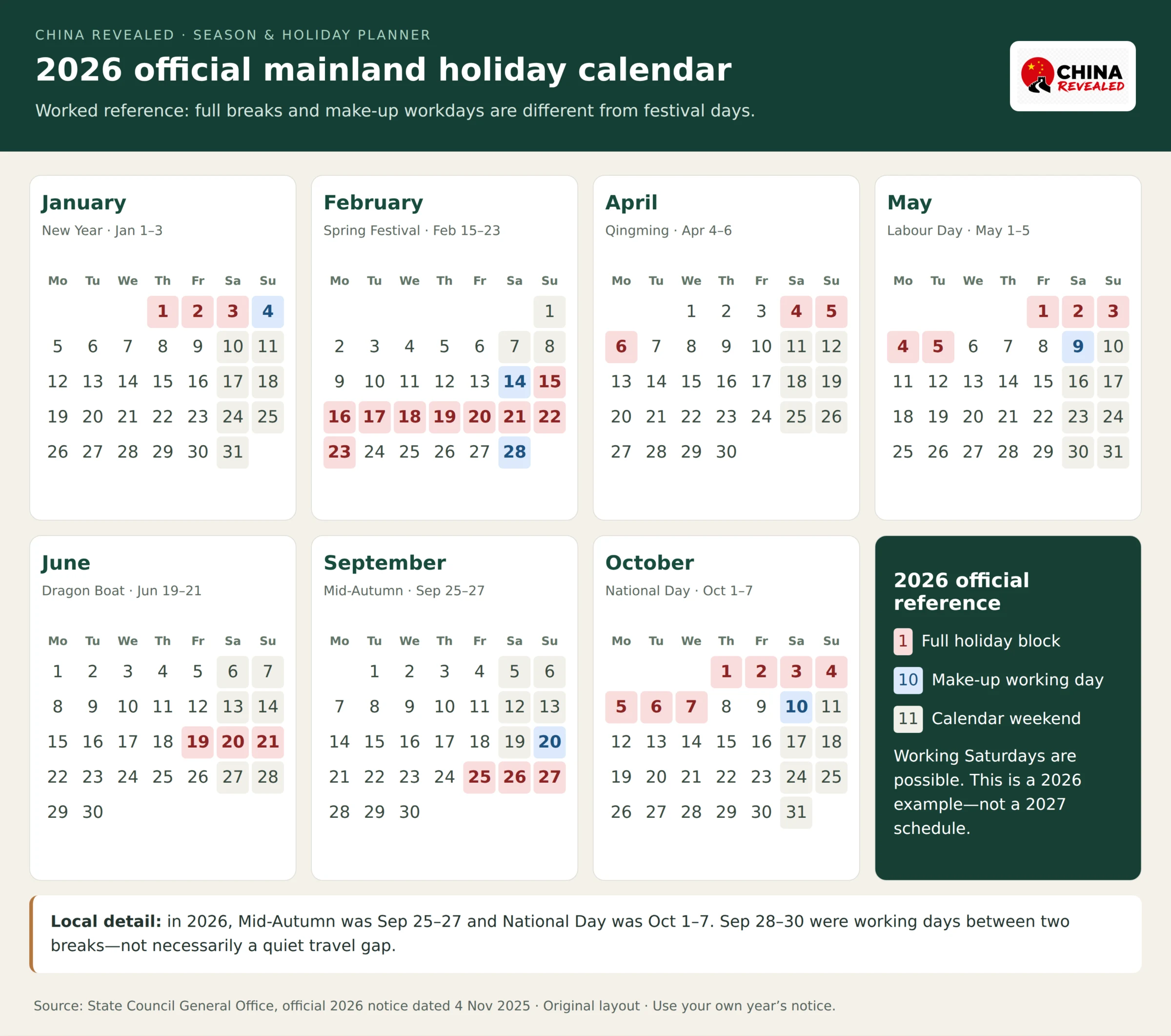
The official 2026 calendar below is a worked reference, not the schedule for a 2027 trip. It shows the full breaks and make-up workdays. For example, Mid-Autumn ran September 25–27 and National Day October 1–7: the working-day gap between them was not automatically a quiet travel window.
For your own year, search “[year] 国务院办公厅 部分节假日安排” and open the State Council or government notice. Read the full date range, not just the festival’s name. Mainland China, Hong Kong, Macao and Taiwan have different holiday schedules.
4. When a festival is worth the busy dates
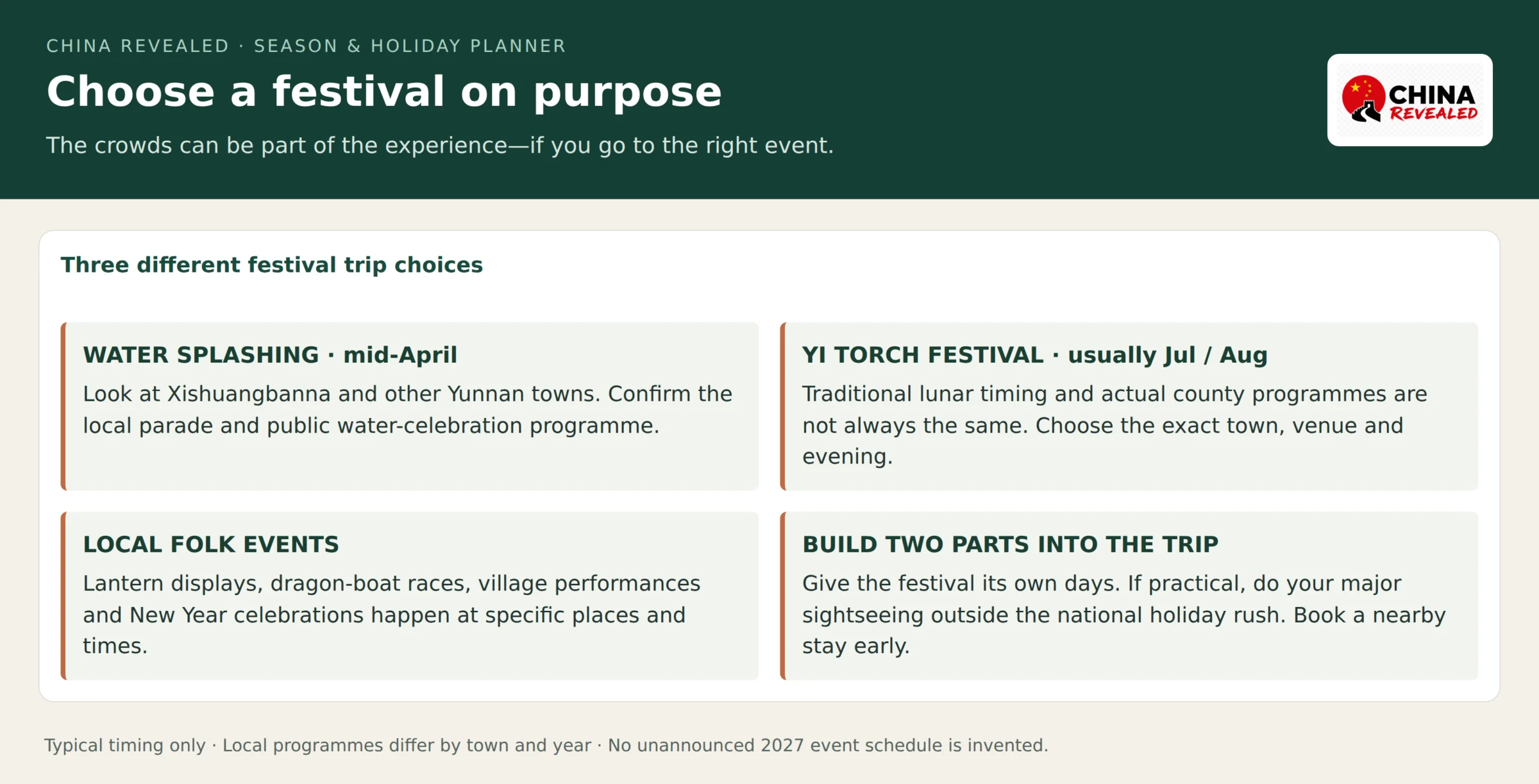
I wouldn’t avoid a festival you genuinely want to experience. The question is whether the extra crowds buy you something special. Three good examples:
Water Splashing Festival in Yunnan: usually in mid-April, with Xishuangbanna a well-known centre. Water celebrations, Dai cultural performances, parades and other local events can make this a memorable reason to travel. Programmes differ by town and year. Book accommodation early, protect your phone and passport from water, and join designated public celebrations rather than treating every passer-by as a participant.
Torch Festival in Yi communities: often associated with the 24th day of the sixth lunar month, usually in July or August. Liangshan in Sichuan and parts of Yunnan are important places to look. Evening torches, dancing and folk performances are the attraction. County programmes can start earlier or spread over several days, so confirm the specific town, venue and performance time, not just the lunar date.
Local New Year, lantern, dragon-boat and folk events: these can be excellent if you build the itinerary around a particular celebration. A race, parade or village performance happens somewhere specific; being in the province on the right day is not enough.
My approach is to give the festival its own few days, then do the major sightseeing outside the national rush if the dates allow. It turns a crowded trip into a purposeful one. A local guide or tour can help with event transport and meeting points; check which events and tickets are actually included.
5. Match the season to your route
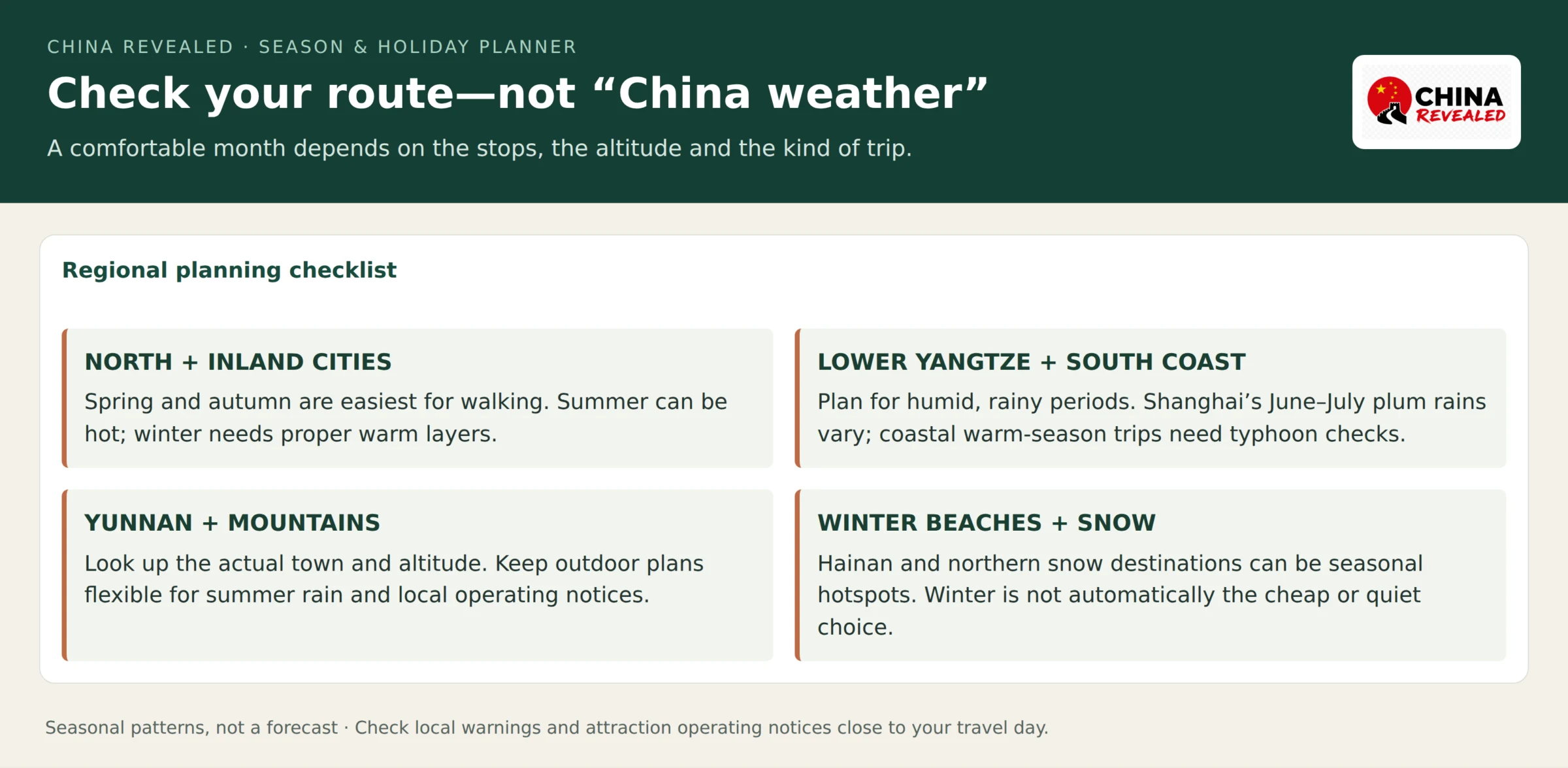
China is too large for one national temperature or one “rainy season” to describe your trip. Here’s the practical version:
| Route or trip type | My planning advice |
|---|---|
| Northern and inland classic sights, such as Beijing and Xi’an | Spring and autumn are easiest for walking. Summer can be hot; winter needs proper warm clothing. |
| Shanghai and the lower Yangtze | Spring and autumn work well. Late spring and early summer can be wet and humid, including the variable June–July plum-rain season. |
| Southern China and the southeast coast | Expect more heat, humidity and rain in warmer months; coastal trips also need typhoon awareness. Autumn and winter can suit a city trip better. |
| Yunnan and mountain routes | Check the exact town and altitude. A warm valley and a high mountain stop need different clothing; summer rain can affect outdoor plans. |
| Hainan beaches or northern ice-and-snow trips | Choose winter for the experience, but recognise these as seasonal hotspots rather than automatically cheap winter travel. |
For a normal city itinerary, plan outdoor walking for the morning in hot weather and keep a museum or other indoor option for heavy rain. For mountains, boats and exposed viewpoints, check local weather warnings and operating notices—not just whether the forecast has a little rain icon.
A monthly climate guide helps you choose the season. A forecast checked roughly a week before departure helps you pack, and the next-day forecast helps you arrange the actual day.
Book hotels, flights, train tickets, attractions and other travel services on Trip.com.
6. Choose your dates in five steps
- Choose the reason for the trip. Classic sightseeing, beaches, snow, autumn colours or a particular festival?
- Check that year’s full holiday blocks. Include the days before and after if you have several intercity journeys.
- Match the season to the actual stops. Don’t buy a flight for “nice China weather” without looking at your route.
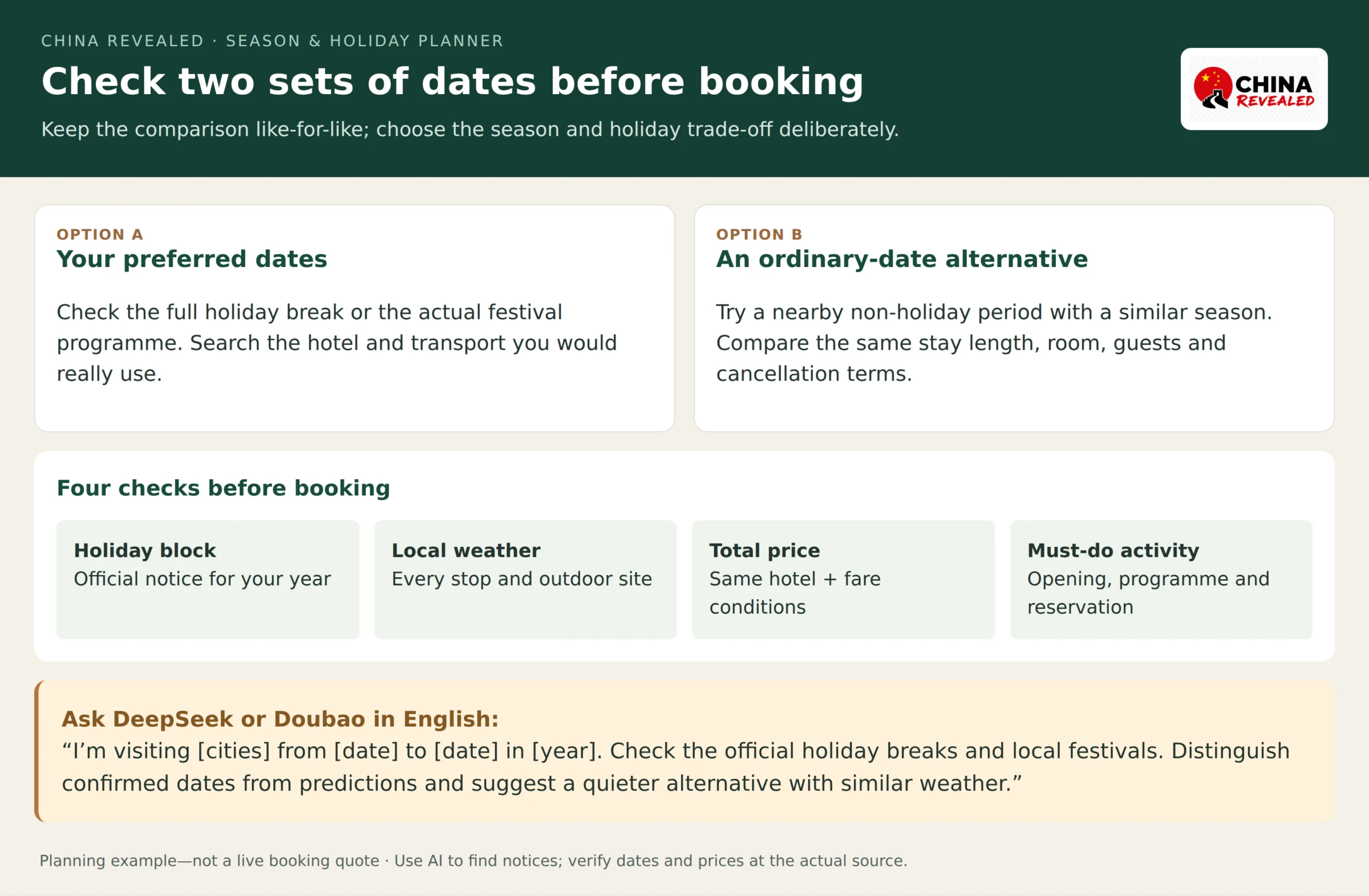
- Compare two sets of dates on Trip.com. Use the same hotel, room type, guest count, stay length and cancellation terms. Compare your domestic flights too. A weekday stay is useful to test, not an automatic guarantee of a lower price.
- Check the must-do item before paying. Confirm the festival programme or important attraction’s opening and reservation availability, then secure transport and accommodation around it.
If Chinese search results are difficult to navigate, use DeepSeek or Doubao in English. Give the year, your dates and the exact cities. I’d ask:
I’m visiting China from [date] to [date] in [year], going to [cities]. Do these dates overlap the official mainland public-holiday breaks or important local festivals? Show official sources, distinguish confirmed dates from predictions, and suggest a quieter alternative with similar weather. If I want to attend [festival], what town, venue and event dates should I check?
Use AI to find the right notices quickly; open the linked official notice for dates, and use the current booking page for prices. For weather, ask for seasonal patterns when planning months ahead—not a forecast for a day far in the future.
7. If you can only travel in a busy period
You can still have a good trip. I’d book the key transport and popular accommodation early, use the first available entry slot at crowded sights, and stay in fewer places rather than travelling between cities every other day. Leave time for queues and don’t schedule a tight train connection immediately after a major attraction.
Balance the headline sights with neighbourhood walks, smaller museums and quieter local stops. For festivals, stay near your chosen event if practical and agree on a clear meeting point with your guide or group. For summer travel, slow the pace and give yourself a proper midday break.
My final choice is simple: for an easy first sightseeing trip, choose spring or autumn outside the big holiday breaks. For a festival trip, choose the celebration deliberately and plan for the extra demand. Busy dates are a trade-off—not a ban on visiting China.
About China Revealed
China Revealed is an independent English-language travel guide dedicated to China.
We bring together China travel guides, destination information, local insights and practical travel resources in one place.
Our travel database covers China's provinces, cities, famous attractions, hidden gems, local cuisine, transportation, accommodation, visa requirements, digital payments, mobile connectivity and the other practical details travelers need to explore China.
We focus on depth, careful research and accuracy. Our guides combine official sources, detailed destination data, local knowledge and regularly updated information to give reliable, practical travel advice.
Whether you're visiting China for the first time or exploring beyond the popular destinations, China Revealed is an all-in-one resource for discovering the real China.
China Revealed — Your practical guide to China.
Some links on China Revealed, such as Trip.com booking links, are affiliate links. If you book through them, we may earn a commission at no extra cost to you. This does not change what we recommend.