

How to Board a China High-Speed Train: Passport Gates, Platforms and Finding Your Carriage
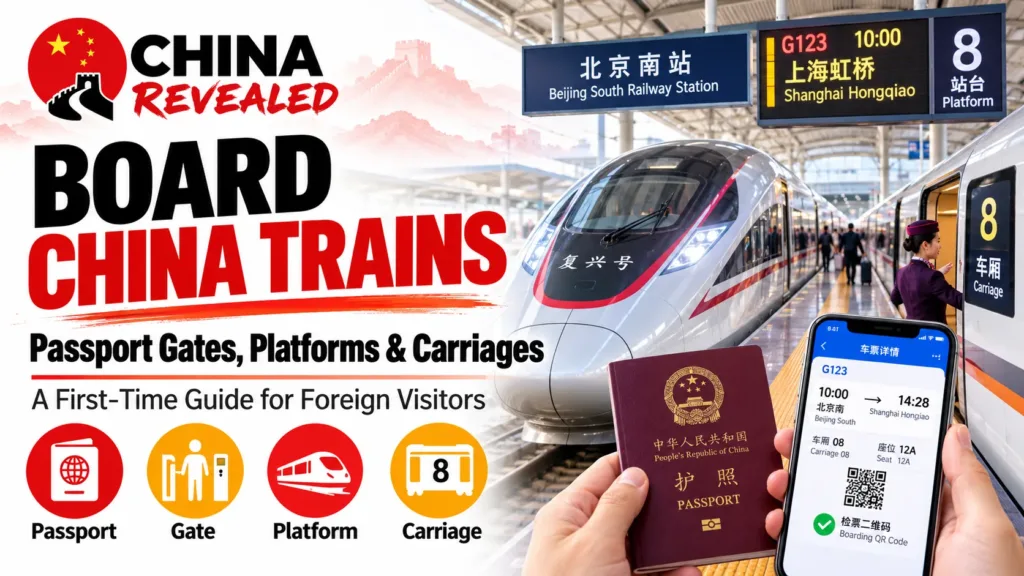
Bring the original passport used to book your ticket, reach the correct railway station about an hour early, and use the staffed passport-check channel when directed. Once inside, find your train number on the departure board, go to its boarding gate, then follow the platform signs to your carriage and seat.
The part that catches first-time visitors out is not the train. It is confusing the station entrance, boarding gate, platform number and carriage number. They are four different things. Your phone helps you find the journey; your booked passport is the document railway staff need to check it.
Railway information checked October 14, 2026. This guide covers ordinary mainland high-speed journeys; Hong Kong and other cross-border services have additional procedures. Images are credited reference scenes, not a newly purchased or personally filmed journey.
In this guide
- 1. Before leaving: check the station, ticket and original passport
- 2. Enter the station: original passport, then the correct staffed channel
- 3. Pass security and collect every bag
- 4. Read the departure board: train number first
- 5. At the boarding gate: show the passport again
- 6. Follow the platform number, then check which train to board
- 7. Use the platform’s carriage markers—not a random coloured number
- 8. Check the carriage beside the door, then find your seat
- 9. Settle your bags, watch your stop, and keep the passport handy
- 10. At your station: follow Exit and use the booked passport
- Save a no-internet, no-battery backup before departure
1. Before leaving: check the station, ticket and original passport
Open your issued train booking in Trip.com or 12306. Check the departure date, departure time, train number, Chinese departure station, arrival station, carriage and seat. A paid request that is still processing or waitlisted is not an issued ticket. For buying and checking tickets, start with our China train tickets guide.
Keep the full Chinese station name. 上海虹桥站 is Shanghai Hongqiao Railway Station, not Shanghai Railway Station and not Hongqiao Airport. 北京南站 is Beijing South, not Beijing Railway Station or Beijing North.
There is another easy mix-up: 北进站口 means a station’s north entrance; 北京北站 means Beijing North Railway Station. A north entrance at Beijing South is still at Beijing South. Do not change stations because you saw the word “North.”
Plan to reach the railway station itself about 60 minutes before departure for your first journey. Give a large unfamiliar station, holiday crowds, children or heavy luggage more time—around 90 minutes is a sensible buffer. If you still need passport verification or a ticket-office problem fixed, arrive earlier. These are planning recommendations, not boarding cutoffs.
Use Amap to check the exact station and your approach. In DiDi, select a passenger departure entrance or drop-off point where available, not the arrival pickup zone or an adjacent metro station. The app’s arrival time means getting to the location, not completing station checks.
2. Enter the station: original passport, then the correct staffed channel
Look for 进站口 / Entrance or 出发 / Departures. A large station can have several entrances and levels. Follow the railway departure signs; a metro entrance is not necessarily the railway boarding entrance.
Have your original booked passport ready before joining the identity-check queue. An ordinary mainland e-ticket normally does not require collecting a paper ticket first. A phone itinerary, a passport photo and a different passport are not substitutes for that original document.
For an ordinary foreign passport, make the staffed channel your default. Look for 人工通道, 人工验证, 人工核验, Manual Check or Manned Ticket Check, and show your passport to the railway employee. If staff direct you to a passport-capable reader, use it as instructed. If it cannot read the document or rejects it, step aside and ask for manual checking rather than repeatedly trying an ordinary Chinese-ID reader.
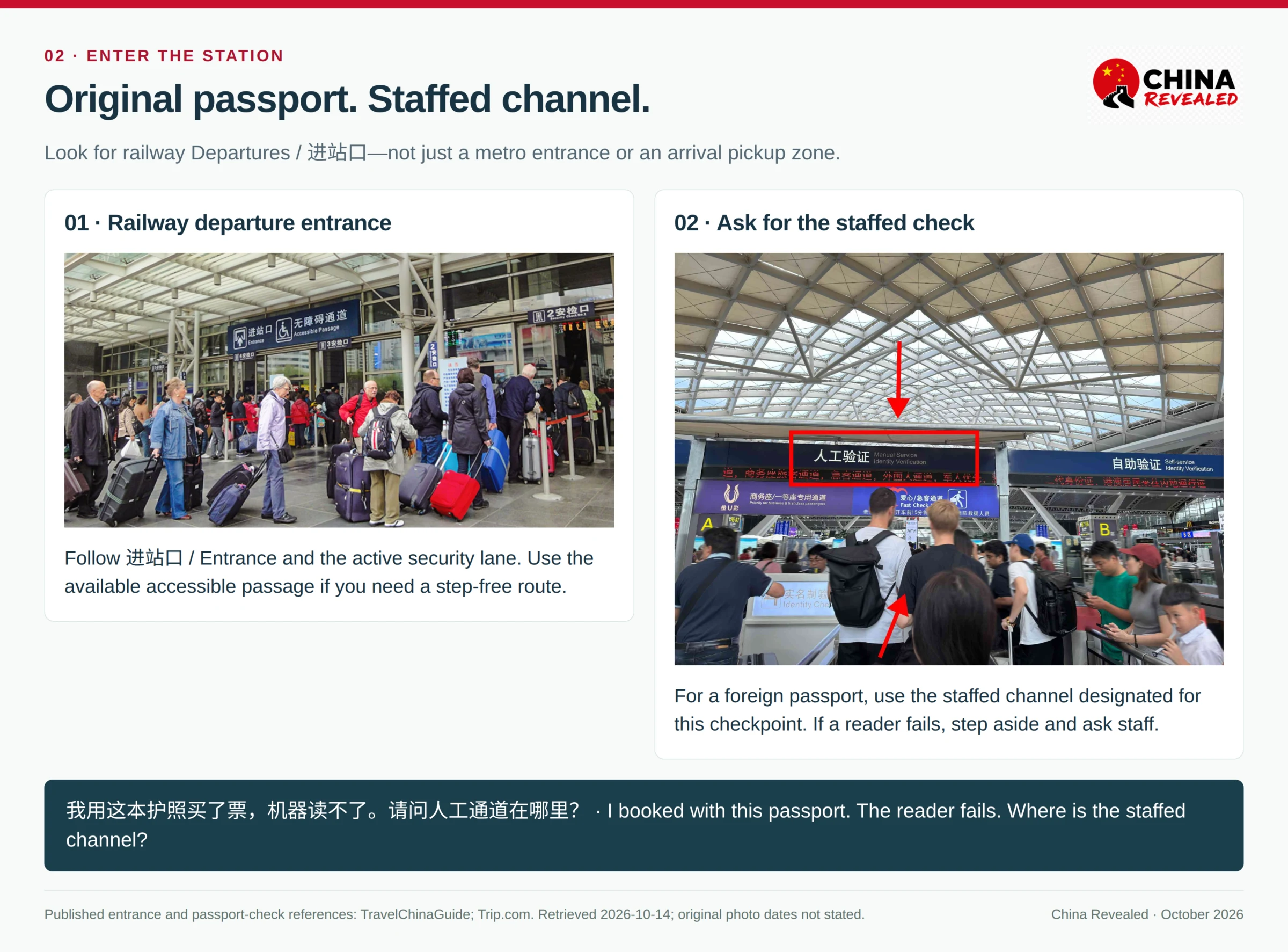
Show this if the reader fails:
我用这本护照买了票,机器读不了。请问人工通道在哪里?
I booked with this passport, but the machine cannot read it. Where is the staffed channel?
Keep the booking details accessible in case staff need your train or order number. You do not need to search your phone for an airline-style boarding-pass QR code while the employee is asking for your passport.
If staff find a wrong passport number, unresolved verification or no issued ticket, that is a ticket/identity problem, not simply a faulty gate. Ask for the appropriate railway service window and contact your booking platform. An entrance check is not the place to assume an existing ticket’s passenger identity can be edited.
3. Pass security and collect every bag
Identity checking, security screening and boarding-gate checking are separate steps. The order of the first two can vary with the station’s layout.
Put your bags on the luggage scanner, pass the screening point and follow any additional inspection request. Pick up all your belongings on the other side—including a small bag, phone or bottle you put down separately. Keep the passport somewhere you can reach for the next check.
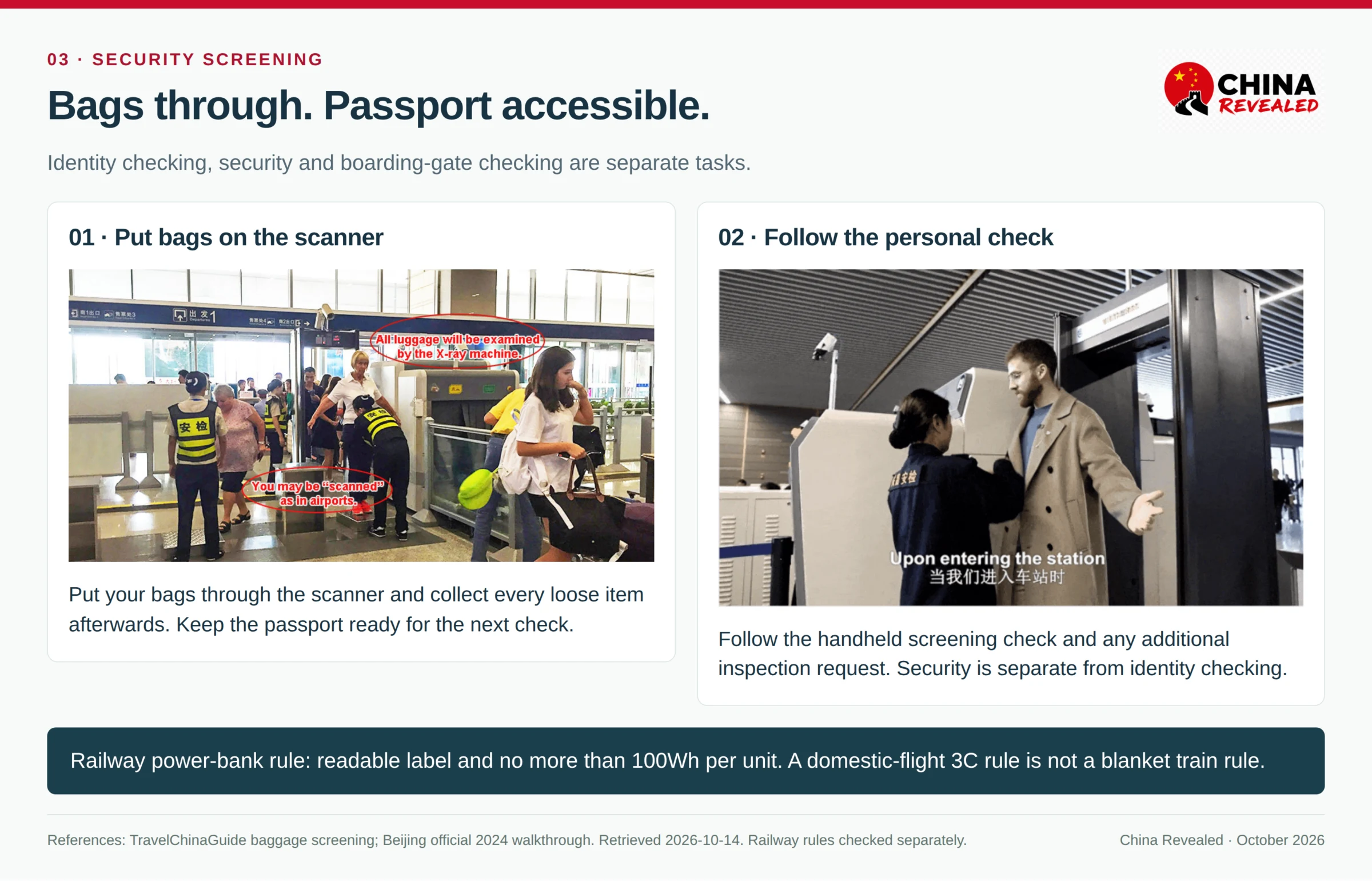
Do not apply an airline’s entire packing rulebook to a train, but do not treat rail security as optional. Knives, flammable substances and restricted batteries or sprays can cause problems. Check the official railway prohibited and restricted items list if carrying anything unusual.
For a power bank, keep its capacity label readable. The railway list permits clearly marked power banks/lithium batteries with no more than 100Wh per unit. The domestic-flight 3C requirement is a separate aviation rule, not a blanket high-speed-rail requirement. Follow any current station notice and inspection instruction.
Book hotels, flights, train tickets, attractions and other travel services on Trip.com.
4. Read the departure board: train number first
Inside the waiting hall, find the large departure board. Look for 车次 / Train, 开点 or 开车时间 / Departure Time, 终到站 / Destination, 检票口 / Check-in Gate and 状态 / Status.
Match your train number and departure time first. The destination column often shows the train’s final terminus, not every intermediate stop. You can be travelling to a station before that terminus, so a different final destination does not automatically mean you found the wrong train.
In the reference board below, G905 → 哈尔滨西 / Harbin West → 11:05 → 6B identifies the row. 6B is the boarding gate, not carriage 6 and not a promise that the train uses platform 6. Use your own ticket’s train, not the example’s.
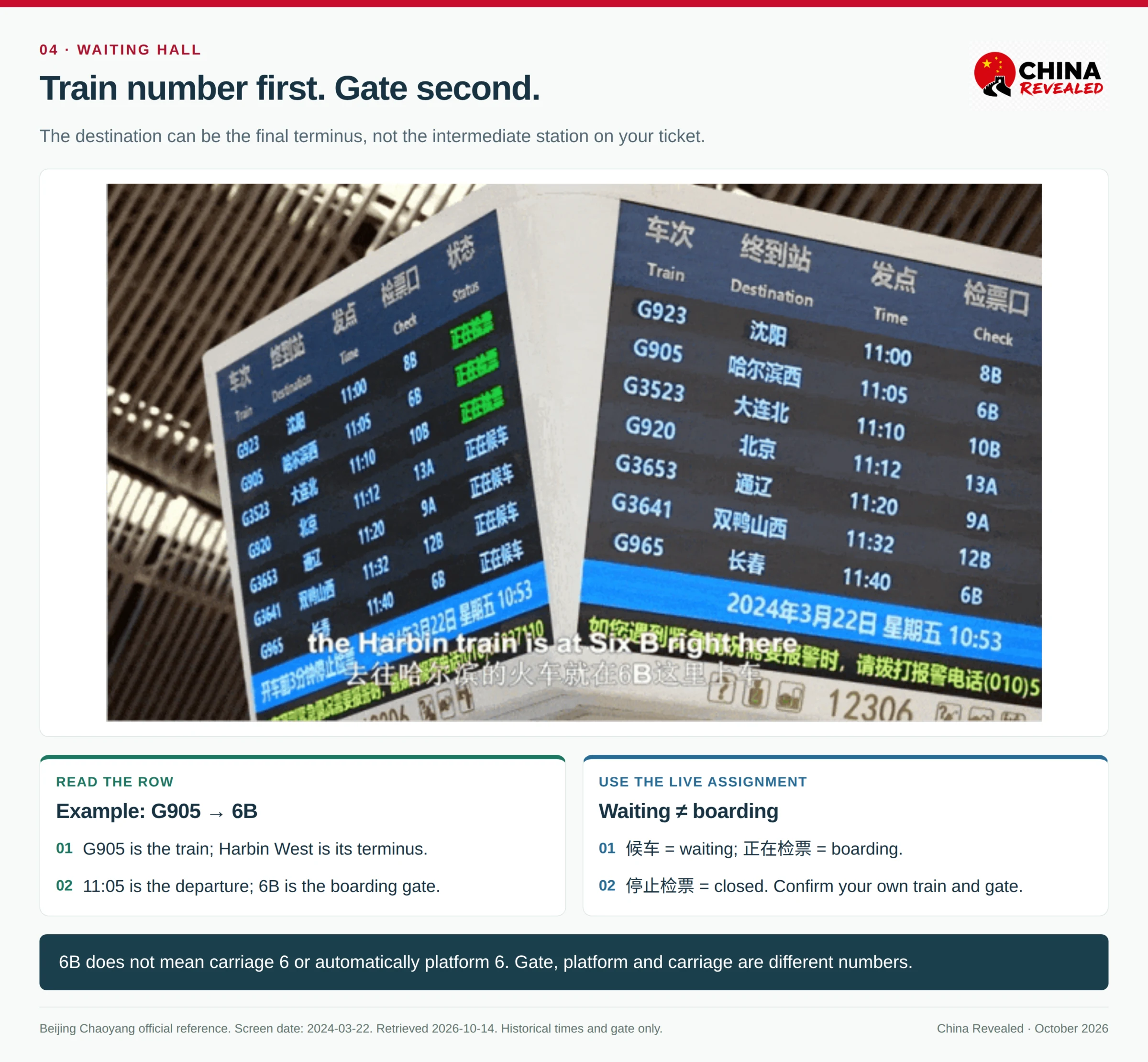
The common status words are 候车 / Waiting, 正在检票 / Boarding or Checking Tickets, 停止检票 / Boarding Closed, and 晚点 / Delayed. Identify the words, not a guaranteed colour scheme. If boarding is open, go to that gate; if the screen changes, follow the updated assignment.
Find the gate before buying a meal or settling far away. A waiting-hall screen and the smaller display above the gate should agree about your train. Ask a railway employee if they do not.
5. At the boarding gate: show the passport again
Wait near the correct 检票口. When your train is called or its status changes to boarding, join its queue. The same gate can serve different trains at different times; do not follow a queue just because people are moving.
At the gate, staff check the ticket attached to your booked identity document again. Use the designated staffed passport channel or the reader staff direct you to. Have the passport out before reaching the front.
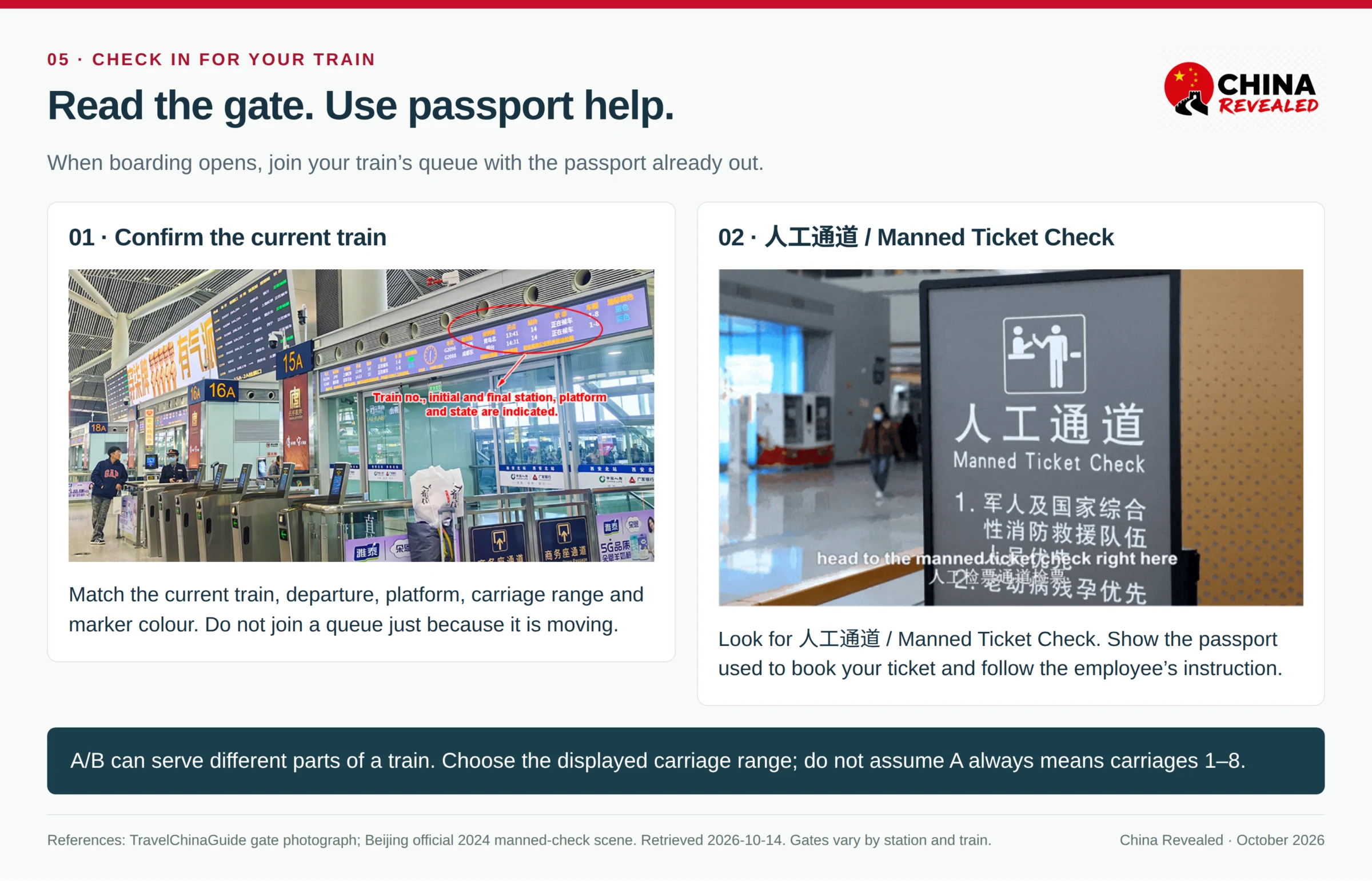
Boarding closes before the train’s departure time. The interval is announced by the station; there is no universal “you always have five minutes left” rule to rely on. Once boarding starts, finish the check and walk to the platform. Do not use the departure time as your target arrival at the gate.
What do A and B mean?
A and B can be access points serving different parts of a platform or train. When both are open for your departure, the displayed carriage ranges help you choose the shorter walk. Do not assume A always serves carriages 1–8 and B always serves 9–16. The arrangement depends on the station and train formation.
Check the current train and carriage-range information above the gate, or show staff your assigned carriage. Not every displayed A/B gate is open for your train.
6. Follow the platform number, then check which train to board
After the gate, follow 站台 / Platform signs through the passage, stairs, escalator or lift. Your gate number, platform number and carriage number can all be different.
A shared island platform can have a train on each side. Check the overhead platform display for the train number and departure before walking to a door. “There is a high-speed train here” is not enough.
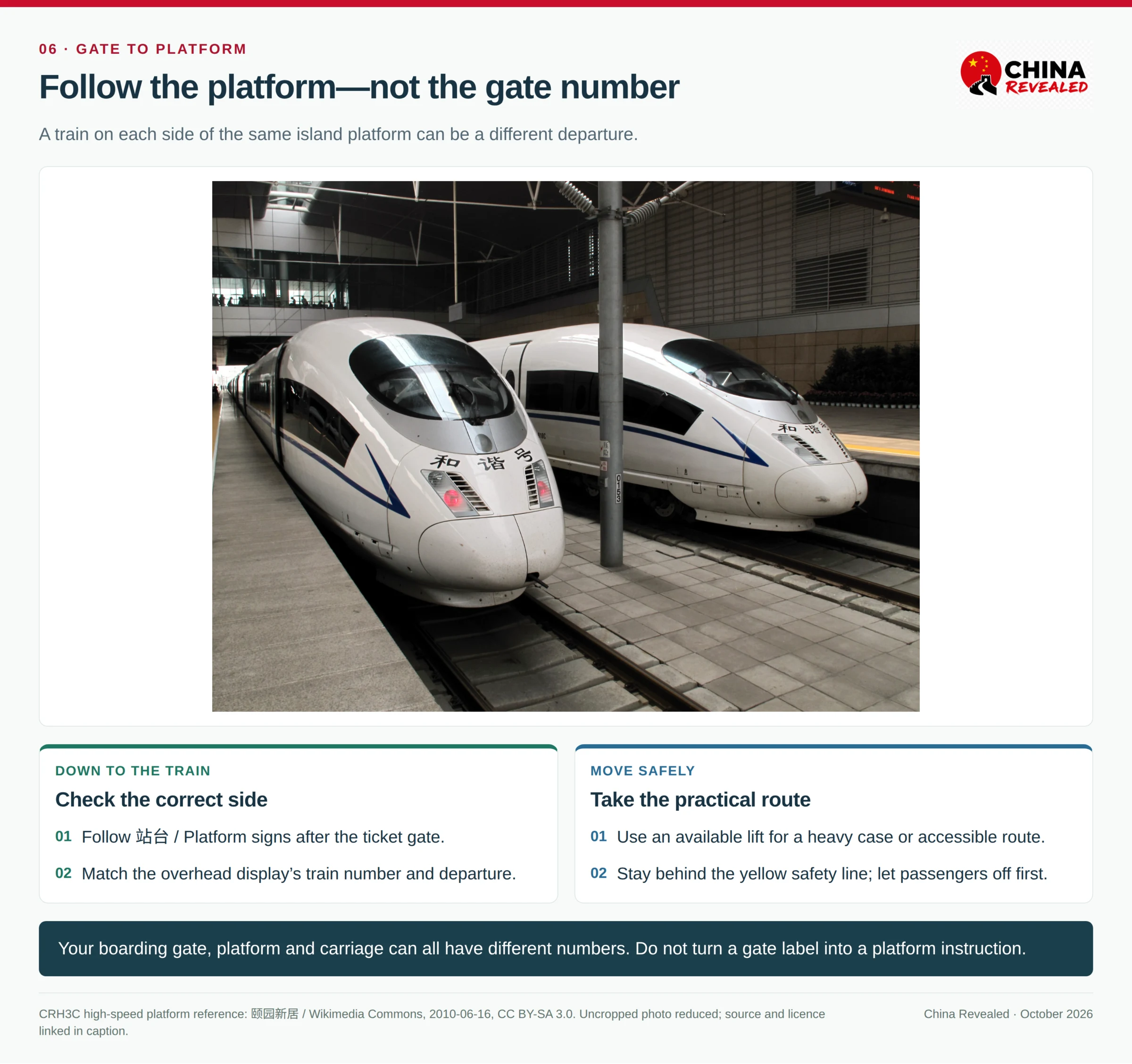

With a heavy case, use the lift when available instead of struggling on an escalator. Ask staff for an accessible route if necessary. Wait behind the yellow safety line and allow arriving passengers to leave before boarding.
7. Use the platform’s carriage markers—not a random coloured number
Many platforms have coloured ground plaques with carriage numbers and arrows. Several colours can show different numbers at the same spot because different train lengths and directions stop there.
First look at your train’s platform display or the boarding-gate display for its marker colour. Then follow that colour’s numbers and arrows to your assigned carriage. Do not memorise “blue is always my train” or use the nearest plaque regardless of colour.
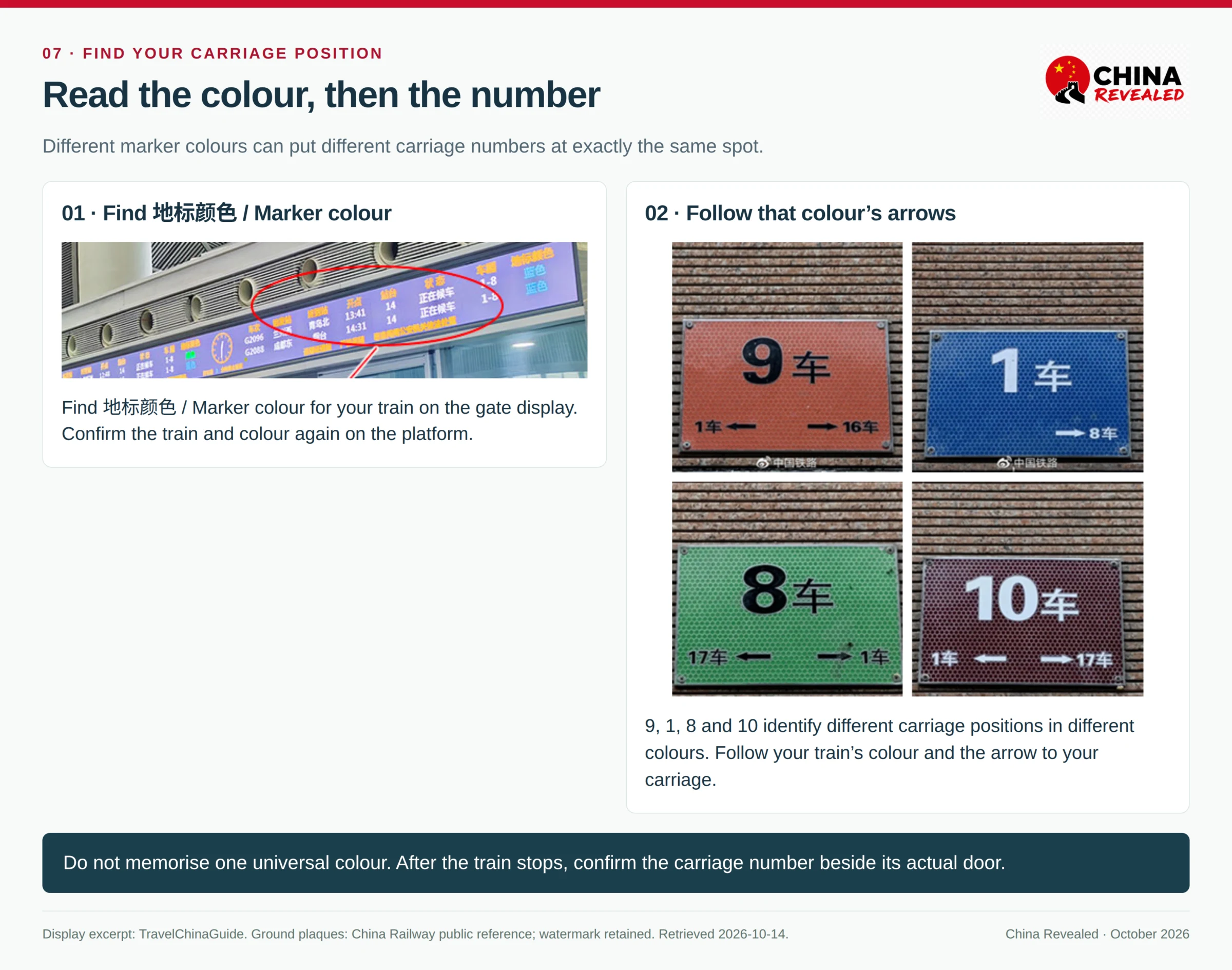
If no colour is shown, the platform has a different marking system, or the information is unclear, use the actual train’s carriage numbers and ask staff. The markers help you position yourself; the number beside the stopped train’s door is the final check.
A yellow carriage plaque is not the same thing as the yellow safety line. Do not stand at the platform edge merely because your number is painted nearby.
8. Check the carriage beside the door, then find your seat
Look for 车厢号 / Carriage or Coach Number beside the door or on its electronic display. Compare it with the ticket. A train formation code printed on the body is not your seat number.
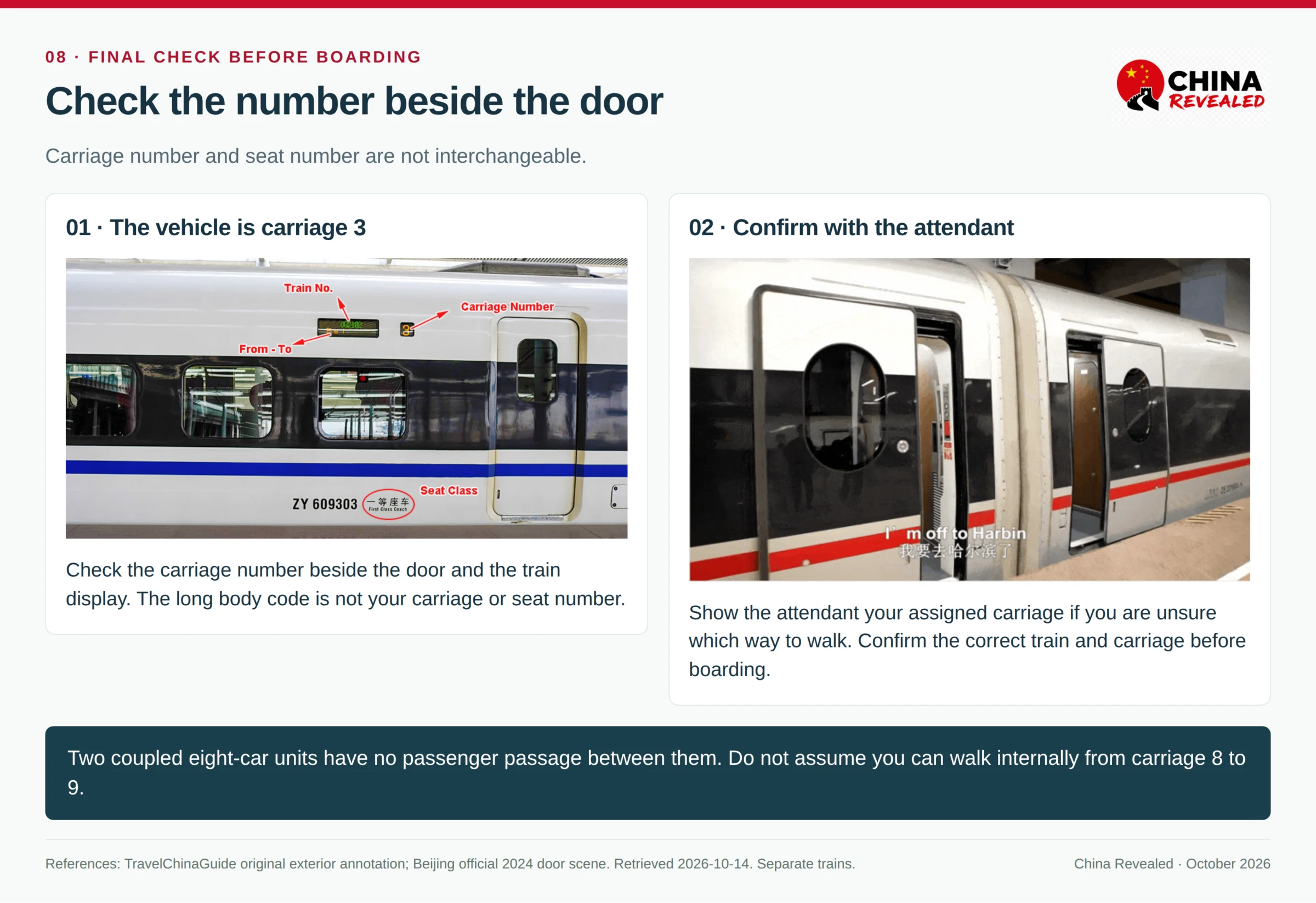
If you are beside the wrong carriage, ask the platform employee or train attendant which way to go. On an ordinary connected train, an attendant may direct you to board a nearby carriage and walk through. Do not count on being able to walk from carriage 8 to 9: on two coupled eight-car trainsets, passengers cannot pass internally between the two units. Board the correct half and follow staff instructions.
Once the doors are closing, do not hold them, chase the train or try to jump on. If you have missed boarding, speak to station staff and use the change options in your original booking.
Carriage 3, seat 14F: read the two numbers separately
In the historical ticket example, Carriage 3 identifies the vehicle; 14F identifies row 14, seat F inside it. Find the row number on the label above the seats or beside the window, then the letter for your place. Row numbers repeat in different carriages, so finding “14” before checking the carriage is not enough.
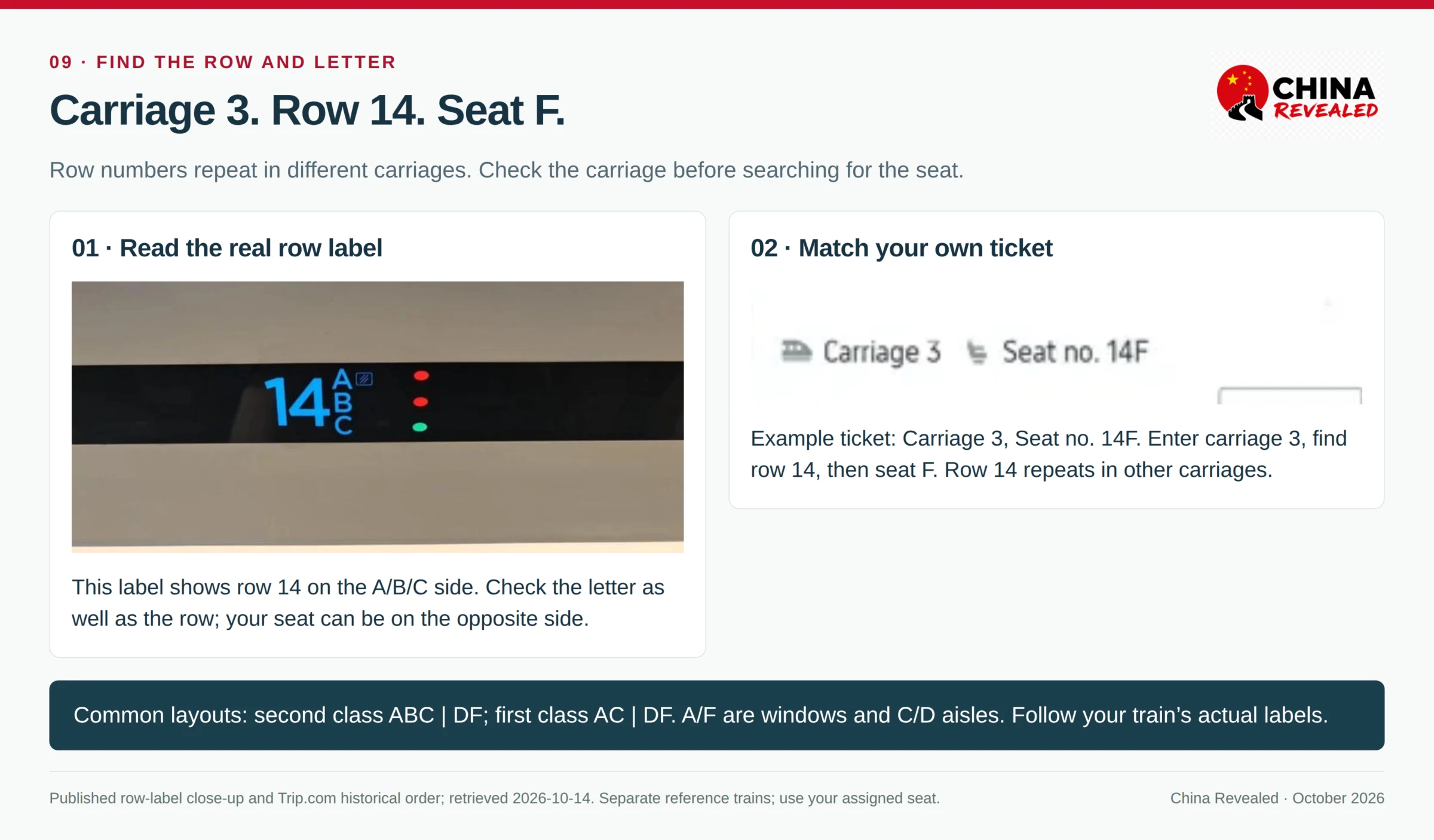
On the common second-class 2+3 layout, letters are A, B, C on one side and D, F on the other: A/F are windows, C/D aisles and B the middle seat. The common first-class 2+2 layout uses A, C, D and F. There is no need to look for an E seat. Follow the labels if your train’s arrangement differs.
If someone is in your seat, show the carriage and seat on your booking and ask the attendant to help. A green seat indicator does not override your assigned ticket or give you permission to move into first class.
9. Settle your bags, watch your stop, and keep the passport handy
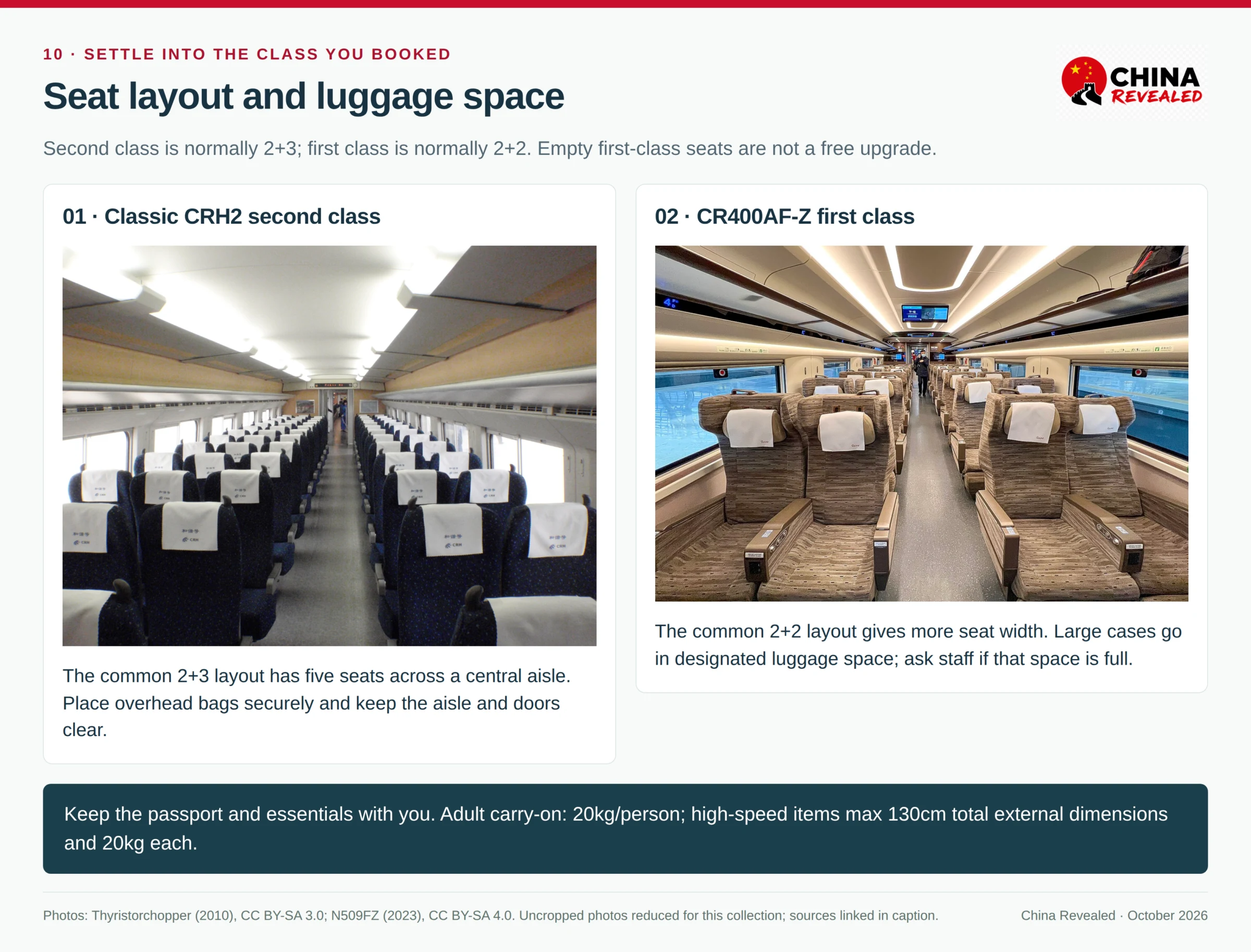
Second class is the comfortable default for most daytime trips. First class normally gives a wider 2+2 layout and more space. Your boarding procedure is the same: sit in the class and seat you booked. Ask the attendant about a paid upgrade rather than simply taking an empty first-class seat.
Use the overhead rack for a bag you can lift and place securely. Large suitcases belong in the designated luggage space near the carriage ends where available. Keep them out of the aisle, door area and emergency routes; store an under-seat bag only where it fits without obstructing anyone. Ask the attendant if the luggage space is full.

.jpg)
For ordinary adult passengers, the mainland railway carry-on allowance is 20kg per person; on a high-speed train, each item’s external length + width + height must not exceed 130cm, and each item must not exceed 20kg. The fact that a case might fit in a rack is not a different official baggage allowance.
Keep the passport, phone and valuables in a small bag with you, not buried in a suitcase at the other end of the carriage. Staff may need the passport during the trip, and you will need it at the arrival exit.
Watch the onboard screen and announcements for your arrival station, not just the final terminus. Start gathering your belongings before your stop. Intermediate stops can be brief: do not get off for photos or a cigarette and assume the train will wait. High-speed trains are non-smoking, including toilets and connecting areas.
10. At your station: follow Exit and use the booked passport
When the train stops at your booked arrival station, collect your belongings, step off carefully and follow 出站 / Exit. Signs may direct you down to an underpass or up to a concourse. Do not wander back into the departure platform area looking for a taxi.
At the railway exit check, keep the same original booked passport ready. Use the staffed channel for a foreign passport, or a supported reader if staff direct you to it. If it fails, show staff the passport and journey details. Do not tailgate another passenger or try a metro payment code on a railway exit gate.
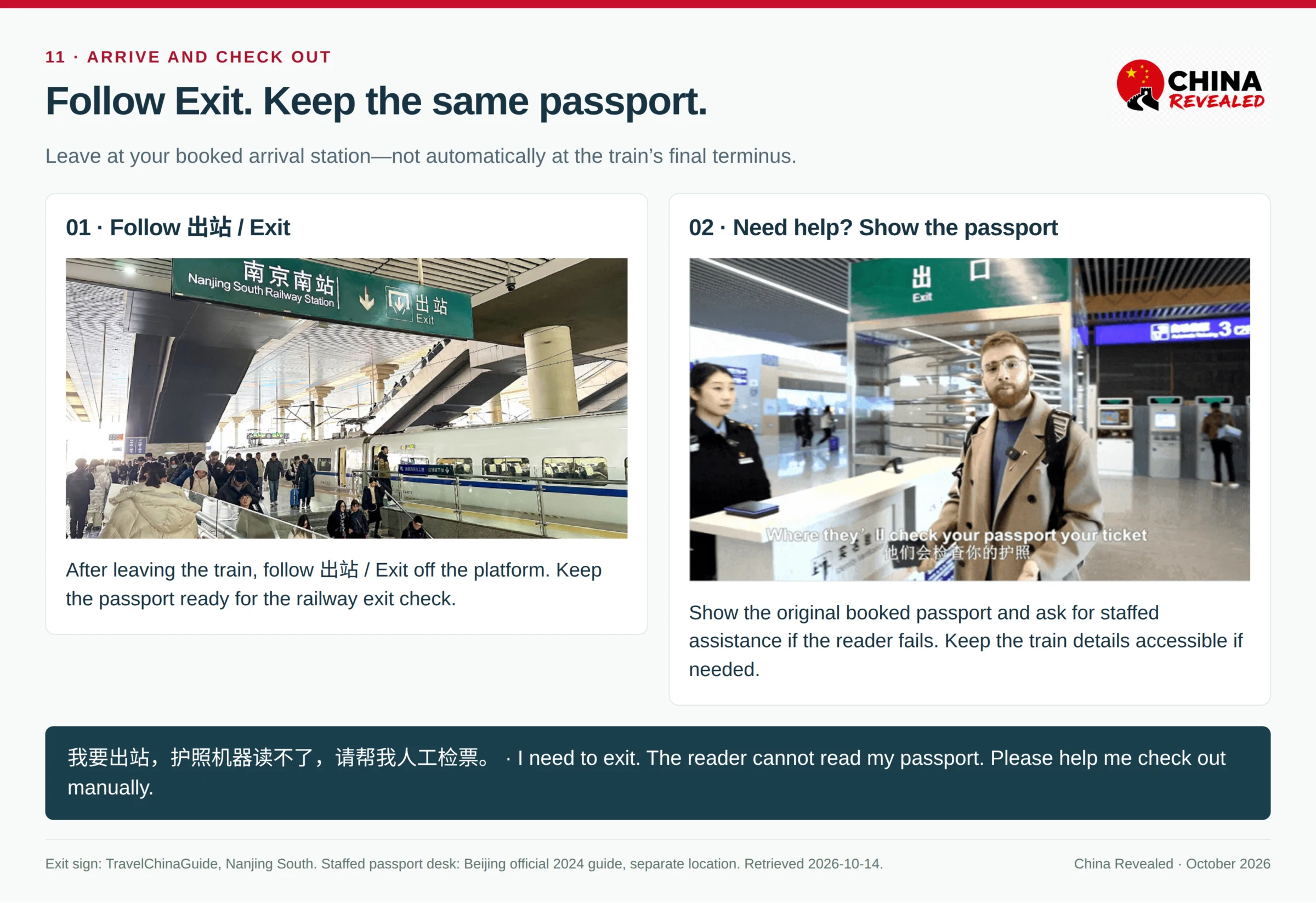
Show this if needed:
我要出站,护照机器读不了,请帮我人工检票。
I need to exit, but the machine cannot read my passport. Please help me check out manually.
After the railway exit, choose 地铁 / Metro, 出租车 / Taxi or 网约车 / Ride Hailing as appropriate. Note whether you emerged from the north, south, east or west side before requesting a ride. Our DiDi guide explains station pickup zones; Amap helps plan the walking or onward transit route. Neither replaces the station’s live signs or proves that every station has a complete indoor map.
If you have another train, follow 便捷换乘 / Transfer signs and ask staff which route serves your connection. Do not exit first if the station provides a suitable in-station transfer route.
Save a no-internet, no-battery backup before departure
Save the issued booking screenshot locally, not only as a link in an email. Keep the travel date, train number, Chinese departure and arrival stations, departure time, carriage/seat, hotel name and Chinese hotel address in a separate note. A gate saved earlier can change; recheck it on the station board.
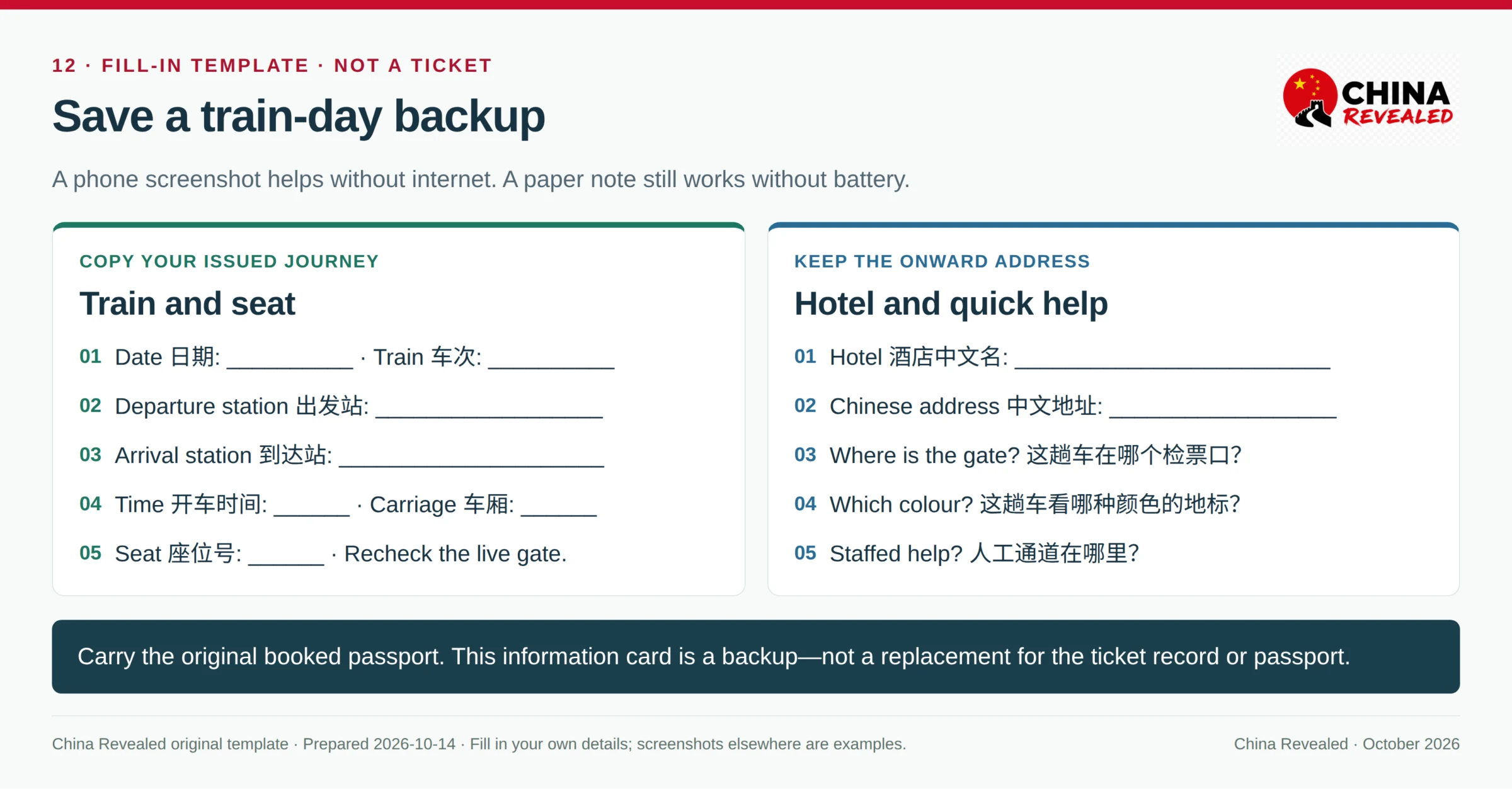
A screenshot still needs a working phone. Write the essential journey and hotel details on paper too, or print a simple information sheet. That sheet helps staff identify the trip; it is not a substitute for the ticket record and original passport.
Useful short requests:
请问这趟车在哪个检票口? — Which gate is this train using?
请问去几号站台? — Which platform should I go to?
请问这趟车看哪种颜色的地标? — Which coloured carriage markers should I follow?
这是我的车厢和座位,请帮我看一下。 — Here are my carriage and seat. Please help me check.
If you cannot find the gate, show your train number to an employee. If the reader fails, show the original passport. If you are unsure of the carriage, show the carriage/seat field to the attendant. Those three details get you further than searching your phone for a separate boarding pass.
Cover image: a historical Trip.com train order and Beijing Chaoyang station from Beijing’s official 2024 walkthrough, retrieved October 14, 2026.
About China Revealed
China Revealed is an independent English-language travel guide dedicated to China.
We bring together China travel guides, destination information, local insights and practical travel resources in one place.
Our travel database covers China's provinces, cities, famous attractions, hidden gems, local cuisine, transportation, accommodation, visa requirements, digital payments, mobile connectivity and the other practical details travelers need to explore China.
We focus on depth, careful research and accuracy. Our guides combine official sources, detailed destination data, local knowledge and regularly updated information to give reliable, practical travel advice.
Whether you're visiting China for the first time or exploring beyond the popular destinations, China Revealed is an all-in-one resource for discovering the real China.
China Revealed — Your practical guide to China.
Some links on China Revealed, such as Trip.com booking links, are affiliate links. If you book through them, we may earn a commission at no extra cost to you. This does not change what we recommend.