

China Etiquette Dos and Don’ts for Travelers
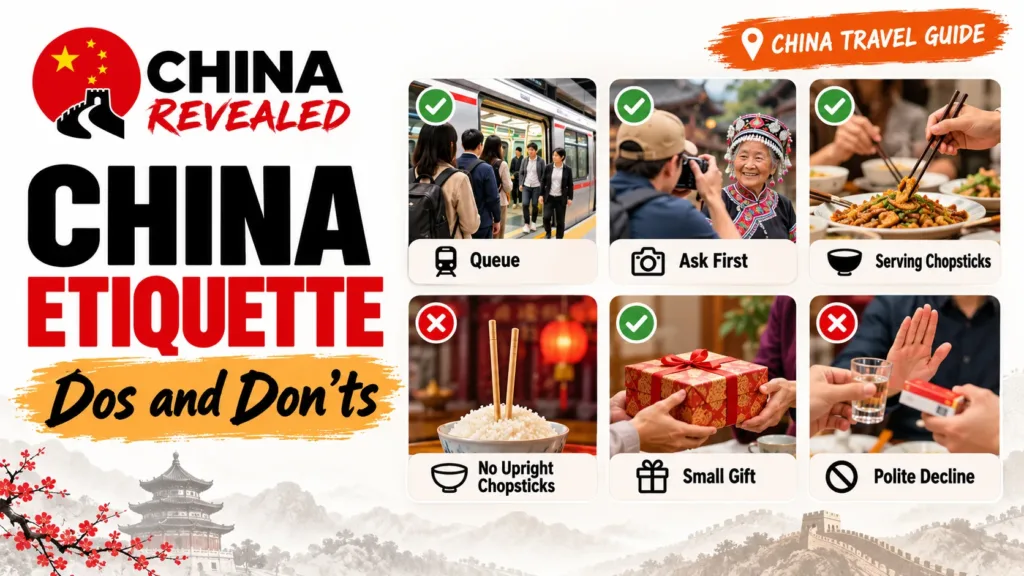
China etiquette dos and don’ts are simple for most travelers: join the queue, ask before photographing people, use serving utensils for shared dishes, bring modest gifts and keep first conversations friendly. You do not need to master formal banquet rituals to enjoy a trip; paying attention to the people and signs around you matters much more.
I recommend learning a few practical defaults rather than memorizing a long list of taboos. A busy noodle shop, a family dinner and a formal banquet are different settings. Start politely, follow your host’s lead and ask when something is unclear.
Tap any red Chinese text to hear it in Mandarin.
Quick takeaways
- Queue properly and let passengers get off first. A crowded doorway is not an invitation to push through.
- Ask before taking someone’s portrait. At museums and temples, check the rules for that particular room, not just the building.
- Keep eating chopsticks separate from serving utensils. Never leave chopsticks standing upright in rice.
- For a home visit, a small gift is enough. Tea, a modest box of treats or something from your hometown works better than an expensive gesture.
- You can decline alcohol, cigarettes and personal questions. A warm, clear refusal is more useful than forcing yourself to participate.
Queues, doors and public space
At metro platforms, ticket counters, security checks and attraction entrances, join the actual queue. Look for barriers, waiting boxes and arrows on the floor. If the queue is not obvious, ask 请问,队尾在哪里? — “Excuse me, where is the end of the line?”
In busy places, keep close enough that it is clear you are waiting, without pressing into the person ahead. Leave space for people crossing the walkway. A loose group beside a restaurant entrance may be waiting for numbers to be called rather than forming one physical line; ask staff how the wait works before joining it.
At a metro door, stand to the side and let arriving passengers get off before boarding. Follow the platform’s safety line and local waiting marks. Once aboard, move away from the doorway so the next people can enter. The same simple courtesy helps at lifts: let people out first.
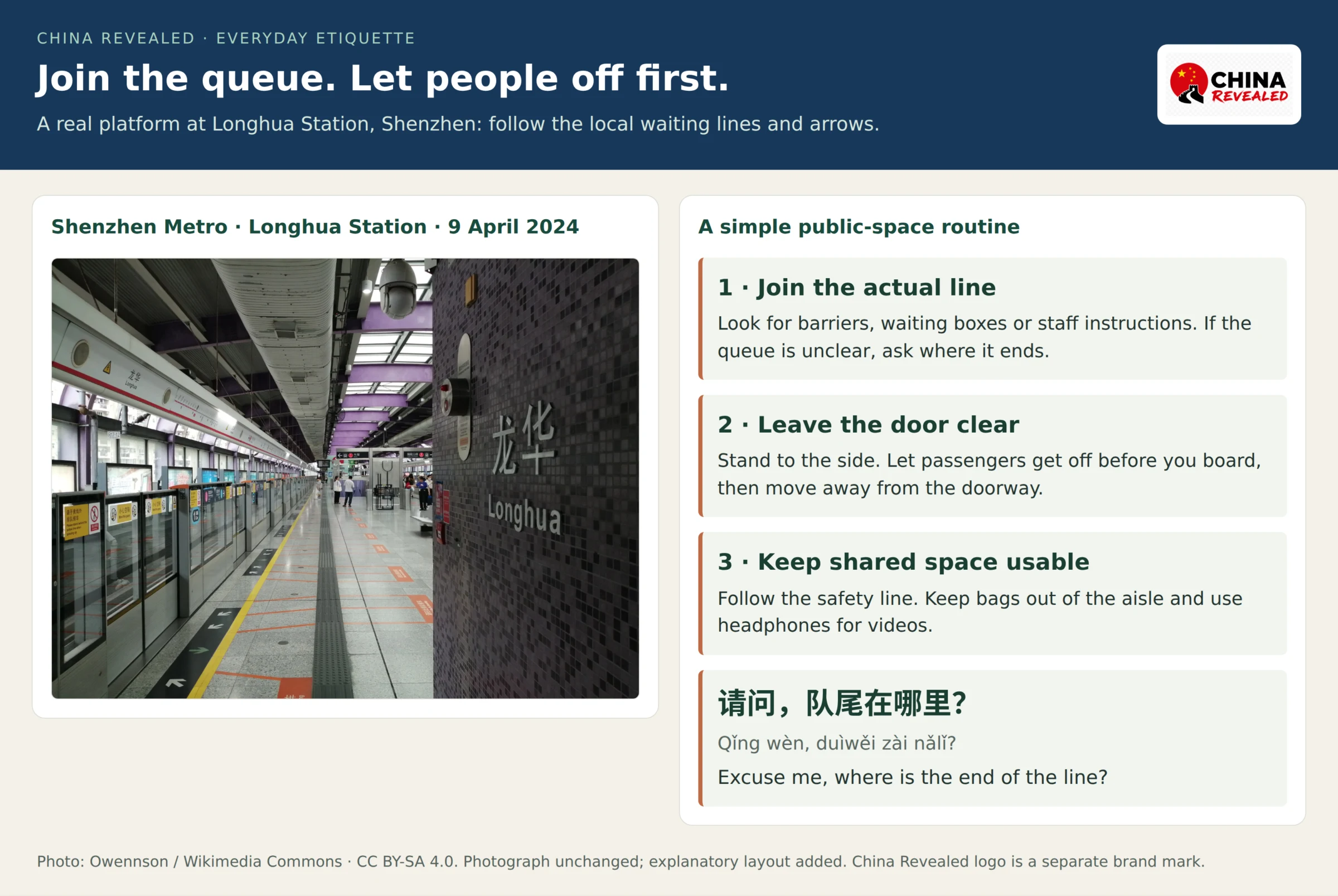

You may encounter someone edging ahead. Do not copy them or treat it as the accepted rule. A calm 不好意思,请排队。 — “Excuse me, please queue” — is a reasonable reminder. If the exchange becomes tense, ask the attendant to handle it rather than pushing, grabbing or turning it into a shouting match.
Keep videos and voice calls off speaker in carriages, museums and quiet waiting areas. Busy restaurants can be lively; a train full of people trying to rest is a different environment. Keep your bag out of the aisle, do not block an entrance for a photograph and give up a priority seat when someone needs it more.
Photography: people, museums and temples
China is rewarding to photograph, but a person is not part of the scenery simply because they are in public. Wide street views with passersby in the background are different from a close portrait of a recognizable stranger.
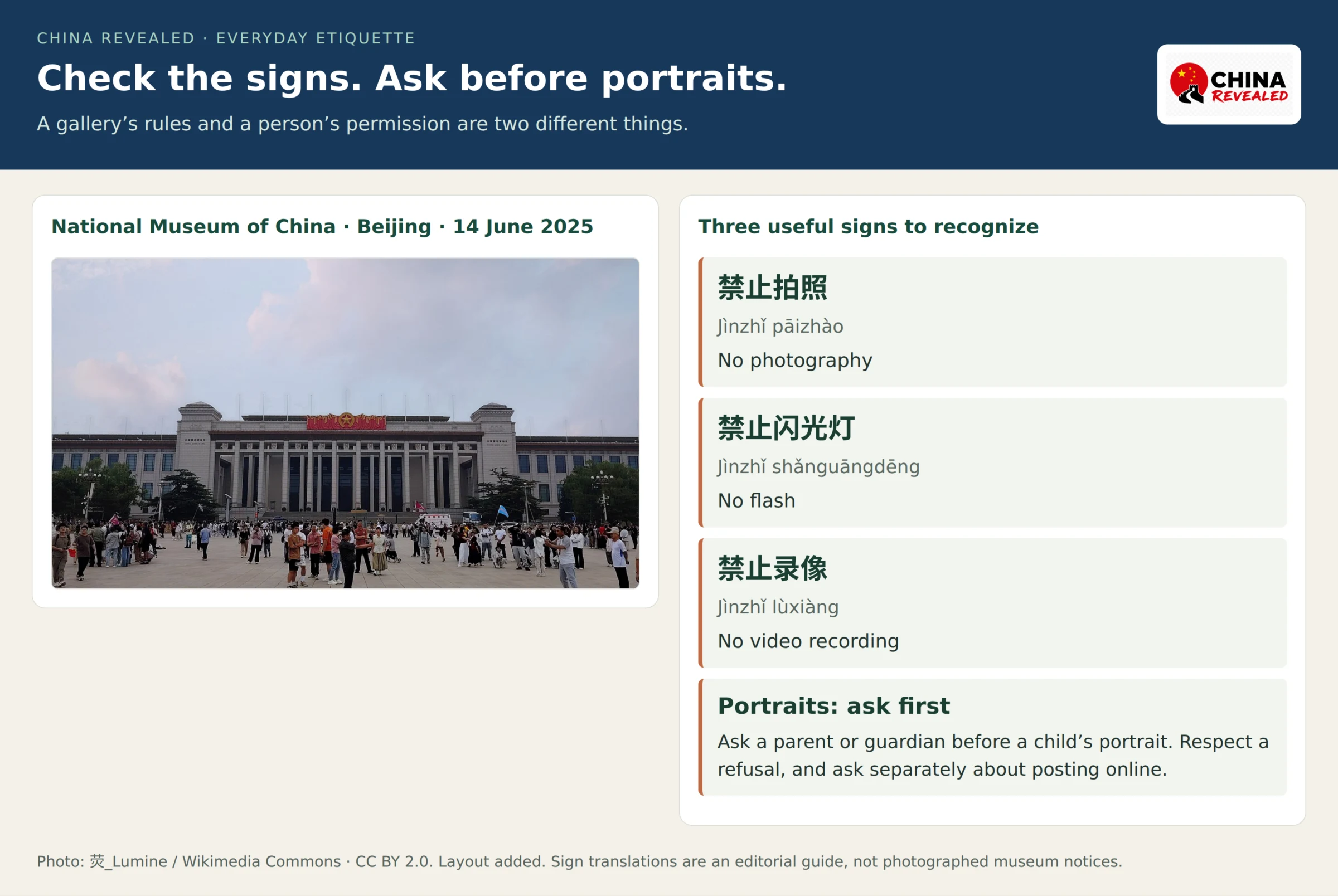
For a portrait, ask first. Show your camera, point gently and say 可以给您拍张照片吗? — “May I take a photo of you?” For a child, ask the accompanying parent or guardian. If someone hesitates, turns away or says no, move on. Do not use a long lens to get the picture anyway.
Ask separately if you plan to post a recognizable portrait online. Agreement to a holiday photo is not automatically agreement to appear in a promotional video. Avoid filming people in distress, hospital patients, private screens or documents, and people worshipping without permission.
Read the rule for the room you are entering
Museums and religious sites do not all have the same photography policy. One gallery may allow ordinary pictures while another prohibits them. Recognize these signs:
- 禁止拍照: no photography.
- 禁止闪光灯: no flash.
- 禁止录像: no video recording.
“No flash” does not mean “no photos,” but it does mean turning flash off before you shoot. Tripods, selfie sticks and large equipment may have separate restrictions. Follow the room’s signs and staff instructions, even if another visitor is ignoring them.

At an active temple, keep your voice down, let worshippers pass and do not step into a ceremony for a better angle. Ask before photographing an altar or ritual when the rule is unclear. Visitors do not need to join in religious practice to behave respectfully.
If locals ask to take a photo with you, you can say yes or politely decline. The same permission principle works both ways.
Chopsticks and shared meals
At many sit-down Chinese restaurants, dishes go in the middle for everyone to share, while each person has a small bowl or plate. Noodle shops and simple rice meals often work differently, with individual portions. Look at how the table is set before assuming every dish is yours alone.
Serving chopsticks are not eating chopsticks
Use 公筷 (gōngkuài, serving chopsticks) or 公勺 (gōngsháo, serving spoon) to move food from a shared dish to your own bowl or plate. Then eat with your personal utensils. Do not put the serving chopsticks in your mouth or return your used eating chopsticks to a shared dish when serving utensils are provided.
A restaurant may place an extra pair beside each diner or leave a pair with each dish. Color is not a nationwide code. Look for a label such as 公筷, or ask 哪双是公筷? — “Which pair is for serving?” If none is provided, ask the waiter for a clean pair or serving spoon.
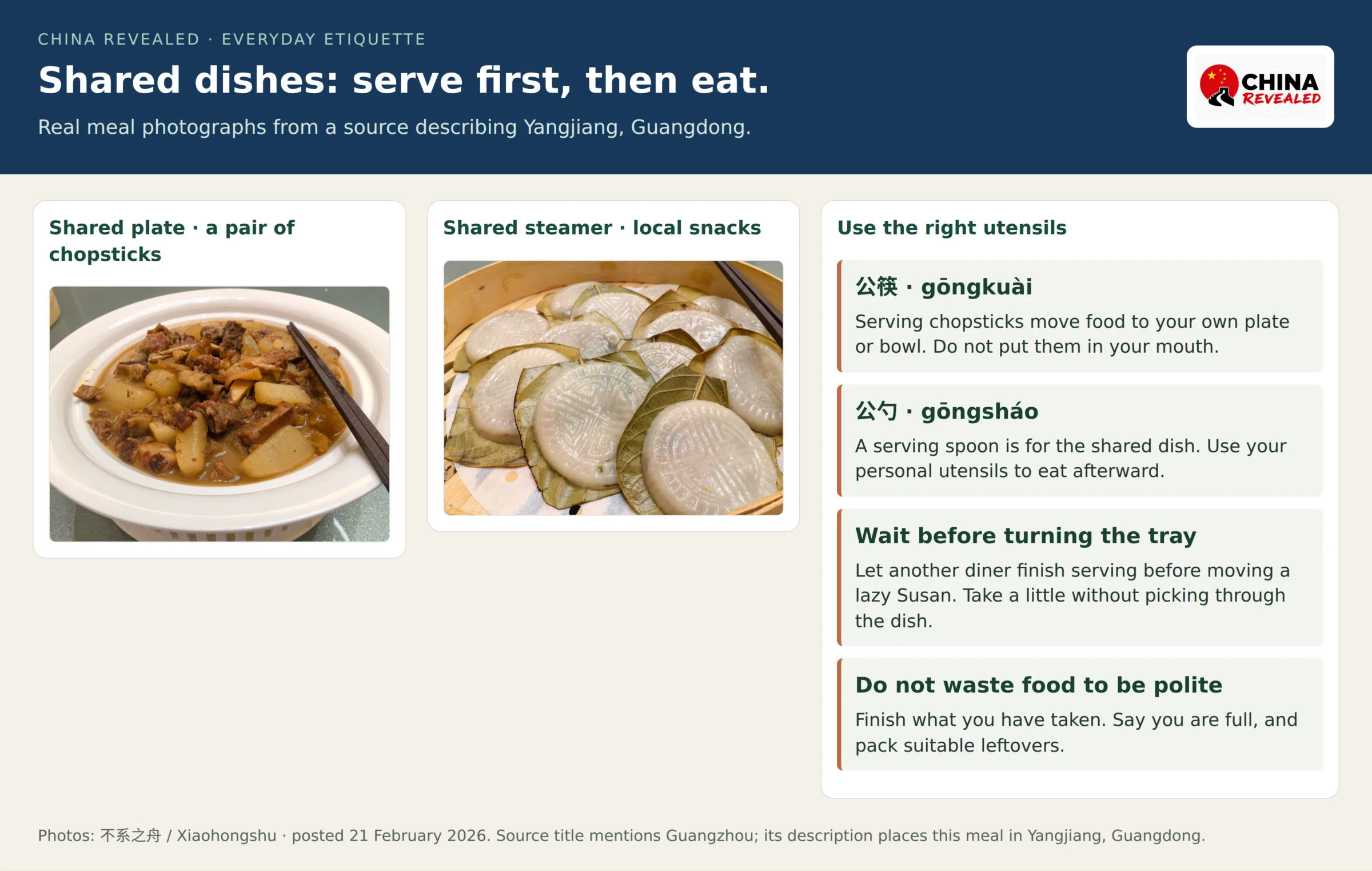
Take a little at a time rather than picking through a dish for the best pieces. If the table has a rotating tray, wait until other people have finished serving themselves before turning it. Move it gently; do not spin a dish away while someone is reaching for it.
The chopstick habits worth remembering
The most important taboo is easy to avoid: do not stick chopsticks upright in rice. It resembles the incense used in offerings and funeral rites. When you pause, set them together on the chopstick rest. If there is no rest, lay them neatly on your own plate or across the bowl’s rim, keeping the eating tips off the bare table.
Do not point at people with chopsticks, wave them while talking or use them to drum on a bowl. Avoid licking them or digging through a communal dish. These habits matter more than whether your grip looks perfect.
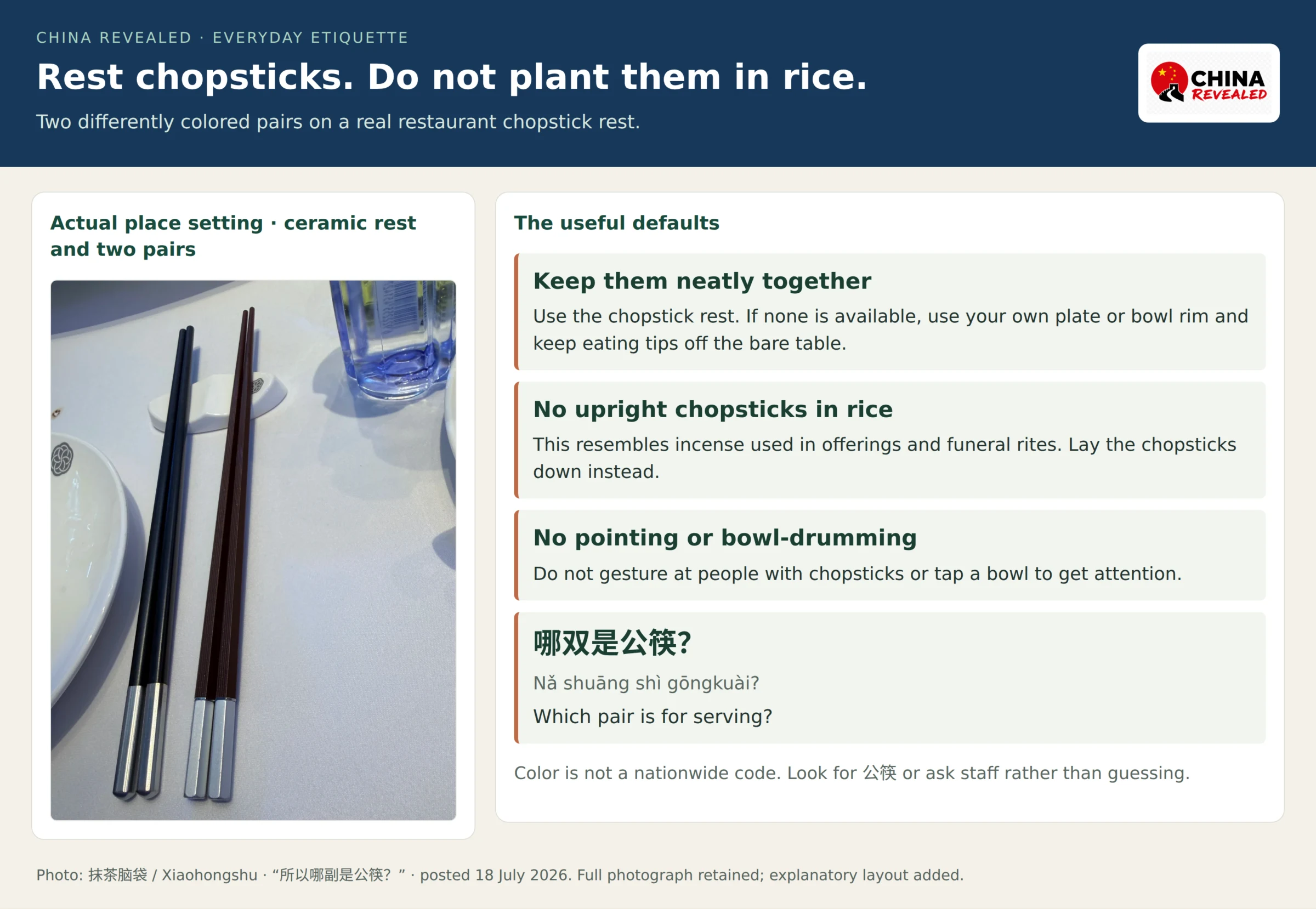
If chopsticks are difficult, ask for a spoon or fork. You do not need to struggle through the meal to prove respect. A straightforward 有叉子吗? — “Do you have a fork?” — is fine.
At a hosted meal, follow the host rather than a diagram
For a family invitation or a formal banquet, let the host indicate your seat. Once everyone is settled, wait for a welcoming gesture before starting. At an ordinary restaurant meal with friends, this can be as simple as “Let’s eat.” You do not need to calculate every seat’s rank.
Compliment a dish you genuinely enjoy. If you do not want more, say 很好吃,我吃饱了,谢谢。 — “It’s delicious; I’m full, thank you.” A host offering another helping is being hospitable; you can decline without giving a long explanation.
Do not deliberately waste food to show that the host provided enough. Order sensible quantities, finish what you have taken and ask to pack suitable leftovers. Modern anti-waste habits are a better default than the old advice that every guest must leave food behind.
Book hotels, flights, train tickets, attractions and other travel services on Trip.com.
Gifts and visiting someone’s home
You do not need to bring presents for hotel staff, drivers or everyone who helps you. For a genuine invitation to someone’s home, a small, thoughtful gift is a nice gesture. A modest box of tea, chocolates, packaged treats from your hometown or some fruit bought locally is usually easier than something extravagant. Check dietary preferences if you are bringing food.
Keep it proportionate to the relationship. An expensive gift can create pressure to return the favor. Cash, a red envelope or alcohol is not the automatic answer for a casual visit; those belong to particular relationships and occasions.
Offer the gift with both hands when convenient and say that it is a small thank-you. If the recipient says “You shouldn’t have” or politely waves it away, you can explain once that it is just a little gift. Do not keep pushing if they continue to decline.
A few low-effort gift mistakes to avoid
For a first visit to someone you do not know well, skip clocks and elaborate funeral-style wrapping. Giving a clock has an unfortunate sound association with “seeing someone to the end.” Plain, cheerful wrapping is enough.
You may also hear warnings about umbrellas or shoes. Some people take these associations seriously; others do not. There is no reason to test the issue with a first-time host when tea or a small hometown souvenir is straightforward. Helping someone with an umbrella in the rain is not the same as choosing one as a ceremonial present.
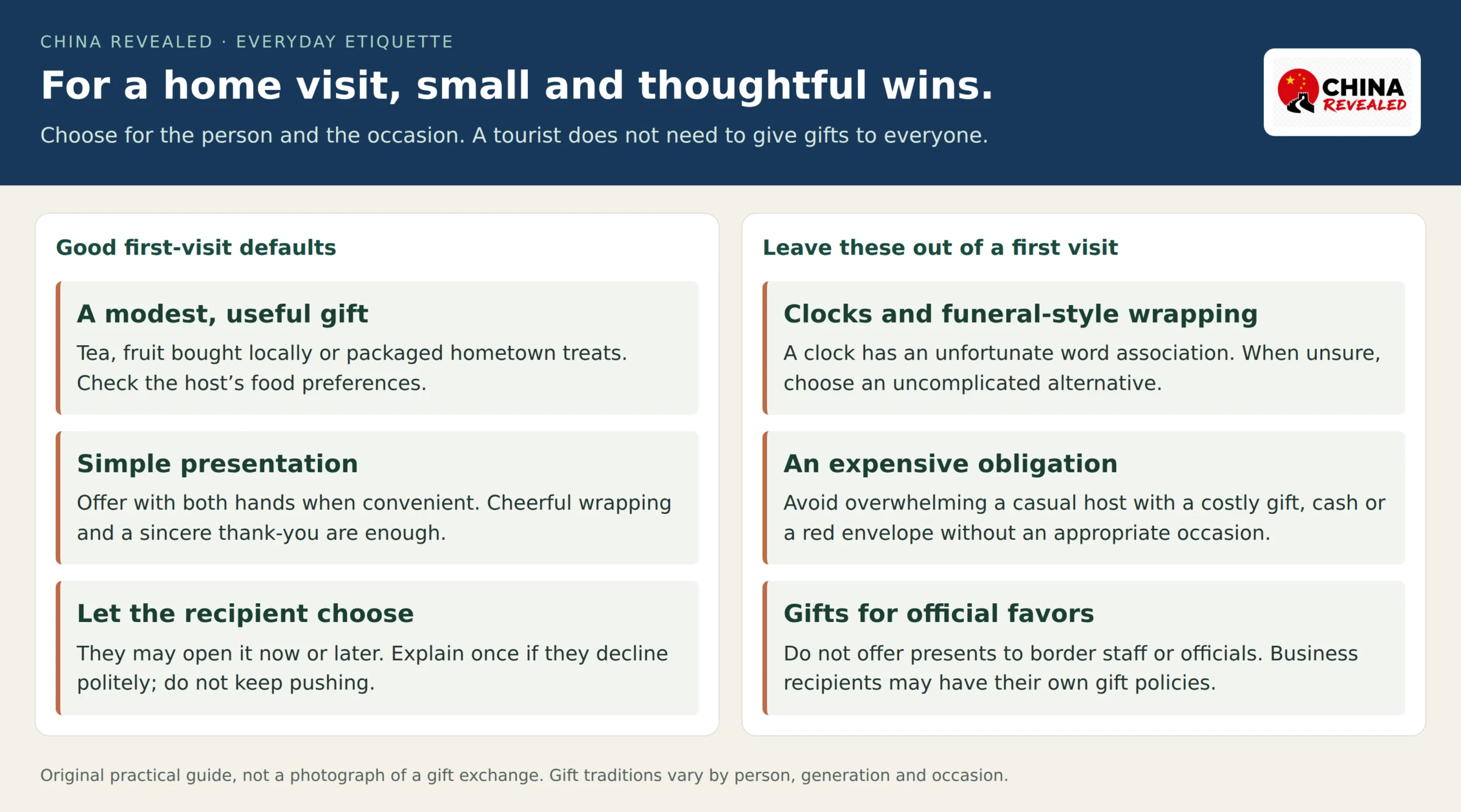
Do not insist that the recipient open your gift immediately. Some people prefer to do so later; others happily open it in front of you. If you receive a gift and are unsure, ask whether they would like you to open it now, then thank them sincerely.
At the door, check whether the household wants shoes removed. Follow the host’s lead and use offered slippers. Ask before photographing the home. Being on time, putting your phone away and thanking the host afterward are more important than elaborate gestures.
This is advice for ordinary social visits. Do not offer gifts to officials, border staff or someone making an official decision for you. In a business setting, check the recipient’s gift policy first.
Conversation: what to ask and what to leave alone
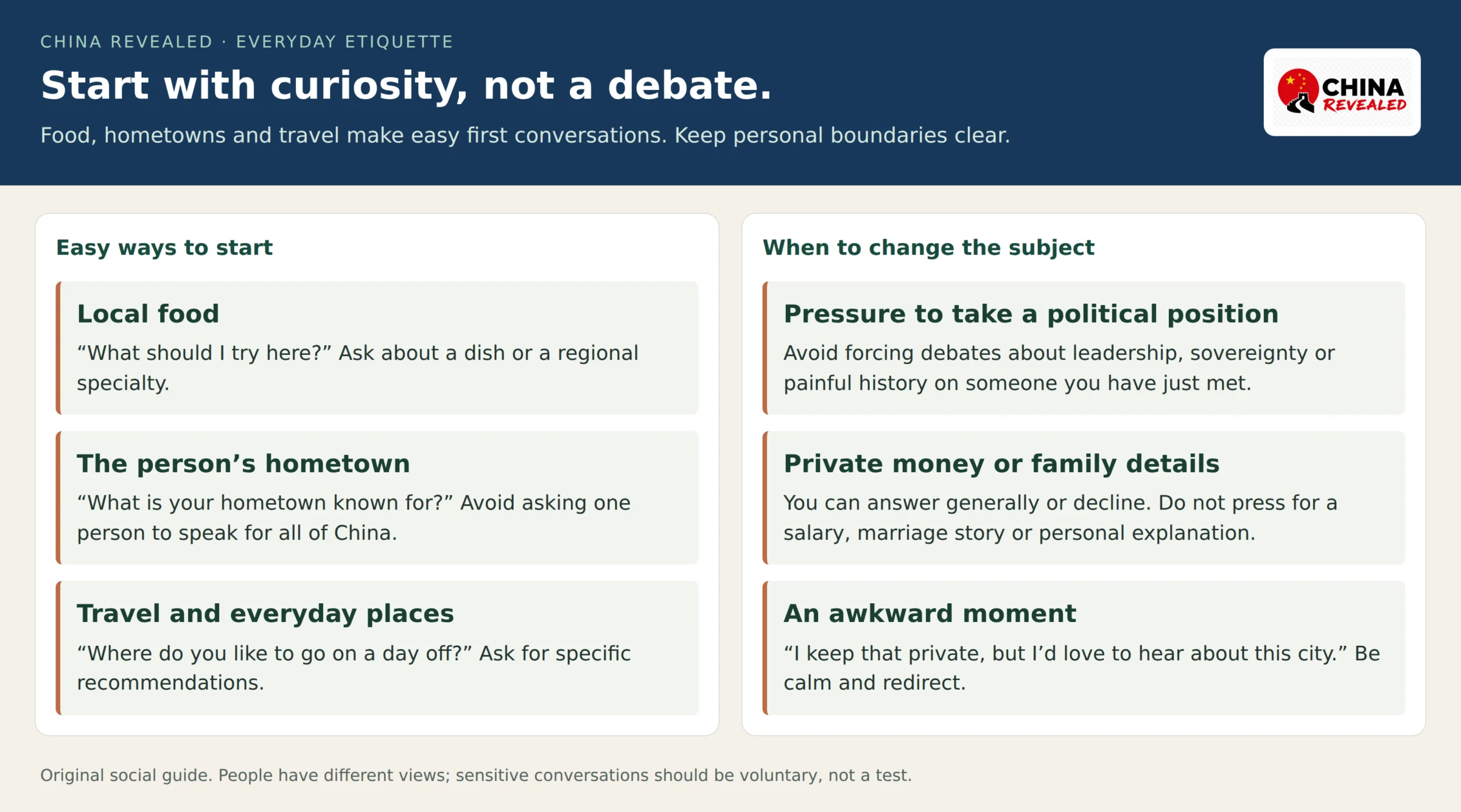
Food, hometowns, travel and local recommendations make easy first conversations. Ask what to eat, what the area is known for or where people like to go on a day off. Specific curiosity is friendlier than asking someone to explain all of China.
You may be asked your age, whether you are married, what you do or how much something costs. These can be everyday questions for the person asking, rather than an attempt to embarrass you. You still do not have to give an exact salary, explain your relationships or answer anything that makes you uncomfortable.
Keep the reply light: “I keep that private, but I’d love to hear about this city.” Or answer generally and change the subject. You can set a boundary without telling the other person that their culture is wrong.
Leave high-pressure debates for another setting
With someone you have just met, avoid turning political leadership, Taiwan, Tibet, Xinjiang, territorial disputes or painful historical events into a debate. Do not demand a stranger’s position or use a meal as a test of what they are willing to say. People have different views and different levels of comfort; let a conversation develop by mutual interest.
Religion, money and family matters also deserve tact. Avoid jokes about someone’s accent, ethnicity, appearance or marital status. A question such as “What do you recommend here?” is more useful on a holiday than “Why do Chinese people always…?”
You may hear 面子 (miànzi) translated as “face.” In everyday travel, the useful lesson is not to embarrass someone in front of an audience. If a host has misunderstood your dietary preference or a staff member has made a mistake, explain the specific problem calmly and, where practical, privately.
You can still ask for the correct bill, a replacement dish or the service you paid for. Respect does not mean accepting every mistake. Focus on fixing the situation rather than proving someone wrong in public.
Declining politely and handling awkward moments
You can join a toast with tea, water or another non-alcoholic drink. 干杯 (gānbēi) literally means “dry the cup,” and some drinking groups use it to mean finishing the drink; you do not have to follow suit. Say 我不喝酒,谢谢。 — “I don’t drink alcohol, thank you” — and raise your tea if you want to join the gesture.
An offered cigarette can also be declined: 谢谢,我不抽烟。 — “Thanks, I don’t smoke.” Our Smoking in China guide covers cigarette-sharing culture and how to deal with secondhand smoke in more detail. If you smoke, use a permitted area and stay away from queues and entrances; someone else lighting up does not give you permission.
For everyday restaurant, taxi and ordinary hotel service, there is usually no routine tipping expectation. Pay the stated amount and say thank you. Organized tours or international-service settings may have their own tipping guidance, so check the arrangement rather than applying a percentage to every purchase.
A smile, nod or ordinary greeting is enough when meeting people casually. Let the other person lead if they offer a handshake. Do not copy a bowing routine from another country or assume physical contact is required.
If you make a small mistake, apologize once and correct it. 不好意思 is useful when getting in someone’s way or misunderstanding an instruction. You do not need a dramatic explanation; stopping the behavior and being considerate usually settles the moment.
Save these polite Chinese phrases
Save the Chinese text on your phone. Start with 请问 to get attention and 谢谢 to finish a request. These are short, practical lines, not a requirement to hold a whole conversation.
请问,队尾在哪里?
Qǐng wèn, duìwěi zài nǎlǐ?
Excuse me, where is the end of the line?可以给您拍张照片吗?
Kěyǐ gěi nín pāi zhāng zhàopiàn ma?
May I take a photo of you?哪双是公筷?
Nǎ shuāng shì gōngkuài?
Which pair is for serving?我不喝酒,谢谢。
Wǒ bù hē jiǔ, xièxie.
I don’t drink alcohol, thank you.
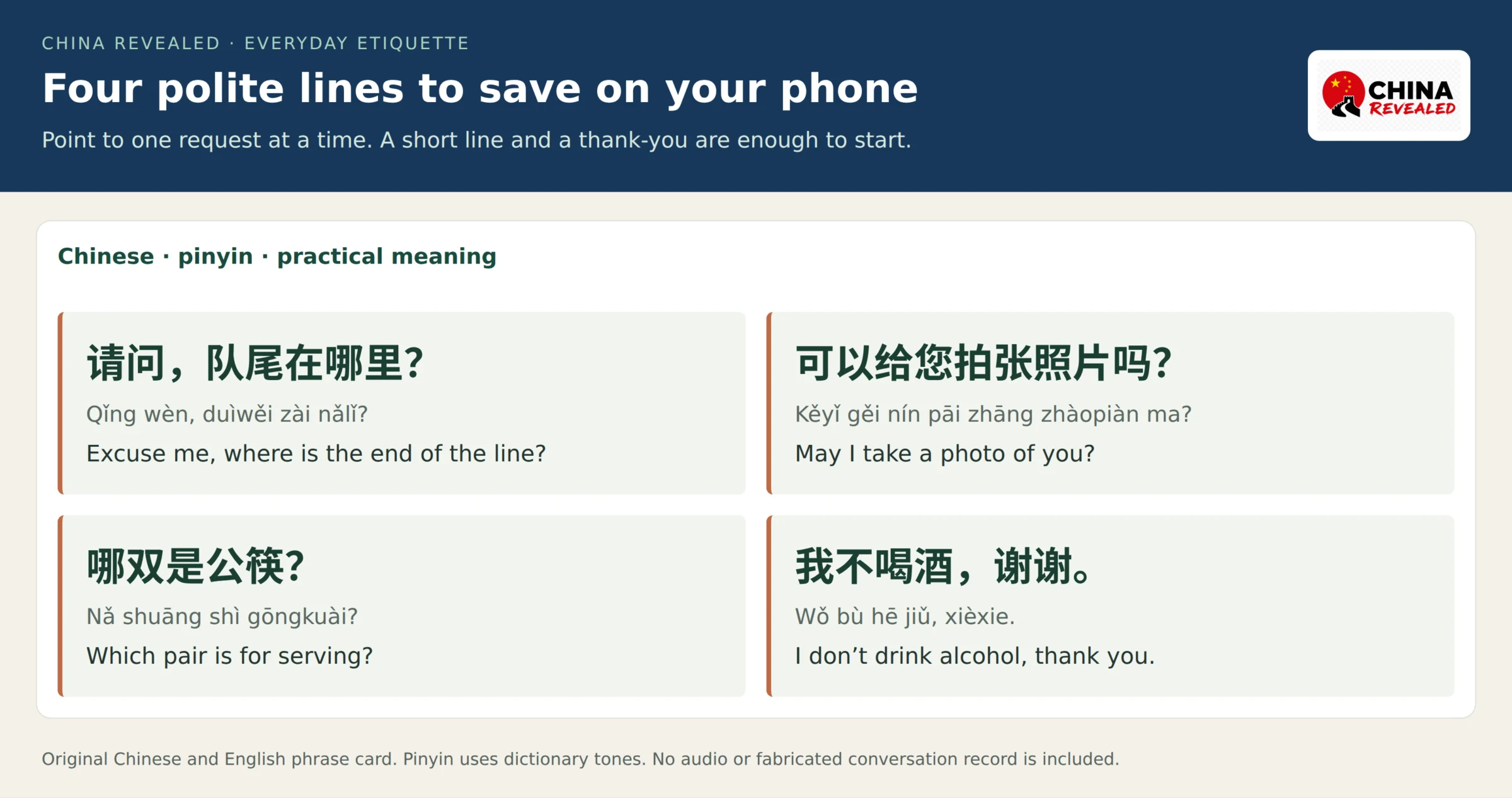
For ordering, directions and prices, continue with our Basic Mandarin Phrases for China Travel guide. The etiquette here helps you choose the right moment and tone; the phrase guide helps you say what you need.
Common questions
Is it rude to finish all the food on my plate?
No. Take a sensible amount and enjoy it. You do not need to leave food deliberately to flatter the host. If you are full, thank them and say so; suitable leftovers can be packed to go.
Can I refuse a drink or cigarette?
Yes. A friendly “No alcohol for me, thank you” or “Thanks, I don’t smoke” is enough. You can toast with tea or another non-alcoholic drink without explaining private medical or personal reasons.
Are serving chopsticks always one particular color?
No. Restaurants use different colors, lengths and labels. Look for 公筷 or ask which pair is for serving. Keep those utensils out of your mouth and use your personal pair to eat.
Do I need a gift every time I meet someone?
No. A modest gift suits a home invitation or a particular personal occasion. It is not expected for routine travel services, and it should not be used to seek favors from someone exercising official authority.
Can I photograph people in the street?
A wide street view is different from making a recognizable stranger the subject of your picture. Ask before a portrait, respect a refusal and ask about posting it online. For children, speak to the accompanying parent or guardian.
What if I do not know the custom?
Ask, or pause and watch what your host does. Do not push, point with chopsticks, photograph someone against their wishes or turn a small mistake into a public argument. Those practical defaults will serve you better than trying to memorize every regional tradition.
About China Revealed
China Revealed is an independent English-language travel guide dedicated to China.
We bring together China travel guides, destination information, local insights and practical travel resources in one place.
Our travel database covers China's provinces, cities, famous attractions, hidden gems, local cuisine, transportation, accommodation, visa requirements, digital payments, mobile connectivity and the other practical details travelers need to explore China.
We focus on depth, careful research and accuracy. Our guides combine official sources, detailed destination data, local knowledge and regularly updated information to give reliable, practical travel advice.
Whether you're visiting China for the first time or exploring beyond the popular destinations, China Revealed is an all-in-one resource for discovering the real China.
China Revealed — Your practical guide to China.
Some links on China Revealed, such as Trip.com booking links, are affiliate links. If you book through them, we may earn a commission at no extra cost to you. This does not change what we recommend.