

Domestic Flights in China: A Passport-to-Boarding Guide
Domestic flights in China for foreigners are straightforward: book with your passport, check the baggage attached to your fare, and use the staffed check-in counter if the app or machine does not accept your document. The mistakes I would focus on avoiding are the wrong airport, a cheap fare without the luggage you need, and a power bank that cannot pass domestic security.
Quick takeaways
- For a direct high-speed train under about four hours, I usually recommend rail. For a much longer journey, compare flights using the full hotel-to-hotel travel time.
- Use the original passport entered on the ticket. Save the issued-ticket confirmation, then collect your boarding pass at check-in.
- Read the fare, not just the airline name. Spring is low-cost; Juneyao is not. Bags, seats and flexibility are worth comparing before payment.
- For your first domestic flight, I recommend reaching the correct terminal about two hours before departure, with more time during holidays or at unfamiliar large airports.
- Carry a clearly CCC-marked power bank of no more than 100 Wh in your cabin bag. Never put it in checked luggage, and do not charge with it on board.
In this guide
- 1. High-speed train or plane?
- 2. How to book through Trip.com
- 3. Which Chinese airline should you choose?
- 4. Check baggage before you pack
- 5. Use your passport at airport check-in
- 6. Get through domestic security
- 7. Power banks on domestic flights
- 8. Board, arrive and handle changes
- 9. Useful answers and Chinese phrases
1. High-speed train or plane?
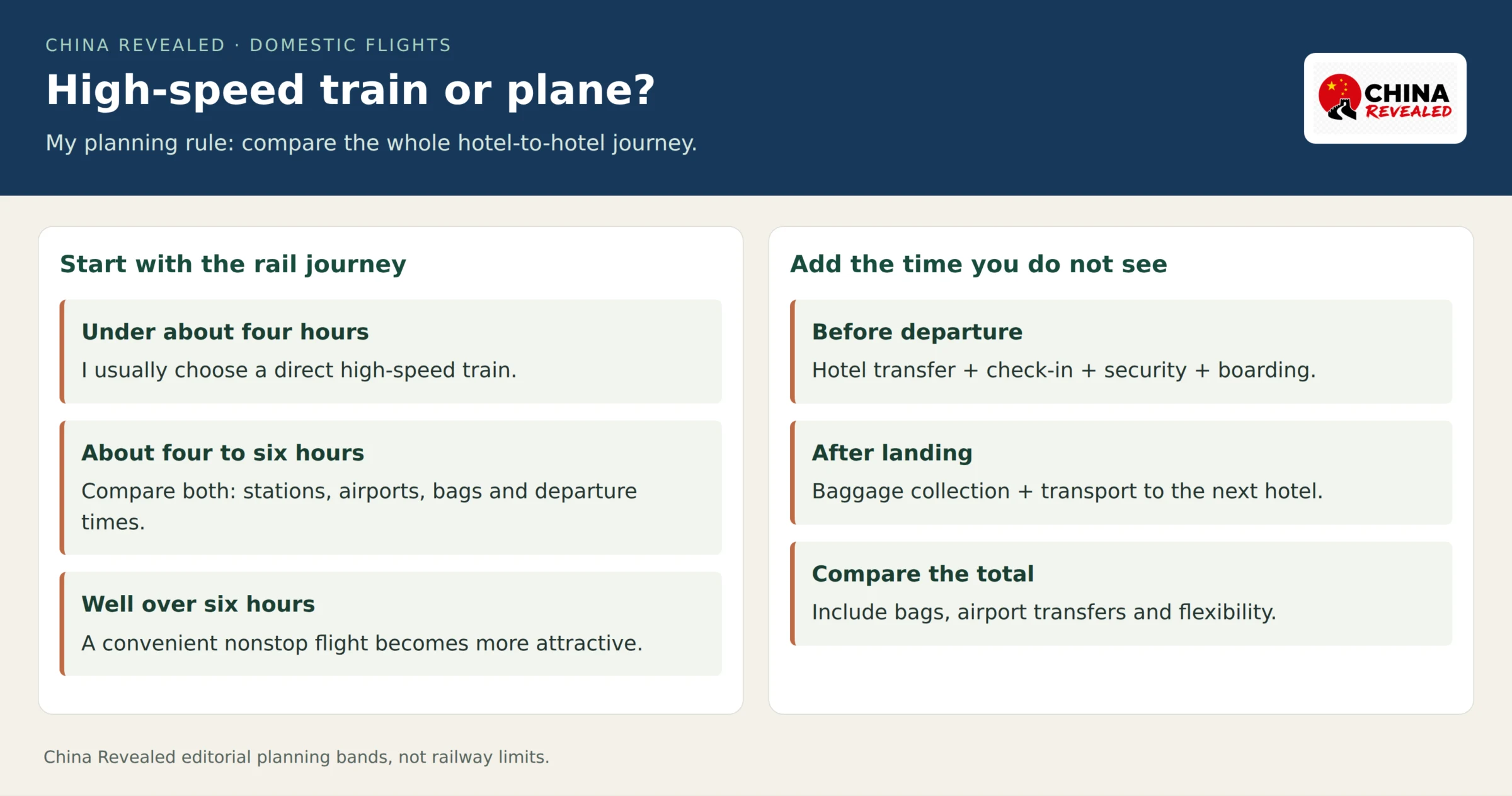
China is large enough that both belong in a sensible itinerary. I would take a direct high-speed train for a short city-to-city leg and save flying for the journeys that would otherwise eat up most of a day.
| Your journey | My recommendation | What to compare |
|---|---|---|
| Direct high-speed train, roughly under four hours | Usually take the train | Station access, departure time and the exact arrival station |
| Train takes roughly four to six hours | Compare both | Hotel-to-station or airport time, waiting, bags and arrival transport |
| Rail takes well over six hours, or involves awkward changes | A nonstop flight becomes more attractive | Flight schedule and the time needed at both airports |
| Several suitcases or a tight connection to an overseas flight | Compare the complete itinerary | Baggage cost, transfer arrangements and whether tickets are separate |
These are my planning rules, not railway limits. A two-hour flight is not a two-hour hotel-to-hotel trip: add the journey to the airport, check-in and security, baggage collection and the ride into the next city. Use Amap to check those ground journeys, and our train travel guide for the rail option.
Compare domestic flights on Trip.com — set English in the language menu if needed, open Flights, then enter your cities and dates.
2. How to book through Trip.com
For a first China trip, I recommend Trip.com as a convenient English booking route. You can compare domestic carriers in one place and keep the ticket and support conversation together. An airline’s own website or app is another option, especially if you already use that airline; a foreign-passport traveler should not spend an hour fighting a Chinese-only form just to save a small amount.
Search cities, then check the actual airports
- Open Flights in the Trip.com app or website. Set your preferred language and currency.
- Choose One-way or Round-trip, enter the departure and arrival cities, select the date, passenger count and cabin, then tap Search.
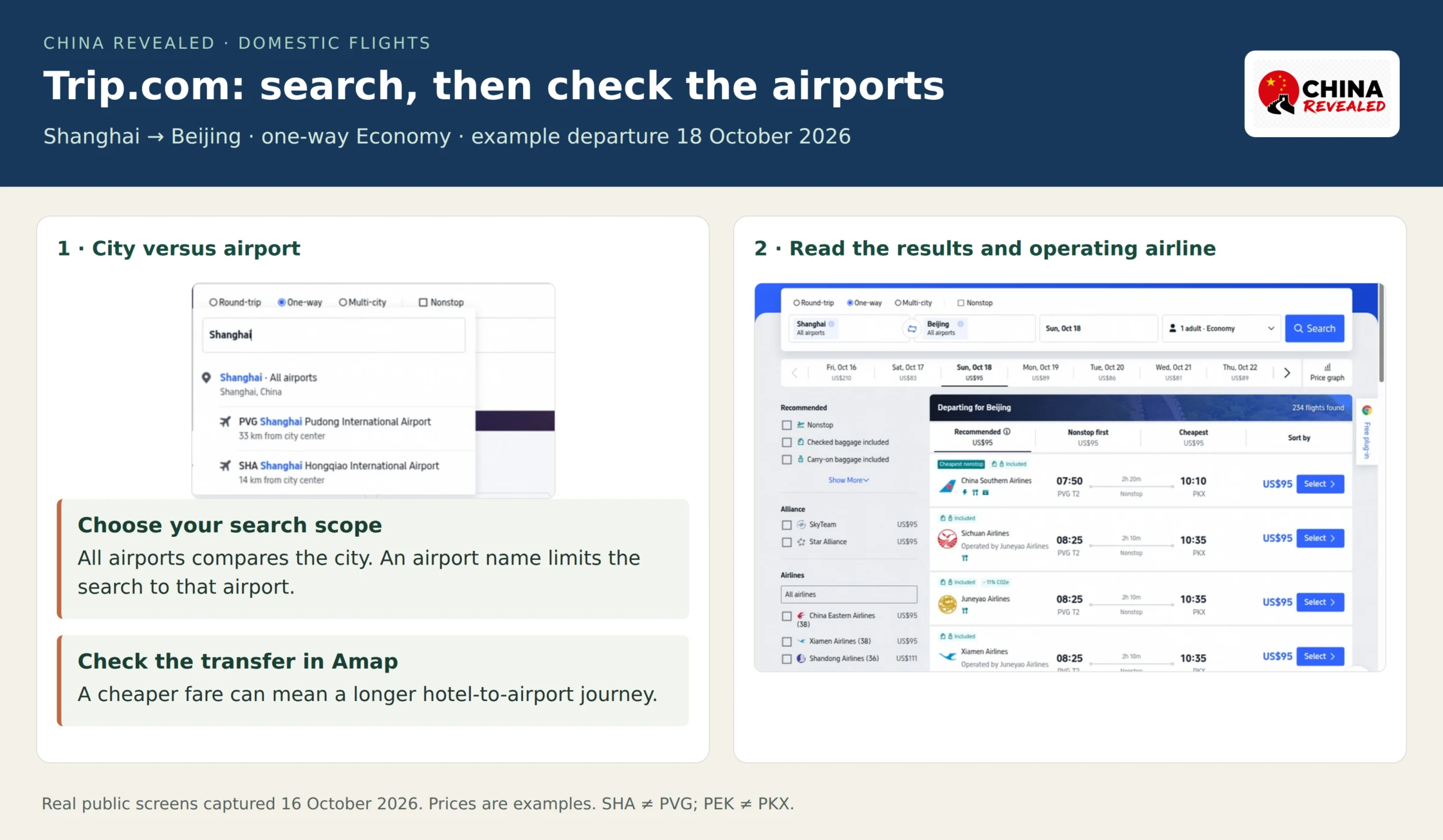
- Start with all airports if you want a broad comparison. Open each promising result and check its airport codes, terminals and times.
- For a simple city-to-city leg, I would filter for Nonstop before sorting by price.
Three airport pairs regularly catch visitors out:
- Shanghai: Hongqiao SHA and Pudong PVG.
- Beijing: Capital PEK and Daxing PKX.
- Chengdu: Shuangliu CTU and Tianfu TFU.
They are not interchangeable terminals. A cheaper flight can mean a longer trip from your hotel. Hongqiao Airport is also not Hongqiao Railway Station. Copy the terminal’s Chinese name into Amap before you set off.
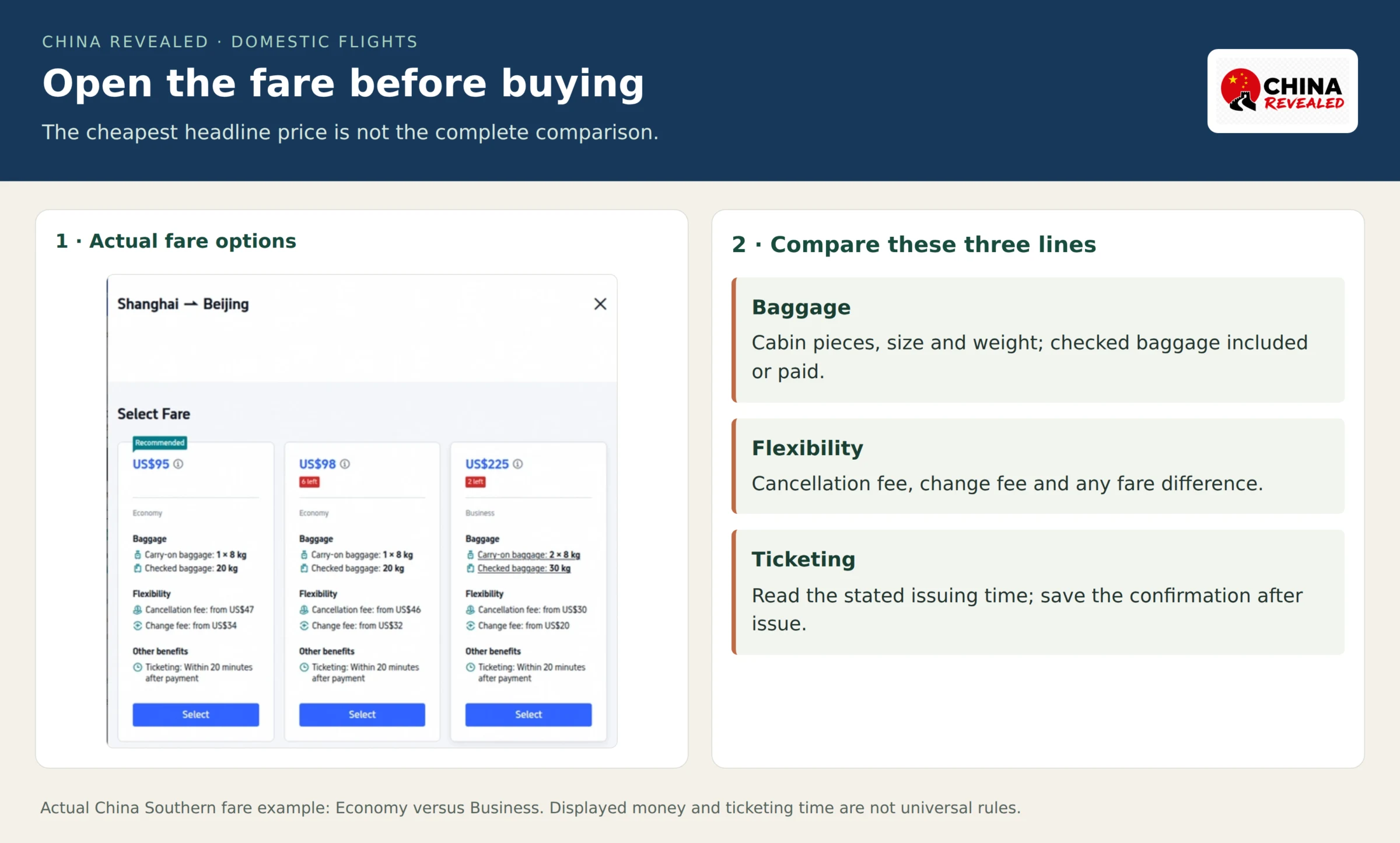
Open the fare details before choosing Book
Compare checked baggage, cabin baggage, change/refund rules and the operating airline. On a codeshare, the name selling the ticket can differ from the airline actually flying it; look for Operated by.
Do not buy the lowest headline price until you have added any luggage you need. Read whether a change is allowed, the fee, and whether a fare difference is also payable. If your trip could move by a day, a more flexible fare may be worth more than a snack or seat-selection benefit.
Enter passport details carefully
Choose Passport as the document type when requested. Enter the surname and given names from the original passport into the matching fields, and include middle names where the form requires them. Fill in the passport number, nationality, birth date and expiry date when asked. Follow the current form’s instructions for spacing or punctuation rather than inventing a Chinese name.
Use an email you can access and your own reachable phone number with the correct country code. A data-only travel eSIM gives you internet, not an SMS number. If a name or document field is rejected, ask Trip.com support before paying; do not change your identity details just to make the form submit.
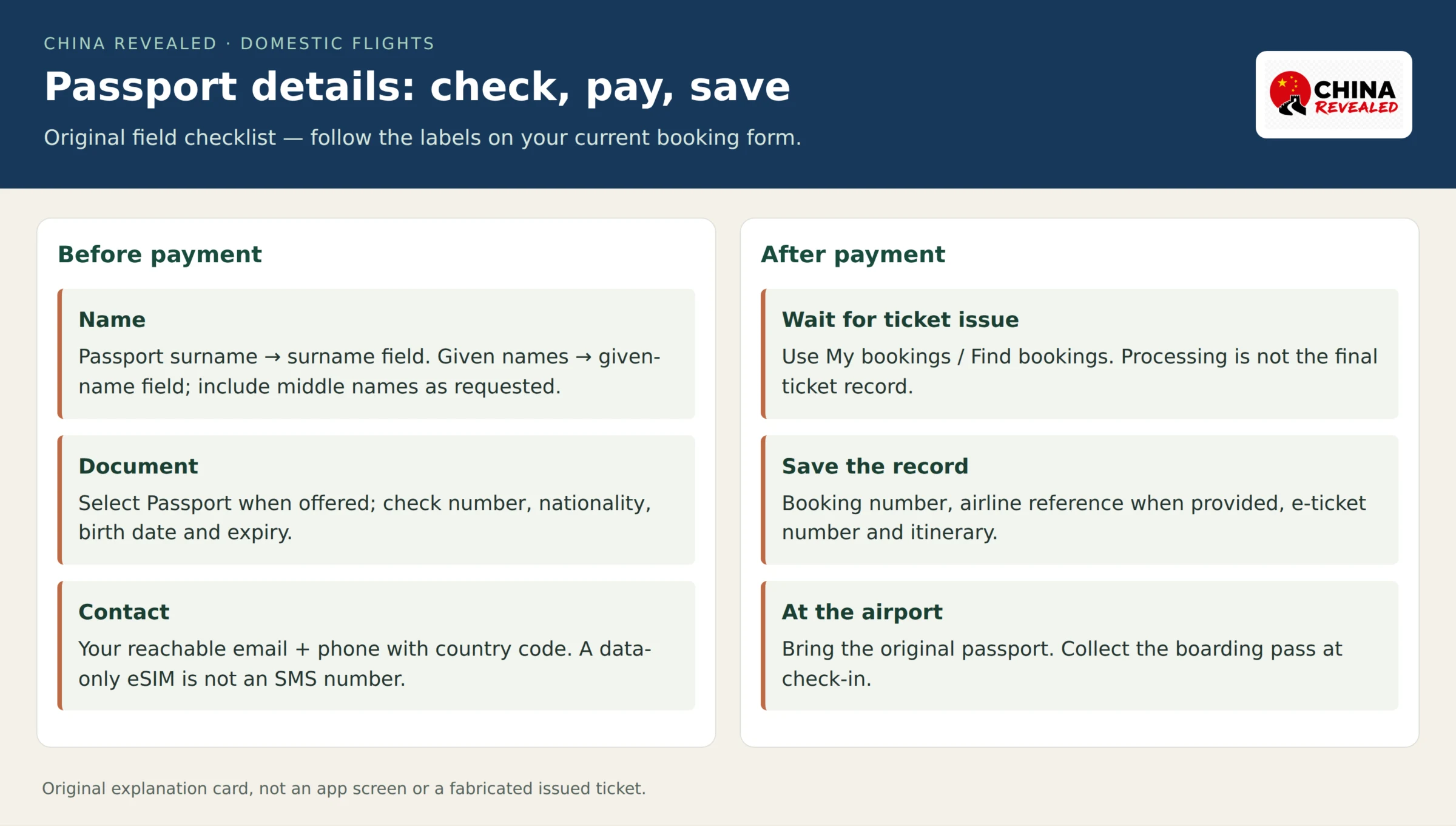
Pay, then save the issued ticket
On the final screen, check the passenger, date, airports, operating airline, luggage and total. Choose an available payment method and review optional insurance or other extras before confirming.
After payment, open My bookings / Find bookings. Wait for the booking to show that the ticket has been issued or confirmed; if it still says processing, follow the order’s stated timeline or contact support rather than making a duplicate booking.
Save the Trip.com booking number, airline booking reference if provided, e-ticket number, flight number and itinerary. Keep the confirmation offline. This is your ticket record; the boarding pass comes later at check-in.
Check flights and baggage options on Trip.com — compare the full price before you pay.
3. Which Chinese airline should you choose?
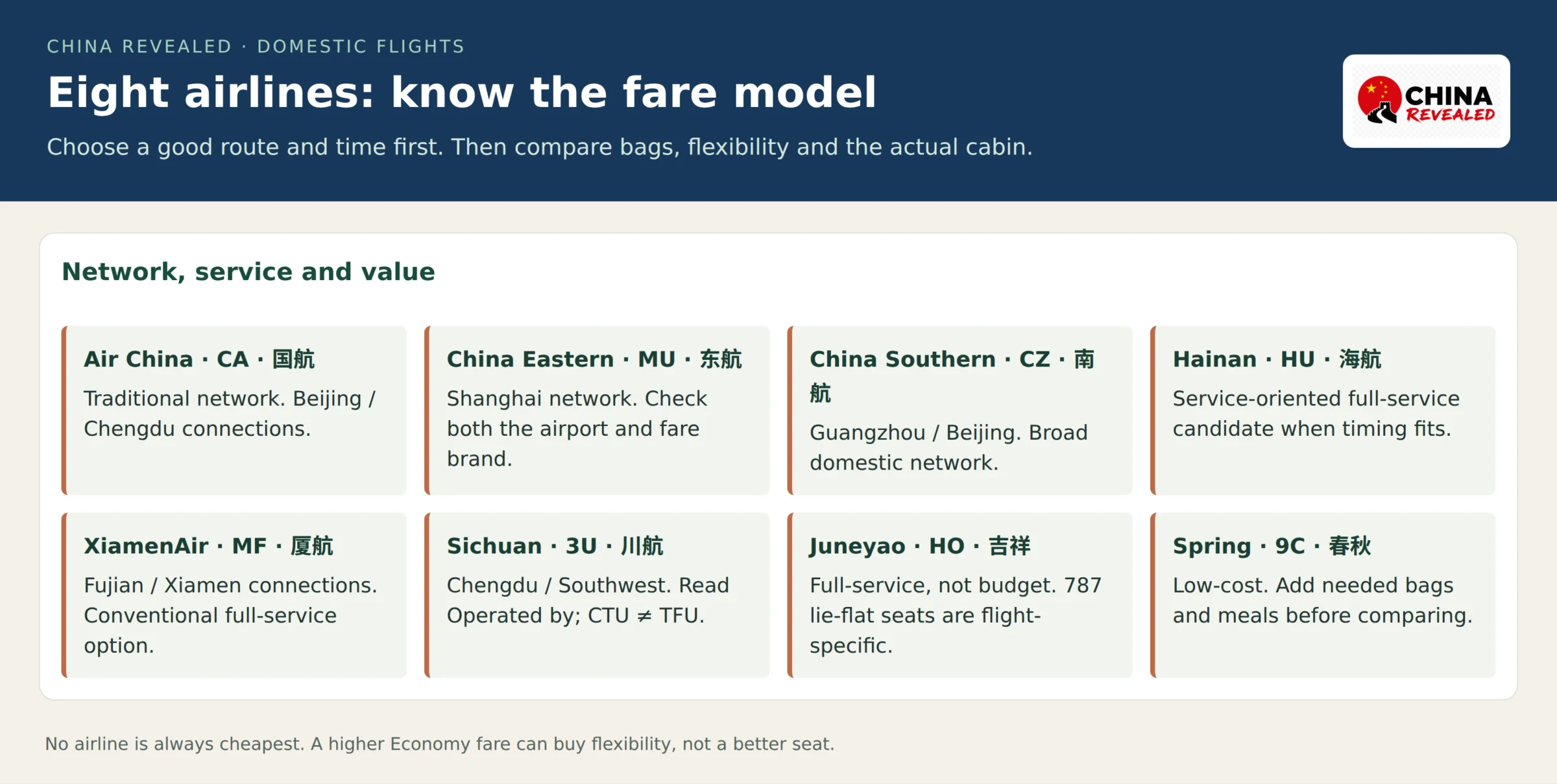
For a straightforward first trip, I would choose a convenient nonstop flight on a full-service carrier when the total price is close. If Spring is substantially cheaper after adding your bags, it can be a sensible choice too. Low-cost means a different fare model, not an automatic judgment about safety.
| Airline | Where it fits well | Main trade-off |
|---|---|---|
| Air China — CA / 中国国际航空 | Major Beijing and Chengdu connections; a broad traditional network | Compare fare flexibility and bags; domestic Economy cabin baggage is generally limited to 5 kg |
| China Eastern — MU / 中国东方航空 | Shanghai routes, plus Beijing, Xi’an and Kunming connections | Fare brands have different change/refund conditions; choose the airports carefully |
| China Southern — CZ / 中国南方航空 | Guangzhou, Beijing and a wide domestic network | Read the specific fare’s baggage and meal information rather than buying on the brand name alone |
| Hainan Airlines — HU / 海南航空 | A service-oriented full-service option when its route and schedule fit | Special fares can have different benefits; look at the actual aircraft if comfort matters |
| XiamenAir — MF / 厦门航空 | Xiamen/Fujian and onward domestic connections | Compare the complete timetable and fare conditions, particularly for connecting journeys |
| Sichuan Airlines — 3U / 四川航空 | Chengdu and Southwest China routes | Check CTU versus TFU and the actual operating carrier on connecting or codeshare flights |
| Juneyao Air — HO / 吉祥航空 | A full-service alternative for Shanghai connections | It is not a budget airline; its wide-body Business Class product is flight-specific |
| Spring Airlines — 9C / 春秋航空 | Light packers seeking a lower base fare | Meals are paid; checked bags and cabin-bag limits depend on the fare package |
Spring: the cheap fare needs a luggage calculation
Spring’s standard domestic cabin allowance is currently one bag up to 7 kg and 20 × 30 × 40 cm. That is smaller than many travelers expect. The Premium product has a larger published allowance; its current rule is up to 10 kg and 20 × 40 × 55 cm.
Ultra Value and a Preferred fare without a baggage package have no free checked baggage. A qualifying Preferred-with-baggage package and Premium include 20 kg under the current domestic rules. Add bags during booking or before the airport, and compare the resulting total. If you want a meal, budget for it too.
What is a genuinely better, more expensive flight?
If the fare difference is modest, I would shortlist Hainan, XiamenAir or Juneyao for a service-oriented option when their timing suits the route. But paying more for Economy can simply buy flexibility, not a different seat.
For a real comfort upgrade, look at Business Class, the aircraft and the seat map. A wider recliner seat on an A320 or 737 is different from a lie-flat seat on a wide-body aircraft. Juneyao’s 787-9, for example, has a lie-flat Business Class product; confirm that your particular flight uses it. If a bed is the reason you are paying extra, read the actual seat description rather than stopping at the word “Business.”
4. Check baggage before you pack
There is no single China-wide Economy baggage allowance. Traditional carriers often publish a 20 kg domestic checked allowance, but the allowance attached to your ticket is the one to pack for. Cabin limits differ too: the current general domestic Economy rules include 5 kg on Air China, 8 kg on China Southern and 7 kg on Hainan, with airline-specific dimensions and conditions.
Open your order and write down:
- Cabin baggage: number of pieces, dimensions, weight and any separate personal-item allowance.
- Checked baggage: included kilograms or pieces, plus the price of extra luggage.
- Connections: whether bags are checked through or you must collect and recheck them.
If staff take your cabin suitcase for hold loading at check-in or the gate, remove the power bank and spare lithium batteries first. Keep your passport, medication, valuables and essential documents with you. Put larger toiletries into checked baggage, subject to the airline’s dangerous-goods rules.
5. Use your passport at airport check-in
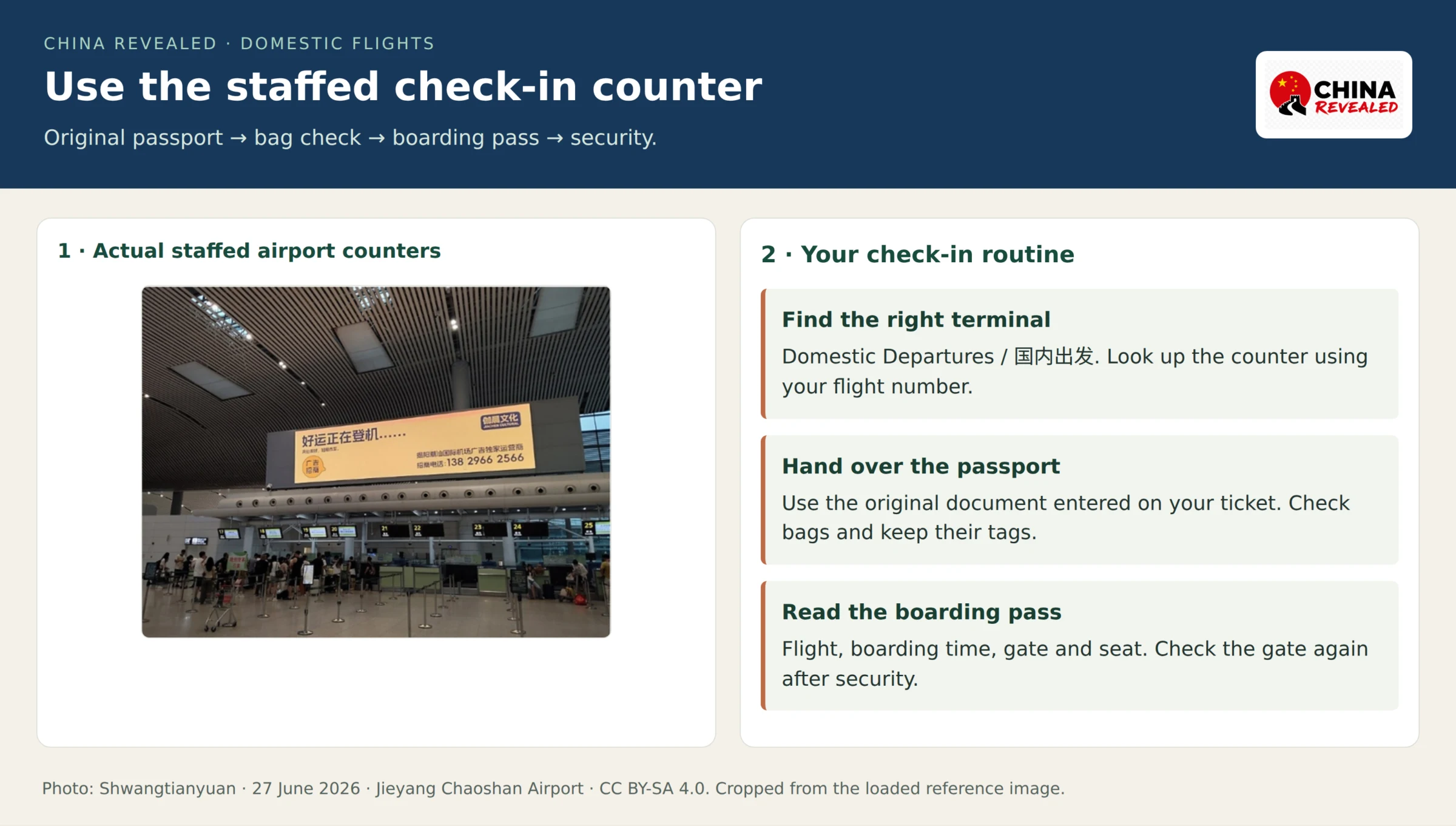
A foreign passport is a valid document for a domestic flight between mainland Chinese cities. Use the same original passport you booked with. For this journey, follow Domestic Departures / 国内出发, not the international immigration route.
I recommend arriving at the correct terminal about two hours before departure for a first domestic flight. Give yourself more time during major holidays, if you need baggage payment or assistance, or if the airport is unfamiliar. Check-in and gate closing times are separate deadlines; read the times specified for your flight instead of treating this arrival recommendation as a deadline.
- Find your flight number on the departures screen and locate its check-in counter or airline zone.
- Join the staffed counter queue. Hand over the original passport and show the flight or booking details if requested.
- Check a bag or deal with excess baggage there. Keep the baggage receipt or tag.
- Collect the boarding pass and read the flight number, gate, boarding time and seat.
- Proceed to security with the passport and boarding pass accessible.
An app or kiosk that only offers Chinese identity-card scanning is not a reason to panic. Use the counter. If online check-in worked and you have no checked bag, follow the airline’s instructions for using its accepted boarding pass; use staff assistance whenever the passport or electronic pass is not recognized.

6. Get through domestic security
The order is passport and boarding-pass check → bag screening → personal screening → collect your belongings. Take off or remove items as staff direct, and take electronics or power banks out of the bag when requested. Put loose items in the tray so you do not leave a phone or passport behind.
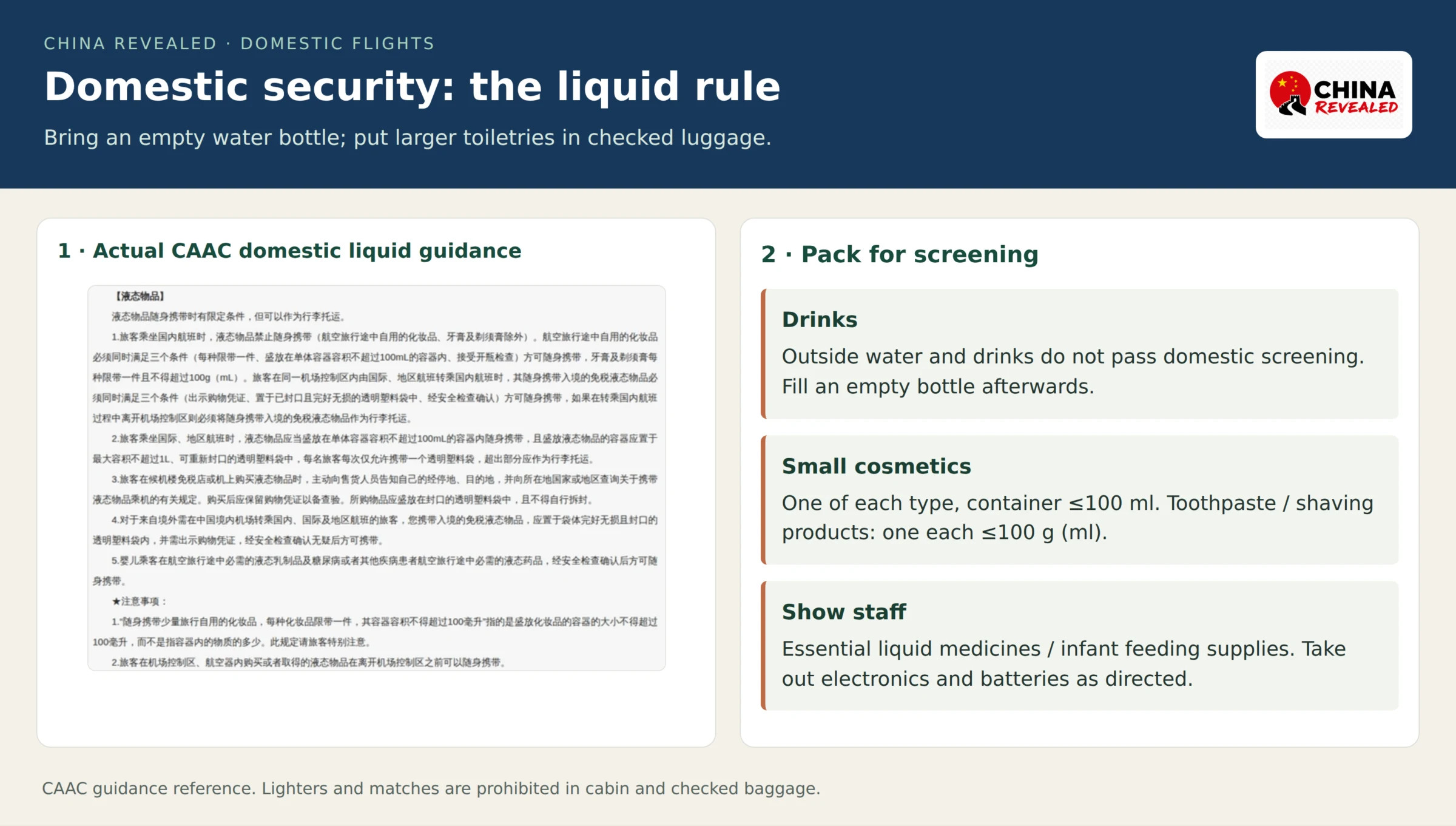
The liquid rule catches visitors who are used to the standard international “100 ml liquids bag” routine:
- Outside water and drinks do not go through domestic security. Carry an empty bottle, then fill it after screening; drinking-water points are common in Chinese airports.
- For travel-use cosmetics, the general domestic rule allows one item of each type in a container of no more than 100 ml, with inspection. Toothpaste and shaving products: one of each, no more than 100 g (ml).
- A 150 ml bottle that is half empty is still a 150 ml container. Put larger toiletries in checked luggage.
- Show essential liquid medicines and infant feeding supplies to staff for separate inspection.
- Do not carry lighters or matches, including in checked luggage. Do not pack knives or defensive sprays as cabin-bag travel essentials.
Once through, check your gate again on the airport screens. Large terminals can involve a long walk or a shuttle, so find the gate before settling down for a meal.
7. Power banks on domestic flights
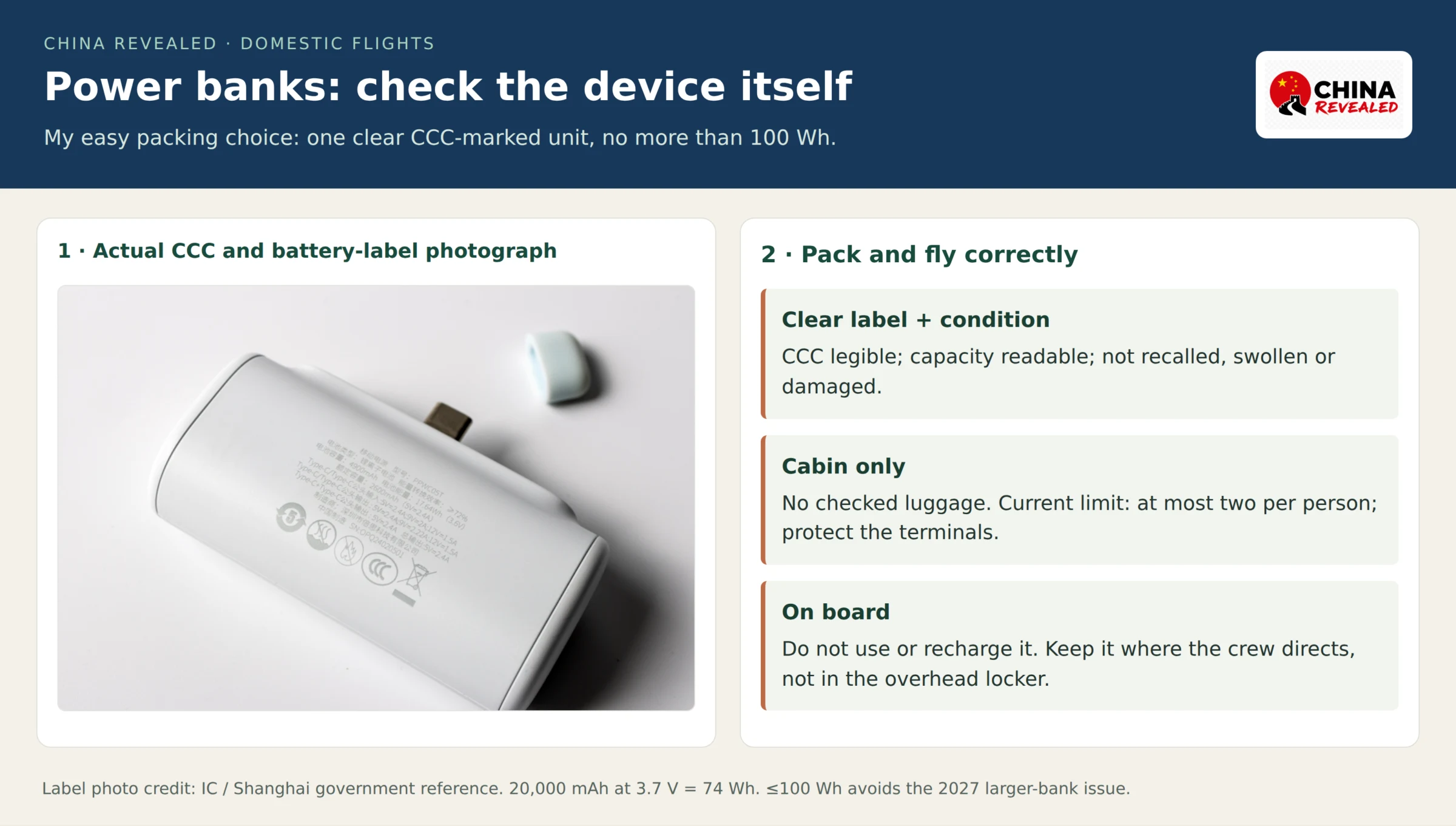
For a trouble-free packing choice, I recommend one clearly labeled, CCC-marked power bank of no more than 100 Wh. A familiar overseas brand name is not enough: the Chinese domestic-flight rule checks the certification mark on the device itself.
Before leaving home, check these details:
- CCC / 3C mark: clear and legible on the power bank. Domestic flights prohibit units with no mark, an unclear mark, or a recalled model/batch.
- Capacity and condition: readable energy/capacity information, no swelling or damage. Look at Wh rather than relying only on the marketing mAh number.
- Number: the current rule limits travelers to two power banks per person. One compliant unit is simpler to manage.
- Packing: cabin baggage only, with terminals protected against short circuits. Never put it into checked luggage.
- On board: do not use it to charge a device or recharge the power bank. Keep it where the crew directs, not in the overhead locker under the current airline guidance reviewed for this article.
For scale, 20,000 mAh at a rated battery voltage of 3.7 V equals 74 Wh. Use the device’s own label; a damaged or unreadable label cannot be fixed by showing staff an online product listing.
The 2026 rules reviewed still include an airline-approval route for some 100–160 Wh units, but I would not plan a trip around that exception. IATA’s announced 2027 rules remove that power-bank allowance. Choosing no more than 100 Wh avoids this issue for a future trip as well.
Charge your phone before boarding. If a power bank falls into a seat mechanism, call the crew rather than trying to move the seat and retrieve it yourself.
8. Board, arrive and handle changes
At the gate, listen for your boarding group or watch the display, then present the passport and boarding pass for scanning. The departure time is not the last time you can reach the gate. Boarding closes earlier, and a delay announcement does not automatically extend your original check-in deadline.
After landing, follow Baggage Claim / 行李提取 if you checked a bag. Match the belt to your flight number, collect the case and keep its tag until you have it. For an ordinary domestic journey between mainland cities, this is not another international immigration or customs clearance.
If a bag is missing, damaged or opened, go to the airline’s baggage-service desk before leaving the arrivals area. Show the baggage tag and file a report. If your flight is cancelled or rescheduled, open the affected Trip.com booking to read the change or refund options; use the airline desk for immediate airport help. If you need an official ticket change or refund, work through the booking channel rather than making a new purchase without checking the original ticket.
Do not schedule a tight self-transfer to your flight home. Separate domestic and international tickets can require collecting bags, changing terminals or airports, and checking in again. I would leave a substantial buffer, or use an overnight stop when the connection is important and the tickets are separate.
9. Useful answers and Chinese phrases
Do I need a Chinese ID card or Chinese phone number?
You can book and fly with a valid foreign passport. A Chinese ID card is not required. Use a reachable phone number and email accepted by your booking channel; an airline’s domestic app may have a narrower sign-in or check-in workflow than its staffed counter.
Can I fly with only a passport photo?
Bring the original passport. A saved photograph and the ticket email are useful backups, not your normal substitute for the original travel document.
Is the flight with the most expensive Economy ticket the nicest?
Not necessarily. It can be the same plane and seat with better refund or change conditions. For a comfort upgrade, compare the cabin and actual seat product. For value, compare the schedule and total with your bags included.
| What you need | Show this to staff |
|---|---|
| Check in with a foreign passport | 我用外国护照办理值机。 — I’d like to check in with a foreign passport. |
| Find the check-in counter | 这个航班在哪里办理值机? — Where is check-in for this flight? |
| Find the gate | 请问这个登机口怎么走? — How do I get to this boarding gate? |
| Check your power bank | 这个充电宝可以带上飞机吗? — Can I carry this power bank on the flight? |
My preferred routine: compare the train first, book a convenient nonstop flight when it saves a meaningful amount of time, read the fare’s luggage rules, and use the staffed counter with your original passport. That keeps a domestic flying day simple.
Booking, airline and aviation rules checked on 16 October 2026.
About China Revealed
China Revealed is an independent English-language travel guide dedicated to China.
We bring together China travel guides, destination information, local insights and practical travel resources in one place.
Our travel database covers China's provinces, cities, famous attractions, hidden gems, local cuisine, transportation, accommodation, visa requirements, digital payments, mobile connectivity and the other practical details travelers need to explore China.
We focus on depth, careful research and accuracy. Our guides combine official sources, detailed destination data, local knowledge and regularly updated information to give reliable, practical travel advice.
Whether you're visiting China for the first time or exploring beyond the popular destinations, China Revealed is an all-in-one resource for discovering the real China.
China Revealed — Your practical guide to China.
Some links on China Revealed, such as Trip.com booking links, are affiliate links. If you book through them, we may earn a commission at no extra cost to you. This does not change what we recommend.