

Basic Mandarin Phrases for China Travel
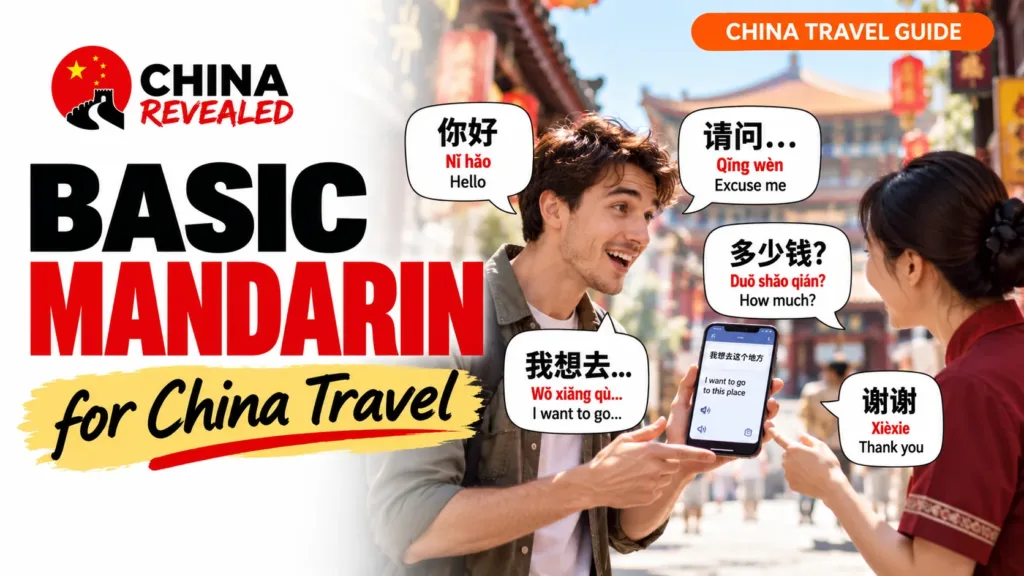
Basic Mandarin phrases for China travel help you ask the way, order what you want and confirm a price without holding a whole conversation. I recommend learning a few short lines, saving the Chinese text on your phone and using a translation app for the reply you cannot understand.
Tap any red Chinese text to hear it in Mandarin.
Quick takeaways
- Start with 请问 (qǐng wèn) to get someone’s attention, then ask one short question.
- At a restaurant, pointing at a dish and saying 我要这个 (wǒ yào zhège) is often more useful than trying to pronounce its full name.
- Bargain at suitable market stalls, not at chain shops, restaurants or official ticket counters.
- Learn the numbers, but confirm the total price and quantity on a screen. A hand sign alone does not tell you whether the price is ¥8 or ¥80.
- Keep a Chinese address and the translation-app guide ready. Short phrases start the exchange; the app handles the details.
Start with five useful phrases
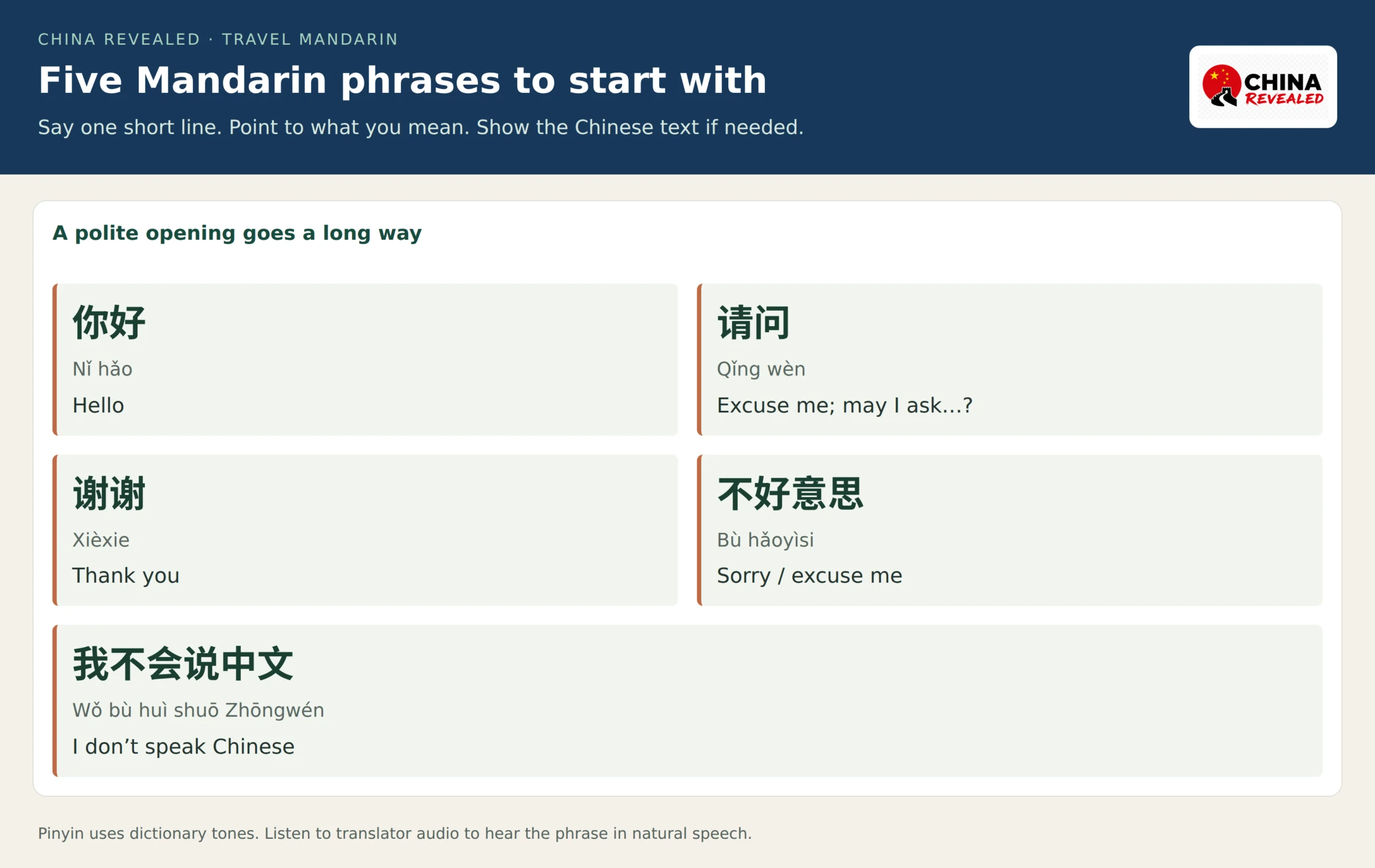
You do not need a long phrasebook for a first trip. Get someone’s attention, point to what you mean and let them see the Chinese if your pronunciation is unclear.
| Chinese | Pinyin | Meaning / when to use it |
|---|---|---|
| 你好 | Nǐ hǎo | Hello. |
| 请问 | Qǐng wèn | Excuse me; may I ask…? Use it before a question. |
| 谢谢 | Xièxie | Thank you. |
| 不好意思 | Bù hǎoyìsi | Sorry / excuse me. Useful when interrupting or squeezing past. |
| 我不会说中文 | Wǒ bù huì shuō Zhōngwén | I don’t speak Chinese. |
Use one sentence at a time. A fast, complicated question is harder to fix than a short one. Face the person, keep background noise down and show the relevant address, dish or number.
The marks above pinyin letters indicate Mandarin tones. For a short visit, listen to a phrase in your translator and copy its rhythm rather than memorizing English-looking spellings. The pinyin here uses dictionary tones; 一 (yī) and 不 (bù) can change tone in connected speech.
This is a mainland Mandarin guide. Local accents and languages vary; Cantonese is widely used in Hong Kong and Macau. Written Chinese and a translation screen are useful when spoken communication stalls.
Ask directions and understand the answer
For a hotel, restaurant or attraction, show the Chinese name and full address. A foreign-language hotel name may not be recognizable, and the right name without the right branch can send you across town.
| Chinese | Pinyin | Meaning |
|---|---|---|
| 请问,地铁站在哪里? | Qǐng wèn, dìtiězhàn zài nǎlǐ? | Excuse me, where is the metro station? |
| 请问,洗手间在哪里? | Qǐng wèn, xǐshǒujiān zài nǎlǐ? | Excuse me, where is the toilet? |
| 我想去这里。 | Wǒ xiǎng qù zhèlǐ. | I want to go here. Point at your map or address. |
| 请帮我看一下这个地址。 | Qǐng bāng wǒ kàn yīxià zhège dìzhǐ. | Please help me check this address. |
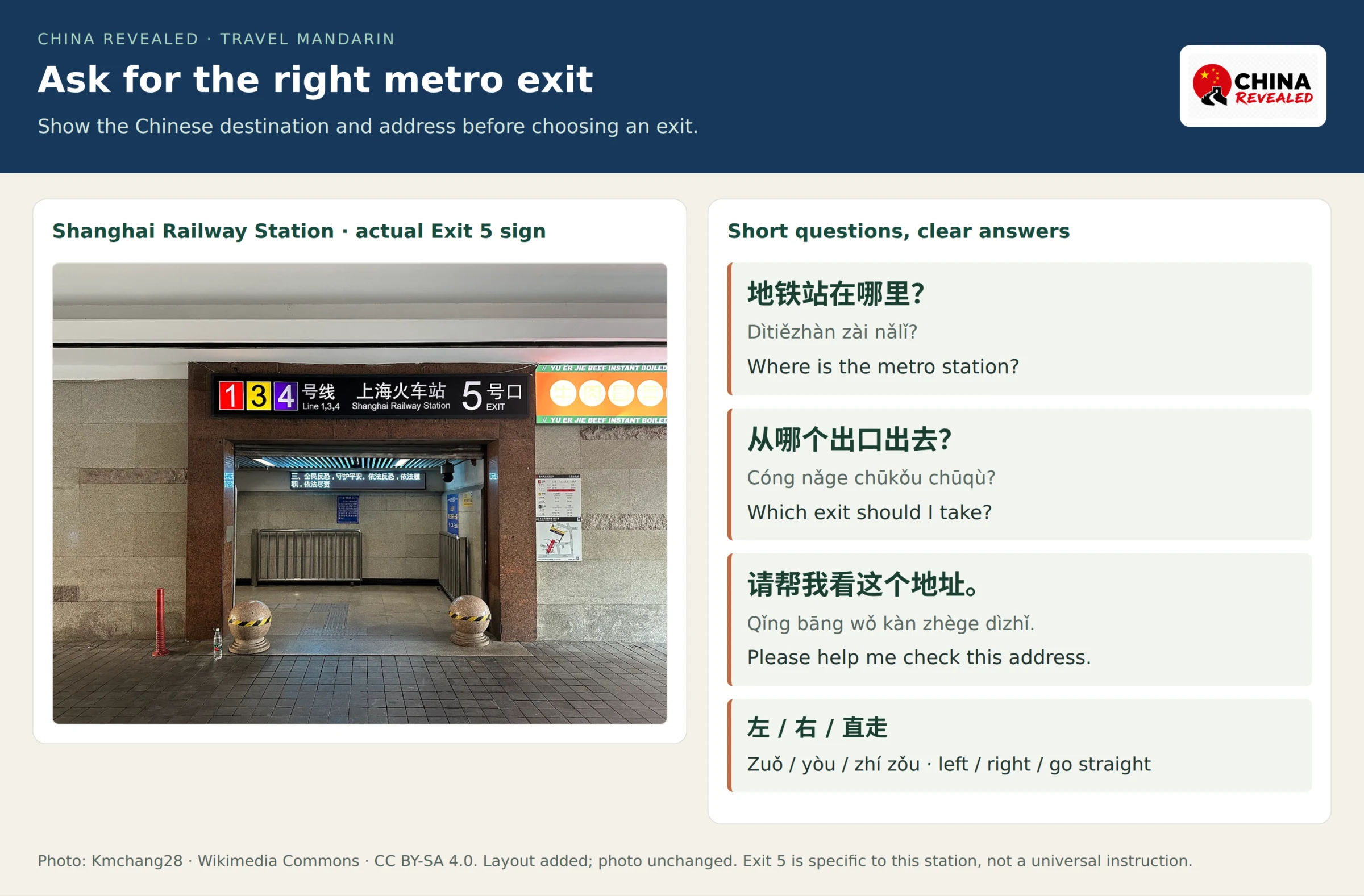
| 从哪个出口出去? | Cóng nǎge chūkǒu chūqù? | Which exit should I take? |
| 请写下来。 | Qǐng xiě xiàlái. | Please write it down. |
The reusable pattern is 请问,…在哪里? — “Excuse me, where is…?” Replace the place word with 地铁站 (dìtiězhàn, metro station), 出口 (chūkǒu, exit) or 洗手间 (xǐshǒujiān, toilet).
At large metro stations, the exit is worth asking about before you leave the paid area. The wrong one may put you on the other side of a wide road or a long way from the building entrance.

Listen for these short replies
- 左边 — zuǒbian: left. 往左走 — wǎng zuǒ zǒu: go left.
- 右边 — yòubian: right. 往右走 — wǎng yòu zǒu: go right.
- 直走 — zhí zǒu: go straight.
- 这里 / 那里 — zhèlǐ / nàlǐ: here / there.
- 到了 — dào le: you have arrived / this is the place.
Do not try to memorize a long spoken route. Ask the person to point on your map or write the exit number. A short question such as “Which exit?” produces a much easier answer than “How do I get all the way to my hotel?”
Order food, adjust spice and pay
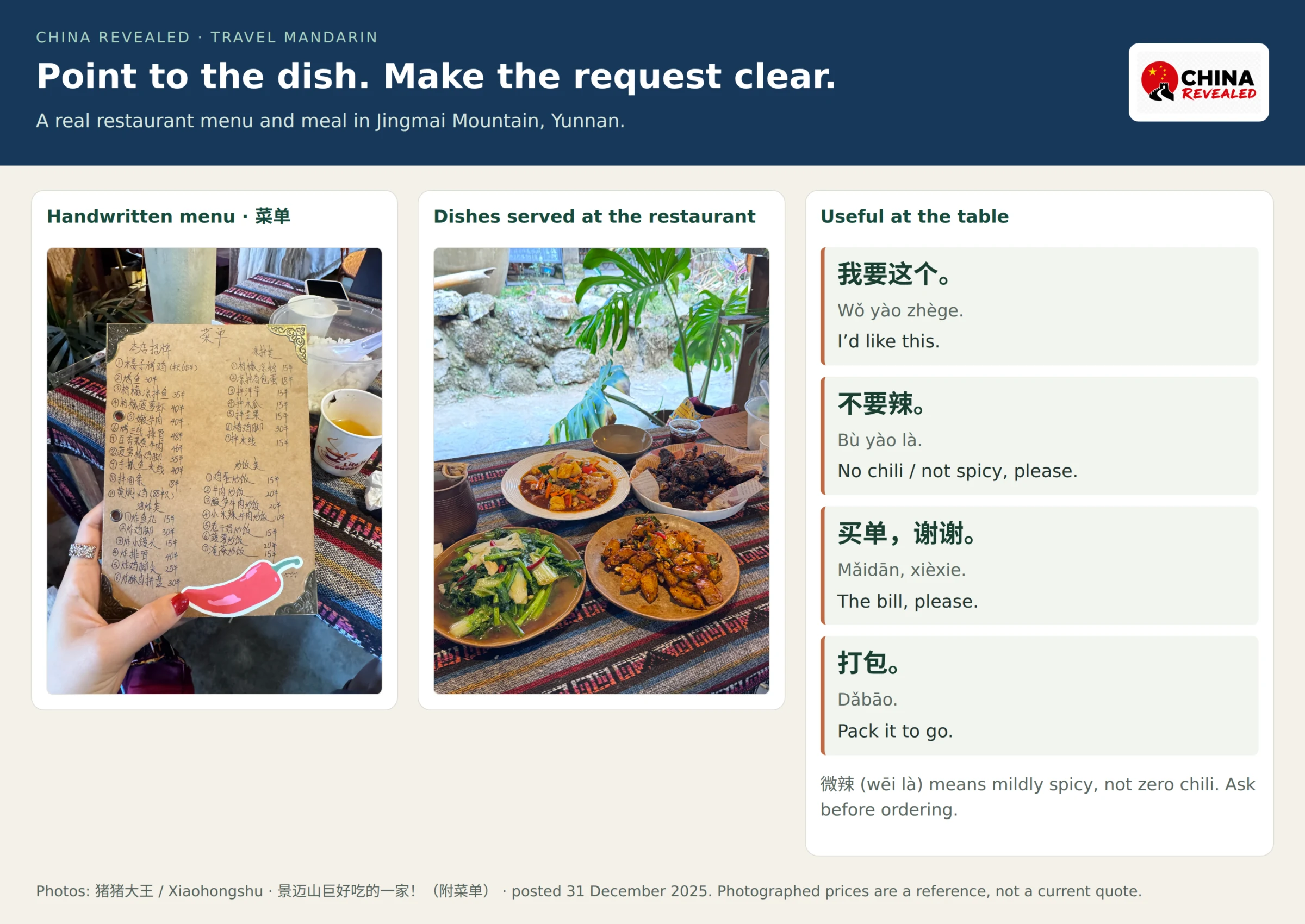
In a small restaurant, a picture menu, wall menu or handwritten board is enough to start. 这个 (zhège) means “this one.” Point at a specific dish, not a whole page, and say 我要这个 (wǒ yào zhège) — “I’d like this.”
For two people, say 两个人 (liǎng ge rén). At many sit-down restaurants, dishes are shared; at noodle and rice shops, each person usually orders their own bowl or plate. Make the quantity clear rather than assuming one dish means one meal.
| Chinese | Pinyin | Meaning / use |
|---|---|---|
| 我要这个。 | Wǒ yào zhège. | I’d like this. |
| 不要辣。 | Bù yào là. | No chili / not spicy, please. |
| 微辣。 | Wēi là. | Mildly spicy. Often a menu spice level. |
| 少辣。 | Shǎo là. | Less chili, please. |
| 不要香菜。 | Bù yào xiāngcài. | No coriander / cilantro, please. |
| 有不辣的吗? | Yǒu bù là de ma? | Do you have anything that isn’t spicy? |
| 买单,谢谢。 | Mǎidān, xièxie. | The bill, please. |
| 打包。 | Dǎbāo. | Pack it to go. Use for takeaway or leftovers. |
微辣 does not mean “no heat.” In chili-heavy regional cooking, even the mild option can feel hot to a visitor. If you really want no chili, say 不要辣 and ask for a dish that is naturally non-spicy. A sauce or broth made in advance cannot always be adjusted.
Dietary preferences and allergies are different
我不吃… (wǒ bù chī…) means “I don’t eat…”. Useful words include 猪肉 (zhūròu, pork), 牛肉 (niúròu, beef) and 肉 (ròu, meat). If you avoid animal ingredients, ask about broth, lard and sauces too; a vegetable dish can still contain them.
For an allergy, use 我对…过敏 (wǒ duì… guòmǐn) — “I’m allergic to…”. For example:
我对花生过敏。请帮我确认这道菜有没有花生。
Wǒ duì huāshēng guòmǐn. Qǐng bāng wǒ quèrèn zhè dào cài yǒu méiyǒu huāshēng.
I’m allergic to peanuts. Please help me check whether this dish contains peanuts.
For a serious allergy, show a written card naming the allergen and ask staff to check with the kitchen, including shared oil and utensils. A phrase helps explain the problem; it does not establish that the kitchen can prepare a safe meal. If staff cannot give a clear answer, choose somewhere else.
What “scan to order” means
You may hear 扫码点餐 (sǎomǎ diǎncān) — “scan the QR code to order.” The code may be on the table and open a WeChat or Alipay menu. It is an ordering code, not automatically a payment code.
If the menu is hard to use, show 可以帮我点餐吗?(Kěyǐ bāng wǒ diǎncān ma?) — “Can you help me order?” Some places take payment before cooking; others bring a bill afterward. Ask for the total when you are ready to pay.
Bargain politely and confirm the price
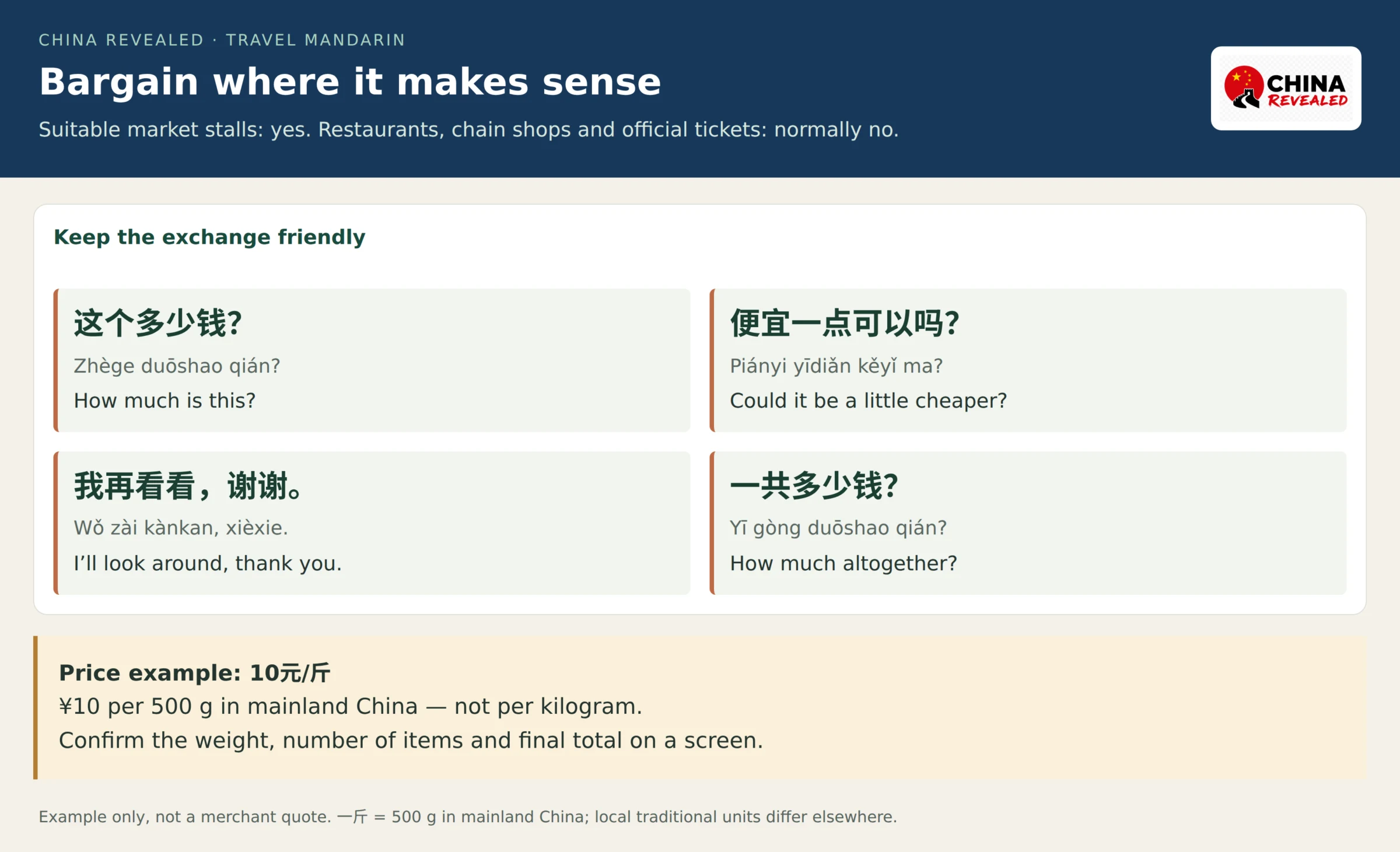
Bargaining makes sense at some souvenir stalls, clothing markets and independent tourist-market shops. It is not the default everywhere in China. Supermarkets, chain stores, restaurants, transport fares and official attraction tickets normally have fixed prices. Even in a market, a clearly priced food stall may not bargain.
I recommend asking the price first, then making one reasonable request for a lower price. You do not need a theatrical argument or a rule about always offering half.
| Chinese | Pinyin | Meaning / tone |
|---|---|---|
| 这个多少钱? | Zhège duōshao qián? | How much is this? |
| 太贵了。 | Tài guì le. | That’s too expensive. Direct; use a friendly tone. |
| 便宜一点可以吗? | Piányi yīdiǎn kěyǐ ma? | Could it be a little cheaper? |
| 最低多少钱? | Zuìdī duōshao qián? | What’s the lowest price? Ask if bargaining is already underway. |
| 我再看看,谢谢。 | Wǒ zài kànkan, xièxie. | I’ll look around some more, thank you. |
| 一共多少钱? | Yī gòng duōshao qián? | How much is it altogether? |
便宜 (piányi) means “cheap”; in this word the first syllable is pián, not biàn.
Before paying, confirm whether the number is for one item, a pair, the whole set or a weight unit. Write the agreed amount in your phone’s calculator and let the seller confirm it. If you are not happy with the price, “I’ll look around” ends the exchange politely.
Book hotels, flights, train tickets, attractions and other travel services on Trip.com.
Read numbers, prices and quantities
Numbers from zero to ten
| Number | Chinese | Pinyin |
|---|---|---|
| 0 | 零 | Líng |
| 1 | 一 | Yī |
| 2 | 二 | Èr |
| 3 | 三 | Sān |
| 4 | 四 | Sì |
| 5 | 五 | Wǔ |
| 6 | 六 | Liù |
| 7 | 七 | Qī |
| 8 | 八 | Bā |
| 9 | 九 | Jiǔ |
| 10 | 十 | Shí |
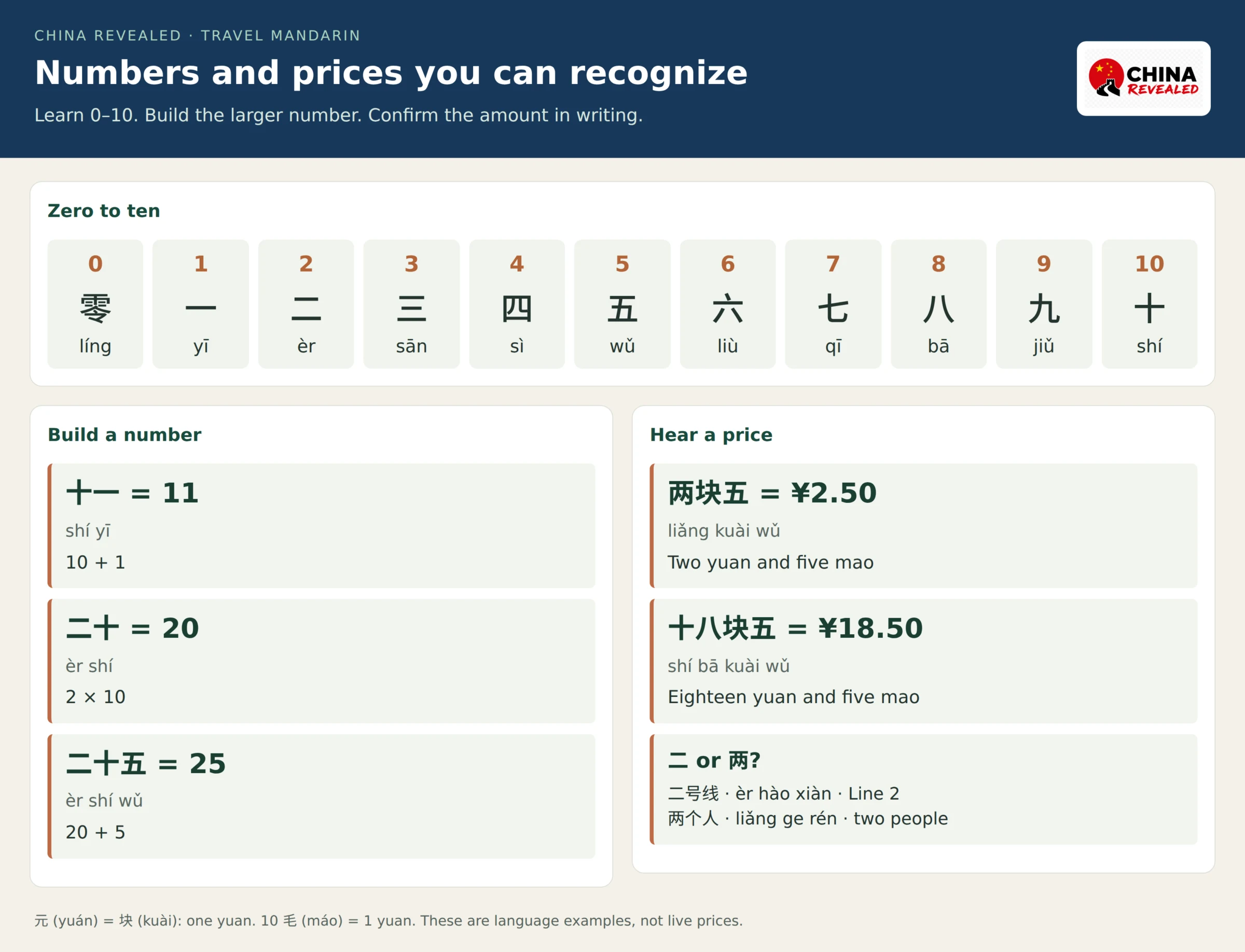
Once you know these, 11–99 follow a simple pattern. 十一 (shí yī) is ten plus one: 11. 二十 (èr shí) is two tens: 20. 二十五 (èr shí wǔ) is two tens plus five: 25. 九十九 (jiǔ shí jiǔ) is 99. For 100, use 一百 (yī bǎi).
How prices are said
元 (yuán) is the formal currency unit; 块 (kuài) is the everyday spoken equivalent. Both mean one yuan. 毛 (máo) is one tenth of a yuan, so ten mao make one yuan. You may see 角 (jiǎo) for that same tenth on formal pricing.
| Displayed price | A common spoken form | Pinyin |
|---|---|---|
| ¥8 | 八块 | Bā kuài |
| ¥12 | 十二块 | Shí èr kuài |
| ¥25 | 二十五块 | Èr shí wǔ kuài |
| ¥2.50 | 两块五 / 两块五毛 | Liǎng kuài wǔ / liǎng kuài wǔ máo |
| ¥18.50 | 十八块五 / 十八块五毛 | Shí bā kuài wǔ / shí bā kuài wǔ máo |
People shorten prices in context. Rather than guessing what a clipped number means, ask 一共多少钱? and check the written amount.
“Two”: when to use 二 and 两
Use 二 (èr) when counting or naming a number: 一、二、三 (one, two, three), 二十 (20) and 二号线 (èr hào xiàn, metro Line 2).
Use 两 (liǎng) before many everyday quantity words: 两个人 (liǎng ge rén, two people), 两碗面 (liǎng wǎn miàn, two bowls of noodles) and 两块钱 (liǎng kuài qián, two yuan). For ordering, learning the whole phrase is easier than learning every grammar rule.
A jin is not a kilogram
At mainland markets, 一斤 (yī jīn) = 500 grams. A sign saying 10元/斤 means ¥10 per 500 g, not per kilogram. 一公斤 (yī gōngjīn) is one kilogram, or two mainland jin. Ask 一斤多少钱?(Yī jīn duōshao qián?) — “How much per jin?” — and check the final weight and total.
This 500 g rule is for mainland China. Do not carry it over to Hong Kong, Macau or Taiwan, where traditional weight-unit conventions differ.
Phone numbers are read digit by digit
Read a telephone number one digit at a time, not as a large number. You may hear 幺 (yāo) instead of 一 (yī) for the digit 1, especially when someone is dictating a number. If you cannot follow it, ask them to type it; a voice translator is less reliable than a written number for this job.
Recognize Chinese number hand gestures
Chinese vendors often show a number with one hand, including numbers above five. The photograph below shows a common set. It is useful to recognize, but it is not the only regional convention, particularly for 7–10.
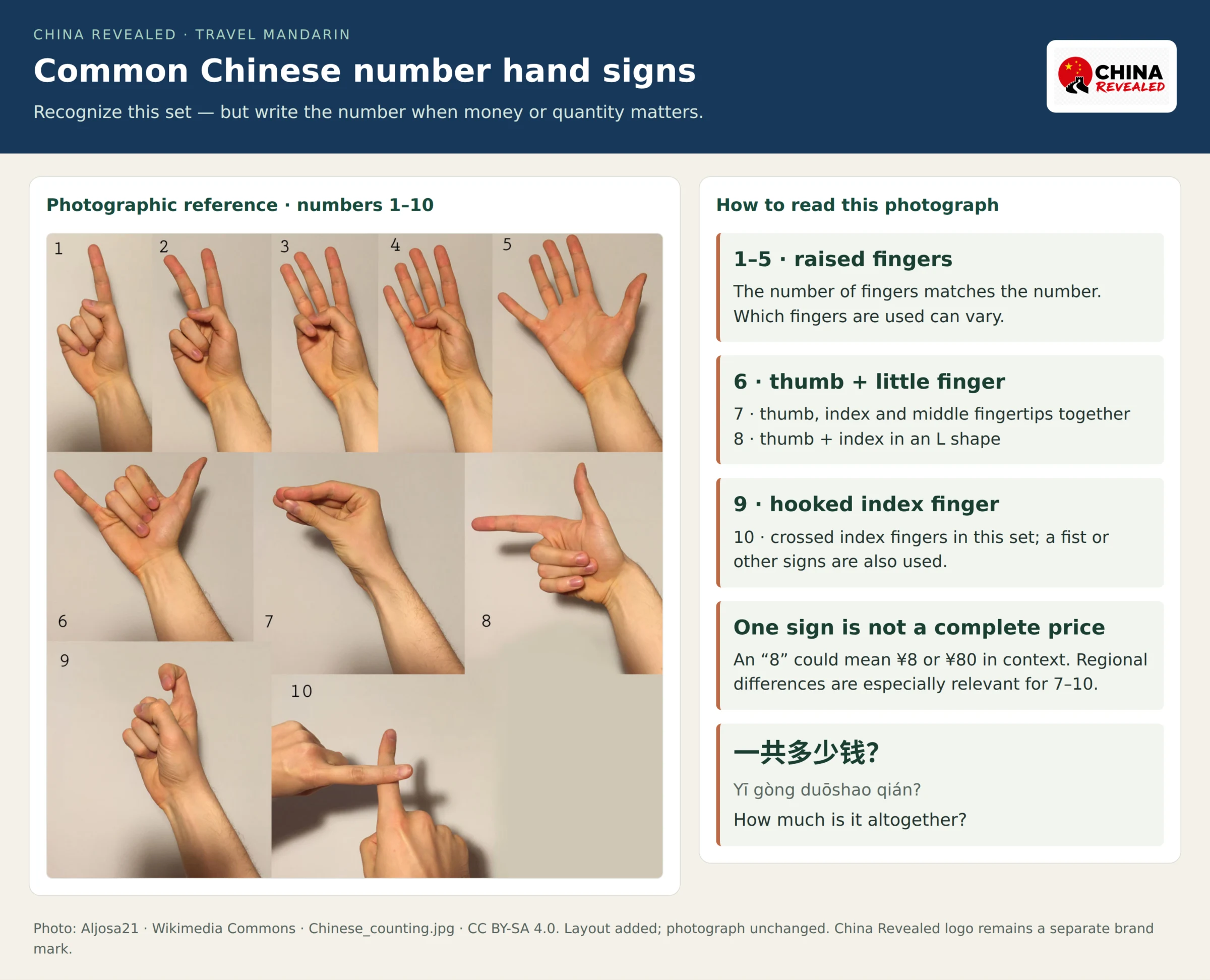

In this photographed set:
- 1–5: the matching number of raised fingers, with five an open hand. Which fingers are used can vary.
- 6: thumb and little finger extended.
- 7: thumb, index and middle fingertips brought together.
- 8: thumb and index finger extended in an L shape.
- 9: a hooked index finger.
- 10: two index fingers crossed. A fist or other signs may also represent ten in some places.
Do not use a hand sign as your only price confirmation. The same “eight” sign can refer to ¥8 or ¥80 in different contexts, and some local signs have different meanings. Have the seller type the price or show it on a calculator, then confirm 一共多少钱? before paying.
Save a show-your-phone phrase card
Save the image below before your trip. These lines work when you have no connection, the room is noisy or you do not want to speak Mandarin. Point to one line, then show the relevant address or price screen.
我不会说中文。请打字。
Wǒ bù huì shuō Zhōngwén. Qǐng dǎzì.
I don’t speak Chinese. Please type.请说慢一点。
Qǐng shuō màn yīdiǎn.
Please speak a little more slowly.请帮我看这个地址。
Qǐng bāng wǒ kàn zhège dìzhǐ.
Please help me check this address.请告诉我多少钱。
Qǐng gàosu wǒ duōshao qián.
Please tell me how much it costs.
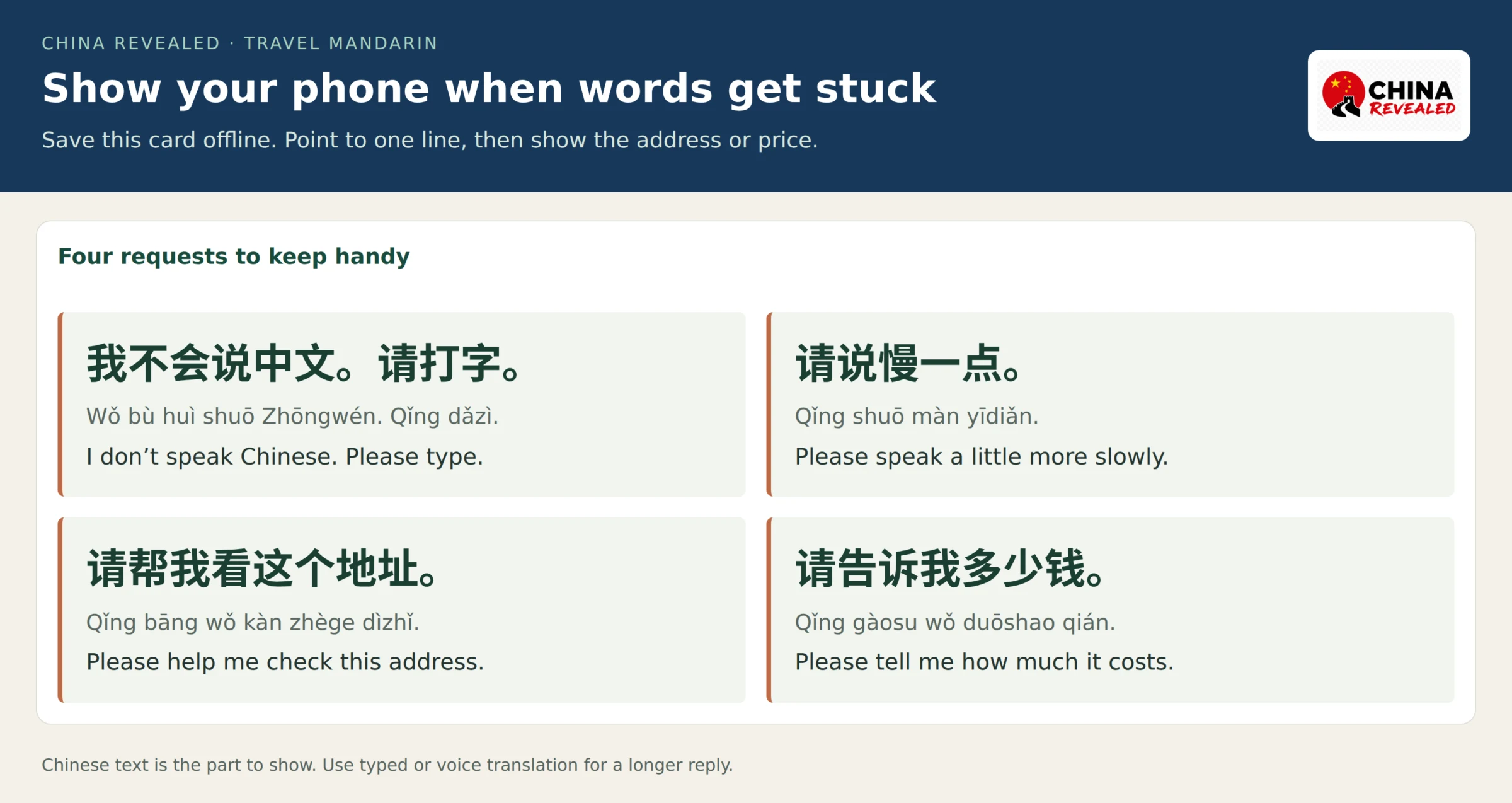
For a longer reply, switch to voice, typed text or camera translation. Our Best Translation Apps for China guide covers the software side, including Chinese AI tools such as DeepSeek and Doubao. This phrase guide is the quick-start companion: say a short line, point to what you mean, then translate the detail.
Common questions
Can I travel in China without speaking Mandarin?
Yes. You can handle much of a short trip with written addresses, menus, maps and a translation app. A few Mandarin phrases make small exchanges easier, especially in independent restaurants and markets. Do not rely on English alone outside places that regularly serve international visitors.
Should I memorize every phrase here?
No. I would start with 请问, 谢谢, 我要这个, 不要辣 and 一共多少钱. Save the rest as Chinese text you can show. Understanding a few likely replies is more useful than memorizing a long list of questions.
Is pointing rude?
Pointing at a menu item, map location or written price is normal practical communication. Keep it relaxed, use 请问 or 谢谢, and avoid pointing a finger close to someone’s face.
Are Chinese hand signs the same everywhere?
No. Many are widely recognized, but regional differences matter, especially from seven upward. For money, quantities and anything important, write the number rather than relying on the gesture alone.
What should I do when someone answers too quickly?
Show 请说慢一点 first. If the answer is still unclear, show 我不会说中文。请打字。 and let them type in your translation app. For an address, exit number or price, written text is usually the fastest way forward.
About China Revealed
China Revealed is an independent English-language travel guide dedicated to China.
We bring together China travel guides, destination information, local insights and practical travel resources in one place.
Our travel database covers China's provinces, cities, famous attractions, hidden gems, local cuisine, transportation, accommodation, visa requirements, digital payments, mobile connectivity and the other practical details travelers need to explore China.
We focus on depth, careful research and accuracy. Our guides combine official sources, detailed destination data, local knowledge and regularly updated information to give reliable, practical travel advice.
Whether you're visiting China for the first time or exploring beyond the popular destinations, China Revealed is an all-in-one resource for discovering the real China.
China Revealed — Your practical guide to China.
Some links on China Revealed, such as Trip.com booking links, are affiliate links. If you book through them, we may earn a commission at no extra cost to you. This does not change what we recommend.