

Eating in China for the First Time: A Practical Food & Stomach Guide
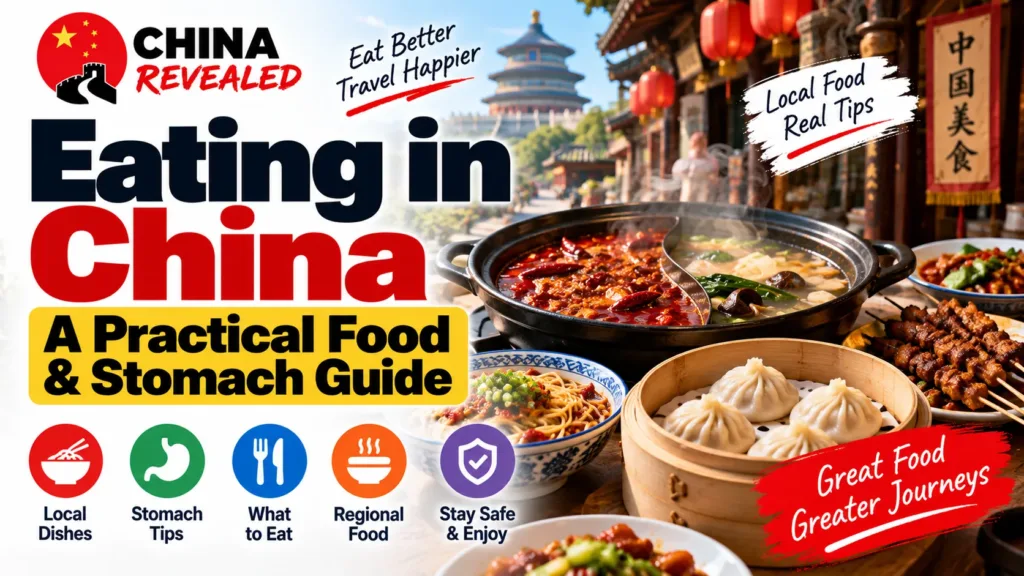
You can enjoy hot pot, night markets and local restaurants in China without making every meal a test of your stomach. Start with food cooked fresh, order less chili and oil when you need to, drink safe water and keep oral rehydration salts in your travel kit.
The mistake is trying to fit a spicy hot pot, fried snacks, several milk teas and a late-night barbecue into your first day after a long flight. Choose a smaller tasting meal, keep some familiar foods in the day and try more once you feel comfortable.
Our practical recommendation: prepare a Chinese ordering note, choose a genuinely non-spicy broth for your first hot pot and pack oral rehydration salts before relying on probiotics. Probiotics are optional, not proven protection against travelers’ diarrhea. If you become ill, do not automatically blame the chili and carry on sightseeing.
Health note: This is general travel and food guidance, not a diagnosis or a personalized treatment plan. Children, pregnant travelers, older adults and people with significant medical conditions should get advice suited to them. Blood in the stool, fever, severe pain or dehydration need medical attention.
In this guide
- Is Chinese food always spicy, oily and salty?
- What changes from one part of China to another?
- What should you eat on your first day?
- How do you ask for less chili, oil and salt?
- How can you enjoy hot pot and chuanchuan more comfortably?
- What about unusual foods, bones and strong flavors?
- How should you choose street food, cold dishes and buffets?
- Can you drink tap water or have iced drinks?
- What if you are vegetarian, gluten-free or have an allergy?
- What should you pack? Are probiotics worth bringing?
- What should you do if you get diarrhea in China?
- A few small dining habits that make the trip easier
Is Chinese food always spicy, oily and salty?
No. Sichuan and Chongqing hot pot get plenty of attention, but they are not the whole of Chinese food. Cantonese cooking includes steamed dishes and mild soups. Many northern dumplings and noodle dishes can be ordered without chili. Jiangnan cooking around Shanghai offers plenty of mild dishes too, although mild does not always mean low in sugar, salt or fat.
A useful distinction is spice tolerance versus food safety. A rich, spicy meal can trigger cramps, reflux or loose stools in some people, particularly those with a sensitive gut or irritable bowel syndrome. Infection from contaminated food or water is a different problem. Repeated diarrhea, especially with fever or blood, should not be dismissed as simply “getting used to China.”
Your usual diet and individual sensitivities matter more than your nationality. Someone who regularly eats spicy food may be comfortable with flavors another traveler finds overwhelming. You do not need to train yourself to eat chili before traveling.
What changes from one part of China to another?
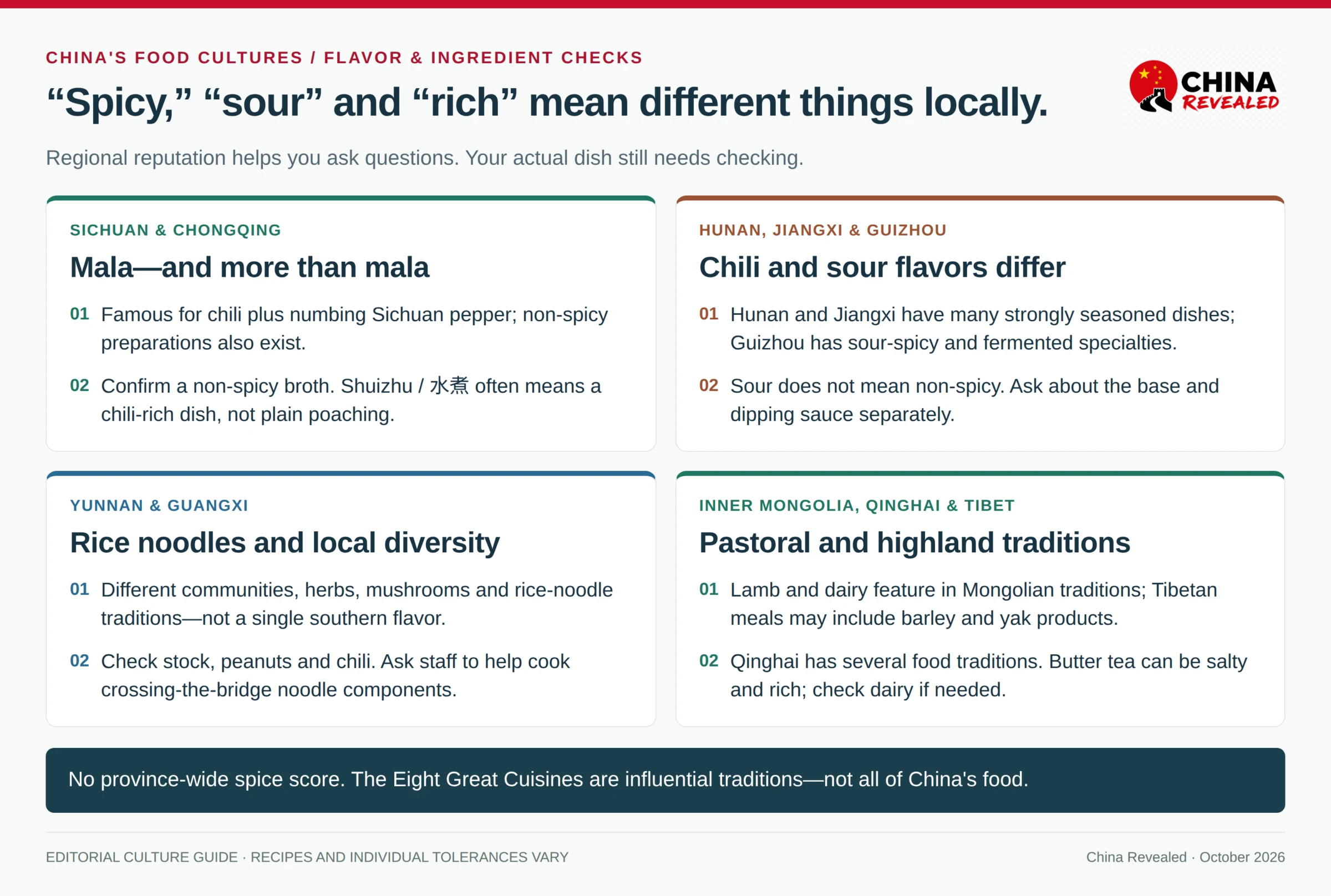
Quite a lot: the staple food, seasoning, cooking method and even what breakfast looks like. Geography, agriculture, trade and different communities have shaped local food. Wheat-based noodles, dumplings and breads have a strong tradition in the north; rice and rice noodles feature prominently across much of the south. These are broad patterns, not rules—people in both areas eat both.
You may hear about the Eight Great Cuisines: Shandong, Sichuan, Guangdong/Cantonese, Jiangsu, Fujian, Zhejiang, Hunan and Anhui. They are a familiar way to describe influential culinary traditions, not a complete list of China’s food cultures. Beijing, the northeast, Xinjiang, Yunnan and many other places have distinctive food too. A province can contain several traditions: Guangdong alone includes Guangfu, Chaoshan/Teochew and Hakka cooking.
For a first trip, the following overview is more useful than memorizing a provincial map. The dishes are examples to help you recognize menus, not promises about every restaurant’s recipe or allergy safety.
Northern and northeastern China: wheat foods, roast meats and hearty dishes
In Beijing, Tianjin and Hebei, you will find dumplings, noodles, buns and other wheat foods. Beijing roast duck is a signature meal, while northern lamb hot pot can use a much plainer broth than the red hot pot associated with Chongqing. Shandong adds a strong tradition of seafood, soups and savory dishes with scallion and garlic; Henan has its own noodle and soup traditions, including huimian / 烩面, a broad-noodle soup.
Across Liaoning, Jilin and Heilongjiang, northeastern or Dongbei / 东北 food is known for dumplings, substantial stews and suancai / 酸菜, fermented cabbage. Coastal Liaoning also offers plenty of seafood. For an easier start, look for a cooked soup or dumplings with a suitable filling. A non-spicy dish can still be rich, and a shared stew may be a large meal rather than one person’s portion.
Shanxi, Shaanxi and the northwest: noodles, breads and meat
Shanxi is especially associated with varied noodle-making and vinegar. Shaanxi, including Xi’an, is known for foods such as biangbiang noodles, roujiamo / 肉夹馍, a filled bread, and yangrou paomo / 羊肉泡馍, bread pieces in lamb soup. The names are similar in English, but Shanxi and Shaanxi are different provinces with different food traditions.
In Gansu, Lanzhou-style beef noodles are an accessible starting point; ask about chili oil before the bowl is finished. Ningxia has prominent Hui Muslim food traditions, including lamb dishes. Xinjiang offers Uyghur and other communities’ cooking, with naan-style breads, noodles, lamb skewers and rice dishes. Cumin does not mean chili-free, and noodle toppings can be spicy. If halal preparation matters, verify the particular restaurant rather than assuming every northwest menu meets your requirements.
Shanghai, Jiangsu, Zhejiang and Anhui: more than “sweet eastern food”
In Shanghai and the Suzhou–Wuxi area of Jiangsu, you may notice sweeter sauces, soy-based braises and dishes such as xiaolongbao / 小笼包. Elsewhere in Jiangsu, Huaiyang cooking is known for careful cutting, soups and delicate preparation. Zhejiang brings different Hangzhou, Ningbo and Shaoxing traditions, with fish, seafood, seasonal vegetables and cooking wine featuring in many dishes.
Anhui adds distinctive traditions such as Huizhou-style braising and stewing, preserved ingredients and fermented specialties. Do not treat the whole east as one sweet, light menu. A steamed fish or simple soup may suit you better than a rich pork braise; mild-tasting food can still contain plenty of salt, sugar or fat. Some xiaolongbao contain hot broth, so let them cool and take a careful first bite.
Guangdong, Fujian and Hainan: coastal food with different local styles
In Guangdong, Cantonese cooking offers dim sum, rice noodle rolls, roast meats, steamed fish and soups. Morning tea / 早茶 is often a leisurely meal with tea and small dishes, not just a drink. Chaoshan food has its own rice porridge, braised dishes and seafood traditions, while Hakka meals include specialties such as stuffed tofu and salt-baked chicken.
Fujian is known for soups, seafood and local snacks, with differences between Fuzhou, southern Fujian and inland areas. Hainan adds tropical ingredients, chicken-rice traditions and seafood; coconut-chicken hot pot is also common on tourist menus. These regions can offer many non-spicy choices, but stock, oyster sauce, dried seafood and salty condiments may be less obvious than the main ingredient. Ask about them if you are vegetarian or have an allergy.
Sichuan and Chongqing: numbing heat, but not only spicy food
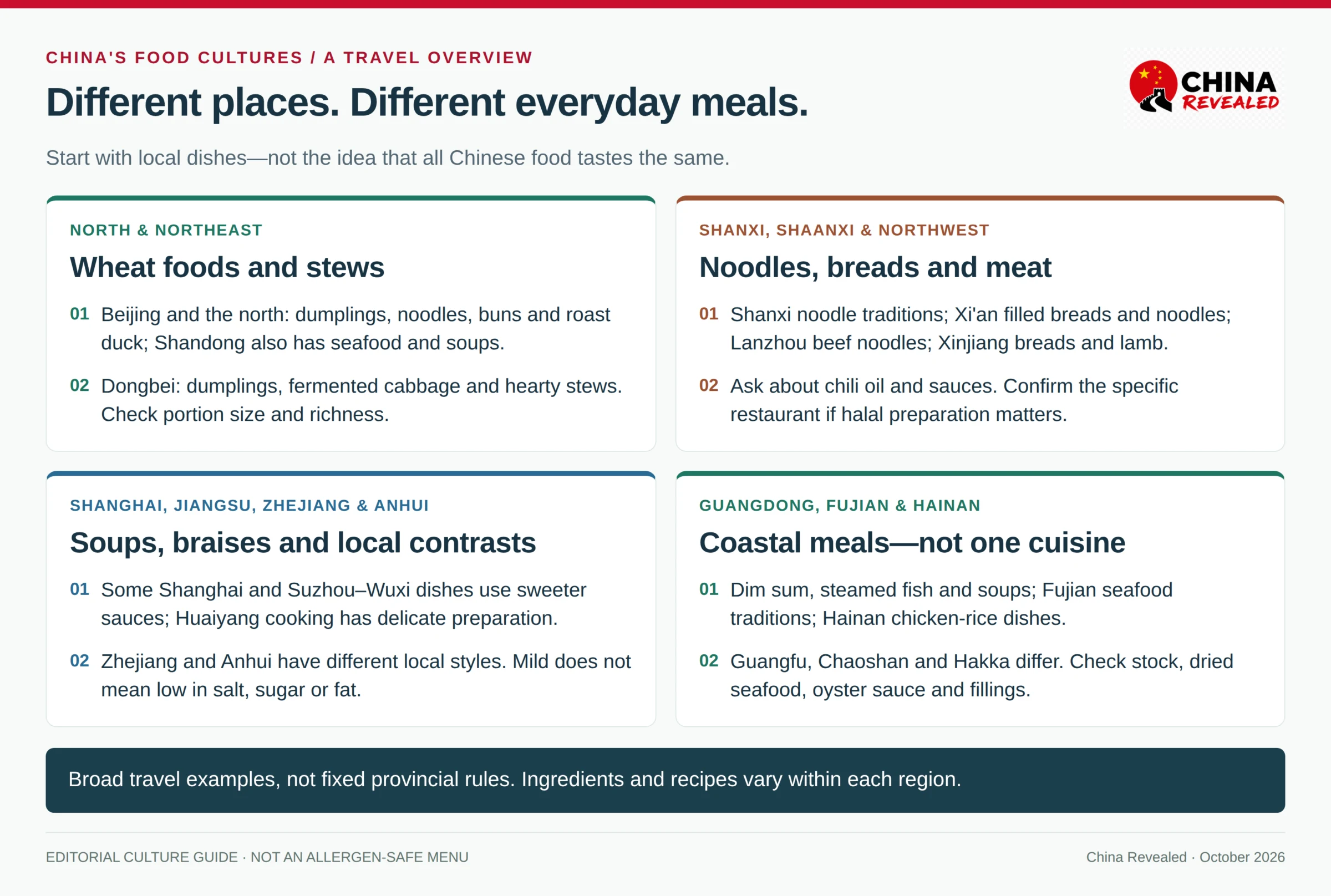
The best-known flavor is mala / 麻辣: chili heat combined with the numbing sensation of Sichuan pepper. Hot pot, mapo tofu and spicy noodles are common introductions. Chongqing is especially associated with strongly flavored red hot pot, while Sichuan has a much wider range of dishes, including non-spicy soups and preparations.
Do not assume everything is spicy, or that a local “mild” level will match yours. Ask for a dish that is genuinely made without chili, or choose a confirmed non-spicy broth. 水煮 / shuizhu, literally “water-boiled,” on a Sichuan meat or fish menu often describes a chili-rich preparation—not a plain poached meal.
Hunan, Jiangxi and Guizhou: different kinds of chili and sourness
Hunan often emphasizes fresh or preserved chilies, alongside smoked and cured ingredients. Jiangxi also has many strongly seasoned dishes and a substantial rice-noodle tradition. Neither should be treated as simply another version of Sichuan’s numbing-and-spicy style.
Guizhou is particularly associated with sour and spicy combinations, fermented ingredients and dishes such as sour-soup fish / 酸汤鱼. Local and ethnic-community traditions differ considerably. Here, “sour” does not mean non-spicy, and a vegetable dish can contain chili or meat seasoning. Ask about the soup base and dipping sauce separately; there is no useful province-wide ranking that tells you exactly how hot your meal will be.
Hubei: breakfast noodles, freshwater fish and steamed dishes
Hubei has a distinct food culture rather than one uniform spicy menu. In Wuhan, hot dry noodles / 热干面, usually dressed with sesame paste and other seasonings, are a familiar breakfast. Freshwater fish, lotus root and steamed dishes also feature prominently. A cooked soup or a suitable steamed dish can be an alternative to a chili-heavy meal, but confirm ingredients. Hot dry noodles are not automatically sesame-free, vegetarian or low-fat.
Yunnan and Guangxi: rice noodles, herbs and varied local traditions
Yunnan has many different food cultures. Rice noodles and mushrooms are familiar starting points; Dai-style cooking in the south can use herbs and sour-spicy flavors, while other areas have quite different ingredients and methods. Crossing-the-bridge rice noodles / 过桥米线 may arrive with components served separately. Ask staff to help assemble and fully cook the meal rather than assuming every topping is ready to eat. Be selective with wild-mushroom dishes, as explained later in this guide.
Guangxi is known for rice noodles too, but Guilin noodles and Liuzhou luosifen / 螺蛳粉 are not the same dish. Sour bamboo shoots, chili and substantial broths can feature in local bowls. A noodle soup with no visible meat can still use animal stock, while toppings may include peanuts. Start with a clearly explained cooked bowl and adjust the seasoning where the kitchen can do so.
Inner Mongolia, Qinghai and Tibet: pastoral and highland food traditions
In Inner Mongolia, Mongolian food traditions give lamb, beef and dairy an important place, although local menus also reflect other communities. Qinghai brings Tibetan, Hui and other food traditions together. In Tibet and Tibetan cultural areas, you may encounter tsampa / 糌粑, roasted barley flour, yak products, dumplings and butter tea / 酥油茶.
Butter tea can be salty and rich rather than the sweet milk tea you might expect. Try a small amount if you normally tolerate dairy; check the actual milk or butter ingredient if you have a restriction. These areas do not all share one cuisine, and “highland food” does not mean every dish is heavy or every restaurant serves the same menu.
A few everyday dining customs to recognize
At many sit-down meals, dishes go in the middle for everyone to share, with individual bowls for rice or soup. A noodle-shop meal or a plate of dumplings may instead be an individual order. Tea can be part of the meal, especially at dim-sum restaurants, and breakfast may be a savory noodle soup rather than cereal or toast.
Shared dishes are an opportunity to taste small amounts, not a requirement to finish everything or try an ingredient you do not want. Use serving chopsticks or a serving spoon where provided, and request them if needed. Keep eating chopsticks out of communal food when possible. If you do not use chopsticks comfortably, it is fine to ask for a spoon or fork.
You may be offered alcohol or a toast at a social meal, but you can decline: 我不喝酒,谢谢。 — I do not drink alcohol, thank you. Hospitality does not require ignoring your health or dietary needs.
What should you eat on your first day?
If you arrive tired and hungry, choose a nearby restaurant with a simple cooked meal rather than traveling across the city for its hottest specialty. Eat at a comfortable pace and stop before you feel overfull. Our first day in China guide covers the airport transfer, hotel check-in and the rest of that first evening.
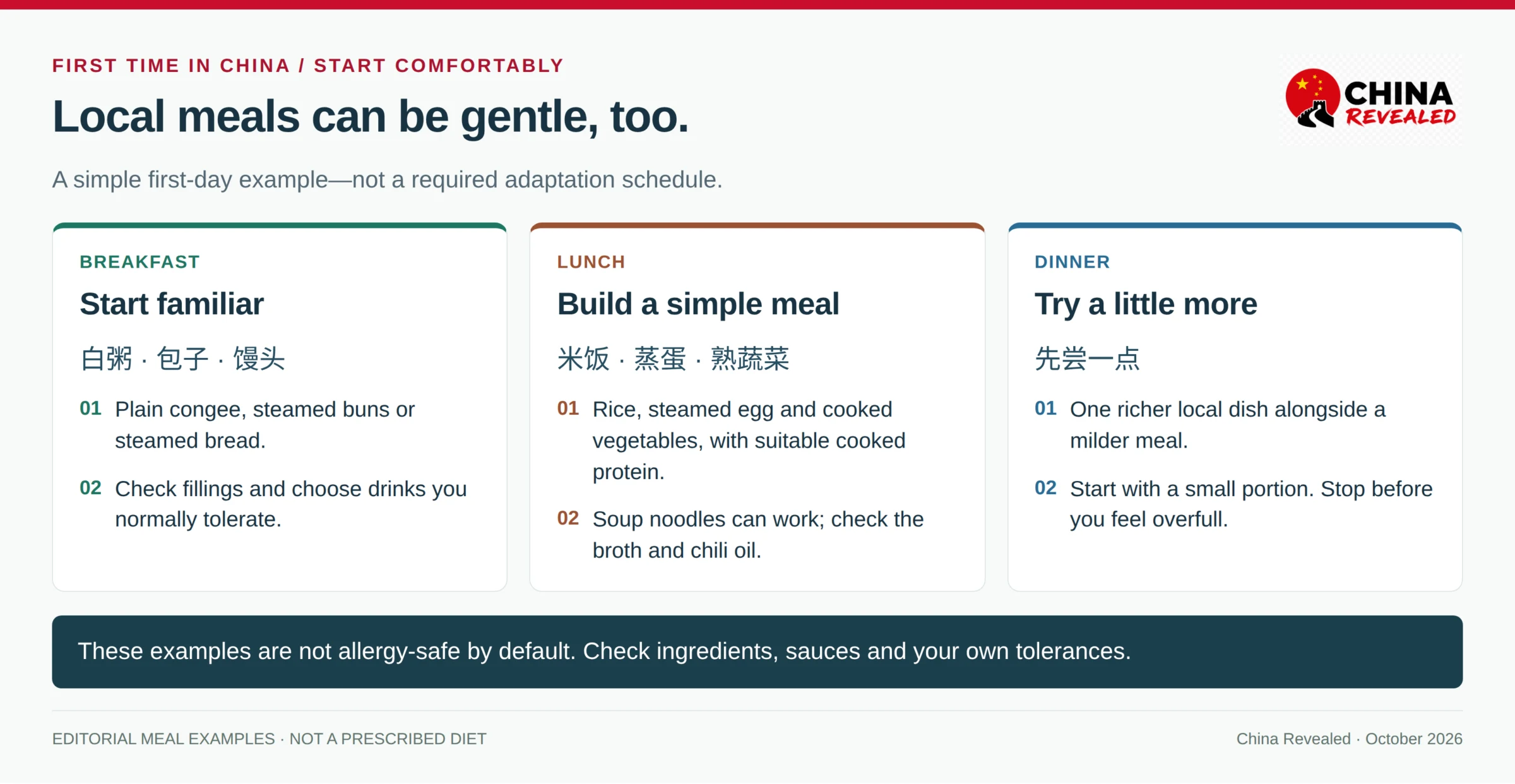
For breakfast, look for plain congee / 白粥, steamed buns / 包子 or plain steamed bread / 馒头. Check bun fillings: they can contain meat, egg, vegetables or sweet fillings. Choose a freshly cooked egg if you want one, and buy drinks that fit your usual tolerances.
For lunch, rice / 米饭, steamed egg custard / 蒸蛋, a freshly cooked vegetable dish and a modest portion of fully cooked fish or meat make an easy combination. Soup noodles / 汤面 can work too, but confirm the broth and ask for no chili oil. These are everyday local meals, not a retreat to Western fast food.
For dinner, try one richer or unfamiliar dish alongside a milder meal. This is a pacing suggestion, not a rule that your gut needs exactly two or three days to “adapt.” If you feel well and normally enjoy chili, you can explore sooner. If your stomach is unsettled, keep it simple.
How do you ask for less chili, oil and salt?
“Mild” is relative to the restaurant. In a hot-pot shop in Chongqing, 微辣 / mildly spicy may still feel very hot if you rarely eat chili. 少辣 / less spicy means a reduction, not zero chili. If you want no chili, say 不放辣椒 / do not add chili, and mention chili oil too.
Show staff this note before choosing your dishes:
我想吃清淡一点的菜。请少油、少盐,不放辣椒,也不放辣椒油。哪些菜可以这样做?
I would like lighter dishes. Please use less oil and salt, with no chili or chili oil. Which dishes can be prepared that way?
Asking which dish can be made that way is more useful than asking a kitchen to remove the chili from a sauce it has already prepared. A red hot-pot base, chili-marinated meat or premixed noodle sauce may not be adjustable. Choose a different dish or broth instead.
For sauce on the side, show 请把酱料另外放。 — Please serve the sauce separately. For a simple non-spicy choice, ask 有没有不辣、清淡一点的菜? — Do you have a non-spicy, lighter dish?
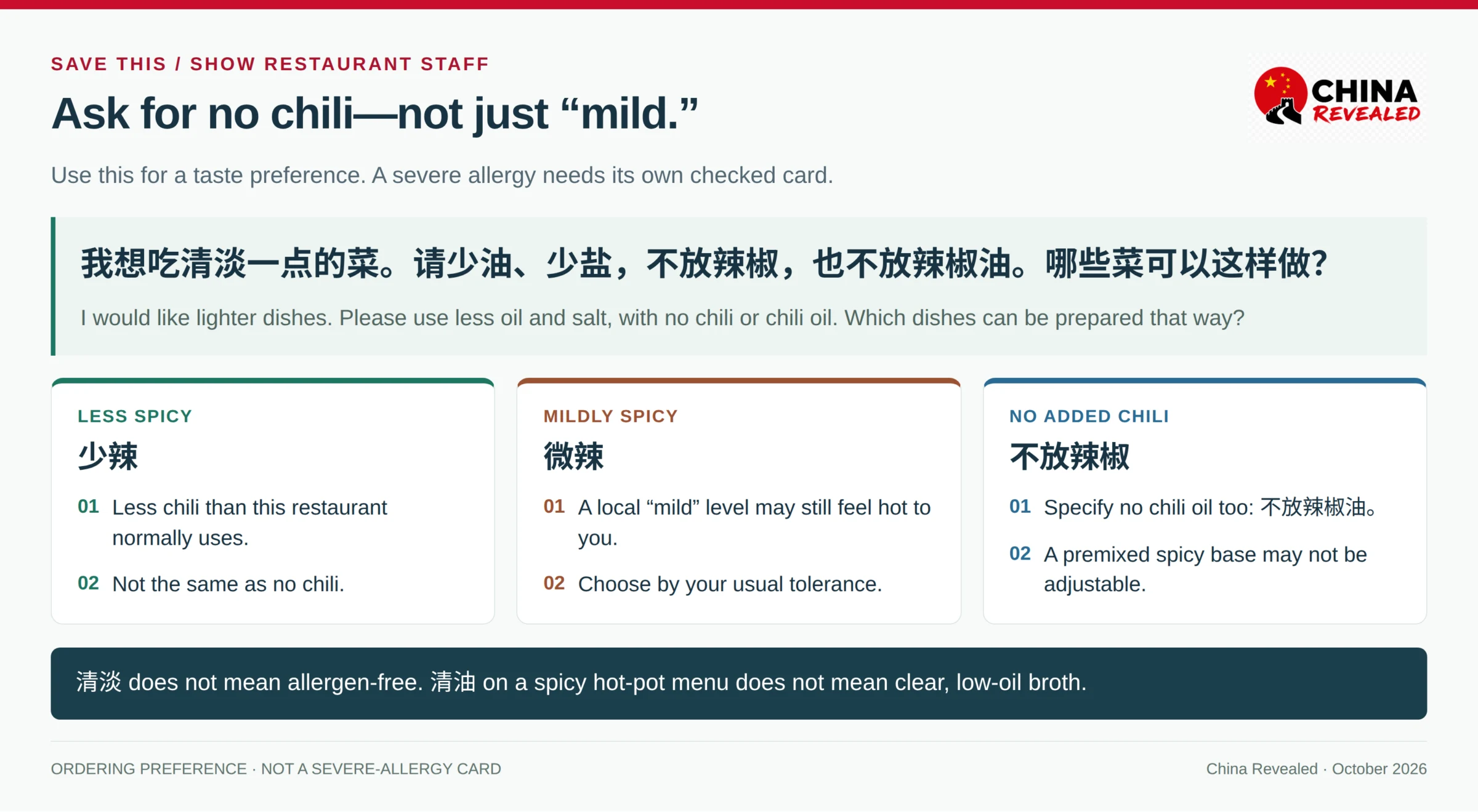
清淡 / lighter is not the same as vegetarian, gluten-free or allergen-free. Likewise, 清油 / qingyou on a spicy hot-pot menu refers to an oil-based style, often using vegetable oil rather than beef fat; it does not mean a clear, low-oil or non-spicy broth.
How can you enjoy hot pot and chuanchuan more comfortably?
Hot pot / 火锅 usually means cooking ingredients in broth at the table. Chuanchuan / 串串 often uses ingredients threaded onto skewers; some versions are cooked for you, while others use a shared pot. Ask whether the food is already cooked before tasting it.
Choose the broth before the ingredients
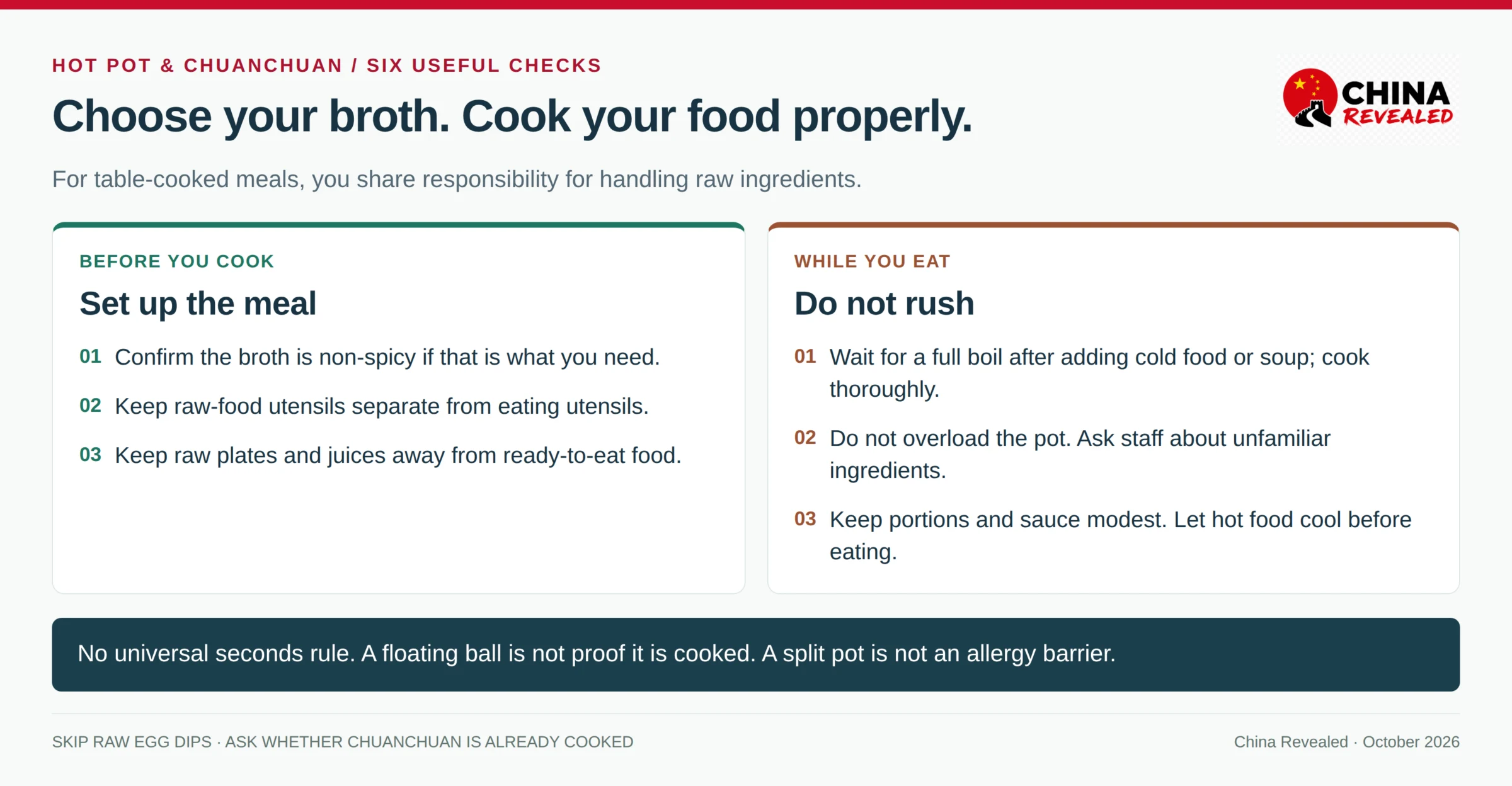
For your first meal, look for 清汤锅 / clear-broth hot pot, or a tomato or mushroom base explicitly confirmed as non-spicy. Those flavors can still include chili, meat stock or substantial salt, so the name alone is not enough.
A 鸳鸯锅 / split pot lets a group order spicy and non-spicy sides. It is useful for different taste preferences, not reliable separation for a serious allergy. Splashes, ladles and ingredients can cross between sides. For an allergy, ask about a separate pot and utensils and whether the kitchen can safely accommodate you.
Cook the food, not just the outside
Let the broth boil properly and cook food thoroughly. After cold ingredients or extra soup are added, wait for it to return to a full boil and allow enough cooking time. Do not overload the pot.
Use separate utensils for placing raw ingredients into the pot and for eating cooked food. Keep raw-food plates and their juices away from ready-to-eat food. Ask staff how to cook unfamiliar items; meatballs, thick meat, poultry, seafood and offal do not all take the same time.
A ball floating, meat changing color or someone counting a few seconds is not a universal proof of safe cooking. Avoid “seven dips” shortcuts for unfamiliar raw ingredients. If you cannot judge or manage the cooking, ask staff to help or order a fully cooked dish instead.
Keep the meal lighter without losing the experience
Order vegetables, tofu, a moderate portion of meat and a starch you like, rather than only fatty cuts, sausages and fried sides. Use a small amount of dipping sauce; sesame paste, chili oil and soy sauce can add much more fat or salt than you expect. Do not add raw egg to a dip.
You do not have to drink the cooking broth. A clear-looking broth can still be salty, and a spicy base can be very rich. Let food cool enough to eat comfortably before swallowing. A non-spicy meal can still burn your mouth if you rush it straight from the pot.
For chuanchuan and malatang / 麻辣烫, check whether the shop can make an actually non-spicy version. Confirm the price per skewer or weight before filling a basket, and begin with a modest amount. For dry pot / 干锅, mala xiangguo / 麻辣香锅 and grilled skewers, ask about seasoning before cooking; chili may be in a marinade, not just sprinkled on at the end.
What about unusual foods, bones and strong flavors?
You may see tripe, duck blood curd, chicken feet or fermented tofu. Unfamiliar is not the same as unsafe. The important questions are what it contains, how it was handled and whether it has been properly prepared. You can try a small portion, ask staff to identify it or decline politely: 我先尝一点。 — I’ll try a little first.
Sichuan pepper creates the characteristic 麻 / numbing sensation in 麻辣 / mala, alongside chili heat. Do not mistake an expected flavor sensation for a reason to ignore a possible reaction: swelling, breathing trouble or faintness needs urgent help.
Fish, chopped chicken and duck may be served with bones, even when the menu photo does not make that obvious. Eat slowly and inspect bites, especially when feeding children. Do not assume a fish dish means a boneless fillet.
Make a clearer distinction for genuine higher-risk choices. Skip raw or partly cooked seafood and raw egg dishes when handling is uncertain. Alcohol in “drunken” seafood, vinegar and chili do not make it pathogen-free.
Do not forage for mushrooms or trust an image-recognition app to identify edible ones. If you are unsure about a wild-mushroom dish, choose a familiar cultivated mushroom or another dish. Cooking cannot reliably destroy poisonous mushroom toxins. Suspected mushroom poisoning needs immediate medical care, even if symptoms start much later.
How should you choose street food, cold dishes and buffets?
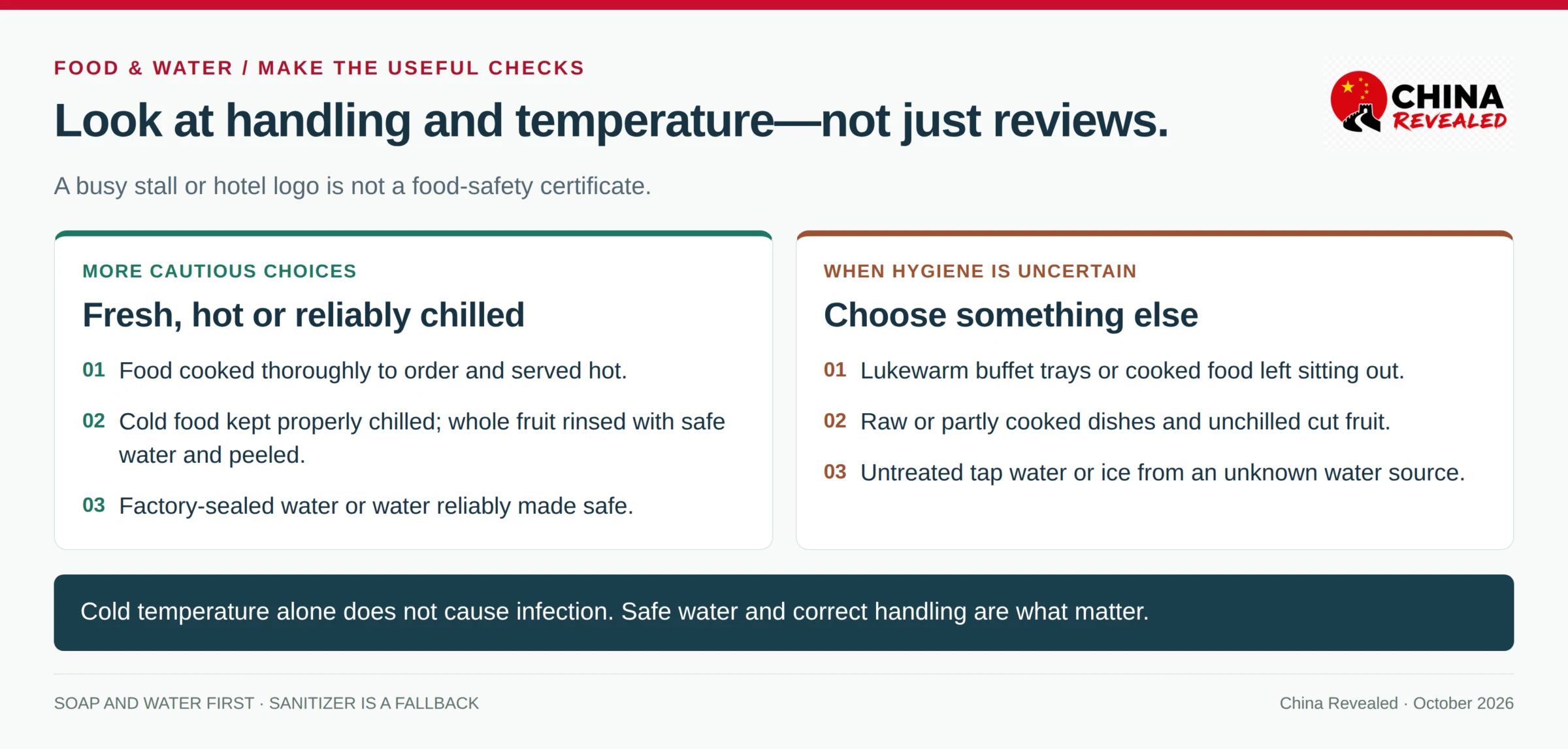
Look at handling, temperature and turnover, not just whether a place is expensive or busy. A queue is a useful clue, not a safety certificate. Freshly cooked food served hot is a more cautious choice than food sitting lukewarm on a counter.
At a stall, watch whether raw meat is kept chilled and handled separately from cooked food. Choose a jianbing cooked on a hot griddle, buns taken from an active steamer or skewers cooked thoroughly to order. Walk away if food handling worries you; a high review score cannot correct it.
Cold dishes such as liangpi / 凉皮, dressed cucumber and cold meats are part of normal Chinese dining. When you cannot judge hygiene or refrigeration, choose freshly cooked food instead. Be more cautious with raw salads, unrefrigerated cut fruit and fresh drinks made with water you cannot verify. Buy whole fruit, rinse with safe water and peel it yourself.
At a hotel buffet, hot food should be kept hot and chilled food kept cold. A hotel logo does not make a lukewarm tray safe. Use serving utensils rather than your eating chopsticks when sharing dishes. A quick rinse of bowls with warm tea is not a substitute for proper cleaning.
Can you drink tap water or have iced drinks?
Do not drink untreated tap water in mainland China. Use factory-sealed bottled water, or water you know has been reliably boiled or otherwise made safe. A dispenser or filter is not automatically proof of drinking-water quality. Use safe water for medicines and oral rehydration salts too; using it to brush your teeth is a cautious option when the tap supply is uncertain.
Ice is a water-source question, not a rule that all cold drinks cause diarrhea. If you cannot confirm the ice was made with safe water, order without it: 不要冰。 — No ice. A sealed chilled bottle is another option. Warm water is not compulsory for a healthy traveler who tolerates cold drinks.
Milk tea can combine dairy, caffeine and a lot of sugar. Large amounts may bother you if you are lactose-sensitive or already have diarrhea. “Less sugar” does not remove lactose, and “non-dairy creamer” is not necessarily free of milk ingredients. Check the actual ingredients if it matters medically.
Avoid stacking several sugary drinks, coffee and alcohol around a rich meal. Yogurt and fermented drinks are foods, not a treatment for food poisoning; choose properly stored, pasteurized products if you normally tolerate them.
What if you are vegetarian, gluten-free or have an allergy?
A photograph cannot tell you everything in a dish. Vegetables may be cooked with lard or oyster sauce. Noodle broth may contain meat. Peanut and sesame ingredients can be in sauces, while wheat can appear in soy sauce as well as noodles and dumplings. Rice noodles alone do not make a complete dish gluten-free.
For a vegetarian request, a useful starting note is 我不吃肉,也不吃用肉汤、猪油、蚝油或鱼露做的菜。 — I do not eat meat or dishes made with meat stock, lard, oyster sauce or fish sauce. Vegans also need to specify eggs, dairy and any other exclusions. Ask staff to check the base and seasonings, not just remove visible meat.
For halal dining, 清真 can help you locate candidates, but confirm that the particular restaurant and preparation meet your requirements. Do not assume a dish is halal just because it is lamb or contains no visible pork.
For a serious allergy or celiac disease, arrange a professionally checked Chinese card before your trip. It should name your exact restriction, explain cross-contact and ask about stock, sauces, oil and shared equipment. Show it before ordering and get a clear response from someone who can check with the kitchen. A delivery note or automatic translation alone is not sufficient assurance.
Carry prescribed emergency medication and follow your existing emergency plan. If staff cannot confidently accommodate you, choose somewhere else. Antihistamines are not a replacement for prescribed epinephrine/adrenaline in anaphylaxis. For a severe reaction, use your prescribed treatment as directed and call 120 for an ambulance.
Book hotels, flights, train tickets, attractions and other travel services on Trip.com.
What should you pack? Are probiotics worth bringing?
You do not need to turn your suitcase into a pharmacy. A small, familiar kit is more useful than buying several supplements you have never tried.
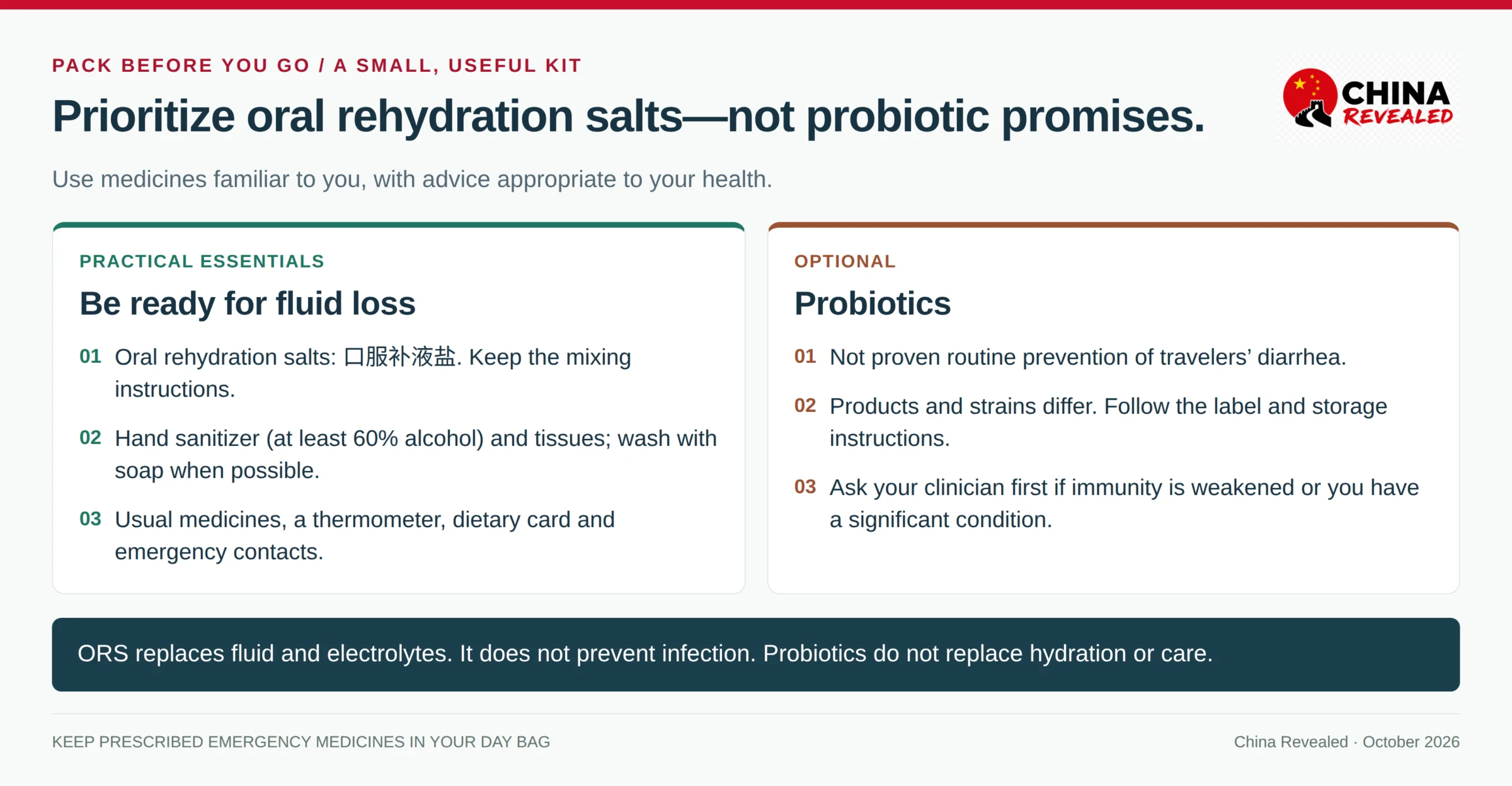
- Oral rehydration salts (ORS). Pack a few sachets and know the mixing instructions. In China, show a pharmacist 口服补液盐.
- Hand sanitizer and tissues. Choose sanitizer with at least 60% alcohol. Wash with soap and water when available, especially after the toilet and before eating; sanitizer is a fallback, not an equal replacement.
- Your usual medicines and a thermometer. Keep medicines in original packaging, check destination rules and discuss suitable symptom relief with a pharmacist or clinician before travel.
- Your dietary card, emergency medicines and insurance contact. Keep important items in your day bag, not only at the hotel.
Probiotics: optional, not your main protection
Some travelers like bringing probiotics they already tolerate. You can discuss that with your clinician, but current evidence is insufficient to recommend probiotics as routine prevention of travelers’ diarrhea. Different strains and products do not all have the same effect. There is no reliable universal brand, dose or “start seven days before flying” plan for every traveler.
If you bring one, follow its label and storage requirements. Do not start several unfamiliar supplements immediately before departure. People with a weakened immune system or significant health conditions should ask their clinician first. Do not assume yogurt, a fermented snack and a clinical probiotic product are interchangeable.
If you have to choose one practical gut-kit item, prioritize ORS over probiotics. ORS replaces fluid and electrolytes when you are losing them; it does not prevent infection or cure its cause. Probiotics do not replace safe food, hydration or medical care.
Before departure, a travel-health appointment can also check routine vaccines and whether hepatitis A or typhoid vaccination is appropriate for your itinerary. Those vaccines protect against particular infections, not every cause of diarrhea. They do not replace food and water care.
What should you do if you get diarrhea in China?
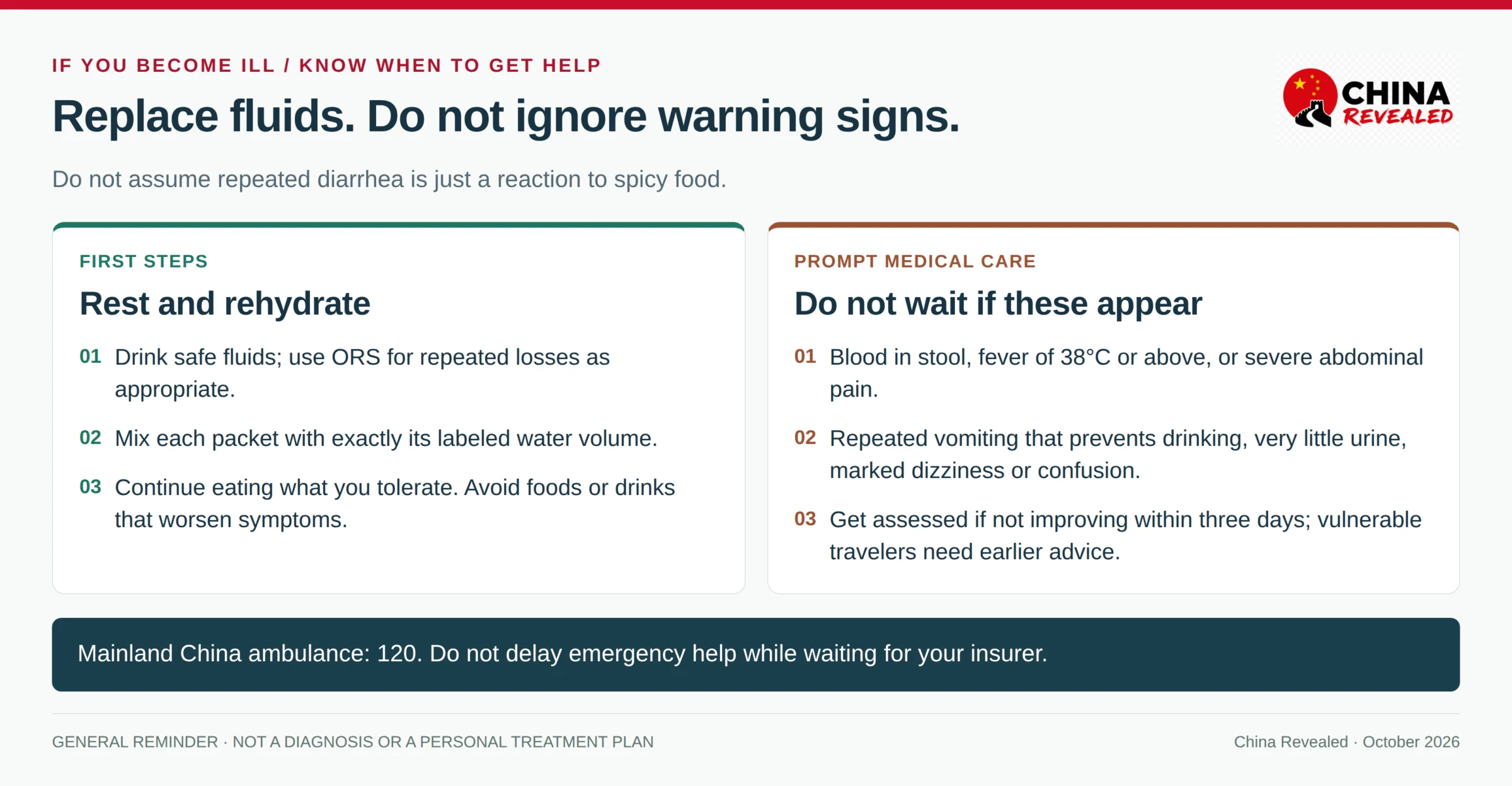
Replace fluid first
Rest, shorten the day’s plans and drink safe fluids. For repeated watery diarrhea, vomiting or difficulty keeping up with losses, use ORS and seek advice as needed. Take small, frequent sips if you feel nauseated.
Mix each ORS packet with exactly the water volume written on that packet. Different products use different amounts; do not assume every sachet is for one liter. Use safe water, do not make it stronger and do not add it to milk tea or juice. Follow its storage and discard instructions.
A pharmacy message you can show is 我腹泻了,想买口服补液盐。请告诉我这包要兑多少水。 — I have diarrhea and would like oral rehydration salts. Please tell me how much water to mix with this packet.
Sports drinks or bottled water can help maintain fluid intake in a mild episode, but a very sweet drink is not equivalent to ORS for substantial losses. Alcohol and large quantities of sugary drinks can make matters worse.
Keep eating what you can tolerate
You do not usually need to fast. When you feel able to eat, try small portions of freshly cooked rice, plain noodles, steamed bread or another familiar food, and return toward your normal balanced diet as tolerated. Plain congee can be comfortable, but you do not have to live on it for days.
Pause greasy meals, chili, alcohol and large caffeinated or sugary drinks if they worsen symptoms. Some adults temporarily tolerate lactose less well after acute diarrhea. This does not mean infants or children should automatically stop their usual milk or age-appropriate diet; get advice appropriate to their age.
Use symptom medicines carefully
A pharmacist or clinician may recommend a short course of loperamide for an appropriate adult with uncomplicated diarrhea. Follow the label. Do not self-treat blood in the stool or diarrhea with fever using a bowel-slowing medicine alone, and seek advice for severe pain or other concerning symptoms. Adult medicines and doses should not be copied for children.
Do not take leftover antibiotics or start a “just in case” antibiotic course after every spicy dinner. If you need a standby medicine because of your health or a remote itinerary, arrange a specific plan with a clinician before travel. Antibiotics are not necessary for every episode and can cause harm.
Know when to get help
Seek prompt medical care for blood in the stool, fever of 38°C or above, severe or worsening abdominal pain, repeated vomiting that prevents drinking, or signs of dehydration. Very little urine, marked dizziness, unusual weakness or confusion are important warning signs. Do not wait several days when these occur.
If diarrhea is not improving within three days, get assessed even without those warning signs. Infants, children, older adults, pregnant travelers and people with immune suppression or significant illness should seek advice earlier.
For an emergency in mainland China, call 120. Ask reception or your guide to help explain your exact address if necessary; do not assume the dispatcher will speak English. Do not delay emergency help while waiting for an insurer. For non-emergency care, your insurer or hotel can help you locate a suitable clinic.
Keep a note of when symptoms began, temperature, vomiting, medicines taken and any suspected unusual food. Save receipts and food photos if several people became ill. If symptoms persist after you return home, tell your clinician that you recently traveled in China.
A few small dining habits that make the trip easier
At a shared restaurant meal, order a modest number of dishes first and add more if needed. A menu’s “one portion” may be intended for sharing, and plain rice may need a separate order. Confirm hot-pot broth, sauce-bar or per-person charges before committing to a large meal.
Table QR menus usually open in Alipay or WeChat (see how to pay in China). If a table QR will not open, ask 可以给我看一下菜单吗? — May I see the menu? Use camera translation to understand dish names, then keep the original Chinese visible for staff. Our TenPayGo guide explains its menu-assistance feature where available, but no translation app can certify an allergy-safe meal.
For delivery, collect food promptly and eat while it is appropriately hot or chilled. Do not leave rice, meat or seafood on your hotel desk overnight. A minibar is not automatically suitable for storing leftovers, and reheating cannot reliably fix food that has been stored badly. Order a smaller meal if you have no dependable refrigeration.
Our Meituan guide for foreigners covers menus, order notes, hotel delivery and payment. If you have a severe allergy, speak with the restaurant rather than relying on the note field alone.
Carry tissues, know how to ask 厕所在哪里? — Where is the toilet? — and keep a dependable simple meal in mind for a day when you do not feel like experimenting. You do not have to eat every unfamiliar item or finish a portion just to be polite.
China gives you plenty of ways to eat well. Start at a pace that suits you, ask clearly for what you need and make the decision that keeps tomorrow’s plans comfortable too.
Prepared by China Revealed from researched travel-health guidance and practical Chinese dining information. The branded cards are original editorial explainers, not personal dining records or medical certifications. This guide covers mainland China; restaurant recipes and individual needs vary.
About China Revealed
China Revealed is an independent English-language travel guide dedicated to China.
We bring together China travel guides, destination information, local insights and practical travel resources in one place.
Our travel database covers China's provinces, cities, famous attractions, hidden gems, local cuisine, transportation, accommodation, visa requirements, digital payments, mobile connectivity and the other practical details travelers need to explore China.
We focus on depth, careful research and accuracy. Our guides combine official sources, detailed destination data, local knowledge and regularly updated information to give reliable, practical travel advice.
Whether you're visiting China for the first time or exploring beyond the popular destinations, China Revealed is an all-in-one resource for discovering the real China.
China Revealed — Your practical guide to China.
Some links on China Revealed, such as Trip.com booking links, are affiliate links. If you book through them, we may earn a commission at no extra cost to you. This does not change what we recommend.