

Smoking in China: Secondhand Smoke, Etiquette & Cigarette Brands
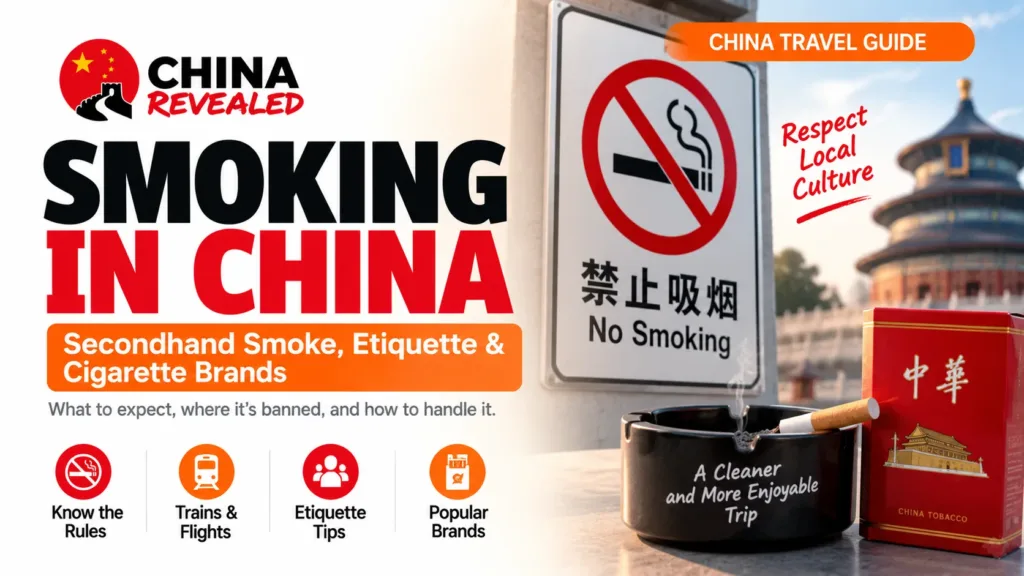
Smoking in China is hard to miss: you can be walking down an ordinary street and find yourself directly behind someone lighting up. Move past them, and another smoker may be waiting outside the next restaurant. If you come from somewhere with strong smoke-free habits, this can be one of the more irritating parts of the trip.
My advice is to plan for it rather than assume a no-smoking sign will always mean clean air. Choose your hotel carefully, check a restaurant before settling in, and know how to ask staff for help. At the same time, cigarette brands, regional names and the habit of offering a cigarette tell you quite a lot about everyday Chinese social life.
At a glance
- Secondhand smoke is a real travel nuisance, especially around entrances, street-side dining and some smaller indoor venues.
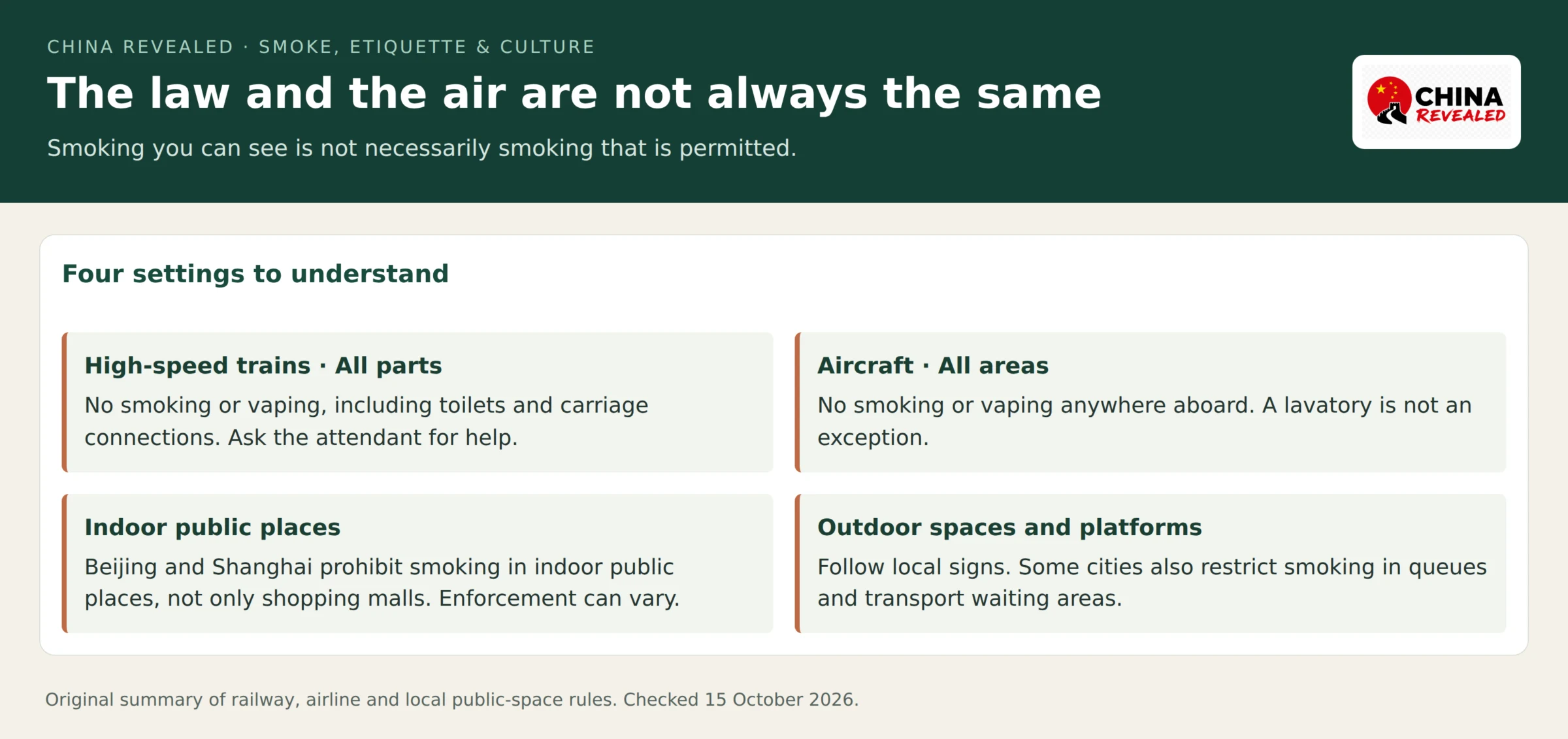
- High-speed trains and aircraft are strictly smoke-free. The ban includes toilets; vaping is not a workaround.
- The rules go beyond malls and transport. Cities including Beijing and Shanghai also prohibit smoking in indoor public places, but enforcement varies.
- You can decline an offered cigarette without making it awkward: “谢谢,我不抽烟” — “Thanks, I don’t smoke.”
- Chinese cigarettes are not one uniform style. Flue-cured tobacco, distinctive packaging and regional identity are important parts of the picture.
In this guide
- 1. How much secondhand smoke should you expect?
- 2. Where smoking is banned—and where you may still smell it
- 3. My simple plan for a less smoky trip
- 4. Why people offer cigarettes
- 5. How Chinese cigarettes differ from those overseas
- 6. A quick guide to regional cigarette names
- 7. The words worth recognising
1. How much secondhand smoke should you expect?
The first places I would watch are busy pavements, restaurant doors, outdoor tables, hotel entrances and transport pick-up areas. You may also encounter smoke in small restaurants, bars, public toilets or a car whose driver ignores the rules. Walking outside does not guarantee that the people immediately around you will be smoke-free.
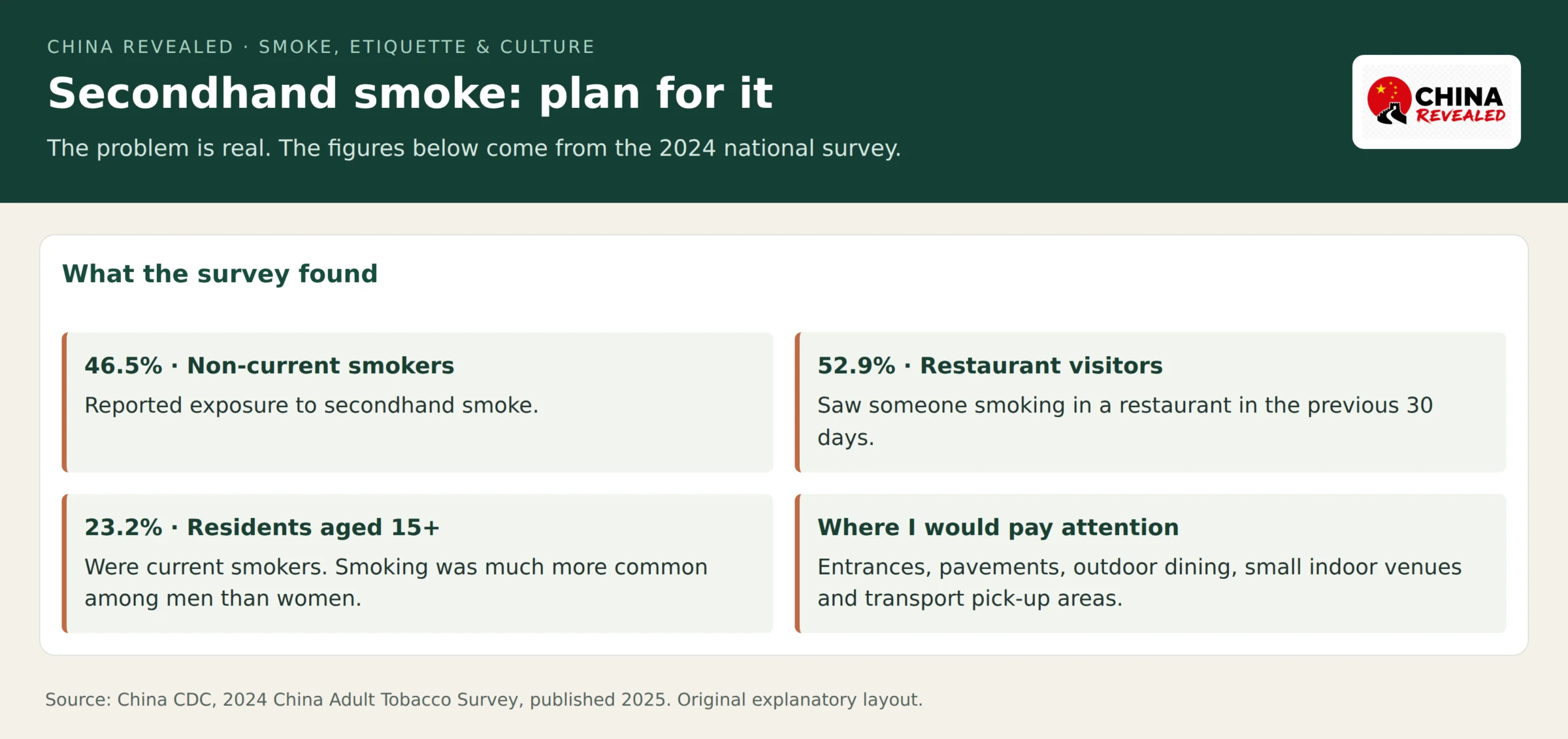
This is more than a collection of travel complaints. In the 2024 China Adult Tobacco Survey, 46.5% of people who were not current smokers reported secondhand-smoke exposure. The same survey found that 52.9% of restaurant visitors had seen someone smoking there in the previous 30 days. That restaurant figure describes visitors’ reports, not the percentage of all restaurants that allow smoking.
The problem is widespread, but not everyone smokes: the survey recorded current smoking among 23.2% of residents aged 15 and over, with a much higher rate among men than women. Exposure had fallen since 2022, yet it remained high enough to matter when planning a trip.
2. Where smoking is banned—and where you may still smell it
High-speed trains and flights are the clearest no-smoking environments. Do not smoke anywhere aboard a high-speed train, including its toilet or carriage connection. Aircraft also prohibit smoking and vaping throughout the cabin. A train’s open-air platform is a separate setting: rules and enforcement differ by city and station, so follow the signs and staff instructions there.
Malls, museums and large managed attractions are usually easier places to find a smoke-free indoor space. The awkward part is often the doorway: people step outside to smoke, leaving you to walk through the smoke on the way in.
For restaurants, bars and hotels, separate the law from what people actually do. Beijing and Shanghai have broad indoor public-place smoking bans; seeing an ashtray or someone lighting up does not turn a prohibited space into an authorised smoking area. Smaller venues can still have inconsistent enforcement. Some cities also restrict smoking in outdoor queues and transport waiting areas.
| Setting | My practical advice |
|---|---|
| High-speed train or aircraft | No smoking or vaping, including in toilets. Ask the crew to handle an incident. |
| Mall, museum or managed attraction | Follow the signs; step away from smoking clusters outside the entrance. |
| Restaurant or bar | Look and smell before ordering. If someone starts smoking, ask staff to intervene or move you. |
| Hotel | Request a non-smoking room, then check it before unpacking. |
| Street, outdoor terrace or open-air platform | Expect more uneven conditions. Move away from the plume; do not assume every outdoor space permits smoking. |
Book hotels, flights, train tickets, attractions and other travel services on Trip.com.
3. My simple plan for a less smoky trip
Book a room, not just a “non-smoking” label
Check recent hotel reviews for “smoke,” “cigarette smell,” 烟味 and 无烟房. A hotel’s room category tells you its intended policy, not necessarily how the previous guest behaved.
At check-in, say:
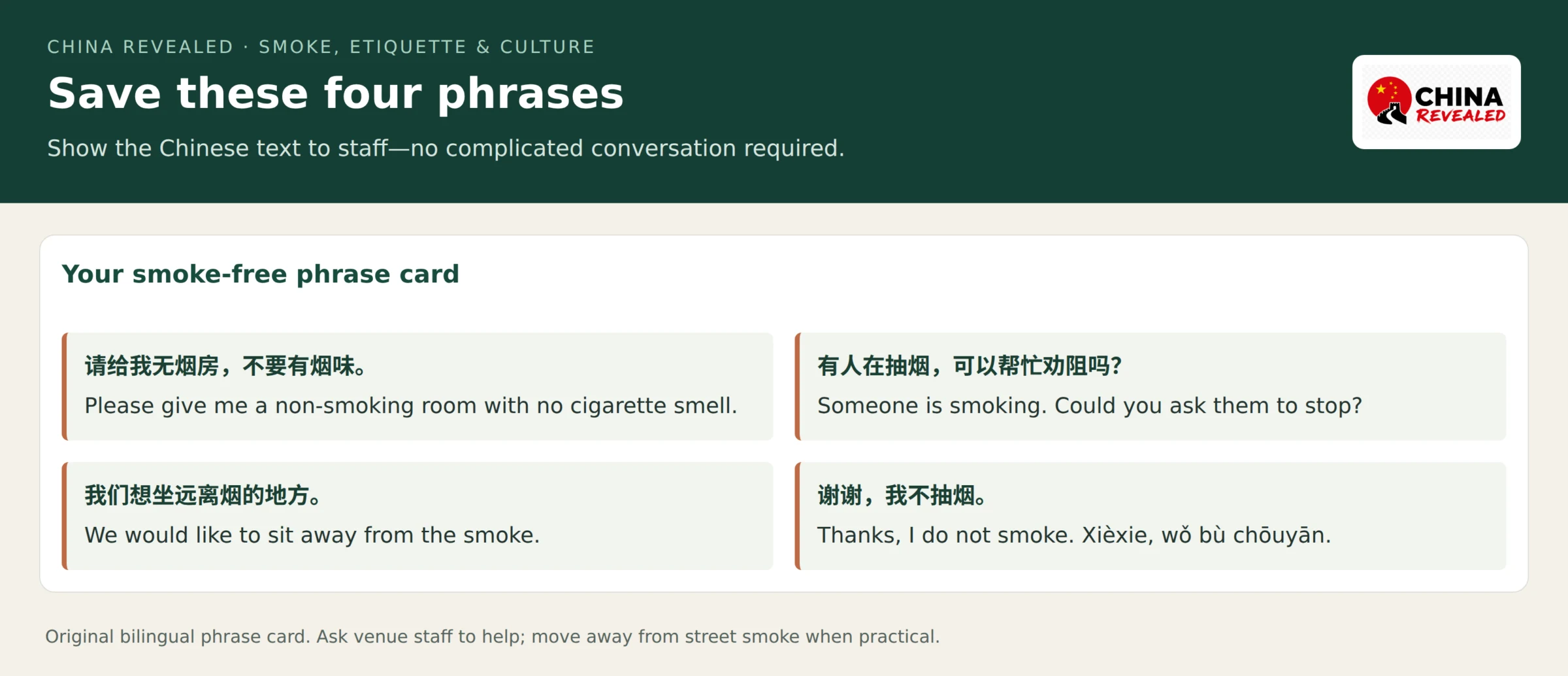
请给我无烟房,不要有烟味。
Please give me a non-smoking room with no cigarette smell.
Open the door and check the air, curtains and bedding before unpacking. If the room smells strongly of cigarettes, request another room immediately. Air freshener is not the same thing as removing smoke contamination.
Check restaurants before committing
Take a quick look at neighbouring tables. A small restaurant with smokers already seated is a poor bet if smoke bothers you. An outdoor table beside an ashtray or busy entrance may be worse than a well-managed indoor table.
Ask the staff:
有人在抽烟,可以帮忙劝阻吗?
Someone is smoking. Could you ask them to stop?
Or, if changing seats is the quickest fix:
我们想坐远离烟的地方。
We’d like to sit away from the smoke.
Use staff rather than starting a street argument
For a smoky taxi or ride-hailing car, ask the driver not to smoke and stop safely if you need to leave. On a train, tell the attendant. In a hotel, speak to reception. For a persistent breach in a prohibited public space, ask the venue about its complaint channel; Shanghai’s 12345 service accepts smoking complaints.
On the street, the easiest move is often to pass the smoker or move out of the smoke’s path. Opening a window or turning on a fan indoors does not make secondhand smoke harmless. If you have asthma or travel with children, put more effort into choosing smoke-free accommodation and dining spaces.
4. Why people offer cigarettes
递烟—offering someone a cigarette—can be a social gesture, particularly in groups of men, informal business conversations and some family gatherings. It can function as an icebreaker or a small sign of hospitality rather than a carefully considered gift.
You may also see cartons presented at weddings or during visits. The brand and packaging can communicate status, regional identity or the significance of an occasion. This helps explain the red-and-gold designs, landmark imagery and auspicious characters on many packs.
None of this means you need to accept. I would simply smile and say:
谢谢,我不抽烟。
Thanks, I don’t smoke.
Xièxie, wǒ bù chōuyān.
A friendly refusal is enough. If you want to take something to a host, tea, fruit or a local food gift is a straightforward alternative. You can understand the custom without participating in it.
5. How Chinese cigarettes differ from those overseas
The tobacco style
Many familiar Chinese cigarettes are 烤烟型—flue-cured, commonly associated with Virginia-style tobacco. By contrast, many American-style cigarettes use a blend of Virginia, burley and oriental tobaccos. That difference in leaf and preparation helps explain why the aroma and taste may differ from a familiar American blend.
But “Chinese versus foreign” is too simple: Virginia-style cigarettes are also familiar in the UK and several other markets, and China has blended products too. There is no single Chinese taste, and no reliable rule that Chinese cigarettes are all stronger or all milder. The particular product matters more than the nationality of the name on the pack.
The packaging and regional identity
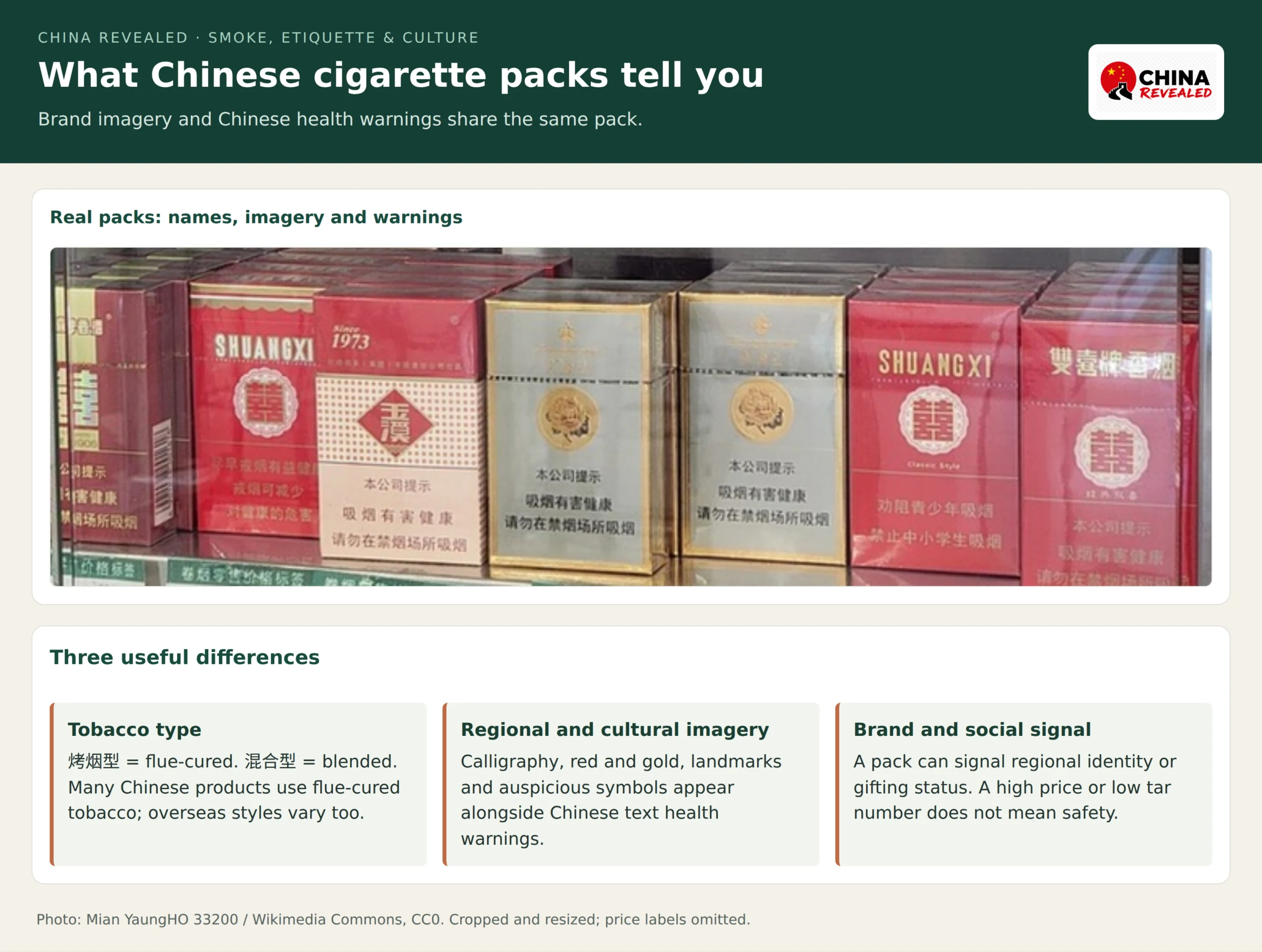
Compared with markets that require plain packaging or large graphic warnings, mainland Chinese packs often leave much more space for colour, calligraphy, local landmarks and brand imagery, alongside Chinese text health warnings. A name may refer to a city, a mountain, a tower or a traditional symbol.
You will also see hard and soft packs, regular and slim formats, and several versions under the same brand. The brand name alone does not tell you the exact product, price or composition.
The social meaning
In China, a recognisable brand can act as a social signal as well as a tobacco product. A higher-priced or elaborately packaged cigarette may be chosen for gifting or status. Price, a “light” impression or a low printed tar number is not a measure of safety.
6. A quick guide to regional cigarette names
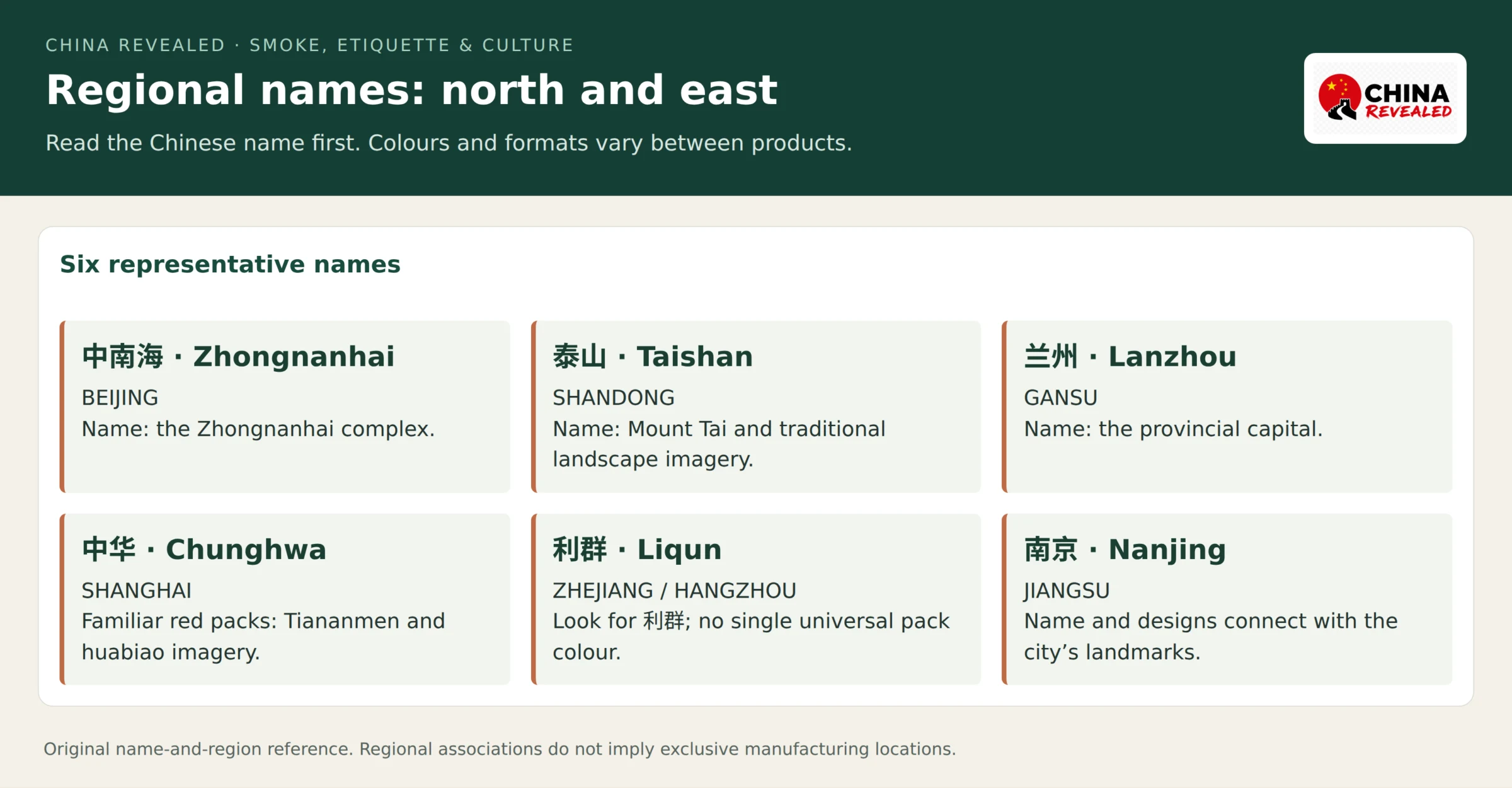
These are representative regional associations, useful for recognising names you may hear or see—not a ranking or a list of every province’s brands. Many are sold far beyond their home region, and pack designs vary between products.
North, northwest and the east coast
| Region | Brand name | What the name or design tells you |
|---|---|---|
| Beijing | 中南海 · Zhongnanhai | Takes its name from the Zhongnanhai complex in Beijing; the Chinese characters are the easiest identifier. |
| Shandong | 泰山 · Taishan | Named for Mount Tai, with landscape and traditional-cultural associations. |
| Gansu | 兰州 · Lanzhou | Takes the name of the provincial capital; associated with Gansu’s cigarette-making industry. |
| Shanghai | 中华 · Chunghwa / Zhonghua | A nationally recognisable, historically premium-positioned brand; familiar red packs use Tiananmen and huabiao imagery. |
| Zhejiang | 利群 · Liqun | Rooted in Hangzhou’s cigarette-making history; recognise the characters 利群 rather than one fixed pack colour. |
| Jiangsu | 南京 · Nanjing | Named for the city; the range’s history and designs draw on Nanjing landmarks. |
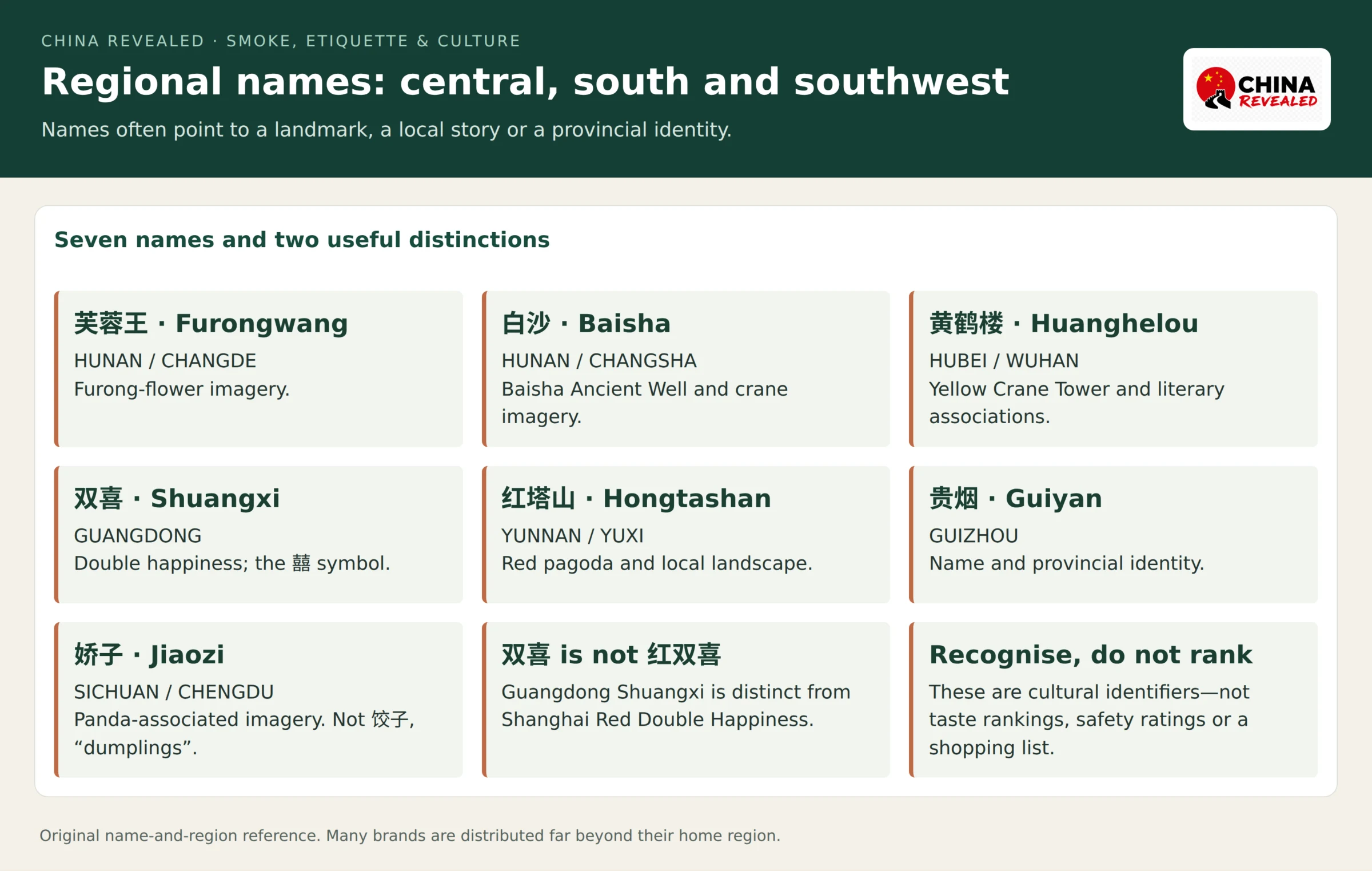
Central, southern and southwestern China
| Region | Brand name | What the name or design tells you |
|---|---|---|
| Hunan / Changde | 芙蓉王 · Furongwang | A Hunan-associated name with furong-flower imagery across brand references. |
| Hunan / Changsha | 白沙 · Baisha | Connected with Changsha’s Baisha Ancient Well; cranes appear in its brand imagery. |
| Hubei / Wuhan | 黄鹤楼 · Huanghelou | Named for Wuhan’s Yellow Crane Tower and its literary-cultural associations. |
| Guangdong | 双喜 · Shuangxi / Double Happiness | Uses the celebratory double-happiness idea and 囍 symbol. This Guangdong brand is distinct from Shanghai’s 红双喜 · Red Double Happiness. |
| Yunnan / Yuxi | 红塔山 · Hongtashan | Named for Yuxi’s red pagoda on a hill; tower and landscape imagery reflect that origin. |
| Guizhou | 贵烟 · Guiyan | A Guizhou-associated brand whose name and provincial identity are closely linked. |
| Sichuan / Chengdu | 娇子 · Jiaozi | Associated with Chengdu and Sichuan panda imagery. 娇子 is not 饺子, the Chinese word for dumplings. |
7. The words worth recognising
| Chinese | Meaning |
|---|---|
| 禁止吸烟 / 严禁吸烟 | No smoking / smoking strictly prohibited |
| 无烟房 / 禁烟房 | Non-smoking room |
| 烟味 | Cigarette smell |
| 二手烟 | Secondhand smoke |
| 吸烟区 | Designated smoking area |
| 烤烟型 | Flue-cured type |
| 混合型 | Blended type |
| 吸烟有害健康 | Smoking is harmful to health |
If you smoke, use a permitted designated area, stay away from queues and entrances, and never treat someone else lighting up as permission to do the same. If you do not smoke, keep the hotel-room phrase handy and be selective about where you sit.
My bottom line: cigarette culture is easy to notice in China; avoiding other people’s smoke takes a little more attention. Recognise the names, understand the gesture, and choose the spaces that make your trip comfortable.
About China Revealed
China Revealed is an independent English-language travel guide dedicated to China.
We bring together China travel guides, destination information, local insights and practical travel resources in one place.
Our travel database covers China's provinces, cities, famous attractions, hidden gems, local cuisine, transportation, accommodation, visa requirements, digital payments, mobile connectivity and the other practical details travelers need to explore China.
We focus on depth, careful research and accuracy. Our guides combine official sources, detailed destination data, local knowledge and regularly updated information to give reliable, practical travel advice.
Whether you're visiting China for the first time or exploring beyond the popular destinations, China Revealed is an all-in-one resource for discovering the real China.
China Revealed — Your practical guide to China.
Some links on China Revealed, such as Trip.com booking links, are affiliate links. If you book through them, we may earn a commission at no extra cost to you. This does not change what we recommend.