

China Accommodation Registration: Hotels, Homes and Online

China accommodation registration for foreigners is handled by hotels for hotel stays; at a friend’s home, rental or other non-hotel address, the guest or host must register within 24 hours of check-in.
This is the detail that catches visitors staying with family, borrowing an apartment or booking a self-check-in homestay. A room reservation, entry stamp or address on the arrival card does not register the stay. Neither does a host saying that nobody checks in their town.
The useful change is that China rolled out nationwide online non-hotel registration on September 21, 2026. A police-station visit is no longer the only route. For a first stay at someone else’s home, however, the national system starts with the host—not a visitor independently filling in a new address.
Quick takeaways
- Hotel stay: the hotel registers and reports it. Ask reception to complete the passport registration.
- Private stay: arrange registration within 24 hours of checking in, including in small towns and rural areas.
- First online registration at someone else’s home: ask the host to use 留宿人代为登记 / Registration by the host.
- Keep the completed electronic record. National online registration has the same legal effect as registration in person.
- Missed registration: correct it promptly. The law provides a warning and allows an additional fine of up to RMB 2,000; this is not an automatic fixed fee charged to every visitor at departure.
In this guide
- 1. Who registers each type of stay?
- 2. The 24-hour rule includes small towns
- 3. Use the new national online service
- 4. First stay: the host registers the guest
- 5. Prepare the right information and materials
- 6. Use the local police route if online registration fails
- 7. Check and save the electronic record
- 8. Moving, returning and repeat registration
- 9. Missed registration, fines and departure
- 10. Chinese requests to send to the host
- 11. Common questions
1. Who registers each type of stay?
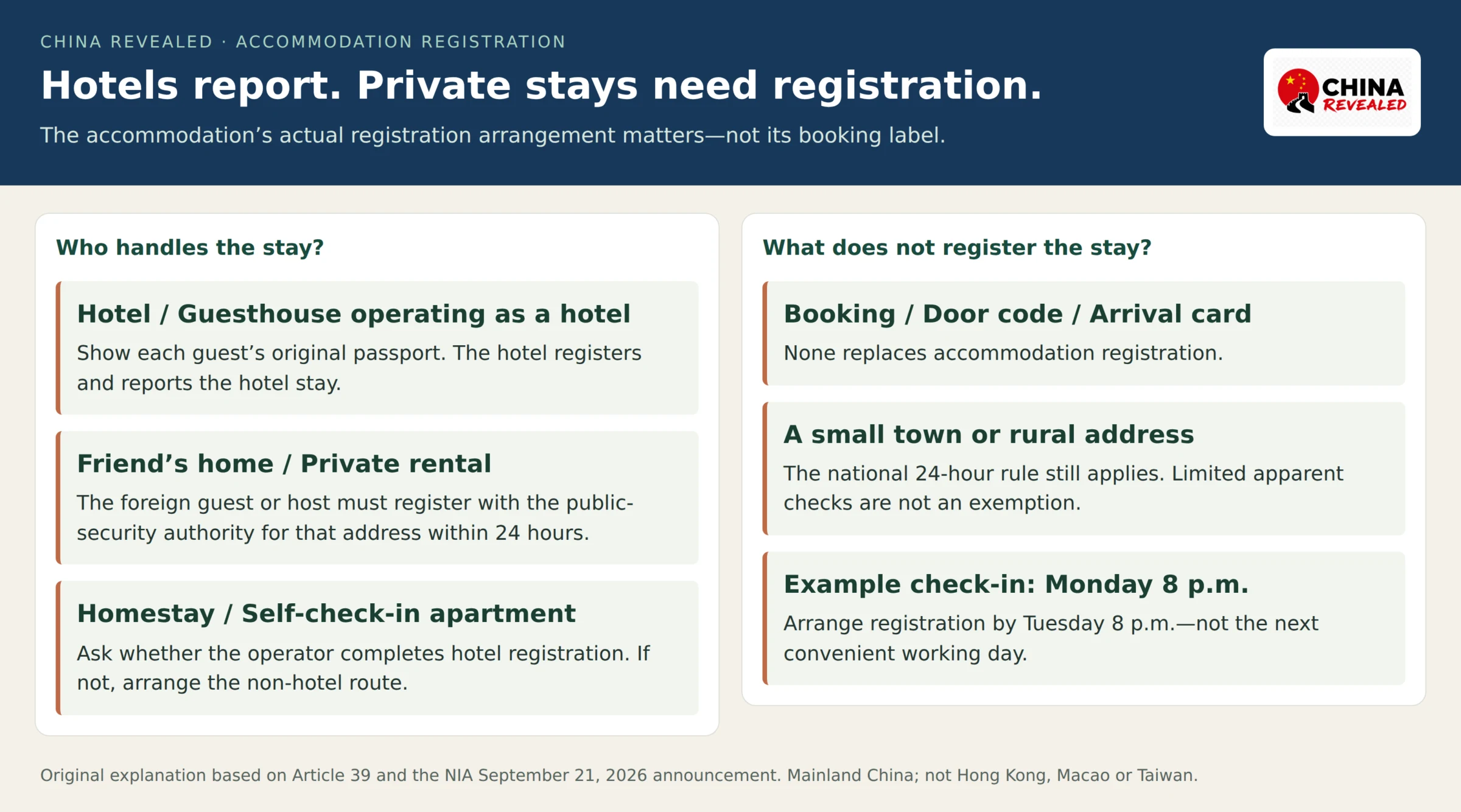
Hotels and guesthouses operating as hotels
The hotel has the legal duty to register foreign guests and report their accommodation information to the local police. Bring the original passport for each foreign guest, including children. Staff may also check the entry stamp, visa or residence document as appropriate.
Ask reception to finish registration during check-in. For that properly registered hotel stay, a visitor normally does not need a second visit to a police station. If reception has a passport-processing problem, ask the manager to resolve it rather than accepting a stay with no registration.
A friend’s home, family home or private rental
At a non-hotel address, the foreign guest or the host must complete registration with the public-security authority responsible for that address within 24 hours. One correctly completed registration is enough; the guest and host do not both need to submit duplicate registrations for the same stay.
A host can be Chinese or foreign. The practical point is to agree before arrival who will handle it, which official channel they will use and how the guest will obtain the completed record.
Homestays, apartments and self-check-in properties
“Homestay” is a booking description, not an answer to the registration question. Some properties operate and register guests as hotels. Others are private accommodation requiring the non-hotel route.
Ask the actual operator: “Do you complete hotel accommodation registration for foreign passport holders, or do we need non-hotel registration with the host?” A booking platform, door code or automated check-in message does not answer that question.
If the operator cannot explain how registration will be completed, sort it out before booking. A low room price is not worth finding an uncooperative host after arrival.
For the rest of arrival day, see Your First Day in China.
2. The 24-hour rule includes small towns
The deadline starts when the foreign visitor checks in at the non-hotel address, not when the holiday ends or when someone first asks for the paperwork.
For example, checking into a friend’s apartment at 8 p.m. on Monday means arranging registration by 8 p.m. on Tuesday. This is a 24-hour deadline, not “sometime the next working day.” Do it that evening or the following morning rather than leaving no time for an address or SMS problem.
The same national rule applies in a small city, village or quieter neighborhood. A friend may genuinely have hosted people without being checked. That describes their experience; it does not create an exemption.
Visa-free entry does not remove the duty. Nor does having a residence permit automatically cover a new private address. Register each foreign visitor in the household, including a child with a foreign passport.
Book hotels, flights, train tickets, attractions and other travel services on Trip.com.
3. Use the new national online service
The National Immigration Administration, or NIA, expanded online non-hotel accommodation registration nationwide on September 21, 2026. The 24-hour obligation remains, while registration online and registration in person have the same legal effect.
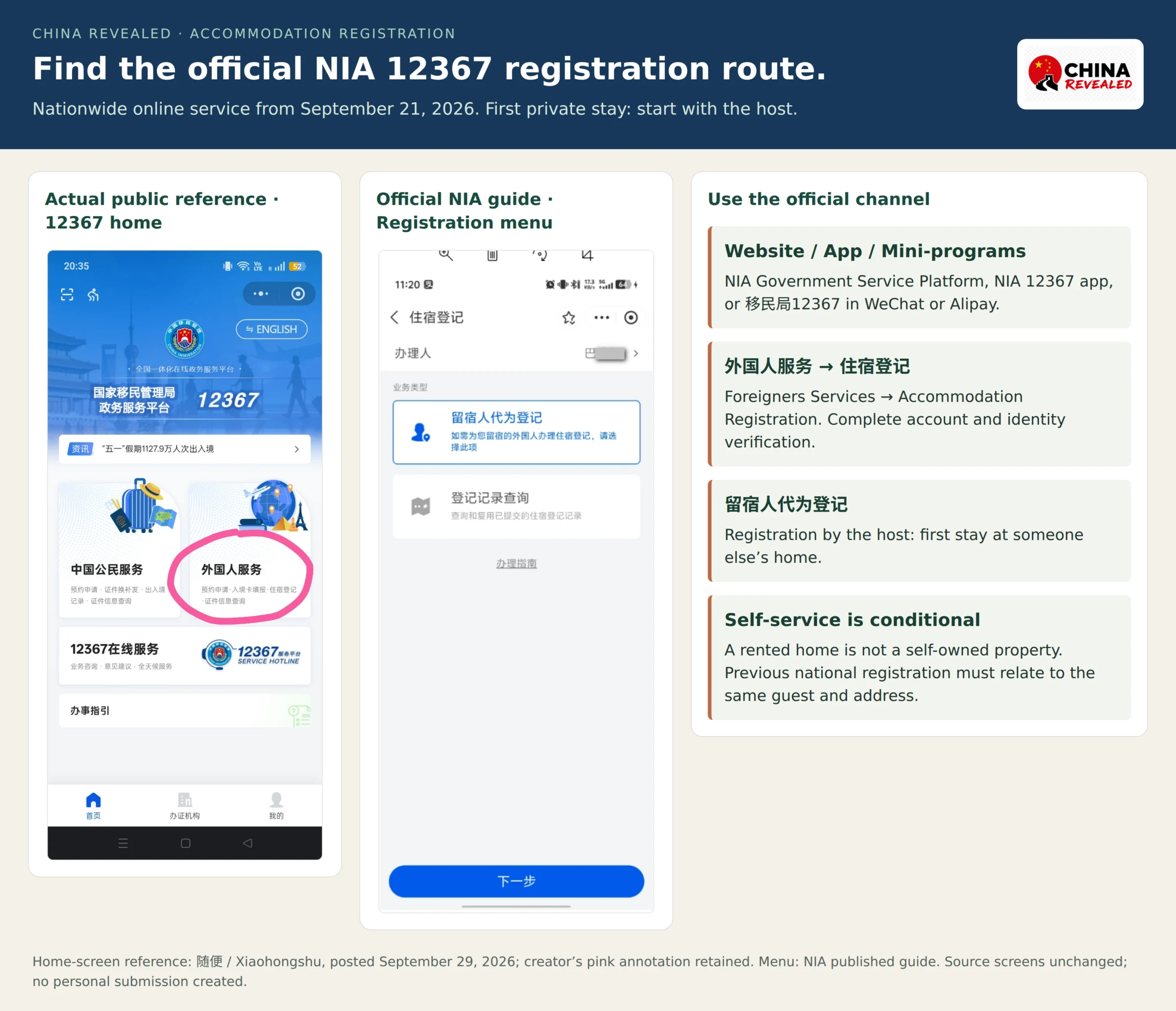
The four official channels are the NIA Government Service Platform, the NIA 12367 / 移民局12367 app, and the 移民局12367 WeChat and Alipay mini-programs. Search the exact Chinese name and check that the service is the official National Immigration Administration platform.
After account registration and identity verification, open 外国人服务 / Foreigners Services → 住宿登记 / Accommodation Registration. Read the registration requirements, then choose the appropriate category. The official illustrated guide explains the host, returning-guest and self-owned-home routes.
The national categories are:
- 留宿人代为登记 — Registration by the host: the starting point for a first stay in someone else’s home.
- 住宿人登记(他人住所) — Registration at others’ residence: for the eligible returning guest at an address previously registered through this platform.
- 住宿人登记(本人住所) — Registration at own residence: for a home owned by the foreign guest or the guest’s spouse in China.
A rented apartment is not a self-owned home simply because it is the visitor’s current home. Choose the category that matches the actual arrangement.
4. First stay: the host registers the guest
For a first private stay at the address, ask the host to take the Registration by the host / 留宿人代为登记 route. NIA’s guide specifies host assistance for the initial registration, because the host is better placed to confirm the address and its local police jurisdiction.
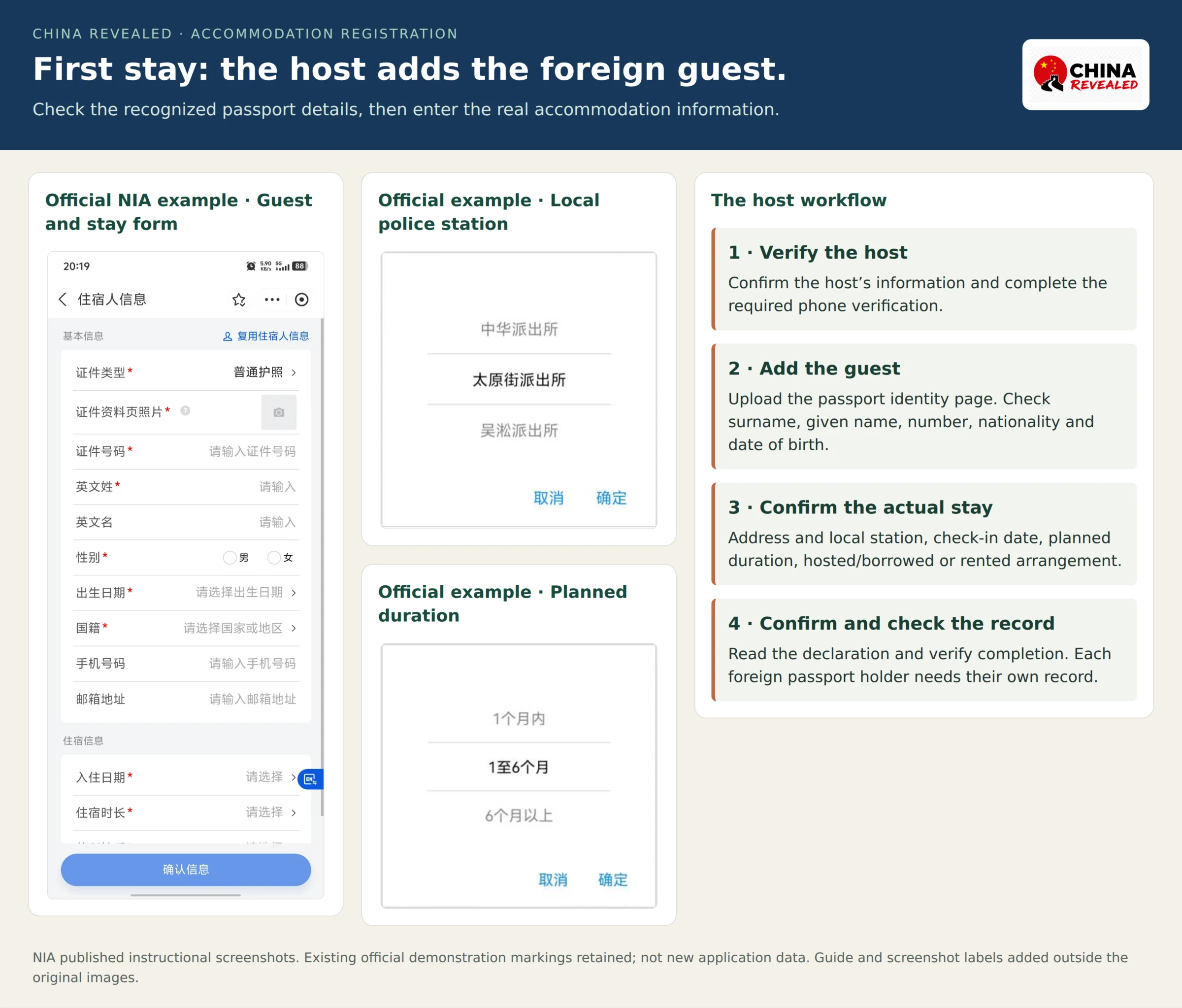
The actual host sequence
- Confirm the host’s information. The host completes the platform’s identity checks and the mobile verification shown on the page.
- Add the foreign guest. Upload a clear photograph of the passport’s identity-information page. The system recognizes and fills details; compare them with the passport and correct any mistakes.
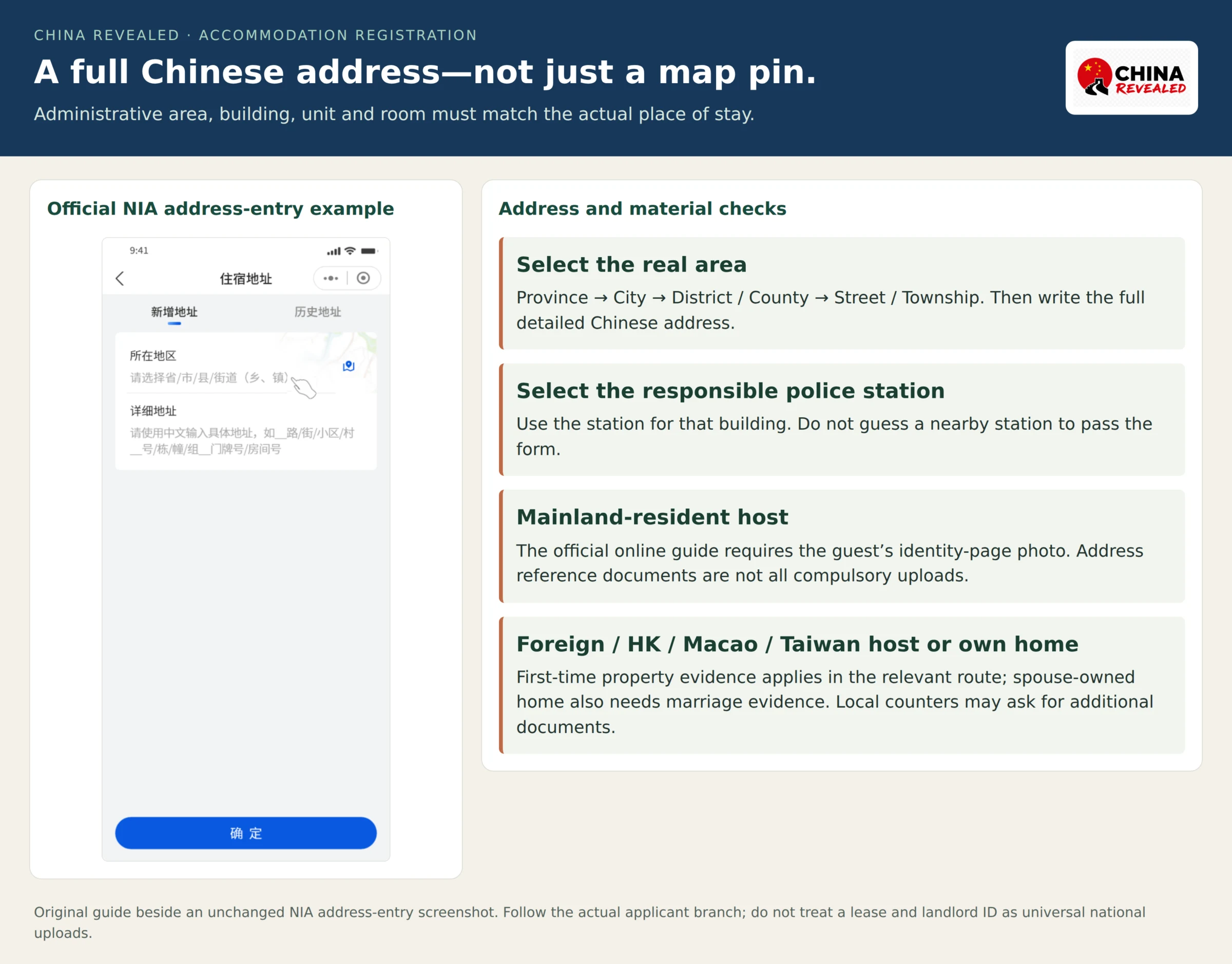
- Enter the accommodation address. Choose the province, city, district or county, and street or township. Add the full Chinese street/building/unit/room address.
- Select the responsible police station and stay details. Use the station serving the actual address. Enter the real check-in date, planned duration and whether the stay is borrowed/hosted or rented.
- Read the declaration and confirm. Then check the completed result and the accommodation-registration record.
For several visitors, check that a record exists for each passport holder, rather than assuming one person’s record covers the family.
The guest’s passport name, document number, nationality and date of birth should match the document. The national form distinguishes 英文姓 / surname from 英文名 / given name. Do not reverse them because a booking website used a different display order.
The planned-duration choices in the official guide are up to one month, more than one to six months, and more than six months. The accommodation choice is 借住 / hosted or borrowed accommodation or 租住 / rented accommodation. Enter the real situation; these selections do not grant extra immigration stay time.
If the visitor’s own account or SMS does not work
For a first stay at someone else’s home, start with the host route instead of spending the deadline trying to make the visitor’s independent route accept a new address.
The public NIA guidance does not settle every overseas-number or device-verification scenario. If account verification is blocked, ask the host to complete the permitted route, call 12367, or use the local police route. Do not assume changing the phone’s language or using a different foreign number will fix eligibility.
5. Prepare the right information and materials
Have a clear passport identity-page image, the actual check-in date, and the complete Chinese accommodation address ready. Ask the host to supply the address as written on their address documents, including the building, unit and room number. A map pin by itself is not a complete apartment address.
Keep the original passport and relevant visa, residence-permit or entry information available for an in-person check. A visa-free visitor does not need to invent a visa number or produce a visa sticker that was never issued.
Materials depend on the route
For the mainland-resident host route, the national illustrated guide requires the guest’s document-information-page photograph. It says the host can use an ID card, household register, property certificate or purchase contract as a reference for the correct address; it does not say that every one of those documents must be uploaded.
For a Hong Kong, Macao, Taiwan or foreign host, the official national guide includes additional evidence on the first registration at that address: a property certificate or purchase contract, and a marriage certificate if using a spouse-owned home. The foreign guest registering a self-owned home has a corresponding first-time property-evidence requirement. Follow the branch shown for the actual applicant.
A local police counter or separate local system may request a lease, proof of ownership, host identification or another address document. Have the host ask what that office needs. “Passport + landlord ID + lease, all compulsory everywhere” is not an accurate description of the national online workflow.
If the host is another foreign resident renting the home and the property-evidence step does not fit the arrangement, ask the landlord and local police how to register it correctly. Do not claim ownership or upload an unrelated property document to pass the form.
6. Use the local police route if online registration fails
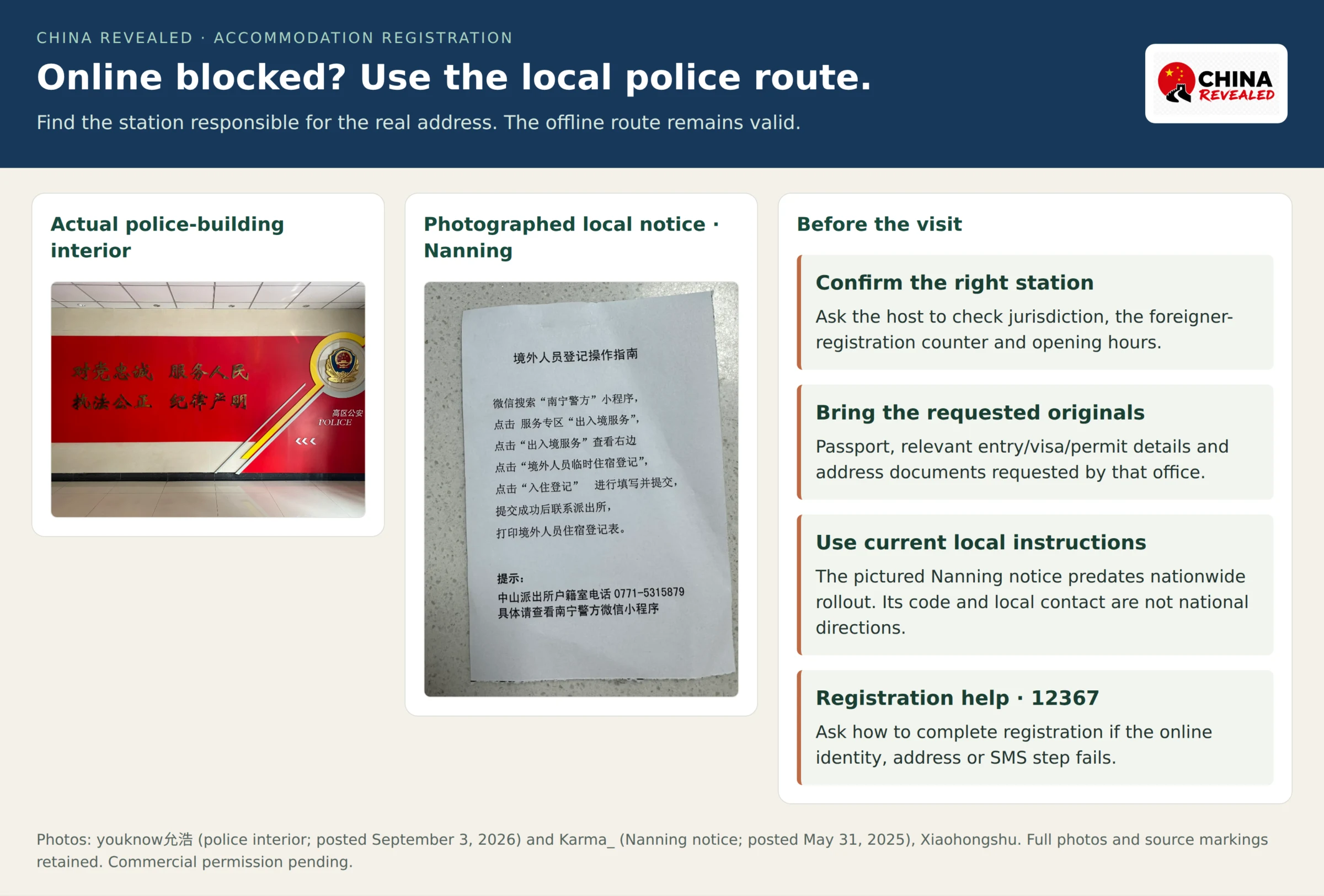
The offline route remains valid. Go to the 派出所 / local police station responsible for the accommodation address, or ask the local public-security exit-entry service window for help identifying the correct registration point.
The nearest station on a map is not necessarily the station responsible for the building. Have the host confirm the jurisdiction, the foreigner-registration counter, opening hours and required materials before making the trip. A community police office or service station may also be able to help where the local police direct visitors there.
Bring the original passport, relevant entry/visa/permit details, the full address and the supporting documents that the actual office requests. Going with the host usually makes address verification and communication easier.
At the counter, say 办理外国人住宿登记 — to register a foreign visitor’s accommodation. Check the details before leaving, and keep any paper form or record provided.
What if the address will not match online?
Use the host’s official Chinese address and check the district and street or township. Try the provided address selection or map function. If it still fails, ask the host or responsible police station to resolve the location instead of selecting a nearby but incorrect address or station.
Some cities retain local online systems. For example, Shanghai Police’s registration selector distinguishes the national system from a separate Shanghai-only self-service system. Local instructions can be useful in that city; a local QR code is not automatically valid across China.
If the deadline is close, get help now. A failed upload, unanswered host message or screenshot of an error does not complete registration.
7. Check and save the electronic record
On the national platform, use 登记记录查询 / Registration Record Inquiry to find the 住宿登记记录 / Accommodation Registration Record. Check the guest’s name and passport number, actual address and check-in information. If the host handled registration, have them provide the completed record for the guest’s own files.
Save a screenshot or the available electronic record offline. NIA’s national guidance calls this an electronic accommodation-registration record, rather than requiring every visitor to obtain a separate approval “receipt.”
There is no need to print the national electronic record. NIA states that it can be shown when applying for visa documents or during checks without separately providing a paper accommodation form. If a paper form is needed, it can be collected from the police station identified in the electronic record.
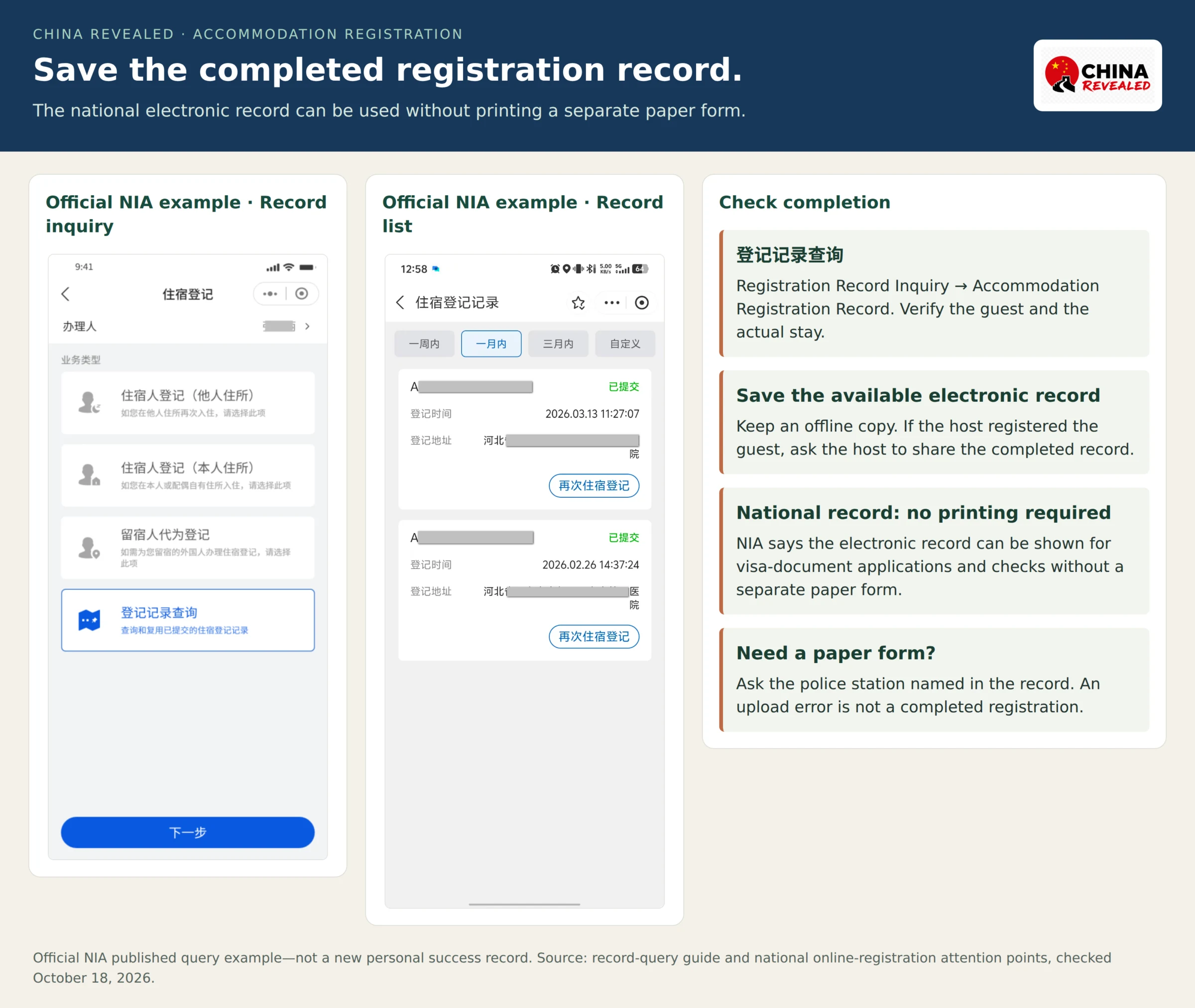
This is especially useful if plans later involve a China visa extension or residence-permit application. Keep the accommodation record separate from a visa application’s acceptance receipt: they serve different purposes.
8. Moving, returning and repeat registration
Moving to a different private address
Register the new non-hotel stay within 24 hours of checking in, even if it is in the same city. A record for one apartment does not cover a friend’s apartment across town.
A new hotel handles its own hotel reporting. If the next stop is another private home, arrange the non-hotel route there. A later hotel stay does not retrospectively register earlier nights in a private home.
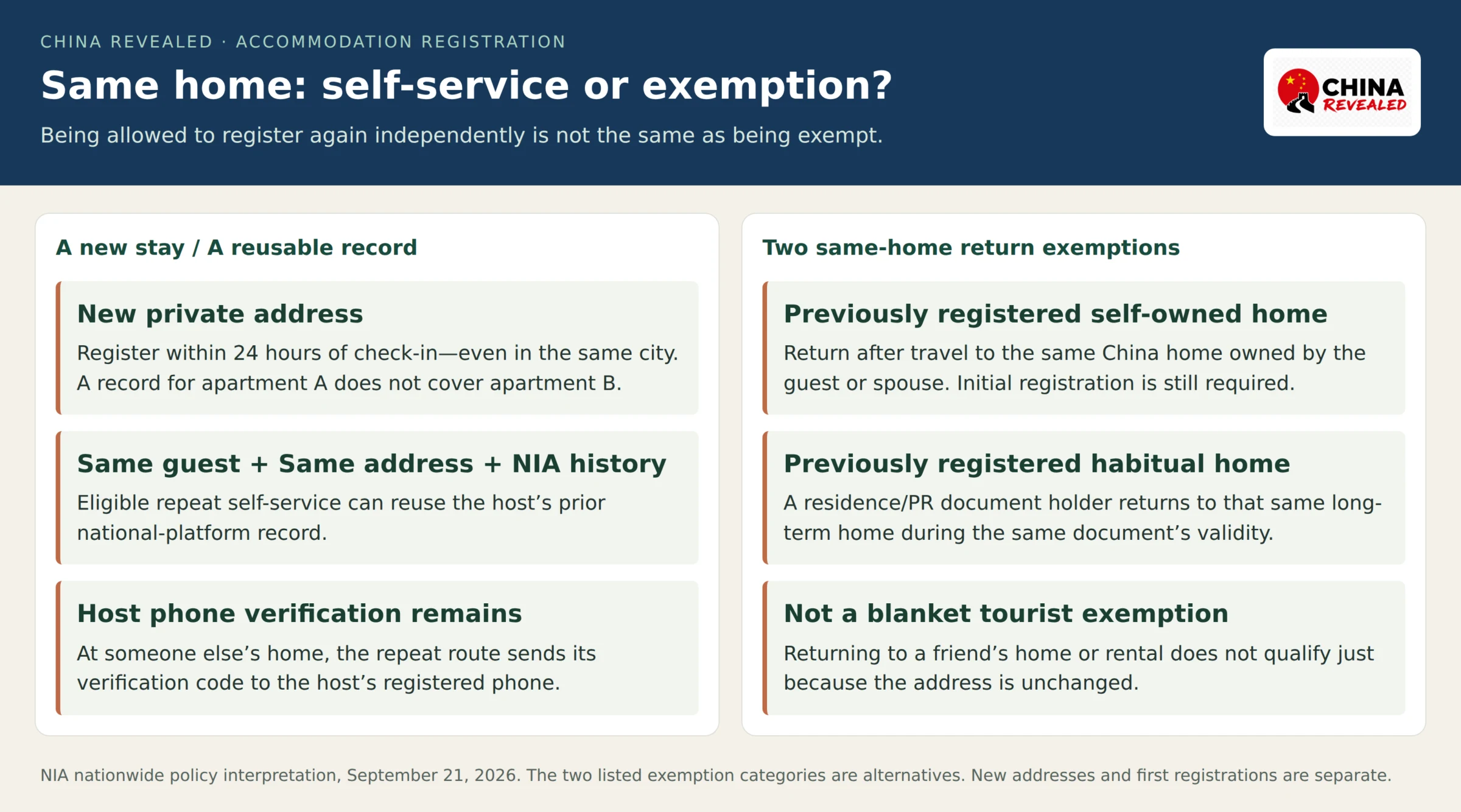
Returning to the same home: two specific exemptions
The national policy simplifies certain return visits after the address has already been properly registered:
- Self-owned home: a foreign guest returning after domestic or overseas travel to the same home owned in China by that guest or the guest’s spouse does not need repeat registration under the stated policy.
- Habitual home with a valid residence or permanent-residence document: a holder returning after domestic or overseas travel to that same habitual home, during the validity of the same document, does not need repeat registration under the stated policy. A habitual home means a long-term home; the regulations define long-term residence as more than 180 days.
These are two qualifying categories, not a blanket exemption for everyone who has previously used an address. A short-term tourist returning from Hong Kong to the same rented apartment or friend’s home should not assume the “same address” alone is enough.
Self-service repeat registration is not the same as exemption
If the host previously registered that guest at that address through the national NIA platform, an eligible guest can use 住宿人登记(他人住所) on a later registration. The system sends its host-verification code to the host’s registered phone, so the host still needs to cooperate with that specific registration step.
An old paper record or a record from a different city’s local system is not automatically a reusable national-platform record. If no usable history appears, have the host arrange the correct route.
For a permanent move by a residence-permit holder, also ask Exit-Entry Administration whether the residence file or permit information needs updating. The 10-day rule for changes to registered residence-permit details is not a 10-day grace period for non-hotel accommodation registration.
9. Missed registration, fines and departure
Can staying in a small city without registration cause a fine?
Yes. The registration obligation is national. Under Article 76 of the Exit-Entry Administration Law, failure to complete the required non-hotel registration brings a warning and may also bring a fine of up to RMB 2,000. The law does not set RMB 2,000 as an automatic charge for every late case.
The visitor or the host can face responsibility if the required registration was not completed. How an individual case is handled depends on its facts and the applicable enforcement process, not on whether a neighbor says police rarely visit.
Will the fine automatically appear at airport departure?
There is no universal rule that every unregistered tourist is automatically charged a fixed fine when leaving China. It would be equally unwise to assume departure removes the risk.
A missing registration can come to light during a police check or immigration-related paperwork. If a violation is identified and a penalty is issued, the law permits collection at a port in specified circumstances. Do not build the trip around an assumption that the airport will either ignore the issue or conveniently settle it at the last minute.
The practical answer is to complete registration during the stay—not discover an unresolved problem when the flight is about to board.
If the 24 hours have already passed
Contact the host and register the real stay promptly. If the online form cannot handle the dates or circumstances, contact the responsible police station or 12367 and explain when the visitor actually checked in. Take the passport and address documents requested.
Do not change the check-in date to hide the delay, and do not assume a new hotel booking fixes the earlier omission. Prompt correction is sensible, but it does not guarantee that a warning or fine will be waived. If departure is close, tell the authority the flight date so the issue can be addressed before going to the airport.
10. Chinese requests to send to the host
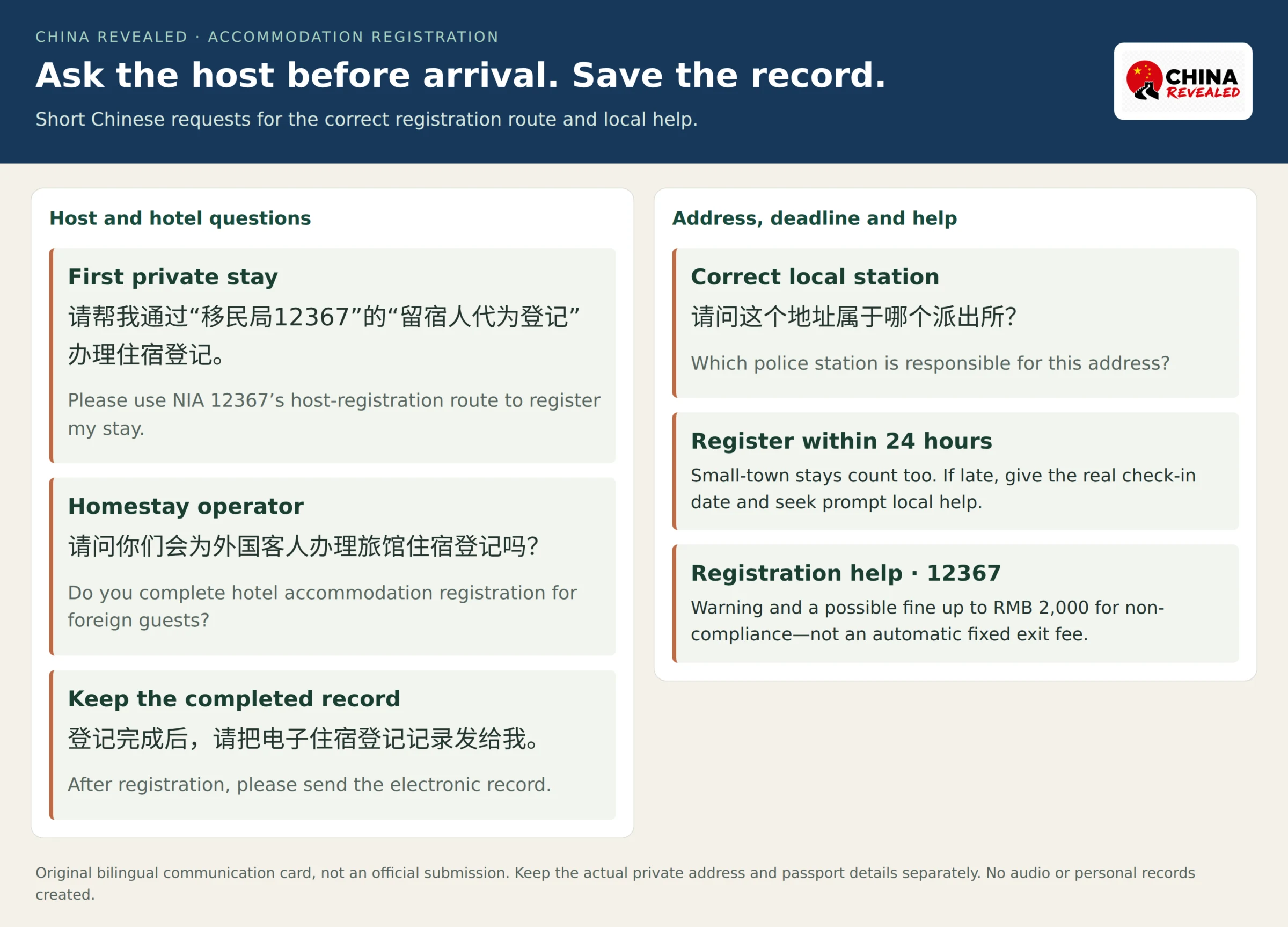
These short messages are useful before arrival. Save the actual Chinese address separately; a translation app can help with the conversation, but the registration itself belongs in the official system.
To a friend or rental host:
我是外国护照持有人,需要在入住后24小时内办理住宿登记。请帮我通过“移民局12367”的“留宿人代为登记”办理。
I hold a foreign passport and need accommodation registration within 24 hours of checking in. Please help by using “Registration by the host” in NIA 12367.
To a homestay operator:
请问你们会为外国客人办理旅馆住宿登记吗?如果不是旅馆登记,谁来办理非旅馆住宿登记?
Do you register foreign guests as hotel guests? If not, who will handle the non-hotel accommodation registration?
For the address and completed record:
请发给我完整的中文地址,包括楼栋、单元和房间号。登记完成后,请把电子住宿登记记录发给我。
Please send the full Chinese address, including the building, unit and room number. After registration, please send the electronic accommodation-registration record.
At the police station:
我想办理外国人住宿登记,请问这个地址属于哪个派出所?
I need to register a foreign visitor’s accommodation. Which police station is responsible for this address?
For help reading messages and translating document labels, use our translation apps guide for China.
11. Common questions
Does visa-free entry mean no accommodation registration?
No. Visa-free entry changes the entry route, not the registration obligation. Hotels report their guests; at non-hotel addresses, arrange registration within 24 hours unless a specific already-registered-home return exemption applies.
Is one night at a friend’s home too short to matter?
There is no general “one night does not count” exemption in Article 39. Arrange the stay’s registration rather than assuming a short visit is ignored.
Must the foreign visitor personally go to the police station?
Not in every case. The host can arrange registration, and national online registration is available. If online verification fails or the local police need to check the documents, use the in-person route they direct.
Does putting the address on the arrival card register the stay?
No. Entry information and accommodation registration are separate. The address on an arrival card does not complete the police-registration process.
Does a foreign child need a record too?
Yes. Register each foreign passport holder. A parent’s accommodation record is not the child’s record.
Do all travelers need a printed, stamped form?
No. National electronic records can be shown for visa-document applications or checks without a separate paper form. If a paper version is needed, request it at the police station named in the record.
Is 12367 the emergency police number?
No. 12367 is the immigration-management service hotline for questions such as registration procedures. It is not a substitute for an emergency police call.
For a private stay, agree on the host route before arrival, register the actual address within 24 hours and save the completed record. That is much simpler than trying to reconstruct an unregistered stay on departure day.
About China Revealed
China Revealed is an independent English-language travel guide dedicated to China.
We bring together China travel guides, destination information, local insights and practical travel resources in one place.
Our travel database covers China's provinces, cities, famous attractions, hidden gems, local cuisine, transportation, accommodation, visa requirements, digital payments, mobile connectivity and the other practical details travelers need to explore China.
We focus on depth, careful research and accuracy. Our guides combine official sources, detailed destination data, local knowledge and regularly updated information to give reliable, practical travel advice.
Whether you're visiting China for the first time or exploring beyond the popular destinations, China Revealed is an all-in-one resource for discovering the real China.
China Revealed — Your practical guide to China.
Some links on China Revealed, such as Trip.com booking links, are affiliate links. If you book through them, we may earn a commission at no extra cost to you. This does not change what we recommend.