

Altay Fat-Tailed Sheep Hand-Grabbed Meat 阿勒泰大尾羊手抓肉
Bone-in lamb from the Altay sheep tradition is gently simmered so that the meat, fat and broth carry the flavour of the pastoral region. The most interesting part is not a fixed recipe or restaurant, but the way a shared platter can connect breed, winter food-making and hospitality.
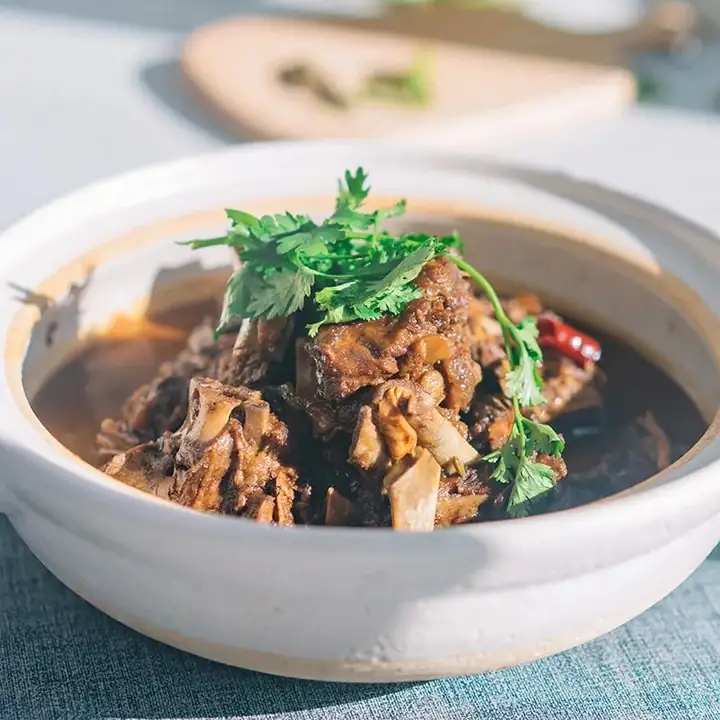
Image notes
Resized for the web; the photo itself has not been edited.
Tap any red Chinese text to hear it in Mandarin.
What this dish is
阿勒泰大尾羊手抓肉 is a clear-simmered, bone-in lamb dish associated with the wider Altay Prefecture of northern Xinjiang. The sheep behind the name have also been called Fuhai Fat-Tailed Sheep and Altay Fat-Tailed Sheep; the breed was formally named “Altay Sheep” in 1984. Fuyun County is repeatedly identified in local and regional reporting as an important place of origin for the breed, so the dish’s geographical story should not be reduced to a single restaurant in Altay City.
The name describes how the meat is traditionally eaten rather than a branded preparation. Large cuts are cooked with water and little seasoning, allowing the lamb’s own aroma and the gelatin around the bones to remain noticeable. A local account describes the meat being served with onion and eaten by cutting from the bone with a knife and taking pieces by hand; a separate account describes adding only a little salt and cooking the lamb slowly rather than covering it with a heavy sauce.
What to notice at the table
Look first at the cut: this is not boneless lamb in a thick sauce. Bone, lean meat and pockets of fat arrive together, and the texture changes from clean and springy to soft and rich as you move between pieces. Taste a little broth and an unseasoned piece before adding any salt, chilli or other dip. Onion is a common fresh counterpoint, but accompaniments and seasoning vary by kitchen.
The dish can also be a way to observe hospitality rather than just a way to fill a bowl. A 2025 feature in Altay Daily, drawing on local elders and folk-custom specialists, describes a customary division of a sheep into bone-in portions with different social meanings. The head is reserved for a respected elder, in-law or distant guest; the pelvis, valued for its balanced fat and lean meat, is also presented to important guests; and the foreleg bone traditionally goes into the pot first. These are cultural patterns described for particular communities, not a rule that every city restaurant follows.
If you are invited to a home or pastoral household, let the host guide the order of serving and accept that the platter may carry a social message. Ask before photographing people, family gatherings or food preparation. Observing the serving sequence and the shared platter is more respectful than treating the custom as a performance.
Real variations and dietary notes
The simplest version uses bone-in lamb, water and salt. Household versions may add onion or local aromatics, while related clear-cooked dishes may be served with noodles, naan or other staples. A 2023 Fuyun hand-grabbed-meat event listed lamb as the main ingredient but also allowed cooks to work with goat, beef, horse meat, dried meat, smoked horse meat, horse sausage or stuffed offal. That is evidence of a real local range in celebratory cooking, not a claim that all of those ingredients belong in the standard Altay sheep version.
This is a meat dish, not a vegetarian option. Ask what is in the broth and dipping condiments, especially if you avoid onion, ginger, pepper or other aromatics, and ask about shared utensils if cross-contact matters to you. Do not infer a restaurant’s halal certification, allergy controls or preparation standards from the dish name alone.
How to look for it in Altay
There is no single entrance, address or return route for this dish. In Altay City, search 阿勒泰大尾羊手抓肉 Ālètài Dàwěiyáng Shǒuzhuāròu on Meituan (美团) or Amap/Gaode (高德地图); if results are sparse, try 手抓肉 Shǒuzhuāròu, 清炖羊肉 Qīngdùn Yángròu or add 阿勒泰市 Ālètài Shì. Check the current menu, recent reviews, opening information and that day’s availability before setting out. Search results are a way to find nearby options, not proof that a restaurant is the most traditional or that it serves the breed named in the dish.
Because the breed’s source story is especially tied to Fuyun County in the Altay Prefecture, a meal found there and a meal found in Altay City should be described as experiences in different places, even though they share the wider regional food culture. If you travel to Fuyun specifically, confirm the venue’s current map pin and plan the return from that venue; this dish itself has no fixed station, shuttle stop or visitor entrance.