

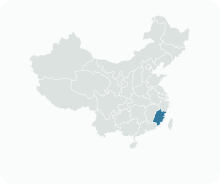
Get to know Zherong County

Photo adjustments
Full frame retained; proportionally resized and converted to WebP. No retouching or changes to the photographed subject. Card displays may crop the view.
- Administrative area
- County · 县
- Part of
- Ningde
- Chinese name
- 柘荣县
- Local areas
- County guide
Area & population
- Area in the source
- 548.00 km²
- Population · 2020
- 92,989
Source: cited geographic source, as of the dates shown.
Setting and landscape
The Taimu range (太姥山脉) crosses the county, and the land falls from east to west. Average elevation is over 500 metres and 93 peaks pass 1,000 metres; the top is Dongshanding (东山顶) at 1,479 metres, while the lowest point, in Yingshan (英山乡), is 78.8 metres. The county town sits at 666 metres, with a summer mean of 24.4°C. The larger streams include the Longxi (龙溪) and Jiaoxi (交溪).
History
The county name appears to derive from Zheyang (柘洋), the older name of the area. Under the Song it was Zheyang li, part of Changxi County (长溪县), and the Ming set up a Zheyang patrol post in 1441. In 1935 Fujian created a Zheyang special district here, and on 1 October 1945 it became Zherong County. The county was abolished in 1956 and 1970 and restored in 1961 and 1975.
What to see
Two of the county's monuments are on the national key protected list. In Zhayang (乍洋乡) stands the Qing-era Fengqi Wu family mansion (凤岐吴氏大宅), the biggest old house anywhere in Zherong. Dongyuan Bridge (东源桥), also named Shuihu Bridge (水浒桥), dates from the Yuan and has been repaired many times since; its 108 posts stand for the Liangshan heroes (梁山好汉). Temples including Puguang Temple (普光寺) sit on Dongshi Mountain (东狮山) in the eastern outskirts. Each seventh lunar month the county holds a Ma Xian (马仙) procession in five stages, part of a folk belief on the national intangible heritage list.
Food and local products
Zherong paper-cutting (柘荣剪纸) grew out of embroidery patterns; it entered the national heritage list in 2008 and is part of Chinese paper-cutting, inscribed by UNESCO in 2009. Smiths have forged scissors of cast iron with a steel edge since the Yongzheng reign (1723–1735). Taizishen (太子参), a medicinal herb, is a national geographical-indication product, and the county grows high-mountain white tea.
Beef balls (牛肉丸) are minced beef kneaded with starch, soy sauce, chilli powder, vinegar and wine until sticky, pinched into thumb-sized pieces and boiled. Youjuan noodles (油卷面) are rice batter steamed on an iron tray for under a minute, then spread with shallot oil and meat sauce. Bianrou (扁肉), the local wonton, has hand-rolled skins so thin they turn almost transparent; the bianrou of Fuxi (富溪) is the best known.
Highlights
- Dongyuan Bridge 东源桥: Yuan-dynasty bridge with 108 posts for the Liangshan heroes; a national key protected site.
- Fengqi Wu family mansion 凤岐吴氏大宅: Qing residence in Zhayang, the largest old house in the county.
- Zherong paper-cutting 柘荣剪纸: National intangible heritage since 2008 and part of UNESCO-listed Chinese paper-cutting.
- Beef balls 牛肉丸: Thumb-sized boiled balls of minced beef kneaded with starch, soy sauce, chilli and vinegar.
Sources for this guide
柘荣概况 · Zherong County People's Government
柘荣历史 · Zherong County People's Government
灿烂文化 · Zherong County People's Government
柘荣美食 · Zherong County People's Government
柘荣县 - 维基百科,自由的百科全书 · Wikipedia (Chinese) · CC BY-SA 4.0
Original English written from the listed sources and checked sentence by sentence against quoted extracts by a separate reviewer. Updated 2026-09-23.
Explore Zherong County
Core places to explore, with English and Chinese names.
Zherong County 柘荣县
Plan your visit
Getting there
Zherong County is about 70 km in a straight line from central Ningde. Search for 柘荣县 in a map app to find stations and your accommodation.
Where to stay →More in Ningde
Sources & geographic information
Administrative names and parent areas: Official geographic directory · Reference date 2026-09-06.
Some facts checked against 柘荣县 — Wikipedia contributors, CC BY-SA 4.0.
Map data © OpenStreetMap contributors. Pins mark approximate centres, not entrances or boundaries.