

Explore the region
Why this museum deserves time
Gansu is easier to understand here as a corridor than as a single historical period. The displays move from early communities making painted vessels to the movement of goods, beliefs and artistic techniques along the Silk Road, then to the province’s fossils and modern revolutionary history. The museum has been collecting and exhibiting Gansu’s material culture since its founding in 1939; the provincial government describes it as one of China’s earliest comprehensive museums and records five long-term basic displays, including painted pottery, Silk Road civilisation, palaeontology, Buddhist art and Red Gansu.
The Bronze Galloping Horse is a good place to slow down rather than simply take a photograph. The museum’s own description gives it a height of 34.5 cm, a length of 45 cm and a weight of 7.3 kg. Look at the suspended legs and the single supporting foot, then at the small bird beneath it: the point is how a compact bronze sculpture conveys speed while remaining balanced.
What to look for
Start with Gansu Painted Pottery (甘肃彩陶). Instead of treating the vessels as interchangeable decorated pots, compare the changes in silhouette, painted bands and geometric or animal motifs. The museum’s exhibition is organised as a sequence from early painted pottery through later prehistoric and Bronze Age traditions, so the useful question is how technique and design change over time.
The Gansu Silk Road Civilization Exhibition (甘肃丝绸之路文明展) is the museum’s broadest historical route. Its official description covers objects from the Bronze Age to the Qing period and presents the road as a history of contact and adaptation, not just a trade route. Give yourself time to compare writing materials, textiles, metalwork and religious images rather than looking only for famous names.
The Gansu Paleontological Fossil Exhibition (甘肃古生物化石展) changes the scale of the visit. Fossils associated with the Yellow River ancient elephant and other extinct animals show that the province’s story began long before human settlement. The Gansu Buddhist Art Exhibition (甘肃佛教艺术展) then returns to human movement, presenting Buddhist objects from Gansu across many centuries and making a useful companion to the Silk Road galleries.
The museum’s 1 November 2026 online listing also showed four recently arranged displays: Between Heaven and Earth—Gansu’s Natural Wealth (天地之间——甘肃自然富源展), Tang Style along the Silk Road—Objects from the Tomb of Murong Zhi (丝路唐风——慕容智墓出土文物特展), Classics in Splendour—The Siku Quanshu of Wensuge (典耀中华——文溯阁四库全书展) and The Origin of Model Calligraphy—The Prince Su Edition of Chunhua Ge Tie (法帖祖源——肃府本淳化阁帖展). These listings are useful for planning a return visit, but temporary or newly arranged galleries can change; check the museum’s current notices before relying on any one display.
A focused visit can take about two hours: follow the current signs to the painted-pottery gallery, compare the Silk Road and fossil displays, and finish with Buddhist art or a temporary exhibition. There is no need to force every gallery into one pass. Leave time for the object labels, since the museum’s value lies in the connections between collections from different parts of Gansu.
Admission and practical limits
Admission is free. The museum currently lists opening from 09:00 to 17:00, Tuesday to Sunday; reservations end at 16:00, entry stops at 16:30, and Monday is normally closed except when a holiday notice says otherwise. Individual tickets can be reserved up to three days ahead through the museum’s WeChat service or subscription accounts, with ticket release listed at 17:00 each afternoon. The official visitor guide lists a passport among the reservation documents. Bring the original document used for the reservation and confirm the booking flow if the Chinese account interface is unfamiliar.
There is an important date-specific exception. A notice issued on 28 October 2026 says that the museum will close for equipment inspection from 2 to 11 November 2026 and reopen from 12 November. If your visit falls in that window, do not travel to the museum expecting the normal schedule. Recheck the official notice before setting out after the stated reopening date.
The visitor guide says that large bags can be left at the front-square luggage storage area or self-service lockers, and that manual wheelchairs and strollers are available for use with a guardian. It also asks visitors not to touch cases or objects and bans flash, selfie sticks and tripods in galleries. Pets, smoking and dangerous items are not allowed.
Getting there
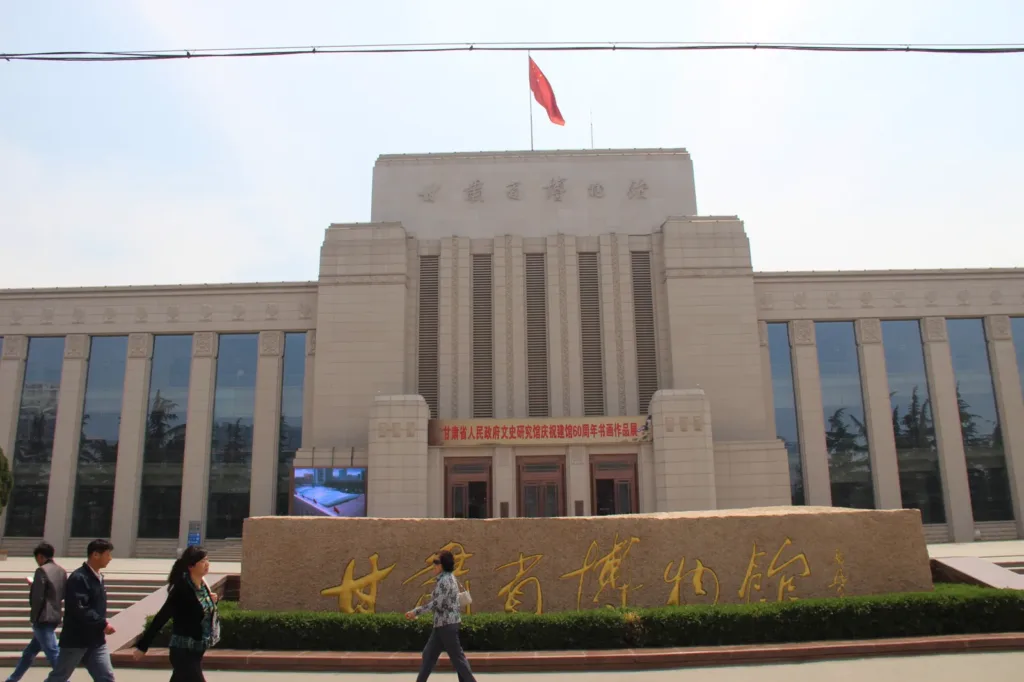
The museum is at 3 Xijin West Road (兰州市七里河区西津西路3号) in Qilihe District.
- Metro: Take Lanzhou Metro Line 1 to Xizhan Shizi Station (西站什字站). The museum homepage currently directs visitors to Exit A and then east for about 500 metres. Its visitor guide, updated on 29 September 2026, instead lists the C/D exits at Xizhan Shizi or Qilihe as walking approaches. Keep the line and station as the stable route, but check the live exit instruction on the day because the museum’s own pages do not agree.
- Bus: The homepage currently lists routes 31, 32, 53, 58 and K102 to the Gansu Provincial Museum stop (甘肃省博物馆站), followed by about 100 metres on the south side. The visitor guide also lists routes serving Qilihe Bridge (七里河桥) or the museum stop, including 1, 18, 31, 32, 50, 53, 58, 106, 129, 136, 137 and 158. Route lists can change, so keep the Chinese stop name when checking a live departure.
- Taxi or ride-hailing: Show the destination 甘肃省博物馆,兰州市七里河区西津西路3号 and ask for the museum’s visitor entrance/front plaza. The front plaza is also where the museum says large luggage can be stored.
Combine your visit
A suggested order for the documented features and stops.
-
Painted-pottery gallery
Begin with the forms and designs of early regional communities.
-
Silk Road civilisation gallery
Continue to the exchange networks represented by the archaeological finds.
-
Buddhist-art gallery
Compare the province’s religious sculpture with the wider route history.
This is an editorial sequence. Check access and any road or boat transfers; it does not establish a walking route, common ticket or guaranteed same-day connection.
Find Gansu Provincial Museum
甘肃省博物馆 · 兰州
The pin marks the area, not the entrance.
More places nearby
Approximate straight-line distances between map pins, not travel distances.
Lanzhou Stele Forest 兰州碑林
3 km awayLanzhou Stele Forest presents calligraphy in a garden setting on the western side of White Pagoda Mountain. Caosheng Pavilion is its architectural centre, with carved versions of works associated with the Chunhua model-book…
View guide →White Pagoda Mountain 白塔山
4 km awayWhite Pagoda Mountain rises directly above the north bank of the Yellow River. Its white brick pagoda combines a rounded lower form with an octagonal, seven-tiered upper tower. Terraces and temple buildings climb the slope below…
View guide →Zhongshan Bridge 中山桥
4 km awayZhongshan Bridge is a metal river crossing framed by the Yellow River below and White Pagoda Mountain beyond. Its latticework and curved strengthening arches distinguish it from the older floating bridges that once served this…
View guide →Sources & visit information
Sources checked on 1 November 2026. Hours, tickets, reservations and transport can change; confirm with the operator before you go.
- Gansu Provincial Museum official homepage ↗
- Gansu Provincial Museum official visitor instructions ↗
- Gansu Provincial Museum official exhibition listings ↗
- Gansu Provincial Museum high-quality development report ↗
- Amap place page for Gansu Provincial Museum ↗
- Temporary closure notice sourced from Gansu Provincial Museum ↗
Image credits & notes (1)
- Front façade of Gansu Provincial Museum on Xijin West Road, Lanzhou. Photo: Gary ToddPhoto: CC0 1.0